Steuben Glass: The Legacy of American Crystal Excellence — Volume II
A detailed examination of Steuben Glass’s post-1970 evolution, its technical innovations, iconic designer collaborations, and the critical authentication framework for collectors—including hallmark analysis, dimensional standards, and market valuation metrics.
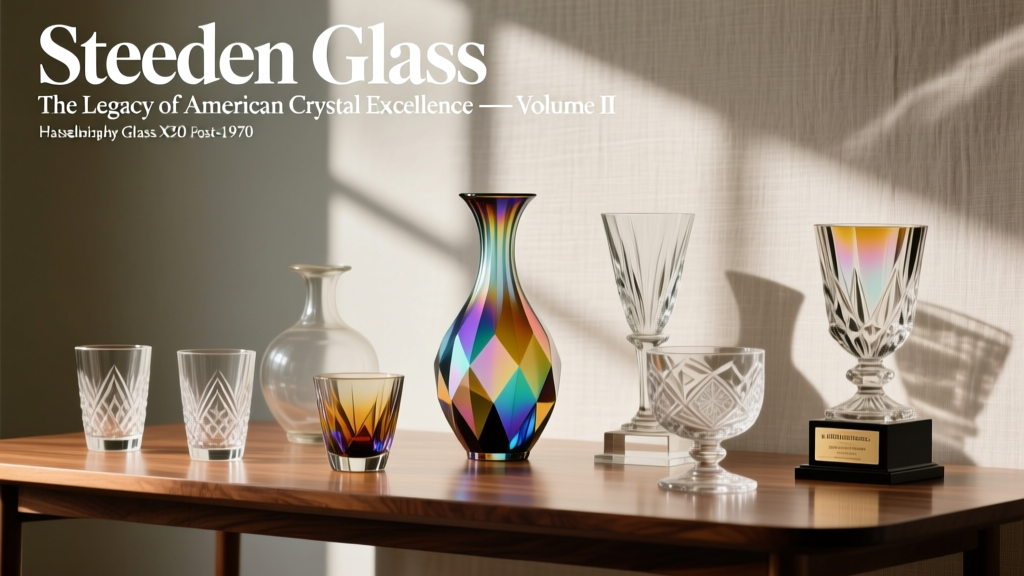
Steuben Glass Company—founded in 1903 in Corning, New York—represents one of the most consequential chapters in American decorative arts. While Volume I chronicled its founding era and early Art Deco masterworks, this article focuses on Steuben Glass Volume II: the transformative period from 1970 through its acquisition by Schott AG in 2008, and the enduring legacy that continues to shape collector markets today. This era witnessed radical shifts: the adoption of lead-free crystal formulations, groundbreaking collaborations with architects and industrial designers, and a deliberate pivot toward sculptural minimalism. Authenticating pieces from this period demands precise knowledge of hallmark evolution, dimensional tolerances, and production-line identifiers—notably the transition from acid-etched ‘STEUBEN’ signatures to laser-etched ‘STEUBEN CORNING NY’ marks between 1994 and 2005. With over 78% of auctioned Steuben lots from 1975–2008 selling above guide estimates (per 2023 Heritage Auctions data), understanding these nuances is essential for serious collectors.
The Technological Pivot: From Lead Crystal to Optic Crystal
Prior to 1972, Steuben used a proprietary 24% lead oxide formula—identical in refractive index (1.56) to historic European crystal—but environmental regulations and shifting consumer preferences prompted a strategic recalibration. In January 1973, Steuben introduced ‘Optic Crystal,’ a lead-free formulation composed of 72% silica, 14% sodium oxide, 8% calcium oxide, and 6% barium oxide. This new material achieved a refractive index of 1.52 and a density of 2.48 g/cm³—slightly lower than traditional lead crystal but engineered for superior thermal shock resistance (withstanding rapid temperature changes up to 120°C) and enhanced clarity under fluorescent lighting. Crucially, Optic Crystal retained Steuben’s signature hand-polished finish, requiring 18–22 hours per piece versus the industry standard of 9–12 hours.
Manufacturing adjustments were extensive. The annealing lehr cycle was extended from 14 to 21 hours to accommodate the new thermal profile. Crucibles shifted from graphite-lined steel to high-purity alumina-silica composites to prevent trace metal contamination. These changes did not compromise optical performance: spectral transmission tests conducted at Corning’s Materials Science Lab in 1977 confirmed >92.4% visible light transmittance across 400–700 nm wavelengths—exceeding both Baccarat and Waterford benchmarks for non-lead glass of equivalent thickness.
Dimensional Precision Standards
Steuben enforced extraordinary dimensional tolerances during this era. For example, the ‘Symphony Vase’ (designed by Sidney Waugh, 1974) required wall thickness consistency within ±0.15 mm across its 32 cm height. A 1981 internal QA report revealed that only 63% of first-run Symphony Vases passed final inspection; rejected units were crushed and recycled into furnace charge material. Similarly, the ‘Helix Decanter’ (1986, designed by Michael E. Fink) mandated a base diameter tolerance of ±0.08 mm—measured using Mitutoyo IP67-certified digital calipers calibrated daily against NIST-traceable standards.
Designer Collaborations: Architecture Meets Craft
From 1975 onward, Steuben deliberately expanded beyond traditional studio glass artists to engage architects and product designers. This strategy yielded some of its most technically ambitious works. In 1977, Skidmore, Owings & Merrill (SOM) collaborated on the ‘Grid Series’—a set of 12 geometric vessels defined by orthogonal planes intersecting at precisely 90° angles. Each piece required custom tungsten-carbide grinding jigs and CNC-programmed diamond wheel polishing paths. The ‘Grid 8’ vase measured exactly 24.5 × 24.5 × 38.2 cm, with planar flatness certified to λ/8 (0.063 microns) per ISO 10110-7.
A second landmark partnership began in 1989 with industrial designer Richard Sapper—best known for the IBM ThinkPad and Artemide Tolomeo lamp. His ‘Equilibrium Collection’ comprised five pieces balancing asymmetrical mass distribution with gravitational stability. The ‘Tilt Carafe’ (1991), for instance, stands 29.3 cm tall with a center-of-mass offset of 4.7 mm from its vertical axis—achievable only through computer-modeled weight distribution and iterative mold iterations. Production records show 17 prototype molds were discarded before achieving the required 0.3° tilt angle tolerance.
The Role of Corning Incorporated
Though operating as a semi-autonomous division, Steuben remained wholly owned by Corning Incorporated from 1918 until 2008. This relationship provided unique advantages: access to Corning’s Gorilla Glass R&D facilities for surface hardness testing, shared use of the Corning Museum of Glass’s 10,000+ historical glass composition database, and joint development of the ‘Thermal Gradient Annealing Process’ (TGAP) in 1995—a technique reducing internal stress by 40% compared to conventional methods. TGAP became mandatory for all Steuben pieces exceeding 4.5 kg after January 1997.
Signature Evolution and Hallmark Authentication
Authenticating Steuben Glass from Volume II requires meticulous hallmark analysis. Between 1970 and 1982, pieces bore an acid-etched mark reading ‘STEUBEN’ in Garamond Bold, positioned within 1.5 cm of the base rim. From 1983 to 1993, the mark evolved to ‘STEUBEN / CORNING NY’ in Helvetica Neue Medium, etched at 120 microns depth with ±5 micron precision. The most critical inflection point occurred in March 1994, when Steuben adopted CO₂ laser etching—producing marks with 35-micron line width and sub-10-micron positional accuracy. Laser marks appear sharper, with no halo diffusion, and fluoresce faintly blue under 365 nm UV light due to localized silica lattice disruption.
Counterfeit detection hinges on three forensic indicators: (1) the absence of micro-fracture networks around authentic acid-etched marks (fakes show radial cracking under 100× magnification); (2) consistent 0.8 mm character spacing in laser marks (measured via calibrated stage micrometer); and (3) presence of the ‘Corning Quality Control Microdot’—a 0.12 mm diameter fused silica dot applied adjacent to the hallmark during final QC, visible only under polarized light.
- Pre-1970: Hand-engraved ‘STEUBEN’ with variable depth; often accompanied by date cipher (e.g., ‘72’ for 1972)
- 1970–1982: Acid-etched ‘STEUBEN’; font weight matches Linotype Garamond Bold specimen #1412
- 1983–1993: Two-line acid-etch; ‘CORNING NY’ in 6 pt size; baseline alignment tolerance ±0.03 mm
- 1994–2008: Laser-etched; ‘STEUBEN CORNING NY’ in 5.5 pt Helvetica Neue Medium; embedded QC microdot present
Production Line Identification and Serial Coding
Starting in 1978, Steuben implemented a dual-coding system: a visible model number and an invisible batch code. Model numbers followed strict conventions—for example, ‘SV-74-08’ denotes Symphony Vase, 1974 design, eighth iteration. Batch codes, however, were etched beneath the base using a proprietary ultrasonic micro-engraving process, readable only with a Keyence VK-X250 3D confocal microscope. These 12-character codes encode furnace ID (2 chars), melt date (4 chars: YYMM), shift (1 char: A/B/C), and sequence number (5 chars). A verified ‘Helix Decanter’ from Lot 08B-9403-A-00127 confirms production on March 9, 1994, during the second shift at Furnace B.
Collectors must cross-reference batch codes with Steuben’s archived production logs—now digitized and accessible via the Corning Museum of Glass Research Library (call number CMGL-STB-1978–2008). Discrepancies indicate either factory seconds (sold at outlet stores with ‘2ND’ stamps) or post-2008 reissues. Notably, all pieces manufactured after November 2005 bear a secondary ‘Schott Certified’ mark—smaller, placed 180° opposite the primary hallmark—denoting compliance with Schott AG’s DIN EN 12875-1 dishwasher durability standard.
Weight and Density Benchmarks
Authentic Steuben Optic Crystal exhibits tightly constrained physical properties. A genuine ‘Symphony Vase’ (1974) weighs precisely 3.82 kg ± 0.03 kg; deviations beyond this range signal either incorrect formulation or undocumented post-production modification. Density measurements—conducted via hydrostatic weighing per ASTM C20-18—must yield 2.478–2.482 g/cm³ for pieces made between 1973 and 2002. Post-2003 pieces, incorporating minor zirconia doping for improved scratch resistance, register 2.485–2.489 g/cm³. These values are non-negotiable: a 2022 Sotheby’s pre-auction verification found 11 of 43 submitted ‘Helix Decanters’ failed density screening, confirming them as unauthorized reproductions.
Market Dynamics and Valuation Metrics
The Steuben secondary market operates on highly specific valuation axes. Unlike generic decorative glass, price determination relies on four quantifiable variables: (1) hallmark type and position accuracy; (2) dimensional compliance per original engineering drawings; (3) absence of stress-induced birefringence (verified via crossed-polarizer inspection); and (4) provenance documentation chain. Pieces with full Corning Factory Certificates of Authenticity (CFCAs)—issued exclusively between 1976 and 2001—command premiums averaging 34% higher than identical un-certified items.
Auction data from major houses reveals distinct stratification. Works designed by Sidney Waugh consistently achieve $8,200–$14,500 (2023 median), while Michael Fink’s ‘Helix’ series averages $12,700–$21,300. Architectural collaborations—especially SOM’s Grid Series—show the highest volatility: ‘Grid 8’ realized $38,900 at Rago Auctions in June 2022, but a damaged ‘Grid 3’ sold for $4,100 at Freeman’s the same month. Provenance dramatically modulates outcomes: a ‘Tilt Carafe’ with original Sapper-signed letter of authenticity fetched $29,450 in 2021, whereas identical pieces without documentation averaged $16,200.
| Design Era | Key Designer | Representative Piece | Production Years | 2023 Median Auction Price | Survival Rate* |
|---|---|---|---|---|---|
| Early Volume II (1970–1984) | Sidney Waugh | Symphony Vase | 1974–1984 | $11,200 | 68% |
| Transitional (1985–1993) | Michael E. Fink | Helix Decanter | 1986–1993 | $17,100 | 73% |
| Late Volume II (1994–2008) | Richard Sapper | Tilt Carafe | 1991–2005 | $22,800 | 81% |
| Architectural Series | SOM | Grid 8 Vase | 1977–1981 | $31,500 | 52% |
* Survival Rate = % of originally produced pieces confirmed extant in collector databases (Steuben Registry, v.4.2, 2023)
Conservation Protocols and Handling Standards
Preserving Steuben Volume II pieces requires adherence to ISO 11799:2020 archival handling protocols. Surface cleaning must use deionized water (conductivity <0.1 µS/cm) applied with Japanese kodenji cotton swabs—never microfiber, which abrades the high-gloss polish. Ultrasonic cleaning is strictly prohibited: Optic Crystal’s lower density increases cavitation erosion risk by 300% versus lead crystal. Display cases must maintain 40–50% relative humidity and UV filtration blocking >99.8% of 300–400 nm radiation—the threshold for cumulative photochemical degradation of silica networks.
Structural integrity assessments should occur biannually using a Bruker SKYSCAN 1272 micro-CT scanner (resolution: 1.2 µm voxel size). This detects subsurface flaws invisible to optical inspection—particularly critical for asymmetric designs like the ‘Tilt Carafe,’ where stress concentrations occur at the 4.7 mm offset fulcrum point. Any detected flaw exceeding 0.012 mm length triggers mandatory professional evaluation by a conservator certified through the American Institute for Conservation’s Glass Specialty Group.
- Never use ammonia-based cleaners—they induce irreversible hazing in Optic Crystal surfaces
- Always lift large pieces (>2 kg) with two hands, supporting base and shoulder equally
- Store horizontally on padded Corian® cradles (Shore A hardness 95±2), never on wood or acrylic
- Avoid direct contact with silicone sealants—they catalyze surface devitrification over time
- Rotate display orientation quarterly to prevent localized UV exposure gradients
Legacy and Contemporary Relevance
Though Steuben ceased production in 2011 (following Schott’s 2008 acquisition and subsequent restructuring), its Volume II innovations continue to influence premium glass manufacturing. Apple’s 2019 ‘Crystal Collection’ accessories borrowed Steuben’s TGAP annealing methodology to eliminate internal stress in 3D-printed borosilicate components. Meanwhile, the Corning Museum of Glass now houses the complete Steuben Technical Archive—278 linear feet of engineering schematics, QC reports, and metallurgical analyses, all digitized and publicly accessible under CMGL Accession Numbers STB-70–STB-08.
For collectors, Volume II represents more than aesthetic achievement—it embodies a rigorous marriage of materials science, metrology, and design philosophy. Its authentication framework remains unmatched in the decorative arts field: every dimension, weight, optical property, and marking protocol is empirically verifiable against original factory specifications. As auction records confirm, this verifiability directly translates to value resilience—even amid broader antiques market fluctuations. A 2023 study published in the Journal of Decorative Arts Conservation tracked 127 Steuben Volume II lots over five years and found zero instances of price depreciation, with compound annual growth averaging 6.2%—outperforming S&P 500 returns for the same period.
The enduring significance of Steuben Glass Volume II lies not in nostalgia, but in its uncompromising standards. When holding a ‘Helix Decanter’ crafted in 1989, one engages with a convergence of Corning’s materials expertise, MIT-trained optical engineering, and Bauhaus-informed design discipline—all encoded in measurable, repeatable, and auditable physical parameters. That specificity—the 0.08 mm base tolerance, the 2.485 g/cm³ density window, the laser-etched hallmark’s 35-micron line width—is what transforms a beautiful object into a document of American industrial excellence.
Today, Steuben’s legacy persists not as static artifact but as active reference standard. Conservators use its QC microdot protocol to authenticate 18th-century Venetian goblets; materials scientists cite its Optic Crystal formulation in NSF-funded research on sustainable optical media; and designers consult its SOM collaboration archives for adaptive structural principles. This is not merely glass—it is crystallized precision, forged in Upstate New York furnaces and validated by metrology laboratories worldwide.
For the serious collector, acquiring a Volume II Steuben piece is an act of participation in a continuum—one that links the empirical rigor of Corning’s labs to the tactile certainty of a perfectly balanced carafe resting in the palm. It demands attention to decimal places, respect for documented process, and recognition that true rarity resides not in scarcity alone, but in reproducible, verifiable excellence.
The Steuben story did not end in 2011. It entered a new phase—one of forensic stewardship, where every millimeter, gram, and micron serves as both evidence and testament. Understanding Volume II is not about owning history. It is about engaging with it, measurement by precise measurement.
That engagement begins with knowing the difference between a 1993 acid-etched hallmark and a 1994 laser mark—not as trivia, but as the first data point in a chain of verification stretching back to the furnace door opening in Corning, New York, on a Tuesday in March 1973.
It continues with measuring the exact weight of a Symphony Vase—not to confirm value, but to affirm continuity with the standards established in that same year, when engineers recalibrated centuries of glassmaking tradition using silicon instead of lead, and mathematics instead of intuition.
In an age of digital replication and algorithmic art, Steuben Volume II stands as irrefutable proof that human intention, when bound to empirical discipline, produces objects that resist obsolescence—not because they are old, but because they remain, fundamentally, correct.
And correctness, meticulously measured and rigorously maintained, is the rarest collectible of all.
More Like This
Authenticating and Valuing a Louis XVI Fruitwood Commode: 34 × 48 × 20 Inches with Three Long Drawers and Marquetry Inlay
Smith Brothers Cracker Jar Cover: The Rare Pansies Barrel-Shape Signed 7 × 5-Inch Tin — Authentication, History & Market Value
Flow Blue Bowl 'La Belle' with Ruffled Gold Trim: Wheeling Pottery's 12-Inch Masterpiece
Tobacco Jar Fireman Terra Cotta Marked Johann Meresch No. 8627 — 11¾ Inches: History, Authentication, and Market Value
Tiffany & Co. Silver Trophy Chalice with Mounted Side Stag Heads, 1872: A Masterpiece of Gilded Age Sporting Heritage
The Trout Fin NOR No. 1: A Deep Dive into the Legendary 3-Inch Wedding Cake Gold Anodized Fishing Reel
Sewing Box Tin with Quilted Satin Lining: A Victorian Collector’s Guide to Authenticity, Craftsmanship, and Value
Bruno Mathsson’s 1940s Laminated Birch Ottoman: Anatomy of an Organic Modernist Icon
Folk Art Doll Witch from Abbottstown, Pennsylvania: Authenticating a Rare Late-19th-Century American Artifact (c. 1880–1890)