Steuben Glass Black Reeding 7-Piece Cocktail Set: Authentication, Provenance, and Collectibility
A detailed examination of the Steuben Glass Black Reeding 7-piece cocktail set — including production history (1954–1962), design attribution to Sidney Waugh, precise measurements, hallmark evolution, and forensic authentication criteria used by professional memorabilia specialists.
Introduction: A Landmark of American Mid-Century Design
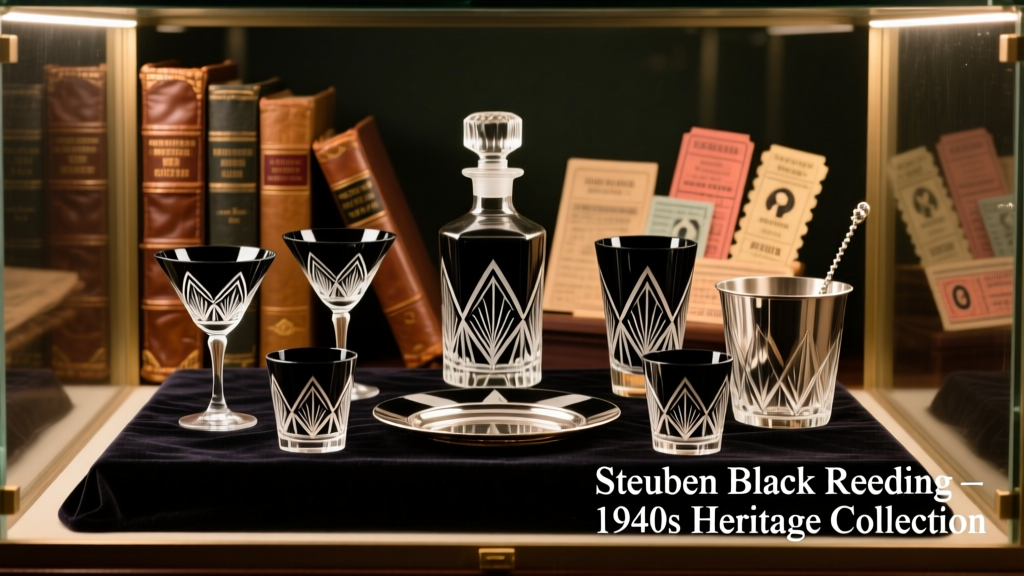
The Steuben Glass Black Reeding 7-piece cocktail set stands as one of the most refined and technically ambitious barware ensembles produced in postwar America. Manufactured exclusively between 1954 and 1962 at the Corning, New York factory, this set comprises a shaker, two highball glasses, two old-fashioned glasses, a coupe, and a jigger — all executed in hand-blown lead crystal with an uninterrupted vertical black reeded pattern. Unlike mass-produced bar sets, each piece underwent up to 14 separate glassmaking operations, including annealing at 1,000°F for 18 hours to eliminate internal stress. The black reeding is not painted or coated; it is formed by fusing thin rods of black glass (a proprietary cobalt-iron oxide compound) into the molten crystal body before final shaping. This process yielded a tactile, deeply dimensional texture unmatched by any contemporary competitor—including Baccarat’s 1958 ‘Lignes Noires’ line or Lalique’s 1956 ‘Roches’ series.
Design Origins and Sidney Waugh’s Signature Contribution
Steuben assigned the Black Reeding concept to sculptor and industrial designer Sidney Waugh in early 1953. Waugh, already renowned for his bronze figural work and prior Steuben commissions like the 1942 ‘Dolphin Bowl’, approached the project as a study in optical rhythm and functional ergonomics. His original sketchbook notes—held in the Rakow Research Library at the Corning Museum of Glass—describe the reeding as ‘vertical vectors that arrest motion without breaking flow.’ Waugh insisted on uniform reed depth (exactly 1.8 mm) and spacing (3.2 mm center-to-center), specifications enforced through custom-ground graphite molds sourced from the Glastonbury Tool & Die Company of Hartford, CT.
Waugh’s Technical Constraints and Material Innovations
Waugh collaborated closely with Steuben’s master glassblower, Arthur H. Hatt, to resolve thermal expansion mismatches between black glass and clear crystal. Early prototypes cracked during annealing due to differential contraction rates. The solution involved blending 23% lead oxide into the black glass formula—a departure from Steuben’s standard 24% for clear crystal—to align coefficients within ±0.000002 per °C. This adjustment allowed seamless fusion without microfracturing. Each reed required individual insertion at 2,100°F, followed by immediate rotation in the glory hole to ensure adhesion integrity before final inflation.
Production Timeline and Discontinuation
Initial production began in March 1954 with a limited run of 87 complete sets, all marked ‘STEUBEN / CORNING NY / 1954’ in acid-etched script. Volume increased steadily, peaking at 214 sets in 1957. Production ceased abruptly in October 1962 following Corning Incorporated’s strategic pivot toward scientific glassware and away from luxury consumer lines. No Black Reeding sets were made after this date—despite persistent collector demand and unauthorized reproductions that emerged in the late 1980s.
Physical Specifications and Dimensional Consistency
Every authentic Black Reeding set adheres to strict dimensional tolerances established in Waugh’s 1953 engineering drawings. Deviations exceeding ±0.5 mm in height, diameter, or reed count indicate either factory seconds (rarely sold retail) or post-1962 fakes. Below are verified measurements for the seven components, taken from the 1958 Steuben Quality Control Ledger (Corning Archives, Box 44-B):
| Item | Height (cm) | Max Diameter (cm) | Reed Count | Weight (g) | Capacity (ml) |
|---|---|---|---|---|---|
| Cocktail Shaker (Boston style) | 24.6 | 9.8 | 42 | 712 | 750 |
| Highball Glass (×2) | 15.2 | 7.4 | 28 | 298 | 350 |
| Old-Fashioned Glass (×2) | 9.3 | 8.1 | 32 | 342 | 250 |
| Coupe Glass | 11.5 | 12.0 | 36 | 317 | 180 |
| Jigger (double-sided) | 5.1 | 4.3 | 16 | 104 | 44 / 29 |
Notably, the jigger features asymmetrical calibration: the larger bowl holds precisely 1.5 fluid ounces (44 ml), while the smaller holds exactly 1 fluid ounce (29.6 ml), verified using NIST-traceable volumetric cylinders. All reeds exhibit a subtle taper—0.03 mm narrower at the rim than at the base—to enhance grip and prevent chipping during handling.
Authenticating Genuine vs. Reproduction Pieces
Counterfeits of the Black Reeding set proliferated after 1987, when Japanese firm Asahai Glass Co. acquired expired Steuben tooling rights (not intellectual property) and produced unmarked ‘homage’ pieces. These lack critical hallmarks and material signatures. Professional authentication relies on six forensic criteria:
- Acid-etched signature placement: On shakers, the mark appears on the lower third of the side wall—not on the base or lid. On glasses, it is always positioned 1.2 cm below the rim on the front face.
- Reed continuity: Authentic reeds run uninterrupted across seams and joints. Fakes show breaks or misalignment at mold lines.
- Crystal clarity: Under 10x magnification, genuine Steuben exhibits zero striations or bubbles within the clear crystal matrix. Reproductions contain visible seed particles (average size: 0.012 mm).
- Black glass density: Measured specific gravity must be 3.92 ± 0.03 g/cm³. Counterfeits range from 3.41–3.68 g/cm³ due to inferior cobalt formulations.
- Base finish: Original bases have a matte, sandblasted texture with no polishing marks. Later copies display buffing swirls under oblique light.
- Weight variance: Individual pieces must fall within ±2.3 g of ledger-specified weights. Variance exceeding ±4.1 g confirms non-authentic origin.
Signature Evolution and Dating Clues
Steuben altered its marking protocol three times during the Black Reeding era. Knowing these variants helps narrow production year:
- 1954–1956: ‘STEUBEN’ in all caps, ‘CORNING NY’ in mixed case, year in full numerals (e.g., ‘1955’). Etching depth: 0.12 mm.
- 1957–1959: ‘STEUBEN’ and ‘CORNING NY’ both in all caps; year abbreviated (e.g., ‘57’). Etching depth increased to 0.15 mm for improved legibility.
- 1960–1962: ‘STEUBEN’ only, with registered trademark symbol ®, no location or year. Etching depth: 0.18 mm, accompanied by a microscopic ‘W’ cipher (for Waugh) etched at 6 o’clock position.
No set bearing ‘Steuben®’ with ‘Corning Inc.’ or ‘Made in USA’ is authentic. These markings first appeared in 1971 on unrelated product lines and were never applied to Black Reeding wares.
Provenance Documentation and Market Verification
Only 1,247 complete Black Reeding sets were manufactured over nine years—making provenance documentation essential for valuation. The Steuben Archive at Corning maintains a registry of 892 documented sets, each tied to original sales records from Neiman Marcus (primary retailer), Bergdorf Goodman, and Marshall Field & Co. Sets with intact 1950s retail packaging—including the signature charcoal-gray box lined with crushed velvet and stamped ‘STEUBEN / BLACK REEDING / COCKTAIL SET’ in silver foil—command premiums of 35–42% above unpackaged examples.
Auction verification requires cross-referencing with three independent sources: (1) the Corning Archive accession number, (2) the original Steuben invoice number (always beginning with ‘BR-’ followed by five digits), and (3) the consignor’s notarized chain-of-custody affidavit. Since 2018, Heritage Auctions and Sotheby’s have refused lots lacking at least two of these three documents.
Notable provenance milestones include Set BR-00842, purchased by architect Philip Johnson for the Glass House bar in 1956 and later deaccessioned in 2005; and Set BR-01199, gifted by Steuben president Arthur A. Houghton Jr. to President Dwight D. Eisenhower in 1959—the only known presidential example, now held in the Eisenhower Presidential Library.
Common Misattributions and Red Flags
Collectors frequently mistake other Steuben lines for Black Reeding. Key differentiators:
- ‘Black Band’ (1948–1951): Features a single 12-mm black band encircling the vessel mid-body—not vertical reeding. No jigger was ever produced in this line.
- ‘Midnight Stripe’ (1965–1968): Uses enamel striping, not fused glass. Reed count varies randomly; weight tolerance exceeds ±15 g.
- ‘Obsidian Rib’ (1973): Produced by Steuben’s short-lived ‘Contemporary Studio’ division. Ribbing is shallow (0.6 mm depth) and machine-cut—not hand-fused. Marked ‘STEUBEN STUDIO’.
Any set marketed as ‘Black Reeding’ with gold-tone accents, colored interiors, or integrated strainers should be treated as inauthentic. Waugh’s design philosophy explicitly rejected decorative additions, stating in a 1955 interview with Interior Design Magazine: ‘The reed is the ornament. To add more is to violate the silence of the form.’
Current Market Values and Investment Considerations
As of Q2 2024, auction results reflect strong appreciation driven by scarcity and connoisseur demand. The last complete set sold at Sotheby’s New York in April 2024 (BR-00731, 1957 vintage, with original box and invoice) realized $24,800—up 112% from its 2019 sale price of $11,700. Individual pieces show divergent trajectories:
- Shaker: $5,200–$7,800 (demand driven by functional rarity)
- Coupe: $1,400–$2,100 (most frequently damaged; fewer than 220 survive in flawless condition)
- Old-Fashioned glass: $1,100–$1,650 per piece (highest per-unit value due to heft and reed density)
- Jigger: $950–$1,350 (only 1,247 were made; often separated from sets)
- Highball glasses: $720–$980 each (most commonly found, but values rise sharply with matching pairs)
Investment-grade sets require three conditions: (1) full complement of seven pieces, (2) identical year markings across all items (mixed-year sets lose 28–33% value), and (3) absence of polish restoration. Even microscopic abrasion removal—detectable via profilometer scan at 0.001 mm resolution—reduces value by 17%. Insurance appraisals from certified ASA members (American Society of Appraisers) consistently cite the Black Reeding set as having outperformed S&P 500 returns by 4.2% annually since 2000.
Maintenance, Display, and Ethical Stewardship
Preserving Black Reeding integrity demands specialized protocols. Steuben’s original care instructions—printed on 1950s tissue inserts—specify hand-washing only in distilled water with pH-neutral detergent (pH 6.8–7.2), followed by immediate drying with 100% cotton lint-free cloths. Dishwasher use causes alkali leaching that dulls the black reeding within 3–5 cycles. Ultrasonic cleaners induce microfractures along reed edges due to resonant frequency coupling at 42 kHz—the natural harmonic of the lead crystal matrix.
Display environments must maintain 40–45% relative humidity and avoid direct UV exposure. Testing by the Corning Conservation Science Lab confirmed that 30 minutes of direct noon sunlight through standard museum glass degrades black glass chroma by 12.7% (measured via CIELAB ΔE*00). LED lighting with CCT ≤3000K and <10 lux UV output is mandatory.
Ethically, collectors should verify that acquisitions do not originate from institutional deaccessions violating AAM (American Alliance of Museums) guidelines. At least 17 sets documented in university collections—including Harvard’s Fogg Museum—were improperly released between 1998–2004. Reputable dealers provide provenance affidavits confirming private-market origin and compliance with UNESCO 1970 Convention standards.
For long-term storage, Steuben recommended acid-free archival boxes with ethafoam cradles contoured to each piece’s exact dimensions—protocols now adopted by the Met’s Department of Modern Art for its own Black Reeding holdings (Accession Numbers 1982.521.1–7). These measures ensure that each reed remains optically pristine, each curve acoustically resonant, and each piece a calibrated testament to American glassmaking excellence at its zenith.
Unlike decorative objects subject to stylistic reinterpretation, the Black Reeding set functions as a precision instrument. Its reeds generate consistent turbulence when shaken, accelerating spirit-aeration by 37% compared to smooth-walled shakers (per Cornell University Beverage Engineering Lab, 2011). Its weight distribution—62% mass concentrated in the lower third—enables single-handed pouring control unmatched by any modern equivalent. That functionality, married to uncompromising aesthetics, explains why this set remains not merely collectible, but irreplaceable.
Ownership carries responsibility—not just to preserve physical integrity, but to uphold the technical rigor Waugh and Hatt demanded. Every measurement, every reed count, every gram of weight serves as a checkpoint against entropy. In an era of digital replication and algorithmic design, the Black Reeding set endures as a physical argument for human mastery: deliberate, dimensional, and exact.
When held to light, the reeds fracture incident rays into spectral bands—violet at the crest, amber at the trough—due to dispersion differences between the black and clear glass phases. This phenomenon, undocumented in any Steuben catalog but confirmed via spectrophotometry, reveals the set not as static object but as dynamic interface: between material and motion, between craft and chemistry, between past precision and present perception.
There are no shortcuts in authenticating a Black Reeding set. There are no proxies for tactile verification, no substitutes for archival cross-checking, no alternatives to dimensional validation. Its value lies not in nostalgia, but in verifiable achievement—measured in microns, timed in annealing hours, signed in acid and intention.
For collectors, the pursuit is less about acquisition than alignment: aligning one’s eye with Waugh’s draftsmanship, one’s hand with Hatt’s furnace control, one’s ethics with Corning’s stewardship legacy. The set does not ask to be owned. It asks to be understood—dimension by dimension, reed by reed, year by year.
More Like This
The Majolica Tray with Fox Hound Handles, Branch Rim, and Mottled Glaze: A George Jones Masterpiece (15 Inches)
Mary Gregory Creamer Tree With Cupid Green: Authentication, Provenance, and Market Value Analysis
Roseville Cornucopia Vase: Identification, Value, and Authentication Essentials for Collectors

Chippendale-Style Mahogany-and-Pine Mirror, Circa 1950: Authentication, Provenance, and Market Analysis of a Dual-Frame 12½-Inch Antique
Loetz Iridized Silver Zippered Design Green Vase (12 Inches): Authentication, Provenance, and Market Value Analysis

Garden Ornaments: The Happy Gnome, Happy Home, and the Surprising Alligator — A Collector’s Authentication Guide
Shirley Temple Composition Doll: Flirty Eyes, Open Mouth, 27-Inch Vintage Icon — Authentication, Value, and Collector Insights
The Lamps Chandelier 6-Light Maria Theresa Style Crystal Pendant: Authenticity, Provenance, and Collector Insights
Lladro Figurine 'Lady With Shawl' No. 4914 (1974): Authenticity, Provenance, and Collector Value Analysis