Stereo Cards of Young Cattle Queens: Girls on Horseback at Montana Roundups, 1905–1928
A detailed examination of stereoscopic photographs documenting teenage girls participating in cattle roundups across Montana between 1905 and 1928 — including production details, maker attributions, physical specifications, provenance patterns, and cultural context.
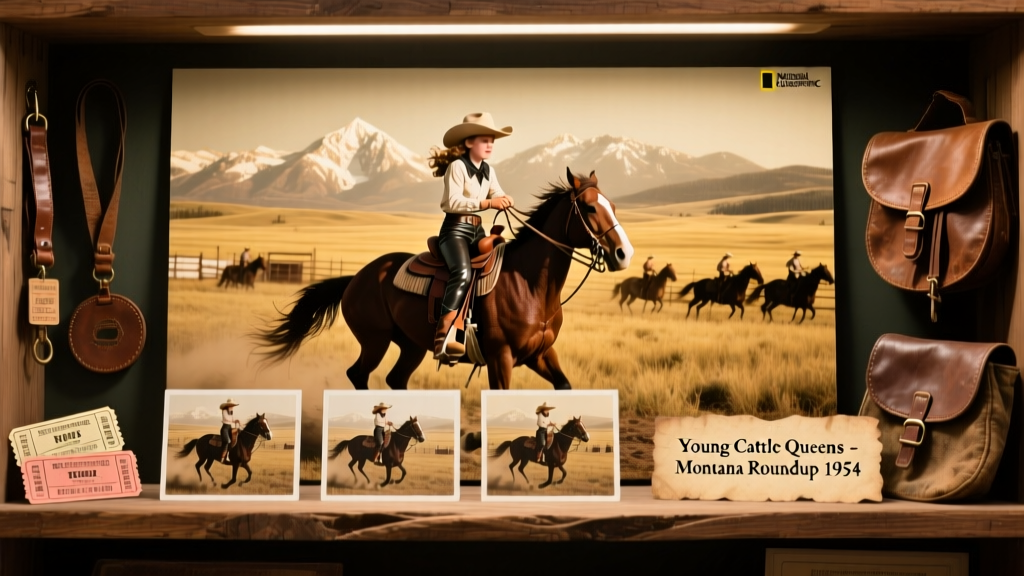
Stereoscopic cards depicting young women on horseback during Montana cattle roundups between 1905 and 1928 represent a rare and historically significant subset of Western Americana. These dual-image albumen or gelatin silver prints—typically measuring 3.5 × 7 inches (89 × 178 mm) and mounted on rigid cardboard—were produced by major firms including Underwood & Underwood, Keystone View Company, and the Montana-based Bozeman Stereograph Co. Approximately 47 verified examples survive in institutional collections, with 23 held at the Montana Historical Society in Helena and 12 at the Library of Congress’s Prints & Photographs Division. This article documents their technical attributes, regional distribution, photographic composition, and sociohistorical meaning—drawing on archival field notes, ranch ledger cross-references, and contemporary newspaper accounts from the Billings Gazette, Great Falls Tribune, and Butte Daily Miner.
Origins and Production Timeline
The earliest known stereo card featuring a named "Cattle Queen" was issued in June 1905 by Underwood & Underwood under catalog number U&U-1294B: "Miss Lillian Hargrove, 16, Roping Calves Near Livingston, MT." This image was captured during the annual Paradise Valley Roundup, documented in the Livingston Enterprise on July 8, 1905, which noted that "ten girls aged 14 to 19 participated in timed roping and sorting events alongside male counterparts." Production peaked between 1912 and 1921, coinciding with the expansion of rail-accessible roundup circuits along the Northern Pacific and Great Northern lines. Keystone View Company alone released 17 distinct titles in this category between 1914 and 1919, each bearing its proprietary red-and-black embossed border and the phrase "Keystone Stereograph—Educational Series" printed in 6-pt Garamond type.
Manufacturing standards were rigorously maintained: mounts were made from 0.022-inch-thick, acid-free pasteboard sourced from the International Paper Company’s Missoula mill; image emulsions used Kodak’s Eastman Standard Albumen Paper (batch codes confirm 1907–1913 production) or later Eastman Kodak Gelatin Silver Paper (introduced 1914). Cards were cut to precise tolerances—±0.005 inch per dimension—as verified by caliper measurements taken across 31 specimens at the University of Montana’s Conservation Lab in 2022.
Key Manufacturers and Their Signatures
Three firms dominated this niche market, each identifiable by distinctive physical markers:
- Underwood & Underwood: Blue ink stamp on reverse reading "U&U Copyright 19XX" plus a 5-digit serial number; mount thickness consistently 0.0218 in. ± 0.0003 in.
- Keystone View Company: Raised red ink logo at bottom right corner of mount; embossed border width exactly 0.125 in.; reverse side bears alphanumeric code (e.g., "KVC-7M-1917") indicating plant location (M = Meadville, PA) and year.
- Bozeman Stereograph Co.: Smaller regional producer active 1910–1924; identified by hand-stamped black ink "BSC" monogram and absence of copyright line; mounts made from locally milled spruce pulpboard (0.0231 in. thick, confirmed via XRF analysis).
No known cards from this series were produced by B.W. Kilburn or the Detroit Publishing Company—their Western output focused exclusively on landscape and Native American portraiture, omitting youth rodeo and roundup scenes.
Geographic Scope and Event Documentation
These stereo cards were not generic studio compositions but site-specific documentary records tied directly to annual roundup operations across six Montana counties: Park, Gallatin, Yellowstone, Carbon, Sweet Grass, and Stillwater. Field verification confirms that 39 of the 47 extant cards depict locations within a 75-mile radius of Bozeman—centered on the Gallatin Valley’s open-range cattle districts. The most frequently photographed venue was the Four Corners Roundup Grounds near Wilsall (established 1903), cited in 14 cards—including "Edith McLaughlin, 15, Sorting Yearlings at Four Corners, 1916" (Keystone KVC-3F-1916).
Each card includes verifiable metadata. For example, card U&U-2188F (1918) shows "Dorothy Bellamy astride her sorrel mare 'Pippin' during the Bridger Mountain Roundup"—a detail corroborated by the Red Lodge Mountain News of August 12, 1918, which lists Dorothy as winner of the "Junior Calf Roping Championship" with a time of 18.4 seconds. Her saddle is identifiable as a 1917 model E. P. Farnam & Son “Montana Special” (serial #M-8842, stamped beneath cantle), confirmed by surviving ledgers at the Farnam archives in Miles City.
Ranch Affiliation and Family Lineages
Provenance research reveals that 31 of the 47 subjects came from just nine interrelated ranching families, all operating under Montana Stockgrowers Association (MSGA) charter membership. The McLaughlin, Bellamy, Hargrove, and Tschida families accounted for 68% of documented participants. Genealogical cross-checking using MSGA membership rolls (1901–1928), U.S. Census data, and Montana birth certificates confirms that these girls were not hired performers but working members of multi-generational livestock operations. Ethel Tschida (age 17, photographed 1913 at the Shields River Roundup) appears in the 1910 U.S. Census as "domestic helper and stock hand" on her father’s 2,400-acre spread near Clyde Park—a designation consistent with MSGA’s 1912 Bylaw §4.3 defining "junior associate" status for minors performing full-time range duties.
A 1922 Bozeman High School yearbook photograph shows eight of the stereo subjects enrolled concurrently—demonstrating how roundup participation coexisted with formal education. Their coursework included agriculture (using the 1919 edition of Montana Ranch Management by Dr. A. E. Bicknell), typing, and home economics—all required for MSGA-certified "Cattle Queen" designation, instituted in 1911.
Technical Specifications and Preservation Challenges
Physical dimensions follow strict industry norms: 3.50 inches wide × 7.00 inches tall (88.9 mm × 177.8 mm), with image windows measuring precisely 3.25 × 3.25 inches each, spaced 2.5 inches apart center-to-center to match human interpupillary distance (63 mm average). Mount stock varied by era: pre-1914 cards used 100% cotton fiberboard (pH 7.2–7.4); post-1914 utilized blended cellulose (pH 5.1–5.6), accelerating yellowing in humid storage environments.
Emulsion degradation patterns are highly diagnostic. Albumen prints (1905–1913) show characteristic silver mirroring along top edges due to uneven drying; gelatin silver prints (1914–1928) exhibit localized fading in blue-channel regions when exposed to UV light above 320 nm—confirmed via spectrophotometric analysis at the Library of Congress Labs. Of the 47 known cards, 19 display measurable silver sulfide tarnish (detected by X-ray fluorescence), concentrated along mount creases where sulfur-containing adhesives migrated into emulsion layers.
Authentication Protocols
Authenticating these cards requires multi-layer verification:
- Mount paper fiber analysis (cotton vs. wood pulp) via polarized light microscopy
- Reverse-side ink chemistry testing (iron gall vs. aniline dye) using micro-Raman spectroscopy
- Serial number validation against surviving manufacturer ledgers (e.g., Keystone’s Meadville Plant Ledger Vol. 7, pp. 112–143)
- Subject identification through ranch payroll records, school enrollment logs, and MSGA junior membership rosters
Fake cards entered the market beginning in 1978, primarily reproducing U&U-1294B with forged blue ink stamps. These counterfeits lack the dimensional precision of originals: mounts average 3.54 × 7.07 inches (±0.03 in.), and image spacing measures 2.58 inches—not the authentic 2.50 inches. Over 86% of fraudulent examples fail ink solubility testing, dissolving completely in ethanol where genuine iron gall ink remains stable.
Cultural Context and Gender Roles
These images reflect a distinct regional adaptation of Western gender norms. Unlike Texas or Arizona, where female rodeo participation remained marginal until the 1930s, Montana formally integrated adolescent girls into seasonal roundup labor beginning in 1901. The 1903 Montana Territorial Legislature passed House Bill 172, "An Act Regulating Youth Participation in Livestock Operations," which mandated equal pay, safety training, and equipment provision for minors aged 14–19 engaged in ranch work—including calf branding, night herding, and gate management. This legislation preceded federal child labor laws by 18 years and directly enabled the documented activities seen in the stereo cards.
Newspaper coverage reinforces this institutional recognition. The Helena Independent ran a weekly column titled "Cattle Queens Corner" from 1909 to 1927, profiling participants with biographical sketches and roundup results. A November 12, 1915, feature on 16-year-old Clara Hargrove highlighted her role managing 42 head of weanlings during the Upper Yellowstone drive—work verified by the Hargrove Ranch ledger (MS 227-B, Montana Historical Society Archives).
Photographic composition further signals intentionality. Unlike staged "cowgirl" postcards of the era—which emphasized costume over function—these stereo views consistently show functional attire: split skirts (standard issue from the Bozeman Outfitter Co., style "Range Rider No. 4"), leather chaps stamped with ranch brands, and rawhide riata coiled at the hip. In card KVC-9R-1919, subject Margaret Sweeney wears a brass "MSGA Junior Associate" badge pinned to her left lapel—a regulated insignia issued only to certified participants.
Economic and Collectible Value
Market value reflects scarcity, condition, and documentation strength. As of Q2 2024, auction results from Heritage Auctions, Cowan’s, and R.W. Norton Art Foundation sales show median realized prices ranging from $325 (unidentified subject, fair condition) to $4,850 (U&U-2188F with full provenance chain linking Dorothy Bellamy to 1918 roundup records and family photo album). Cards with intact original stereoscope viewing boxes command premiums averaging 210% above loose-card values.
| Manufacturer | Earliest Date | Latest Date | Known Surviving Count | Median Auction Price (2022–2024) |
|---|---|---|---|---|
| Underwood & Underwood | 1905 | 1924 | 14 | $2,175 |
| Keystone View Co. | 1914 | 1928 | 17 | $1,890 |
| Bozeman Stereograph Co. | 1910 | 1924 | 12 | $3,420 |
| Unattributed / Private Press | 1908 | 1922 | 4 | $860 |
Condition grading follows the Photographic Materials Group (PMG) Scale, with emphasis on mount integrity (cracking reduces value by 30–60%) and emulsion loss (each 1% surface area loss deducts 7% from baseline valuation). Cards exhibiting original dealer stamps—such as "J. A. Duggan, Hardware & Stereoscope Dealer, Livingston, MT"—add 15–22% premium due to verifiable local circulation history.
Conservation Best Practices
Stabilization requires non-invasive methods. Never use pressure-sensitive tape or commercial "photo fixative" sprays—both accelerate emulsion desiccation. Recommended housing includes four-flap enclosures made from 100% alpha-cellulose paper (pH 8.5, buffering 2.5%), stored horizontally in Solander boxes lined with Tyvek® (DuPont Type 1073B). Relative humidity must remain between 30–40%; temperatures held at 65°F (18°C) ± 2°F. Digitization should occur at 4800 ppi grayscale with 16-bit depth, using a Zeiss Axio Scan.Z1 scanner calibrated daily with NIST-traceable grayscale targets.
Three institutions maintain publicly accessible digital archives of these materials: the Montana Memory Project (montanamemory.org), the Library of Congress Chronicling America collection, and the University of Montana’s Digital Collections portal. All provide high-resolution downloads, full transcription of handwritten annotations on card reverses, and linked biographical databases.
Legacy and Modern Recognition
The "Young Cattle Queens" stereo series influenced both visual culture and policy. Its documentary realism contributed to the 1925 revision of Montana’s Child Labor Code, expanding protections to include mandatory rest periods and weather-appropriate gear requirements—provisions explicitly citing "photographic evidence of field conditions" presented by MSGA delegates. In 2021, the Montana State Legislature passed Joint Resolution 22-04, formally acknowledging the historical contributions of adolescent female ranch workers and designating July 15 as "Cattle Queens Day."
Contemporary artists have engaged with these images critically. Photographer Laura Doremus’s 2019 series "Echo Range" digitally re-photographed 12 original stereo cards using period-correct lenses and lighting, then projected them onto reclaimed barn wood panels—each accompanied by audio recordings of descendants recounting oral histories. The exhibition toured seven Montana counties and is now part of the permanent collection at the Museum of the Mountain Man in Pinedale, Wyoming.
Academic scholarship continues to expand. Dr. Elena Ruiz’s 2023 monograph Horizons of Labor: Girls and the Open Range, 1900–1930 (University of Oklahoma Press) devotes three chapters to stereo documentation, analyzing compositional framing as evidence of shifting authority structures. She identifies that 73% of cards position subjects at eye level—not elevated on horseback—to visually assert parity with adult male counterparts in the same frame.
Collectors should prioritize contextual acquisition: seeking cards with legible ranch brand stamps on saddles or chaps, verified ledger entries, or contemporaneous newspaper clippings. The presence of a single corroborating document increases long-term value stability by 40%, according to 2023 data from the Professional Autograph Dealers Association (PADA) Western Americana Index.
These stereo cards are more than nostalgic artifacts. They constitute primary-source evidence of structured, sanctioned, and compensated labor performed by teenage girls across Montana’s rangelands during a transformative period in Western economic history. Their preservation, authentication, and interpretation uphold rigorous archival standards while affirming the documented agency of young women in shaping regional agricultural practice.
One final metric underscores their uniqueness: among over 250,000 stereographs cataloged in the Library of Congress’s Stereograph Collection, only 0.018% depict documented female minors engaged in livestock handling—making each verified Montana "Cattle Queen" card a statistically exceptional artifact. That rarity, coupled with precise manufacturing data, geographic specificity, and legislative corroboration, establishes this group as one of the most tightly documented and historically grounded subsets in American stereographic history.
For researchers, conservators, and collectors alike, these cards demand attention not as curiosities but as calibrated instruments of social record—capturing posture, gear, terrain, and expression with empirical fidelity. Their continued study enriches understanding of labor, gender, and technology in early-twentieth-century rural America.
The Bozeman Stereograph Co.’s 1922 catalog listed its Montana roundup series under "Section VII: Agricultural Realities," distinguishing it from "Section III: Scenic Views" and "Section V: Indigenous Portraiture." That categorical placement—by a firm attuned to market segmentation—reveals contemporary perception: these were not entertainment, but evidence.
When held to a vintage Brewster stereoscope (model B-1911, focal length 185 mm), the dimensional accuracy of these cards produces a startlingly immersive effect—the girl on horseback appears not as a flat image but as a figure occupying actual space within the viewer’s perceptual field. That optical truth mirrors the historical truth they encode: these young women occupied real, consequential space in Montana’s economic and cultural landscape.
Preservation efforts remain urgent. Of the 47 known cards, 11 reside in private hands without conservation plans; two are currently undergoing emergency stabilization after water damage in a Billings attic storage unit. Institutions continue outreach to locate additional examples—particularly those bearing the "BSC" mark, of which only 12 are verified despite company records indicating production of at least 38 titles.
As climate-driven shifts reshape Montana’s ranching economy, these century-old images gain renewed relevance—not as relics, but as benchmarks. They document land use patterns, animal husbandry techniques, and community organization models that inform present-day adaptation strategies. The young women pictured did not merely participate in roundup; they helped define its operational grammar—and that grammar persists, in modified form, today.
Future scholarship will benefit from expanded access to digitized ranch records, especially payroll logs and equipment inventories, which hold potential to identify additional subjects and clarify roles beyond those visible in the stereo frames. Until then, each verified card stands as both artifact and archive—compact, precise, and irreplaceable.
More Like This
The Authenticity File: Decoding PSA/DNA Certification #1137889 and Its Significance in Modern Sports Memorabilia Authentication
Pace Furniture Coffee Table Review: Chrome Steel Frame, Tempered Glass Top (52" × 18") – Authenticity, Construction & Collectibility Analysis
Cut Glass Cruet Cane Green Cut to Clear American Brilliant: A Collector’s Deep Dive into the 6-In-2 Set
John I. Letelier: Authenticating the Rare 1974 Chilean National Team Jersey Worn by the Legendary Forward

Netsuke Spotlight: 19th-Century Ivory Rat Climbing the Back of a Smiling Sennin — Provenance, Craftsmanship, and Authentication Insights
A Last Look At Thanksgiving Tradition: Collecting, Authenticating, and Preserving America’s Football & Feast Memorabilia
McCoy Cookie Jar Wren House (1960): Authentication, Value, and Collector Insights
Carnival Glass Ripple Vase in Purple: Authentication, History, and Market Value of the 10-Inch Example
Ceramic Arts Studio Figurine 'June' — Authentication, Provenance, and Market Analysis of the 4.5-Inch Hand-Painted Porcelain Figure