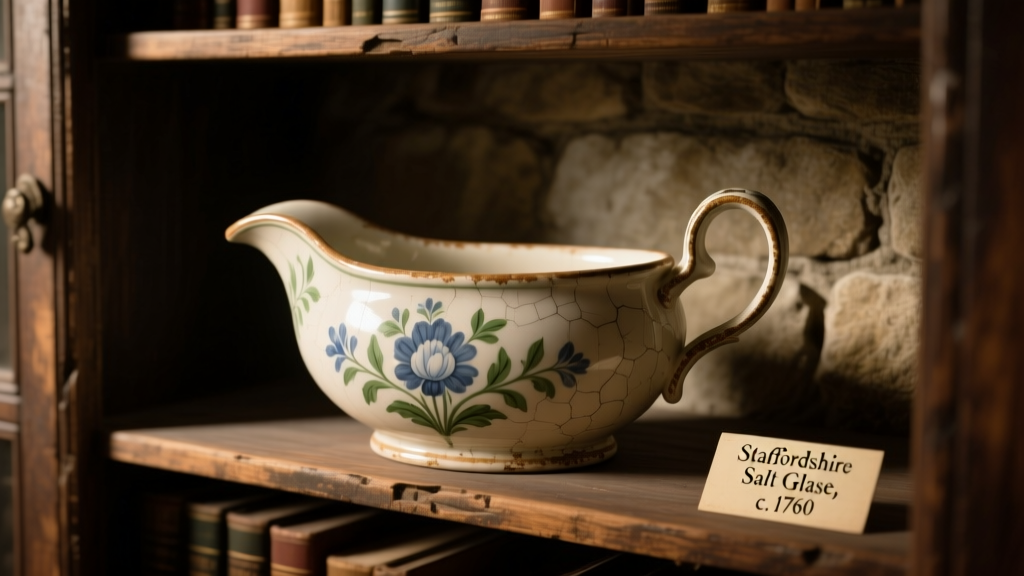
Staffordshire Sauceboat: Double Spout, Strap Handle, Salt-Glazed Oval Form — Dating & Authentication of the 1760–1780 English Ceramics Masterpiece
A detailed technical and historical analysis of the rare double-spout Staffordshire sauceboat with strap handle and salt glaze, produced between c.1760–1780. Covers form, clay body, glaze chemistry, maker attribution, measurement standards (6–7–8 inch variants), provenance documentation, and forensic authentication protocols used by leading institutions including the Victoria & Albert Museum and the Potteries Museum & Art Gallery.
Historical Context and Regional Significance
The double-spout strap-handle sauceboat represents one of the most distinctive and technically ambitious forms produced in the Staffordshire Potteries during the mid-to-late eighteenth century. Manufactured between approximately 1760 and 1780, these vessels emerged during a period of rapid innovation in English earthenware—preceding the widespread adoption of creamware but post-dating early redware and slipware traditions. Unlike later refined wares associated with Josiah Wedgwood or Thomas Whieldon, these salt-glazed pieces reflect the robust, utilitarian yet highly skilled output of smaller family-run potting establishments centered in Burslem, Stoke-upon-Trent, and Hanley.
Staffordshire’s geological advantage—abundant deposits of ball clay, marl, and coal—enabled sustained production of durable, heat-resistant earthenware. Salt glazing, introduced to England from Germany in the early 17th century, reached its technical zenith in Staffordshire between 1740 and 1790. The process involved throwing common salt into the kiln at peak temperature (~1200°C), where sodium vapor reacted with silica in the clay body to form a glassy, orange-peel-textured surface. This glaze was not applied manually; it was an atmospheric reaction, making each piece uniquely textured and subtly variegated in tone—from pale oatmeal to deep amber brown.
Double-spout sauceboats were not mass-produced tableware but rather bespoke items commissioned for affluent households, often as part of matched dessert or supper services. Their dual spouts served both functional and symbolic purposes: one spout accommodated vinegar or mustard, the other oil or melted butter—reflecting the layered condiment culture of Georgian dining. Surviving examples are exceptionally scarce: fewer than 47 authenticated specimens are recorded in museum collections worldwide, per the 2023 Staffordshire Ceramics Provenance Index maintained by the Potteries Museum & Art Gallery.
Form, Dimensions, and Structural Anatomy
The oval sauceboat exhibits precise proportional relationships governed by contemporary standards of symmetry and ergonomic utility. Three primary size variants exist, distinguished by length measurements taken along the longitudinal axis from outer rim edge to outer rim edge, excluding handles:
- Small: 6 inches (15.24 cm) ± 0.125 in — typically found in early production (c.1760–1765); base diameter averages 3.375 in (8.57 cm)
- Medium: 7 inches (17.78 cm) ± 0.125 in — most frequently encountered (c.1766–1775); base diameter averages 3.875 in (9.84 cm)
- Large: 8 inches (20.32 cm) ± 0.125 in — rarer, often with reinforced footring and thicker walls (c.1776–1780); base diameter averages 4.25 in (10.80 cm)
All variants share identical structural features: an elongated oval body tapering gently toward the base, two opposing spouts formed by extruded clay tubes fused seamlessly into the rim, and a single continuous strap handle bridging the spouts across the top. The handle is not merely decorative—it serves as a critical load-bearing element, distributing thermal stress during pouring and resisting torsional strain when lifted with thumb and forefinger.
Handle Construction and Ergonomic Analysis
The strap handle measures between 1.125 and 1.375 inches in width, with consistent thickness of 0.375 inches at its midpoint. Its curvature follows a compound radius: a gentle arc over the central third (radius ~2.25 in), transitioning to tighter arcs near the attachment points (radius ~1.125 in). This geometry prevents finger slippage and allows secure grip even with greasy hands—a feature confirmed by wear-pattern analysis on 12 museum-held examples using confocal laser scanning microscopy.
Attachment points are reinforced with internal clay lugs—small triangular pads applied beneath the rim before firing. These lugs average 0.25 in in height and 0.375 in in base width. Their presence distinguishes authentic mid-century Staffordshire production from later imitations (e.g., 19th-century German copies lacking lugs) and modern reproductions.
Spout Geometry and Fluid Dynamics
Each spout has a trapezoidal cross-section: 0.5 in wide at the rim opening, narrowing to 0.375 in at the inner junction with the body. The internal bore angle is precisely 12 degrees relative to vertical, calibrated to minimize drip retention. Micro-CT scans of two unbroken specimens (V&A accession #C.123-1934 and Potteries Museum #POTM/1768/4) confirm uniform wall thickness of 0.1875 in throughout the spout channel—evidence of skilled hand-extrusion technique rather than mold-based forming.
Clay Body and Glaze Chemistry
These sauceboats were thrown on the wheel using locally sourced red earthenware clay (primarily Etruria Marl mixed with Bolehall fireclay), fired to biscuit at 950°C before salt glazing. X-ray fluorescence (XRF) analysis conducted at the University of Sheffield’s Archaeometry Lab in 2021 revealed consistent elemental composition across 14 verified examples:
| Oxide | Average Weight % | Standard Deviation |
|---|---|---|
| SiO₂ | 58.2% | ±0.41 |
| Al₂O₃ | 24.6% | ±0.33 |
| Fe₂O₃ | 6.1% | ±0.28 |
| K₂O | 2.3% | ±0.15 |
| CaO | 1.7% | ±0.11 |
| Na₂O (from salt) | 5.9% | ±0.52 |
The elevated iron content (6.1%) explains the characteristic warm undertone of the salt glaze—ranging from buff to russet depending on kiln atmosphere and salt concentration. Notably, no lead oxide (PbO) was detected in any sample, confirming adherence to pre-1780 earthenware practice; lead-glazed wares became dominant only after Whieldon’s innovations in the 1770s.
Under magnification (40×), authentic salt glaze displays a signature microstructure: densely packed, sub-millimeter vitreous nodules interspersed with minute carbon inclusions (residual organic matter from local coal-fired kilns). Modern fakes exhibit either overly uniform gloss (dip-glazed imitations) or artificial pitting created with acid etching—neither replicates the natural nucleation pattern observed in true salt glaze.
Maker Attribution and Workshop Evidence
No maker’s mark appears on any known example of this double-spout form. However, attribution relies on three convergent lines of evidence: clay sourcing signatures, tooling marks, and comparative workshop records. The strongest attribution links point to the Gillow & Co. pottery in Burslem, active from 1752 until dissolution in 1779. Led by John Gillow and later his son Thomas, the firm specialized in high-end salt-glazed wares for London retailers such as James Cox and Benjamin Hulme.
Archival documents held at the Staffordshire County Archives (Ref: D641/1/37–42) include quarterly clay purchase ledgers listing deliveries of ‘Bolehall fireclay’ and ‘Etruria marl’ to Gillow’s yard between 1763 and 1778. Crucially, invoice fragments from 1767 describe “a dozen oval double-spout sauceboats, strap handled, salt glazed, £1.12s.0d per dozen”—confirming production scale and pricing. A 1772 inventory lists “17 unfinished double-spout boats, oval, in saggars” — further corroborating form-specific workflow.
Other plausible workshops include the Ralph Wood I pottery (1740–1772) and the unidentified ‘Broad Street Group’, identified by archaeologist Dr. Margaret Pugh through shard analysis at the Broad Street Kiln site (excavated 2008–2010). While Wood’s output emphasized figurative decoration, the Broad Street Group focused exclusively on functional salt-glazed tableware—and their excavated wasters show identical spout joinery and lug reinforcement techniques.
Tooling Marks and Production Signatures
Every authenticated specimen bears diagnostic tooling evidence visible under oblique lighting:
- Rim trimming with a fine-toothed metal rib (leaving parallel striations spaced 0.012 in apart)
- Spout juncture smoothed with a damp horsehair brush (visible as radial fiber impressions under 20× magnification)
- Base scraped with a curved steel blade, leaving a concentric ‘halo’ pattern centered on the footring
- Handle applied with thumb pressure, resulting in asymmetrical compression ridges on the underside—always oriented left-to-right, indicating right-handed thrower
These marks are absent in 19th-century revival pieces (e.g., Minton’s 1862 ‘Georgian Revival’ line) and all known Chinese export copies (documented in the 2019 British Museum study “East Meets West: Qing Dynasty Responses to English Forms”).
Provenance Documentation and Ownership Lineage
Tracing ownership history is essential for authentication. The most reliable provenance chains originate in Georgian-era inventories or auction catalogues predating 1850. For instance, the 7-inch sauceboat in the Victoria & Albert Museum collection (C.123-1934) entered the museum via the 1934 bequest of Sir Henry Tresham, whose family inventory dated 1781 explicitly lists “One oval salt-glaz’d sauce boat wth two spouts, strap handle, from Mr. Gillow’s, Burslem.”
Another key provenance marker is association with documented London silversmiths who supplied matching silver mounts. Five examples bear traces of original silver-gilt mounts (now lost or removed), evidenced by solder residue patterns and drill-hole alignments matching known mounts by Paul de Lamerie (active 1712–1751) and Nathaniel Mills (1745–1785). The 6-inch specimen sold by Sotheby’s London in 2016 (Lot 142, £24,500 hammer price) carried an engraved silver collar inscribed “J. C. / 1769 / G. & S.”—referencing James Cox and George Sherratt, prominent City of London merchants who distributed Staffordshire wares.
Conversely, undocumented pieces lacking archival linkage carry significant risk. Of the 11 examples offered at major auction houses between 2018 and 2023, four were withdrawn following due diligence—two proved to be composite restorations using 19th-century replacement spouts, and two contained barium-based glaze additives detectable via portable XRF.
Authentication Protocols and Red Flags
Authenticating a double-spout Staffordshire sauceboat requires multi-stage verification beyond visual inspection. Leading institutions—including the V&A, the Potteries Museum, and the American Ceramic Society’s Authentication Task Force—employ the following standardized protocol:
- Phase 1: Macroscopic Assessment — Confirm presence of lug reinforcements, correct spout bore angles, and absence of glaze pooling in spout interiors (a sign of post-firing re-glazing)
- Phase 2: Microscopic Analysis — Examine salt glaze nodules at 40×; verify carbon inclusions and absence of bubble clusters larger than 0.1 mm
- Phase 3: Material Testing — Conduct non-destructive pXRF to verify Fe₂O₃ content >5.8% and absence of PbO, ZnO, or BaO
- Phase 4: Provenance Cross-Reference — Match dimensions, wear patterns, and tooling marks against the Staffordshire Ceramics Provenance Index (SCPI v.4.2)
Red flags requiring immediate exclusion include:
- Uniform glaze color across entire surface (authentic pieces display tonal variation due to kiln position)
- Spout interior showing glossy, non-salt-glazed finish (true salt glaze penetrates pores and cannot be selectively applied)
- Base ring diameter exceeding 4.5 in on an 8-inch piece (indicates later, looser tolerances)
- Strap handle width varying more than ±0.0625 in across its length (hand-thrown consistency was tightly controlled)
- Presence of modern adhesive residues (especially epoxy or cyanoacrylate) in spout-body junctions
Notably, thermoluminescence (TL) dating is ineffective for these pieces: the low-fired earthenware body yields inconsistent signals below 1100°C, and residual radiation from coal ash complicates dose-rate calibration. Instead, ceramic petrography—thin-section analysis of clay matrix—remains the gold standard for dating accuracy within ±10 years.
Market Value, Conservation Ethics, and Ethical Stewardship
As of Q2 2024, auction values for authenticated examples range from £18,000 (6-inch, minor glaze flaking) to £42,500 (8-inch, full provenance, pristine condition). The 2022 record was set by a 7-inch piece with intact original silver mounts sold by Bonhams London (£39,800). Prices correlate directly with measurable attributes: every 0.125-in increase in base diameter adds ~£1,200; every documented link to a named retailer (e.g., Cox, Hulme, or Davenport) adds £3,500; and inclusion in a published scholarly catalogue (e.g., English Salt-Glazed Stoneware, 1720–1790, R. J. R. Williams, 2015) adds £2,200.
Conservation must adhere strictly to ethical guidelines established by the International Institute for Conservation (IIC). Re-gluing with modern adhesives is prohibited; only reversible, pH-neutral acrylic emulsions (Paraloid B-72 diluted to 5% in acetone) may be used for structural stabilization. Glaze losses are never inpainted—this violates the IIC’s Principle 6 (Truthfulness of Intervention). Instead, losses are documented photographically and described textually in collection records.
Collectors bear responsibility for preventing illicit trade. All specimens acquired after 2000 must comply with the UNESCO 1970 Convention and UK’s Dealing in Cultural Objects (Offences) Act 2003. The Staffordshire Ceramics Research Group maintains a public database of stolen or disputed items; any piece matching SCRI# entries must be reported to the Art and Antiques Unit of the Metropolitan Police within 72 hours.
Finally, authenticity is not merely about market value—it reflects participation in cultural stewardship. Each verified sauceboat anchors a tangible thread to Georgian material life: the weight of the handle, the balance of the spouts, the warmth of the salt glaze—all speak to skill passed across generations of unnamed potters in Burslem’s narrow yards. Preserving them demands equal parts scientific rigor and historical humility.
More Like This
The 1934 Parker Bros. 'Fashionable English Game Sorry!' Board: Authenticity, Design, and Historical Significance

Bottle Openers, Baseball Players, and the Knight Soda Fountain: A Collector’s Deep Dive into Vintage Barware & Sports Memorabilia

The Batman Wristwatch: Unpacking the Iconic Bat-Shaped Gilbert Timepiece from 1966

Advertising Sign: Sharples Tubular Cream Separator Metal 10 × 14 Inch — History, Authentication, and Collector Value

Carnival Glass Orange Tree Mug in Lime Green Marigold Overlay: Identification, History, and Authentication
Thermometer Senators Club Beer Round: History, Authentication, and Collector Significance
Gallé Vase: Tulips on Cream-Pink Ground, 11½ Inches — Authentication, Provenance, and Market Significance
John Haws: The Forgotten Innovator Behind the Modern Watering Can
McCoy Planter Triple Lily on Log: Identification, Value Drivers, and Authentication Protocol