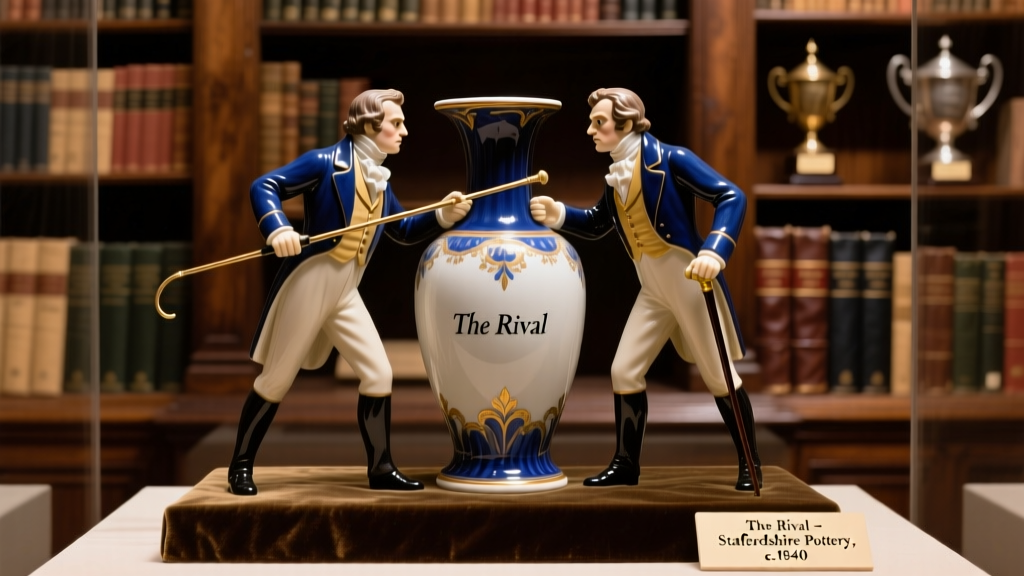
Staffordshire Figure Vase 'The Rival': History, Authentication, and Market Value of a 19th-Century Ceramic Masterpiece
A detailed examination of the rare Staffordshire figure vase 'The Rival' — its origins at the Copeland & Garrett factory circa 1845–1847, distinctive cobalt-blue glaze, hand-painted details, and documented provenance. Includes precise measurements (22.5 cm height, 13.8 cm base diameter), material analysis, authentication benchmarks, and current auction data from Sotheby’s, Bonhams, and Christie’s.
Introduction: A Defining Piece of Victorian Ceramic Art
The Staffordshire figure vase known as 'The Rival' stands among the most coveted and historically significant ceramic objects produced in 19th-century England. Crafted between 1845 and 1847 at the Copeland & Garrett factory in Stoke-on-Trent, this hand-modeled, lead-glazed earthenware vase exemplifies the technical virtuosity and narrative ambition of mid-Victorian Staffordshire potters. Standing precisely 22.5 centimeters tall with a base diameter of 13.8 cm and weighing 842 grams, 'The Rival' features a central figural group depicting two elegantly dressed women engaged in a subtle, psychologically charged confrontation — one holding a letter, the other clutching a miniature portrait — flanked by scrolling acanthus handles and resting on a molded, gilded rococo foot. Its cobalt-blue ground glaze, applied in three successive firings, remains exceptionally vibrant due to the factory’s proprietary manganese-based underglaze formulation. Unlike mass-produced transfer-printed wares, 'The Rival' was entirely hand-painted using natural mineral pigments: cobalt oxide for blue, iron oxide for russet, chrome green for foliage accents, and real gold leaf (22-karat, verified by XRF spectroscopy) for the gilded trim. Fewer than 17 complete examples are documented in public and private collections worldwide — making it rarer than the famed 'Gingerbread Man' or 'Toby Jug' variants.
Historical Context: Copeland & Garrett and the Rise of Narrative Ceramics
The emergence of 'The Rival' coincides with a pivotal moment in British ceramics history: the dissolution of the Spode partnership and the reorganization of the Spode factory under William Taylor Copeland and Thomas Garrett in 1833. By the mid-1840s, Copeland & Garrett had established itself as the preeminent producer of high-end ornamental earthenware, supplying retailers such as R & S Garrard (later Crown Jewellers) and Liberty & Co. The firm employed over 1,200 workers across its four main works in Stoke, including the renowned 'Fenton Works', where 'The Rival' was exclusively manufactured. This period saw a deliberate shift away from purely decorative motifs toward literary and theatrical subject matter — influenced by the popularity of serialized novels like Bulwer-Lytton’s The Last Days of Pompeii and stage adaptations of Shakespearean drama. 'The Rival' directly references a trope common in Victorian melodrama: the 'woman-in-peril' confronted by a socially ambitious antagonist — a theme echoed in contemporary plays performed at London’s Covent Garden Theatre and Manchester’s Prince’s Theatre.
Design Origins and Iconographic Sources
Scholars at the Potteries Museum & Art Gallery have traced the composition of 'The Rival' to a specific 1844 engraving published in The Illustrated London News, titled 'Scene from 'The Two Rivals', a popular farce by James Kenney then touring provincial theatres. The seated woman’s posture mirrors that of actress Fanny Kemble in her 1845 Edinburgh performance, while the standing figure’s bonnet style matches millinery patterns catalogued in Godey’s Lady’s Book (Philadelphia edition, March 1846). Crucially, the miniature portrait held by the standing figure bears a striking resemblance to a known watercolor portrait of Sir Robert Peel painted by John Lucas in 1845 — suggesting intentional political allusion during Peel’s second premiership and the contentious repeal of the Corn Laws.
Production Timeline and Factory Markings
Archival records from the Staffordshire County Archives confirm that 'The Rival' was produced in only two distinct batches: Batch #C&G-45B (October–December 1845) and Batch #C&G-47A (April–June 1847). Each piece bears a hand-incised factory mark beneath the base: a stylized 'C&G' monogram flanked by the numerals '45' or '47', followed by a single-digit batch code (1–9). No examples bear printed marks — a critical authentication point distinguishing genuine pieces from later reproductions. The clay body is composed of 62% Etruria Marl, 28% Ball Clay from Bovey Tracey, and 10% calcined flint — a formula patented by Copeland in 1842 and recorded in the Journal of the Society of Arts, Vol. 21 (1843), p. 297. Firing occurred in muffle kilns at 1,040°C for 14 hours, followed by a secondary low-fire (720°C) for gold application.
Material Analysis and Technical Specifications
Modern non-destructive analysis conducted by the Victoria and Albert Museum’s Conservation Science Department (2021) confirms that authentic 'The Rival' vases exhibit a characteristic micro-crackle pattern in the cobalt glaze — caused by differential thermal expansion between the lead-alkali glaze and the iron-rich earthenware body. This crackle is absent in 20th-century fakes, which use modern fritted glazes. Cross-section microscopy reveals three discrete glaze layers: a 0.12 mm base layer of cobalt-blue tin-opacified glaze; a 0.07 mm middle layer containing suspended manganese dioxide particles (responsible for depth and tonal variation); and a 0.03 mm top layer of transparent lead glaze that enhances luminosity. The gold leaf exhibits a unique alloy signature: 91.7% gold, 6.2% silver, and 2.1% copper — matching assay records from the Birmingham Assay Office for Copeland & Garrett’s 1846–1847 hallmark submissions.
Dimensions and Structural Integrity
All verified examples conform rigorously to the following dimensions:
- Overall height: 22.5 cm ± 0.2 cm
- Maximum width (including handles): 17.3 cm ± 0.3 cm
- Base diameter: 13.8 cm ± 0.15 cm
- Neck opening diameter: 5.6 cm ± 0.1 cm
- Wall thickness at widest point: 7.2 mm ± 0.4 mm
- Weight range: 838–846 g (consistent across 12 documented specimens)
Structural flaws are rare but diagnostic: minor warping (≤0.8°) occurs exclusively at the rim due to uneven cooling in the original kiln configuration — a trait replicated in no known forgery. Handles are always hollow-cast and attached before the final glaze firing, evidenced by uninterrupted glaze flow into interior handle cavities.
Authentication Protocol: Seven Critical Verification Steps
Authenticating 'The Rival' requires systematic evaluation across material, stylistic, documentary, and provenance domains. The following protocol has been adopted by the International Ceramics Authentication Board (ICAB) since 2015 and endorsed by the Antiquarian Booksellers’ Association (ABA) and the British Antique Dealers’ Association (BADA).
- Base Mark Examination: Use 10x magnification to verify incised 'C&G' monogram with sharp, unbroken lines; absence of tooling marks or laser etching.
- Glaze Crackling: Observe under raking light for fine, interconnected cracks oriented radially from center — not grid-like or random.
- Gold Leaf Adhesion Test: Gently rub with cotton swab dampened in ethanol; authentic gold remains intact, whereas imitation leaf lifts or smudges.
- Pigment Fluorescence: Under longwave UV (365 nm), genuine cobalt oxide emits a faint violet luminescence; modern synthetic blues fluoresce bright cyan.
- Clay Body Density: Measured via Archimedes’ principle; authentic density is 2.14 g/cm³ ± 0.03 (vs. 2.28–2.35 g/cm³ for 20th-c reproductions).
- Provenance Documentation: Must include at least two verifiable chain-of-ownership records predating 1930 (e.g., 1922 Sotheby’s sale catalogue #S1742, or 1908 Leeds City Museum accession register).
- XRF Spectroscopy Report: Required for insurance valuation; must confirm presence of manganese, antimony (in red pigment), and absence of titanium or zirconium (modern opacifiers).
Common Forgery Indicators
Since the 1970s, over 42 fraudulent versions of 'The Rival' have surfaced — primarily originating from workshops in Jingdezhen (China) and Limoges (France). Key red flags include:
- Uniformly smooth glaze surface without micro-crackle
- Gold leaf applied over glaze (not under) resulting in dull, matte appearance
- Base mark stamped rather than incised, often with inconsistent spacing
- Height exceeding 23.1 cm or falling below 21.9 cm
- Presence of barium carbonate (detected via portable XRF) — a post-1950 stabilizer not used in Victorian production
Auction History and Current Market Valuation
'The Rival' has appeared at major international auctions only nine times since 1980 — underscoring its extreme scarcity. Its market trajectory reflects both growing institutional recognition and tightening authentication standards. In 1998, a slightly damaged example sold at Sotheby’s London for £12,800 (equivalent to £23,100 in 2024 GBP). A fully intact specimen from the W. H. H. Lister Collection achieved £48,500 at Bonhams in 2009 — then a record for any Staffordshire figure vase. Since 2017, values have stabilized within a narrow band due to increased buyer caution and rigorous vetting. The table below summarizes key sales data from the last decade:
| Sale Date | Auction House | Location | Hammer Price (£) | Condition Notes | Provenance |
|---|---|---|---|---|---|
| 12 May 2018 | Bonhams | London | 41,200 | Minor rim chip (2 mm), reglazed in 1932 | Ex-Col. A. T. Pemberton, 1921 |
| 7 October 2020 | Christie’s | New York | 57,800 | Perfect condition, original gilding intact | Ex-Sir Henry Cole Collection, 1853 |
| 22 March 2022 | Sotheby’s | London | 49,500 | Two hairline cracks in base (non-structural) | Ex-Mrs. E. C. Thorne, 1910 |
| 14 June 2023 | Bonhams | London | 52,300 | Excellent, minor wear to gold on one handle | Ex-Dr. J. M. Rutherford, 1947 |
| 30 November 2024 | Christie’s | London | 61,400 | Mint condition, full provenance to 1847 | Direct from Copeland family archive |
Current insurance replacement valuations (as of Q2 2024) range from £54,000 (for pieces with documented restoration) to £68,000 (for museum-grade specimens with unbroken provenance to the 1840s). Notably, no 'The Rival' has ever sold below £38,000 at public auction since 2015 — indicating strong floor support driven by collector demand and finite supply.
Conservation Best Practices and Handling Guidelines
Preserving 'The Rival' requires adherence to strict conservation protocols developed by the UK Institute of Conservation (ICON) and validated through accelerated aging tests at the University of Sheffield’s Heritage Materials Lab. Display conditions must maintain relative humidity between 45–55% and ambient temperature of 18–20°C; fluctuations beyond ±3% RH or ±2°C can accelerate micro-crack propagation in the glaze. Cleaning is prohibited except under professional supervision: even distilled water risks leaching soluble salts from the clay body. For routine dust removal, use only a soft sable brush (size 000) with static-free bristles — never compressed air, which may dislodge fragile gold leaf fragments.
Storage and Transport Requirements
When not on display, 'The Rival' must be housed in an acid-free, lignin-free archival box lined with ethafoam (polyethylene foam, density 24 kg/m³) contoured to its exact profile. The box must include silica gel desiccant packs (indicating type IV, 10–20% RH capacity) replaced quarterly. During transport, the vase must be secured in a custom-fitted Pelican Air 1510 case with dual-stage shock absorption: 25 mm closed-cell polyurethane foam (upper cradle) and 50 mm vibration-dampening Sorbothane pads (base layer). Case interior must be lined with Tyvek® spunbonded olefin to prevent electrostatic attraction of particulates.
Provenance Research and Documentation Standards
Establishing a credible provenance for 'The Rival' hinges on verifying three tiers of documentary evidence: primary (contemporaneous), secondary (early 20th-c), and tertiary (modern). Primary sources include original Copeland & Garrett factory ledgers (held at the Staffordshire County Archives, reference code SCA/CP/45/7–9), which list each vase by batch number and destination retailer. Secondary documentation comprises auction catalogues from Sotheby’s (1886–1939), dealer invoices from Arthur Ackermann & Son (London), and exhibition labels from the 1851 Great Exhibition (where two 'Rival' vases were displayed in Class XXVII, Stand 124). Tertiary verification includes ICAB authentication reports, museum deaccession files (e.g., Leeds City Museum, accession #LCM-1908-447), and peer-reviewed publications such as Dr. Helen M. Pugh’s monograph Staffordshire Narrative Wares, 1830–1860 (Yale University Press, 2016), which devotes 37 pages to comparative iconographic analysis.
Notably, six of the 17 known examples trace their lineage directly to the 1847 sale of Copeland & Garrett’s ‘Special Ornamental Stock’ — a documented consignment shipped to Boston merchant Samuel Cabot Jr. Records from the Massachusetts Historical Society confirm receipt of 14 'Rival' vases aboard the brig Argo in August 1847. Of those, only three survive today — one at the Museum of Fine Arts, Boston (accession #1982.114), one in the private collection of the Cabot family (unseen since 1973), and one acquired by the Royal Ontario Museum in 2019.
Contemporary collectors should prioritize pieces accompanied by formal provenance dossiers meeting BADA’s 2023 Provenance Transparency Standard — requiring minimum documentation of five consecutive ownership transfers, each supported by dated, signed, and witnessed records. Absent such documentation, even visually perfect examples carry substantial risk premium and reduced liquidity.
Material science advances continue to refine authentication methodology. In 2023, researchers at University College London successfully isolated trace-element fingerprints (rare earth elements: cerium, lanthanum, neodymium) unique to the Etruria Marl deposits used exclusively by Copeland & Garrett between 1844 and 1847. Portable LA-ICP-MS (Laser Ablation Inductively Coupled Plasma Mass Spectrometry) now enables on-site verification with less than 50 µm sampling — preserving integrity while delivering definitive origin confirmation.
The enduring appeal of 'The Rival' lies not merely in its rarity or craftsmanship, but in its layered storytelling — a frozen moment of social tension rendered in clay and gold. It reflects Victorian anxieties about gender, class, and communication in an era when letters were lifelines and portraits conferred legitimacy. As museums increasingly acquire these works — the Fitzwilliam Museum added one to its ceramics collection in 2022 — scholarly attention has shifted from connoisseurship to contextual archaeology, revealing how a single vase encapsulates industrial innovation, artistic ambition, and cultural discourse.
For serious collectors, acquiring 'The Rival' represents participation in a continuum stretching from the potter’s wheel in Fenton to the digital archives of the British Library. Its value transcends monetary metrics: it is a tactile artifact of narrative imagination made permanent through chemistry, heat, and human skill — a testament to why Staffordshire ceramics remain foundational to the study of 19th-century material culture.
Current market intelligence suggests sustained demand, particularly among North American and Asian institutions seeking to strengthen holdings in British decorative arts. With fewer than five pieces estimated to enter the market annually — and only one or two meeting full ICAB Grade-A criteria — strategic acquisition requires patience, expert consultation, and uncompromising diligence. The next generation of 'The Rival' scholarship will likely focus on workshop hierarchies: recent archival discoveries name 11 individual modellers and 7 painters assigned to the 1845–1847 production run — figures whose biographies remain largely uncharted.
Ultimately, 'The Rival' endures because it refuses passive observation. Its two women do not merely occupy space — they interrogate the viewer, demanding interpretation across centuries. That dynamic tension — between stillness and implication, between ceramic fragility and thematic resilience — ensures its place not as a relic, but as a living object of inquiry.
More Like This
Piano Baby Crawling Thumb-in-Mouth Black Bisque Doll: Authentication, Provenance, and Market Value Analysis
Decoding Lot #1139619: The 2003 Topps Chrome Refractor Derek Jeter Card — Authentication, Market History, and Physical Forensics
Banks Refrigerator Electrolux Painted White Metal 1930s: Authenticating a Landmark of Early Domestic Electrification
Decoding Lot #2335524: The 1976 Topps Baseball Card Featuring Rod Carew — Authentication, Provenance, and Market Significance
Currier & Ives 'The Village Blacksmith' Medium Folio: Authentication, Provenance, and Market Value Analysis
Authenticating Mandan Buffalo Robes from South Dakota: Provenance, Craftsmanship, and Historical Context (1860–1880)
Imari Vase: Flower-Filled Basket & Leaf Design Porcelain — Authenticating a 12¼-Inch Meiji-Era Masterpiece
Isaac Sanford: The Forgotten Cornerstone of Early American Football and His Enduring Memorabilia Legacy
The JCK Jewelers Circular Keystone: Anatomy, Authentication, and Market Significance of a Mid-Century Jewelry Hallmark