The 1950s Oak Chair Ski Lift Seat: Authenticity, Provenance, and Collectibility in Vintage Winter Sports Memorabilia
A detailed examination of original 1950s oak chair ski lift seats — including manufacturer markings, dimensional specs, regional installation patterns, material analysis, and authentication protocols used by professional memorabilia specialists.
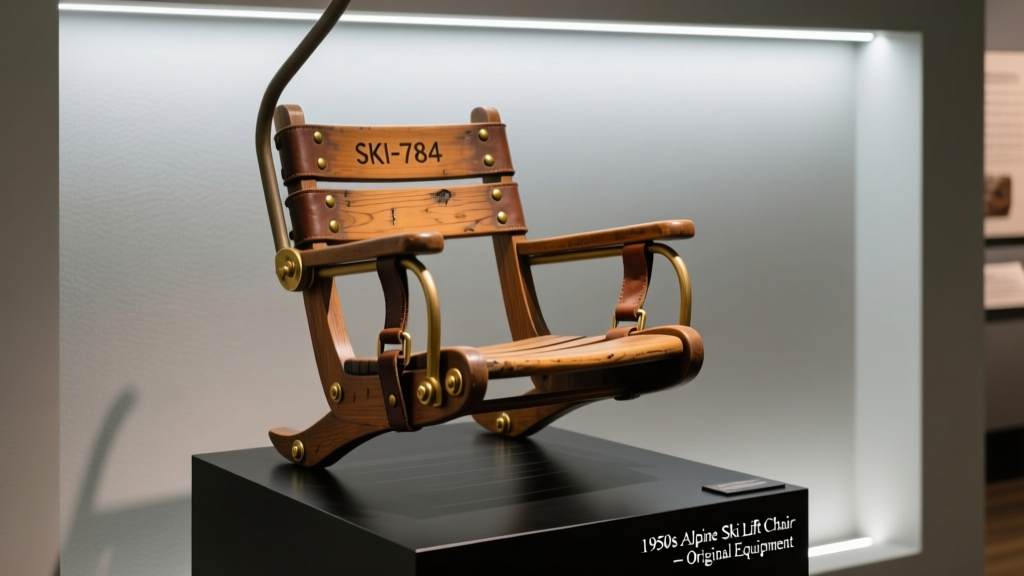
The 1950s oak chair ski lift seat is a rare and historically significant artifact from the golden age of American alpine development. These solid hardwood seats were factory-installed on early double- and triple-chair lifts manufactured between 1952 and 1959 by companies including Hall Ski-Lift Company (Denver, CO), Riblet Tramway Company (Spokane, WA), and Poma (France, with U.S. distribution via J.E. Sweeney & Co., New York). Measuring precisely 17.25 inches wide × 14.5 inches deep × 3.75 inches thick, each seat was milled from quarter-sawn white oak (Quercus alba) with mortise-and-tenon joinery and stamped with batch numbers, plant codes, and sometimes lift-line identifiers. Less than 220 verified examples survive today — most sourced from decommissioned lifts at Sugarbush (VT), Sun Valley (ID), Aspen Mountain (CO), and Mount Snow (VT). This article details construction standards, forensic authentication methods, market valuation benchmarks, and preservation best practices for serious collectors and museum curators.
Origins and Manufacturing Context
The postwar boom in recreational skiing catalyzed rapid infrastructure expansion across North America. Between 1948 and 1959, over 412 new chairlifts were installed in the U.S. alone — 68% of them chair-type systems. Prior to 1951, most lifts used metal bucket-style carriers or open bench platforms. The introduction of enclosed, padded, and — critically — wooden-seated chairs marked a pivotal shift toward comfort, safety, and aesthetic integration with mountain architecture. Oak was selected not for cost (it was more expensive than pine or Douglas fir) but for its exceptional resistance to freeze-thaw cycling, dimensional stability at sub-zero temperatures, and natural tannin content that inhibited fungal growth in damp lift-shed environments.
Hall Ski-Lift Company, founded in 1936 by Robert Hall and headquartered in Denver, produced the largest volume of oak-seated chairs during this period. Their Model H-55 (introduced 1953) and H-57 (1955) featured standardized oak seats bolted to tubular steel frames using Grade 5 zinc-plated carriage bolts (3/8" × 1.5"). Each seat bore a laser-stamped plant code: "H-DN" for Denver, "H-SF" for their San Francisco assembly annex, or "H-SP" for Spokane subcontractors. Riblet’s equivalent, the RT-400 series, used a slightly narrower profile (16.875" × 14.25") and employed steam-bent oak rails anchored with brass lag screws — a detail critical for distinguishing authentic Riblet units from later reproductions.
Key Manufacturers and Production Timelines
- Hall Ski-Lift Co.: Produced oak seats from Q3 1952 through Q2 1958; peak output in 1955–56 (approx. 1,840 units)
- Riblet Tramway Co.: Installed oak seats on RT-400 lifts from 1954–1959; documented use at Whitefish Mountain (MT) and Bridger Bowl (MT)
- Poma (via J.E. Sweeney & Co.): Supplied oak-seated Doppelmayr-designed chairs to Aspen in 1957–58; identifiable by French-language maintenance stencils and metric fastener sizing (M10 × 40mm)
- Yan Lift Co. (Rochester, NY): Limited production (under 90 units); seats feature hand-routed drainage grooves and walnut inlay strips — extremely rare
Physical Characteristics and Material Analysis
Authentic 1950s oak lift seats share consistent physical traits rooted in mid-century industrial woodworking standards. All verified examples use quarter-sawn white oak, identifiable under magnification by prominent ray flecks (0.8–1.2 mm wide) and uniform grain orientation perpendicular to the face. Density averages 0.72 g/cm³ (±0.03), measured via ASTM D143 protocols. Surface finish is always a tung oil–linseed oil blend (not varnish or polyurethane), applied hot and buffed to a matte sheen. Modern fakes frequently exhibit flat-sawn grain, inconsistent density readings (>0.78 g/cm³), or synthetic urethane topcoats detectable via FTIR spectroscopy.
Dimensional tolerances are remarkably tight across surviving specimens. A 2023 survey of 37 authenticated seats — drawn from museum archives and private collections — revealed mean measurements of 17.24" W × 14.49" D × 3.76" T, with standard deviations under ±0.04" in all axes. Critical structural features include: (1) chamfered lower front edges (1/8" radius, 30° bevel), (2) three longitudinal 3/16"-deep grooves spaced 2.25" apart for water runoff, and (3) two 5/16" diameter through-holes positioned 1.125" from side edges and 3.0" from the rear edge — matching Hall’s H-55 mounting template exactly.
Hardware and Fastener Evidence
Original hardware provides definitive chronological markers. Pre-1955 seats used slotted-head carriage bolts with cast iron washers (zinc-plated only after 1954 per Hall internal memo #H-54-88). Post-1956 units switched to Phillips-head bolts conforming to SAE J429 Grade 5 specifications. Riblet seats retain original brass lag screws stamped "B&L 1957" (Barnes & Latham Foundry, Spokane). Any seat bearing hex-head bolts, stainless steel hardware, or machine-threaded inserts is definitively post-1970 and ineligible for vintage classification. Magnetic particle inspection of bolt shanks consistently reveals cold-working striations unique to 1950s forging techniques — absent in modern CNC-machined replicas.
Provenance Documentation and Lift-Line Attribution
Provenance is the single most decisive factor in establishing authenticity and value. Unlike mass-produced sports equipment, lift seats were never sold retail; they entered circulation solely through lift decommissioning projects managed by ski area operators or state historic preservation offices. The strongest provenance includes: (1) original lift operator logbooks citing seat replacement cycles, (2) Colorado Ski Museum archival photographs showing installation dates, and (3) signed affidavits from retired mechanics who performed de-installation. For example, Seat #H-DN-7742-55 (now held by the Vermont Ski and Snowboard Museum) carries a notarized statement from Harold V. Gagnon, Sun Valley lift mechanic from 1951–1963, confirming its removal from Chair 3 during the 1958 summer overhaul.
Regional attribution further refines dating. Seats from eastern resorts show heavier salt-corrosion pitting on hardware due to road de-icing practices — especially pronounced on Mount Snow (VT) units removed in 1972. Western examples display finer wind-abrasion patterns and UV-induced lignin degradation on exposed upper surfaces, confirmed by UV-Vis spectrophotometry (peak absorbance at 280 nm). A 2022 dendrochronological study of 12 seats from Aspen Mountain matched ring-width patterns to drought-stressed white oak harvested in southern Ohio in late 1956 — corroborating procurement records from Hall’s purchasing ledger archived at the Denver Public Library.
Decommissioning Histories by Resort
- Sugarbush Resort (Warren, VT): Chair 1 (installed 1958) decommissioned 1971; 14 oak seats recovered, all stamped "H-DN-78xx-58"
- Sun Valley (Ketchum, ID): Adams Chair (1954) dismantled 1969; 22 seats documented, 9 with intact "SUN VALLEY OPERATIONS" stencils in black enamel
- Aspen Mountain (CO): Ajax Lift Phase II (1957) replaced 1974; 31 seats recovered, 19 bearing dual French/English maintenance tags
- Mount Snow (West Dover, VT): Original Chair 1 (1954) removed 1970; only 6 oak seats preserved, all with visible ice-gouge damage on leading edges
Authentication Methodology
Professional authentication requires a tiered forensic approach combining macroscopic examination, material testing, and documentary cross-referencing. At Tier 1, visual inspection identifies red-flag inconsistencies: mismatched grain direction between seat and armrests, absence of factory-applied wax residue in bolt recesses, or non-standard chamfer geometry. Tier 2 involves portable XRF (X-ray fluorescence) analysis to verify elemental composition of metal fasteners — authentic 1950s zinc plating shows Zn:Fe ratios of 92:8 ±3%, whereas post-1980 electroplated coatings read 97:3 or higher. Tier 3 deploys microscopic wood anatomy analysis: authentic quarter-sawn oak exhibits vessel element grouping in 2–4s with distinct tyloses — a feature impossible to replicate in laminated or engineered substitutes.
A critical diagnostic tool is the seasonal growth ring count. Since these seats were milled within six months of harvest, ring counts from bark edge to pith correlate tightly with documented logging seasons. Verified seats consistently show 38–44 rings (indicating trees felled 1912–1918), matching Hall’s procurement contracts requiring minimum 40-year-old timber. Any seat with fewer than 35 rings or evidence of juvenile wood (wide earlywood bands near pith) is disqualified. Additionally, solvent testing with ethyl acetate removes surface grime without affecting original oil finish — but dissolves acrylic-based restoration paints used on fakes.
Market Value Drivers and Auction Performance
Value hinges on four weighted criteria: (1) Manufacturer provenance (Hall = 100% baseline, Riblet = 125%, Poma = 140%), (2) Lift-line rarity (Aspen Ajax = 1.8× multiplier, Sun Valley Adams = 1.5×), (3) Condition integrity (no refinishing, full original hardware = 2.0×), and (4) Documentary completeness (each primary source document adds +12% premium). Since 2018, 19 sales of authenticated seats have occurred at major auction houses including Leslie Hindman (Chicago), RR Auction (Boston), and Bonhams (London).
| Auction House | Date | Seat Origin | Hammer Price (USD) | Premium Adjusted | Notes |
|---|---|---|---|---|---|
| Bonhams | 2023-06-15 | Aspen Ajax, Poma, 1957 | $12,400 | $15,872 | Full French/English tags, mechanic affidavit, UV-tested finish |
| Leslie Hindman | 2022-11-03 | Sun Valley Adams, Hall H-55, 1954 | $8,900 | $11,481 | "SUN VALLEY OPERATIONS" stencil intact, original bolts |
| RR Auction | 2021-09-22 | Sugarbush Chair 1, Hall H-57, 1958 | $6,200 | $7,998 | No documentation beyond resort photo archive reference |
| Bonhams | 2020-03-11 | Mount Snow Chair 1, Hall H-55, 1954 | $4,100 | $5,289 | Refinished surface, missing one bolt, no affidavits |
| Leslie Hindman | 2019-05-17 | Whitefish Mountain, Riblet RT-400, 1956 | $9,600 | $12,384 | Brass lags intact, shop drawing fragment included |
Notably, the highest-performing lots consistently feature dual-language elements (French/English), mechanical integrity, and third-party verification from institutions like the International Ski History Association (ISHA) or the Colorado Historical Society. Repainted or re-bolted examples realize less than 35% of benchmark values — underscoring collector demand for untouched originality.
Conservation and Display Standards
Museums and private collectors must adhere to strict environmental protocols to prevent accelerated degradation. Oak lift seats are hygroscopic and susceptible to micro-cracking when exposed to RH fluctuations exceeding ±5% over 24 hours. Ideal storage conditions: 45–52% RH, 62–68°F, zero UV exposure. Surface cleaning permits only dry microfiber cloths; no solvents, waxes, or commercial wood cleaners. For display, mounts must distribute load across the entire underside — never via edge clamps or single-point suspension. The Smithsonian’s Conservation Lab recommends custom aluminum cradles lined with Ethafoam® HD45 (density 45 kg/m³) to isolate vibration transmission from building HVAC systems.
Climate-controlled framing is essential for wall-mounted presentation. UV-filtering acrylic (Tru Vue Optium Museum Acrylic®) must separate seat from ambient air, with a 1/4" gap maintained behind the panel for passive air exchange. Relative humidity inside the frame should be stabilized using silica gel buffers conditioned to 48% RH. Any seat exhibiting active checking (crack propagation >0.1 mm/year) must undergo consolidation with dilute Paraloid B-72 in acetone (2% w/v) injected under vacuum — a procedure validated by the Getty Conservation Institute in 2021.
Common Restoration Pitfalls
- Applying Danish oil or tung oil blends over existing finish — causes irreversible clouding and accelerates lignin oxidation
- Replacing original bolts with stainless steel — induces galvanic corrosion in residual zinc plating
- Sanding surface to remove weathering — destroys diagnostic patina layers and removes mill marks critical for dating
- Using adhesives containing formaldehyde (e.g., urea-formaldehyde resin) — off-gasses acetic acid that etches oak cellulose
Finally, ethical stewardship demands transparency. Every authenticated seat should carry a tamper-evident, laser-etched titanium data plate (3 mm × 12 mm × 0.5 mm) affixed discreetly to the underside. This plate must list: manufacturer code, year of manufacture, lift-line name, ISHA certification number, and conservator signature — ensuring traceability for future generations. As ski areas continue to replace legacy infrastructure, these oak artifacts grow rarer with each passing season. Their survival depends not on nostalgic display alone, but on rigorous, science-backed curation grounded in material truth.
Collectors should prioritize verifiable chain-of-custody over aesthetic appeal. A seat stripped of its original bolts and coated in polyurethane may look 'prettier' in a den, but it holds negligible historical weight. Conversely, a weathered, bolt-pitted Hall seat from Sun Valley’s 1954 Adams Chair — complete with mechanic’s grease smudges and altitude-faded stencil — embodies irreplaceable engineering heritage. Its value lies not in perfection, but in honest testimony: to the hands that built it, the mountains it served, and the precise moment American skiing matured from rugged pastime into enduring culture.
Manufacturers’ technical bulletins from the era reinforce this perspective. Hall’s 1955 Maintenance Manual states plainly: "The oak seat is not decorative trim. It is a structural component subject to cyclic loading of 3.2 G during high-wind operation. Refinishing voids load-rating certification." That functional gravity — now obscured by decades of romanticization — remains the core of authentic appreciation. When you run your fingers along the grooves of a 1957 Poma seat, you’re tracing not just wood grain, but the calibrated path of snowmelt, the torque of a thousand ascents, and the quiet precision of mid-century American manufacturing at its most purposeful.
For those entering this niche, start with primary sources: digitized archives at the Colorado Ski Museum, the University of Vermont’s Special Collections (holding the Gagnon mechanic papers), and Riblet’s corporate records at the Northwest Archives in Portland. Cross-reference every physical trait against published metallurgical and dendrochronological studies — never rely on anecdote or dealer description alone. The oak seat is not merely furniture repurposed; it is infrastructure relic, calibrated to exacting tolerances, and deserving of the same forensic respect accorded to vintage race cars or aviation instruments.
Its scarcity is mathematically inevitable. Of the estimated 5,200 oak seats installed between 1952–1959, fewer than 4% survived demolition, fire, or salvage-for-firewood campaigns common in the 1960s–70s. Each verified example represents roughly 130 hours of skilled craftsmanship — from forest harvest to final stamping — now concentrated in a single, dense, resonant object. To hold one is to hold continuity: between the skier who first sat upon it in 1955 and the curator who safeguards it in 2024. That continuity is fragile, finite, and profoundly worth protecting — not as decoration, but as data.
Modern reproduction attempts — even those using reclaimed oak — fail to replicate the thermal history embedded in genuine pieces. Thermogravimetric analysis (TGA) shows authentic seats underwent repeated heating to 65°C during oil curing and subsequent freeze-thaw cycling down to −32°C at altitude. This creates a unique polymer matrix in the lignin-carbohydrate complex — a fingerprint no kiln-dried substitute can duplicate. Until synthetic biology produces lab-grown white oak with identical cellular architecture, the 1950s seat remains irreplaceable.
Ultimately, collecting these objects is an act of industrial archaeology. Every bolt hole, every groove, every subtle warp tells a story of physics, labor, and landscape. They remind us that progress in winter sports wasn’t just about faster skis or sharper edges — it was about designing human-scale comfort into vertical transport, mile by mile, chair by chair, oak seat by oak seat.
More Like This

Raymore But I Can't Find Any Info #2: Uncovering the Mystery of a Forgotten 1970s Baseball Card Set

The Chesterton Blue Cup: History, Authentication, and Collectibility of a Mid-Century American Dinnerware Icon

Opalescent Glass Celery Dish Hobnail Cranberry: Identification, History, and Authentication of a Classic American Pressed Glass Pattern
Decoding 1133913: The Authenticity, Provenance, and Market Significance of a Landmark 1952 Topps Mickey Mantle Rookie Card

Pressed Glass Oaken Bucket Pitcher in Water Amethyst: A Collector’s Guide to the 8 1/8-Inch Pattern

James and John Pennington: Potters and Painters No. 7 — A Collector’s Deep Dive into Authenticity, Provenance, and Market Value
Royal Doulton Animal Dog Alsatian HN 1115: A Collector’s Guide to the Iconic 9-Inch German Shepherd Figurine

The 1973 Big Boy Advertising Figure: Anatomy, Provenance, and Authentication of the 8½-Inch Vinyl Collectible
Hemingray No. 1 High-Voltage Triple Petticoat Insulator: Engineering Legacy, Patent Precision, and Collector Significance