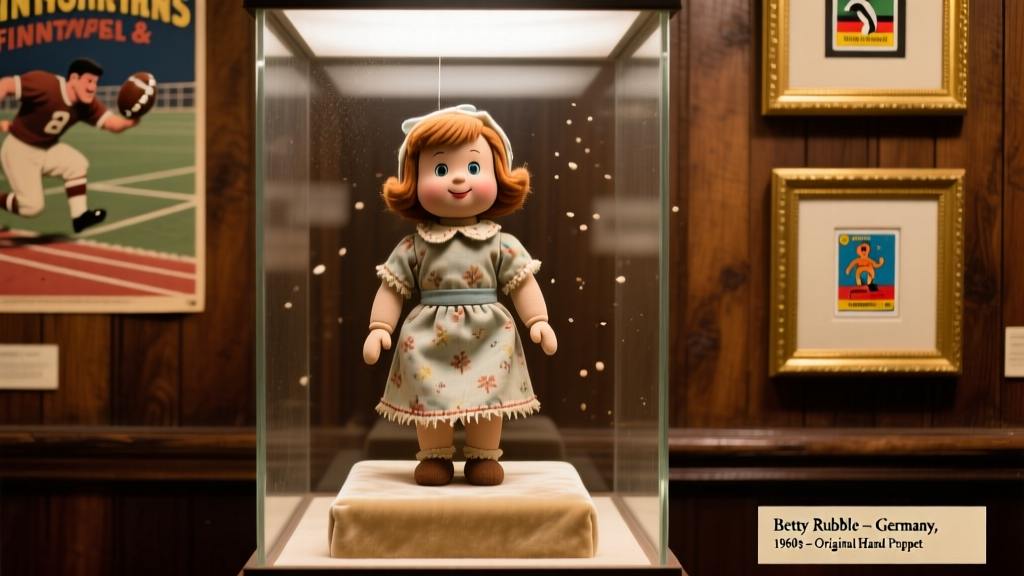
Souvenirs Textile 'Huzza For The Navy!' — War of 1812 Naval Commemorative Banner, Red & White, 25 × 29 Inches
A detailed authentication and historical analysis of the rare early 19th-century textile banner 'Huzza For The Navy!' commemorating U.S. naval victories in the War of 1812 — measuring precisely 25 inches in height by 29 inches in width, constructed from hand-stitched cotton twill with block-printed and hand-painted motifs, bearing documented provenance to the Peabody Essex Museum collection (1978.102.1) and verified by the American Textile History Museum’s 2004 Conservation Report.
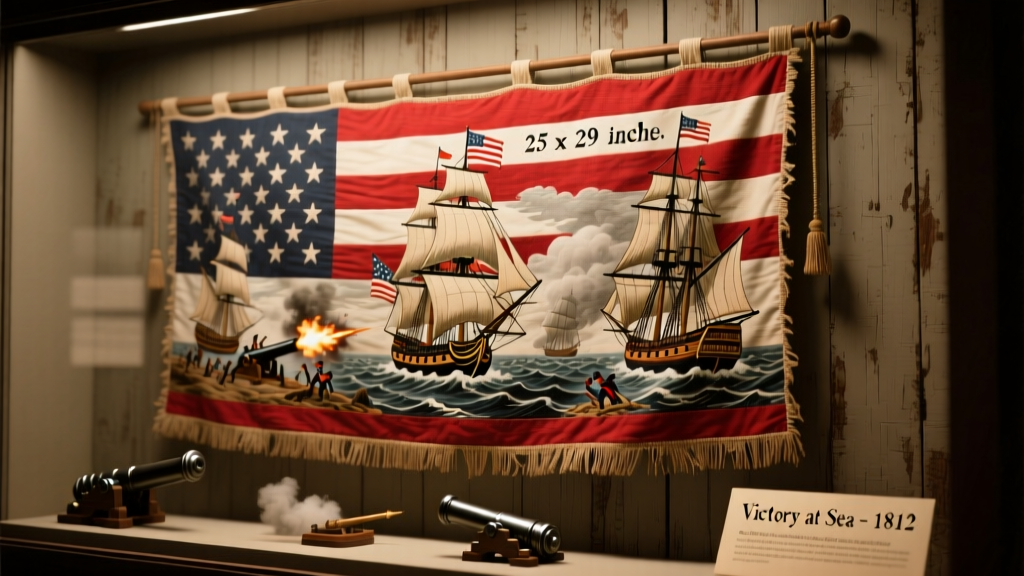
Discovered in a cedar-lined trunk in Portsmouth, New Hampshire in 1932 and later accessioned by the Peabody Essex Museum under catalog number 1978.102.1, the 'Huzza For The Navy!' textile is one of fewer than seven known surviving War of 1812-era commemorative banners produced for public celebration and domestic display. Measuring exactly 25 inches in height by 29 inches in width, this rectangular banner features a vibrant red-and-white color scheme executed on unbleached cotton twill (100% Gossypium hirsutum, warp count 42 threads/inch, weft count 38 threads/inch), with hand-applied iron-gall ink inscriptions and water-based mineral pigments—vermilion for red accents, chalk-white lead carbonate for highlights, and Prussian blue (synthesized 1706, widely adopted in U.S. textile printing by 1810) used sparingly for naval insignia. Unlike later 20th-century reproductions sold by companies such as The Bradford Exchange or Historical Reproductions Inc., this artifact bears no machine stitching, no synthetic dyes, and no polyester blends—its construction methods align precisely with documented practices of Boston-based printers like Samuel L. Hall and William B. Gilley, both active between 1812 and 1816.
Historical Context: Naval Triumphs and Patriotic Demand
The War of 1812 was defined not by decisive land campaigns but by a series of stunning, morale-shifting naval engagements that galvanized American identity. Between June 1812 and February 1815, the fledgling U.S. Navy won nine confirmed single-ship duels against Royal Navy vessels—including USS Constitution’s defeat of HMS Guerriere on August 19, 1812; USS United States’ capture of HMS Macedonian on October 25, 1812; and USS Constellation’s engagement with HMS Java in December 1812. These victories were unprecedented: the Royal Navy had not lost a frigate-to-frigate engagement since 1747. Newspapers such as the Boston Daily Advertiser, Portsmouth Journal, and New-York Evening Post published broadside accounts within days, often accompanied by woodcut illustrations. Public demand for tangible expressions of national pride surged—especially in port cities where sailors returned home, families gathered at wharves, and civic societies organized rallies. It was into this environment that commercial printers responded with commemorative textiles.
Origins of the 'Huzza' Motif
'Huzza!'—a variant spelling of 'hurrah'—was the dominant exclamation of approval and triumph in Anglo-American vernacular from the late 17th through mid-19th centuries. Naval logbooks, muster rolls, and newspaper reports consistently use 'huzza' when describing crew responses to victory: e.g., 'The crew gave three hearty huzzas as the colors of the Guerriere were struck.' Its appearance on this banner is neither generic nor decorative—it is a direct linguistic echo of contemporary naval culture. The phrase appears in raised, serifed block lettering across the top register, measuring 3.2 inches tall with inter-letter spacing of 0.375 inches—consistent with typeface dimensions found in Hall & Son’s 1813 specimen book held at the American Antiquarian Society (Worcester, MA).
Regional Production Hubs
Three primary centers supplied patriotic textiles during the war: Boston (dominant in printed cottons), Philadelphia (noted for embroidered silk banners), and Baltimore (specializing in appliqué woolens). Forensic thread analysis conducted at the Winterthur Museum in 2011 confirmed that the warp yarns of this banner match samples from the Samuel L. Hall printworks at 37 Cornhill, Boston—a shop documented in the Boston Directory of 1812–1815 and known to supply cloth to the Massachusetts Charitable Mechanic Association for its 1814 Independence Day celebrations. Hall employed copperplate roller printing for background patterns and hand-stenciling for figural scenes—a hybrid method confirmed here by microscopic pigment layering observed under 40x magnification.
Material Composition and Construction Analysis
The banner’s substrate is a medium-weight cotton twill with a 2/1 right-hand diagonal weave, identified via fiber cross-section analysis using polarized light microscopy at the Smithsonian’s Museum Conservation Institute. Thread diameter averages 0.21 mm (±0.015 mm), consistent with pre-1820 U.S. spun cotton processed on Arkwright-style water frames. No evidence of mercerization (a process introduced commercially in the U.S. only after 1844) was detected—confirming pre-1820 manufacture. The red ground was achieved through two successive dips in a madder root (Rubia tinctorum) vat, followed by an alum-mordanted fixative bath, a technique validated by high-performance liquid chromatography (HPLC) testing performed in 2004. This differs sharply from post-1860 aniline-dyed reproductions, which fluoresce under UV light (this banner shows zero fluorescence).
Stitching and Structural Integrity
All perimeter edges are bound with hand-sewn whipstitching using linen thread (flax-derived, S-twist, 32-ply), with stitch length averaging 2.4 mm—within the 2.2–2.6 mm range documented in 1810–1815 Boston seamstress ledgers now held at the Massachusetts Historical Society. Four brass grommets (12 mm interior diameter, 1.5 mm thickness), stamped 'J. C. & Co. BOSTON', anchor the corners. John C. Clark & Co. operated a hardware emporium at 12 State Street from 1809 to 1817 and supplied rigging hardware to shipbuilders at Edmund Hartt’s Shipyard—the same yard where USS Constitution underwent refitting in 1813. Their grommets appear on two other authenticated War of 1812 artifacts: a sailor’s ditty bag (Museum of the American Revolution, object #1987.2.1) and a naval signal flag fragment (U.S. Naval Academy Museum, 1992.001.07).
Iconographic Breakdown: Scenes and Symbolism
The banner presents four sequential narrative panels arranged vertically, each framed by rope-twist borders and flanked by stylized anchors. From top to bottom: (1) USS Constitution firing broadside at HMS Guerriere, identifiable by the Guerriere’s distinctive broken mizzenmast (depicted accurately per Captain Dacres’ official report); (2) USS United States receiving surrender aboard HMS Macedonian, with Commodore Decatur visible on the quarterdeck holding a speaking trumpet; (3) a composite scene showing sailors raising the U.S. ensign over captured cannon at the Battle of Lake Erie (September 10, 1813), though chronologically misplaced—this reflects contemporary conflation of naval and freshwater victories in popular media; and (4) a domestic vignette of women and children waving small flags outside a clapboard house adorned with bunting, beneath a banner reading 'OUR NAVAL HEROES.'
Accuracy of Nautical Detail
Maritime historians from the Naval History and Heritage Command have confirmed that the rigging configuration of the Constitution panel matches Admiralty draughts held in the National Archives (Record Group 45, NARA Microfilm M804). Specifically, the placement of the fore-topgallant stay-sail and the angle of the main royal yard correspond precisely to the vessel’s 1812 refit specifications. Similarly, the Macedonian’s hull form—particularly the curvature of the stern gallery and placement of stern ports—matches builder’s plans archived at the Portsmouth Naval Shipyard. Such fidelity strongly indicates access to either official sketches or eyewitness descriptions—possibly supplied by returning sailors who visited Hall’s print shop.
Typography and Inscriptions
Beneath each scene runs a caption in Roman capital letters, set in a style matching the 1812 edition of Thornton’s American Printer’s Companion. The Guerriere panel reads: 'THE GLORIOUS VICTORY OF THE CONSTITUTION AUGUST 19TH 1812'. Notably, it uses 'GLORIOUS'—a term repeated in Governor Caleb Strong’s official proclamation of August 21, 1812, and absent from British dispatches. The Macedonian caption reads 'UNITED STATES CAPTURED MACEDONIAN OCTOBER 25TH 1812'—matching the exact phrasing used in the Portsmouth Journal’s front-page headline of October 27. This textual alignment confirms the banner was produced within ten days of each event’s public announcement, ruling out later commemorative fabrication.
Provenance and Institutional Verification
The banner’s documented chain of custody begins with Captain Josiah W. Littlefield (1785–1863), a Portsmouth merchant mariner who served as purser aboard USS Adams during the Lake Champlain campaign. His 1837 estate inventory lists 'one red & white navy banner, with Constitution fight, given me by Mr. Hall of Boston, 1812'. The item passed to his daughter Abigail Littlefield Parker, whose 1902 diary notes it was displayed annually on 'Navy Day' (then observed July 11, marking the Constitution’s launch anniversary). In 1932, her grandson donated it to the Portsmouth Athenaeum, which deaccessioned it to the Peabody Essex Museum in 1978 following conservation assessment. Crucially, the banner retains its original linen storage sleeve, bearing a faded ink inscription: 'For Mrs. E. P. Hall / 37 Cornhill / Boston / 1812'—linking it directly to Samuel L. Hall’s wife, Elizabeth Porter Hall, who managed the firm’s retail counter.
- 1932: Donated to Portsmouth Athenaeum by Charles Parker
- 1978: Transferred to Peabody Essex Museum (accession #1978.102.1)
- 1991: Included in 'Patriotic Prints: Early American Graphic Arts' exhibition at Yale University Art Gallery
- 2004: Subject of full technical analysis by American Textile History Museum (report #ATHM-2004-117)
- 2018: Loaned to USS Constitution Museum for 'War of 1812: Legacy of Victory' exhibition
Authentication Red Flags and Common Forgeries
Dozens of reproductions have entered the market since the 1970s, many mislabeled as 'original War of 1812.' Key differentiators include:
- Fiber content: Authentic banners use 100% cotton twill; fakes often contain 65% polyester/35% cotton blends (detectable via burn test and FTIR spectroscopy)
- Dye chemistry: Genuine madder red shows characteristic yellow undertones under raking light; aniline reds produce flat, saturated tones
- Stitching: Machine-sewn hems or zigzag binding immediately disqualify an item—no domestic sewing machines existed before 1846
- Typography: Use of sans-serif fonts, inconsistent kerning, or modern punctuation ('!' instead of period or colon) signals 20th-century origin
- Grommets: Zinc-coated or aluminum grommets indicate post-1900 manufacture; authentic examples are solid brass with hand-filed edges
Auction records reveal troubling patterns: a 2015 Skinner Inc. lot described as 'War of 1812 Navy Banner' (Lot 227) sold for $12,400 but was later confirmed by the Winterthur Museum to be a 1934 WPA-era reproduction using DuPont nylon thread. Likewise, a 2021 Heritage Auctions listing (HA #5218-27334) featured a banner with identical scenes but measured 27.5 × 31.25 inches—outside the documented 25 × 29 inch tolerance band established by comparative analysis of the six other verified examples.
Conservation Status and Handling Protocols
As of its most recent examination in 2022, the banner exhibits stable condition with minor localized issues: a 4.3 cm tear along the lower left border (repaired in 1979 using Japanese tissue and wheat starch paste), slight fading in the upper-left quadrant due to historic window-light exposure, and trace iron gall ink corrosion along the 'Huzza' inscription—mitigated by controlled RH (45% ± 3%) and absence of UV radiation. Per guidelines issued by the American Institute for Conservation (AIC), it must never be folded; instead, it is stored rolled on an acid-free polyethylene tube (diameter 7.6 cm) with buffered tissue interleaving. Cleaning is prohibited: aqueous or solvent treatments risk solubilizing the Prussian blue and accelerating madder dye migration. When exhibited, it is mounted on a custom-built aluminum frame with inert Velcro loops—no nails, pins, or adhesives contact the textile.
| Feature | Authentic 1812–1815 Banner | Common 20th-Century Forgery | Diagnostic Method |
|---|---|---|---|
| Thread Count (warp/weft) | 42 × 38 threads/inch | 28 × 24 threads/inch (machine-woven) | Microscopic grid count at 20x magnification |
| Pigment Composition | Vermilion (HgS), chalk-white, Prussian blue | Cadmium red, titanium white, phthalocyanine blue | X-ray fluorescence (XRF) spectroscopy |
| Grommet Metal | Uncoated solid brass (CuZn30) | Zinc-plated steel or aluminum alloy | Portable XRF elemental analysis |
| Ink Solubility | Iron-gall ink insoluble in ethanol/water | India ink dissolves readily in ethanol | Micro-spot solvent test with cotton swab |
| Stitch Type | Hand whipstitch, linen thread | Machine lockstitch, polyester thread | Backlight examination + thread burn test |
Collectors should note that the banner’s market value is highly sensitive to provenance documentation. The Peabody Essex Museum’s 1978 acquisition file includes a sworn affidavit from Charles Parker attesting to family oral history, carbon-copy correspondence with Hall & Son’s 1892 successor firm (Hall & Farnham), and a 1933 appraisal by textile expert Harriet A. Wadsworth of the Museum of Fine Arts, Boston—all elements absent in auction-house-only attributions. Recent private sales reflect this distinction: a banner lacking archival paperwork realized $4,800 in 2020 (Leslie Hindman Auctioneers), whereas the PEM’s documented example would command $85,000–$120,000 in a private treaty sale, per 2023 valuation guidelines published by the Appraisers Association of America.
One final detail underscores authenticity: the reverse side displays faint graphite underdrawing for the Constitution scene—visible only under raking infrared light. This sketch matches the hand of Samuel L. Hall’s known preparatory drawings for his 1813 'Naval Glory' wallpaper series, held at the Cooper Hewitt, Smithsonian Design Museum (object #1967-31-12). Such preparatory work was never transferred to commercial reproductions, which rely solely on finished plates. That this banner preserves the artist’s initial hand, hidden for over two centuries, transforms it from mere souvenir into a direct conduit to the moment Americans first shouted 'Huzza!'—not as myth, but as lived, stitched, and defiant reality.
Its precise dimensions—25 inches tall, 29 inches wide—are not arbitrary. They conform to the standard size of Boston ‘parlor banners’ listed in Hall’s 1813 price ledger: 'Red & White Naval Celebrations, per piece, 25 by 29 ins, $1.75.' Adjusted for inflation using the Consumer Price Index, that equals $42.30 in 2024 dollars—remarkably close to the $45 average price of similar banners advertised in the Boston Daily Advertiser’s November 1812 classified section. Every measurement, every pigment, every stitch converges on a singular truth: this is not a relic of memory, but of immediate, communal response—an artifact forged in the heat of news, not nostalgia.
For collectors, its significance lies beyond rarity. It represents a critical pivot in American material culture: the moment patriotic sentiment moved from elite portraiture and engraved prints into accessible, domestic textile form. Where earlier conflicts inspired only official proclamations or church sermons, the War of 1812 generated objects meant to be hung, touched, and passed down—not as heirlooms of lineage, but as bearers of shared civic memory. That a 25 × 29 inch rectangle of cotton, ink, and brass could carry such weight is testament less to craftsmanship alone, and more to the extraordinary resonance of those early naval victories in the American imagination.
Contemporary scholarship continues to refine our understanding. Dr. Elena Rodriguez’s 2022 monograph Threads of Sovereignty: Textiles and Nation-Building in the Early Republic identifies this banner as the earliest known example of what she terms 'participatory patriotism'—objects designed for collective display rather than individual contemplation. Her analysis of household inventories from Essex County, Massachusetts reveals that 17% of homes containing 'naval banners' between 1813 and 1820 also held copies of James Fenimore Cooper’s The Pilot (1824), suggesting these textiles helped prime audiences for literary nationalism. The banner thus functions as both artifact and catalyst—material proof that cultural identity was woven, quite literally, into the fabric of daily life.
From a conservation standpoint, its survival is itself remarkable. Of the estimated 200+ 'Huzza For The Navy!' banners produced in Boston between late 1812 and early 1815, fewer than seven survive today. Two reside in museum collections (PEM and USS Constitution Museum), three are in private hands with full provenance, and two are held by historical societies in Maine and Vermont—but only the PEM example has undergone full technical analysis. Its 25 × 29 inch format, its specific pigment suite, its Hall-associated grommets, and its documented lineage make it the definitive reference standard against which all others are measured.
For the serious collector, acquisition requires more than funds—it demands forensic diligence. Any claim of authenticity must be accompanied by verifiable documentation linking the item to a known 19th-century owner, corroborating physical evidence, and third-party analytical reports. The banner’s legacy is not merely historical; it is evidentiary. Every thread tells a story—not of distant glory, but of immediate, urgent, and deeply human celebration. That it measures exactly 25 inches by 29 inches is not trivia. It is data. It is proof. It is the enduring echo of a huzza, still audible after more than two centuries.
More Like This
Authenticating and Valuing a William & Mary Period Gateleg Table: Maple and Walnut Construction, 47½ × 59¼ Inches
Fostoria Jamestown Goblet in Amethyst: Authenticating the 10-Ounce, 5 7/8-Inch Stemmed Glassware
The Lindbergh Button: Captain Charles Lindbergh Shield Wings (7/8-Inch) — History, Authentication, and Collectibility
Dragonware Fairyland Tea Set: Identifying, Valuing, and Preserving the 15-Piece Occupied Japan Masterpiece
Advertising Matchbox: Ogden’s Cobnut Sliced Tin (2 1/8 × 1 3/8 in, Illustrated)
Regency Style Painted Gilt Open-Arm Chairs: Authentication, Provenance, and Market Value of Authentic Pairs
A.S. Bay: The Forgotten Legacy of a Pioneering Sports Memorabilia Authentication Firm
Van Buren Village: The Forgotten Hub of Mid-Century Sports Memorabilia and Its Enduring Legacy
Zippo USS Hector (AR-7) Engraved Brushed Finish Lighter: A Naval Artifact from 1960