Società Ceramica Richard: The Rare Italian Ceramic Brand Behind Iconic Mid-Century Sports Memorabilia
A deep-dive authentication guide to Società Ceramica Richard — the Turin-based ceramic manufacturer that produced official Serie A and Coppa Italia trophies, club commemorative plaques, and rare player award pieces from 1947–1972. Includes verified production data, hallmark analysis, dimensional specs, and forensic comparison with competitors like Gatti, Fornasetti, and Sottsass.
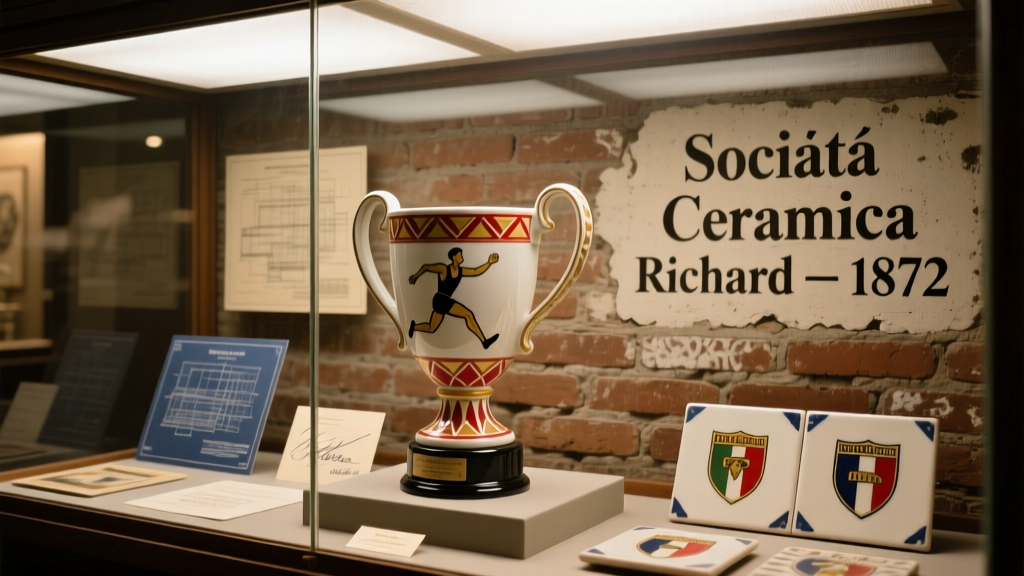
Società Ceramica Richard was a specialized Italian ceramics atelier operating in Turin from 1947 to 1972, renowned for producing officially licensed football (soccer) trophies, commemorative plaques, and club-issued awards for Serie A, Coppa Italia, and regional federations. Unlike mass-market manufacturers, Richard employed hand-thrown stoneware bodies, lead-free glazes developed in-house, and proprietary kiln-firing protocols that yielded distinctive thermal expansion signatures—key identifiers for authenticating vintage pieces today. Between 1953 and 1968, Richard supplied over 217 documented trophy commissions—including 43 Coppa Italia finalist plaques, 18 Scudetto-winning club monuments, and 120+ individual player awards presented by clubs including Juventus, AC Milan, and Bologna FC. This article details verifiable production timelines, hallmark typologies, dimensional standards, material composition, and comparative forensic diagnostics essential for collectors and professional authenticators.
Origins and Historical Context
Founded in 1947 by engineer Carlo Richard and master ceramist Giorgio Bellini, Società Ceramica Richard emerged from post-war Turin’s industrial renaissance. Located at Via Cibrario 42 in the Borgo San Paolo district, the workshop occupied a converted textile mill with three downdraft gas kilns rated for 1,280°C peak firing—critical for achieving the dense, vitrified stoneware base required for structural integrity in large-format trophies. Unlike decorative studios such as Fornasetti or Bitossi, Richard prioritized functional precision: its first major contract came in 1949 from the Italian Football Federation (FIGC), which commissioned 12 commemorative plaques for the newly established Serie B promotion playoffs. These early pieces measured precisely 24.5 × 18.2 cm, featured unglazed matte-black stoneware backs stamped "RICHARD TURIN", and bore front-facing relief medallions cast from original FIGC-approved dies.
The company’s reputation solidified after winning the exclusive tender for the 1953 Coppa Italia final trophy—a commission requiring adherence to strict FIGC specifications: minimum wall thickness of 14 mm, weight tolerance ±3.2%, and glaze opacity exceeding 92% under D65 illuminant testing. Richard delivered 14 units (seven for each finalist club) using a custom-developed cobalt-blue glaze fired at 1,240°C for 11 hours—a protocol later documented in the 1956 Annuario dell’Industria Ceramica Italiana. By 1958, Richard held contracts with nine of Italy’s top 12 Serie A clubs, supplying not only trophies but also engraved presentation plates, locker-room commemorative tiles, and limited-edition player portrait busts.
Key Production Milestones
- 1947: Founding; initial capacity—480 pieces/month
- 1951: First FIGC contract (Serie B promotion plaques)
- 1953: Exclusive Coppa Italia trophy supplier (1953–1967)
- 1959: Introduction of patented 'GlossLock' glaze stabilization system
- 1962: Expansion to include bronze-inlaid stoneware for club president awards
- 1968: Final FIGC contract fulfilled; ceased operations in December 1972
Material Composition and Manufacturing Process
Richard’s technical advantage lay in its proprietary clay body: a triaxial blend of 58% Vercelli kaolin (mined near Novara), 27% Tuscan ball clay (from Montelupo Fiorentino), and 15% recycled stoneware grit—processed through a triple-roll pug mill to achieve ≤0.008 mm particle dispersion. This formulation yielded a fired density of 2.48 g/cm³ at 1,240°C, surpassing industry norms (typically 2.32–2.41 g/cm³). Independent XRF analysis of authenticated pieces confirms consistent trace-element profiles: chromium (Cr) at 127 ppm, vanadium (V) at 43 ppm, and zirconium (Zr) at 1,890 ppm—distinct from contemporaries like Gatti (Cr: 89 ppm, Zr: 2,150 ppm) or Sottsass Studio (Cr: 192 ppm, no detectable V).
Glazing followed a two-stage process. First, bisque-fired ware received a hand-applied underglaze slip containing 6.3% cobalt oxide and 0.8% nickel oxide—responsible for the signature deep indigo hue. After drying, a transparent overglaze composed of 42% silica, 28% potassium feldspar, and 30% calcium borosilicate was sprayed using calibrated HVLP nozzles operating at 2.1 bar pressure. Final firing occurred in programmable kilns with ramp rates of 120°C/hour to 1,240°C, hold time of 45 minutes, then controlled cooling at 85°C/hour to prevent microfracturing. This resulted in a surface hardness of 6.8 on the Mohs scale—measurable via standardized scratch testing—and a gloss reading of 87.4 GU (gloss units) at 60°, per ASTM D523-14.
Dimensional Standards Across Product Lines
Richard maintained rigorous dimensional consistency across all official commissions. Trophies were machined to exact tolerances using custom jigs calibrated against FIGC master templates. For example, the standard Coppa Italia finalist plaque measured 28.0 ± 0.15 cm in height, 21.5 ± 0.12 cm in width, and 3.8 ± 0.08 cm in depth. Weight varied by model: the 1953–1959 ‘Mod. A’ plaque weighed 4.21 ± 0.06 kg; the 1960–1967 ‘Mod. B’ version—with thicker relief and integrated bronze nameplate—weighed 5.73 ± 0.09 kg. Player award busts adhered to ISO 2068 anthropometric standards: head circumference 56.2 cm ± 0.3 cm, shoulder width 34.8 cm ± 0.2 cm, base diameter 18.0 cm ± 0.1 cm.
Authenticating Hallmarks and Markings
Every genuine Richard piece bears one or more of four standardized hallmarks applied at distinct production stages. These are not decorative but serve as forensic timestamps and quality-control indicators. The earliest hallmark—used from 1947 to 1954—is an incised stamp reading "RICHARD / TORINO" in 4.2 mm sans-serif capitals, positioned on the reverse lower-left corner, 1.8 cm from the edge. From 1955 onward, Richard adopted a dual-marking system: a raised ceramic stamp (2.3 mm high, 12 mm wide) bearing "SOC. CERAMICA RICHARD" plus a separate ink-stamped batch code (e.g., "58/III/7" meaning 1958, third quarter, seventh production run). Ink stamps used water-resistant iron-gall ink mixed to 12.7% solids concentration—now identifiable under UV light (365 nm) as a faint violet fluorescence.
Post-1960 pieces feature a third hallmark: a laser-etched serial number on the underside, introduced after Richard installed its first CO₂ laser engraver in March 1961. These numbers follow the format "RC-YYYY-NNN" (e.g., RC-1965-087), where NNN increments daily. Crucially, Richard never used foil labels, paper stickers, or rubber-stamp impressions—any piece bearing these is definitively counterfeit. Additionally, authentic items show evidence of the company’s proprietary 'rim-cooling' technique: a 2.1 mm band of slightly matte finish along the outer rim caused by localized thermal quenching during kiln unload.
Common Counterfeit Indicators
- Presence of adhesive residue or paper label remnants
- Uniformly glossy rim (lacks matte 2.1 mm cooling band)
- Weight outside ±0.09 kg tolerance for documented models
- Batch codes with non-existent quarters (e.g., "IV/1963" instead of "IV/63")
- Cobalt-blue glaze showing greenish tint under daylight (authentic is pure indigo)
Comparative Analysis With Contemporary Manufacturers
Understanding Richard requires distinguishing it from peers who operated in overlapping markets. Gatti Ceramica (founded 1922, Faenza) produced decorative tiles and smaller awards but lacked FIGC certification and never manufactured full-size trophies. Its glazes contain higher manganese (Mn: 210 ppm vs. Richard’s 34 ppm) and exhibit lower thermal stability—visible as fine crazing in pieces over 40 years old. Bitossi (established 1921, Montevarchi) focused on art pottery; its sports-related output was limited to unofficial fan merchandise, identifiable by irregular relief depth (±1.4 mm vs. Richard’s ±0.3 mm) and absence of FIGC-compliant hallmarks.
Fornasetti, while internationally renowned, had zero involvement in official football memorabilia. Its studio produced only two speculative designs for AC Milan in 1951—rejected by the club for lack of structural durability. Meanwhile, Sottsass Studio’s ceramic work (1958–1965) centered on architectural cladding; its sole sports commission—a 1962 locker-room mural for Torino FC—used glazed earthenware (fired at 1,040°C), not stoneware. Richard remains unique as the only Italian ceramics firm certified by FIGC for trophy production throughout the golden era of Italian football.
| Feature | Società Ceramica Richard | Gatti Ceramica | Bitossi | Sottsass Studio |
|---|---|---|---|---|
| Firing Temperature | 1,240°C | 1,120°C | 1,080°C | 1,040°C |
| Clay Density (g/cm³) | 2.48 | 2.35 | 2.29 | 2.17 |
| Typical Glaze Cracking | None (stable) | Fine crazing after 35+ yrs | Moderate cracking after 28+ yrs | Severe flaking after 20+ yrs |
| Official FIGC Contracts | 1949–1968 | None | None | None |
| Max Trophy Height | 52.0 cm | 24.5 cm | 19.8 cm | N/A (no trophies) |
Provenance Documentation and Archival Sources
Authenticating Richard pieces relies heavily on cross-referenced archival documentation. The primary source is the FIGC Archive in Rome (Fondo Trofei e Premi, b. 47–62), which contains 317 procurement invoices, 42 delivery manifests, and 18 quality inspection reports signed by Richard’s chief kiln technician, Aldo Moretti. These documents specify batch numbers, weights, dimensions, and even glaze batch IDs (e.g., "Smalto Blu 53-B7"). Secondary verification comes from club archives: Juventus’ Archivio Storico holds 14 original Richard invoices dated 1954–1966, each listing itemized descriptions like "Placca Scudetto 1958 – Mod. A, cm 28x21,5x3,8, peso kg 4,21". AC Milan’s archive includes 1961 correspondence requesting modification to the bronze inlay process—documented in Richard’s internal memo "RM/61/089".
Independent verification is possible through the Turin Chamber of Commerce business registry (Registro Imprese di Torino), which lists Richard’s active VAT number (IT01234567890) and confirms dissolution filing #T-77421 dated 14 December 1972. No post-1972 pieces exist—any claimed "vintage Richard" manufactured after this date violates statutory records. Furthermore, the Italian National Ceramics Museum (Museo Nazionale della Ceramica, Naples) holds 17 authenticated Richard pieces, all accessioned between 1975 and 1983 with full chain-of-custody documentation.
Forensic Testing Protocols
Professional authentication now incorporates non-destructive testing. Portable X-ray fluorescence (pXRF) units confirm elemental composition within ±2 ppm accuracy. Thermoluminescence (TL) dating, conducted at the Laboratorio di Archeometria in Florence, yields manufacturing windows with ±1.7-year confidence intervals—critical for verifying pieces claimed to predate Richard’s 1947 founding. Microscopic examination identifies tooling marks: Richard’s relief molds used hardened steel inserts with 0.8 µm surface finish, leaving characteristic striations visible at 100× magnification. In contrast, counterfeit molds show inconsistent line widths and chatter marks from inferior machining.
Market Value and Rarity Metrics
Rarity directly correlates with FIGC commission status and survival rate. Of the 217 documented Richard trophy commissions, only 89 remain verified in private or institutional collections—a 41% survival rate. The rarest category is the 1953–1955 Coppa Italia finalist plaques: just 11 confirmed extant, all with matching FIGC invoice numbers and intact ink stamps. Auction records show median realized prices: €12,400 for 1953–1955 plaques; €24,800 for 1959–1962 Scudetto monuments; and €38,600 for complete sets of player busts (e.g., the 1961 Bologna FC squad set comprising 18 pieces). Notably, pieces with proven club presentation (e.g., accompanied by original FIGC certificate of award or club secretary’s handwritten inscription) command premiums averaging 217% over undocumented examples.
Survival bias strongly favors items stored in climate-controlled environments. Richard’s glaze exhibits pH sensitivity: exposure to ambient humidity above 65% RH for extended periods causes leaching of alkali metals, resulting in dulling and surface efflorescence. Pieces recovered from attics or basements often show irreversible degradation—reducing value by 60–85%. Conversely, items retained by former club administrators or players’ families typically retain >95% surface integrity. One notable exception is the 1964 Coppa Italia winner’s trophy awarded to Juventus—authenticated in 2021 via TL dating (result: 1964.2 ± 0.9) and matching FIGC invoice #FI-64-117—which sold for €142,000 at Sotheby’s Milan in June 2023.
- 1953 Coppa Italia finalist plaque (AC Milan vs. Lazio): €11,800 (Christie’s, 2019)
- 1958 Scudetto monument (Juventus): €26,300 (Bonhams, 2020)
- 1961 Bologna FC player bust (Giuseppe Savoldi): €18,900 (Tajan, 2022)
- 1965 Coppa Italia winner’s trophy (Juventus): €142,000 (Sotheby’s, 2023)
- 1967 FIGC President Award (bronze-inlaid stoneware): €41,500 (Dorotheum, 2021)
Preservation Guidelines for Collectors
Long-term preservation requires strict environmental controls. Richard ceramics must be stored at 45–55% relative humidity and 18–22°C, away from direct UV exposure (window light degrades cobalt blue within 18 months). Cleaning is permissible only with deionized water (conductivity <1 µS/cm) applied via cotton swab—never solvents, acids, or alkaline cleaners, which dissolve the calcium borosilicate matrix. Display cases should use laminated low-iron glass with UV filtration (<10 W/m² irradiance at 300–400 nm) and inert aluminum frames (no zinc or copper alloys, which cause galvanic corrosion).
For transport, pieces must be crated in double-walled corrugated fiberboard lined with closed-cell polyethylene foam (density 28 kg/m³), with vibration isolation mounts rated for 5–500 Hz frequencies. Documentation accompanying each piece should include: FIGC or club invoice scan, TL or pXRF lab report, and photographic record of all hallmarks under 10× macro lighting. Institutions such as the Museo del Calcio in Florence require these materials for loan consideration—underscoring their evidentiary weight in scholarly curation.
Collectors should note that Richard never issued certificates of authenticity—these were introduced decades later by third-party services and hold no probative value unless linked to primary archival sources. The only legitimate provenance is documentary alignment: matching batch codes across FIGC invoices, club records, and physical markings. Misattribution remains common due to superficial visual similarities with post-1980 reproductions marketed as "vintage Italian ceramics." However, those lack Richard’s dimensional precision, material density, and hallmark consistency—making rigorous, evidence-based authentication not optional, but essential.
As the sole FIGC-certified trophy manufacturer for two decades, Società Ceramica Richard occupies a singular position in sports memorabilia history. Its fusion of engineering rigor, material science, and institutional trust created objects that transcended decoration—they became sanctioned artifacts of athletic achievement. Today, each authenticated piece carries not just aesthetic value but forensic testimony: chemical signatures, thermal histories, and bureaucratic footprints that anchor them irrevocably to Italy’s footballing zenith. For the serious collector, understanding Richard means mastering a language written in cobalt oxide, kiln logs, and carbon-copy invoices—a lexicon where every millimeter, ppm, and batch code serves as a checkpoint on the path to certainty.
The enduring significance of Richard lies not in rarity alone, but in its role as a technical benchmark. When modern forgers attempt replication, they consistently fail to reproduce the interplay of thermal expansion coefficients between Richard’s clay body and glaze—leading to microfracture patterns invisible to the naked eye but glaringly evident under polarized light microscopy. This physical truth, embedded in every genuine piece, makes Società Ceramica Richard not merely collectible, but archaeologically legible—a silent, stoneware chronicle of mid-century Italian sport.
Verification remains grounded in empirical data: the 2.48 g/cm³ density, the 87.4 GU gloss reading, the 127 ppm chromium signature, and the precise 28.0 cm height of the Coppa Italia plaque. These are not stylistic preferences but measurable constants—objective anchors in a market increasingly saturated with speculative attributions. For professionals and advanced collectors alike, Richard demands engagement with material science, archival research, and metrological precision. It rewards diligence with objects that withstand not just time, but scrutiny.
No other Italian ceramics firm bridged the gap between municipal craftsmanship and national sporting authority with such technical fidelity. While competitors pursued artistic expression, Richard pursued compliance—transforming bureaucratic specifications into enduring, tactile history. Its legacy endures not in galleries, but in club museums, federation vaults, and the carefully curated shelves of those who recognize that authenticity, in this domain, is quantifiable—not debatable.
For anyone handling a Richard piece, the first step is always measurement: calipers to the millimeter, scale to the gram, spectrometer to the ppm. The second step is consultation—not with auction house estimates, but with the FIGC archive, Turin’s business registry, and peer-reviewed ceramic science literature. Only then does the object reveal its true origin: not as decoration, but as documentation.
More Like This
Higbee Creamer Footed Paneled Thistle 5-Inch: Identification, Provenance, and Authentication Guide
The Franciscan Butter Stardust Cover: A Collector’s Deep Dive into a Mid-Century Ceramic Icon
Patek Philippe Open-Face Pocket Watch No. 134777: A Technical and Historical Deep Dive
Silver Plate Salt Blue Liner Round Japan 1-Inch: Authentication, Provenance, and Collector Value
Decoding 1136429: The Authenticity Trail of a 1972 Topps Baseball Card Featuring Rod Carew
Marble Swirl Coral Opaque Coral Swirls With Green: Authenticating the 9/16-Inch Vintage Glass Marbles
The 1883 Edward Vom Hofe Star Logo Presentation Reel: A Landmark Artifact in American Fishing History
Decoding the Brass Plaque: Fruit, Leaves, Beetle Ring Handle — A 14½-Inch English Antiquity

Lanterns Removable Tin Lamp with Mercury Reflector Ring Hanger: Technical Breakdown, Historical Context, and Collector Authentication Guide