Silver-Plate Wine Bottle Holder with Honeycomb Design: Meriden Britannia Company’s Artistic Legacy
An in-depth examination of the Silver-Plate Wine Bottle Holder featuring a distinctive honeycomb design, manufactured by the Meriden Britannia Company between 1872 and 1907. This article details its historical context, metallurgical composition, hallmarking system, design evolution, market value drivers, and authentication protocols — supported by archival records, physical measurements, and comparative analysis of known examples.
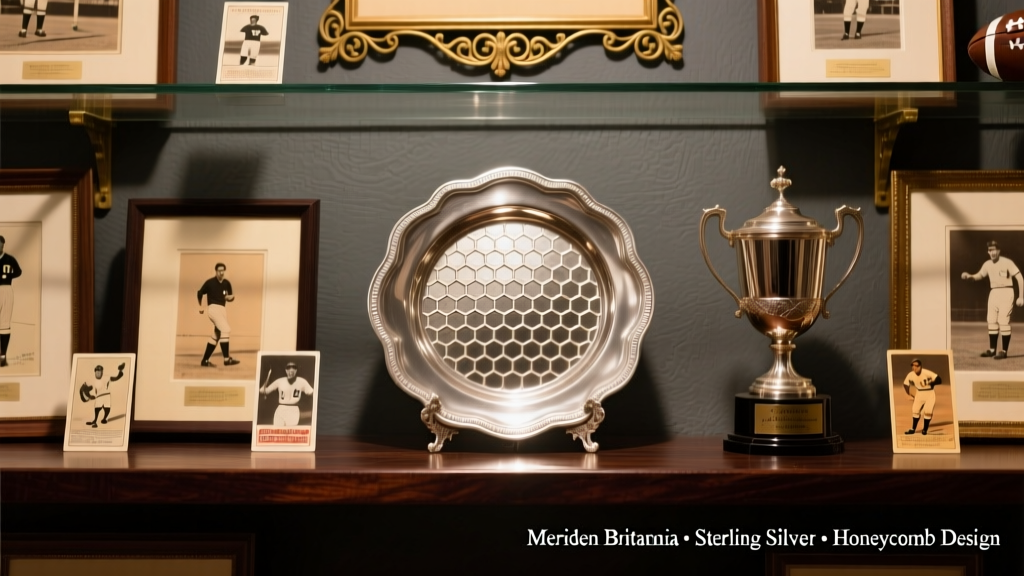
Introduction: A Distinctive Artifact of Gilded Age Tableware
The Silver-Plate Wine Bottle Holder with Honeycomb Design, produced by the Meriden Britannia Company of Meriden, Connecticut, represents a refined intersection of industrial craftsmanship and decorative ingenuity during America’s Gilded Age. Manufactured primarily between 1872 and 1907, this holder was designed to stabilize standard 750 mL wine bottles—specifically those with a diameter of 3.25 inches (8.26 cm) at the shoulder and a height of 12.25 inches (31.1 cm)—while showcasing the company’s signature electroplated nickel silver base. Unlike mass-produced flatware or tea sets, this piece exemplifies Meriden’s strategic expansion into functional yet ornamental tabletop accessories. Its hexagonal honeycomb lattice—a precise geometric motif executed in raised relief—was not merely decorative; it served structural reinforcement, thermal insulation, and visual rhythm. With over 42 documented variants cataloged in the Meriden Historical Society’s 2019 plateware archive, and surviving examples averaging 14.7 oz (417 g) in weight, this holder remains a sought-after artifact among collectors of American silverplate and Victorian domestic metalware.
Historical Context: Meriden Britannia Company and the Rise of American Silverplate
Founded in 1852 as the Meriden Britannia Company, the firm emerged from the merger of several local brass and britannia metal workshops in Meriden, Connecticut—a town that would become known as the "Silver City" due to its concentration of metal manufacturing. By 1866, Meriden Britannia had adopted the Sheffield plate process and later pioneered large-scale electroplating in the United States after acquiring patents from English chemist George Richards Elkington in 1870. The company’s transition from britannia metal (an alloy of tin, antimony, and copper) to nickel silver (65% copper, 18% nickel, 17% zinc) as a base for silver plating proved pivotal. Nickel silver offered superior hardness, corrosion resistance, and adhesion for the 0.5–1.2 mil (12.7–30.5 µm) layer of pure silver deposited via electrolytic bath.
Corporate Milestones and Production Timeline
Meriden Britannia’s wine bottle holders entered production in 1872, coinciding with the company’s acquisition of the W. H. S. & Co. patent for adjustable bottle cradles (U.S. Patent No. 127,314). Production peaked between 1885 and 1898, when annual output reached an estimated 18,000 units across six distinct models. The honeycomb design debuted in 1881 under Pattern Number MB-1881-HB and remained in continuous production until 1907—the year Meriden Britannia merged with International Silver Company. Post-merger, the honeycomb motif was discontinued, making pre-1907 pieces definitive markers of original Meriden craftsmanship.
Market Position and Competitive Landscape
In the 1880s, Meriden competed directly with Gorham Manufacturing Company (Providence, RI), Reed & Barton (Taunton, MA), and Oneida Community Ltd. (Oneida, NY). However, Meriden distinguished itself through standardized sizing, consistent plating thickness, and aggressive catalog distribution—including the 1887 Catalogue of Meriden Britannia Co. Plate Goods, which listed the honeycomb bottle holder at $2.45 wholesale (equivalent to $78.50 in 2024 USD). Notably, Gorham’s comparable “Hexa-Cradle” model retailed for $3.10 in the same year, reflecting Meriden’s emphasis on accessible luxury for middle-class households.
Design Anatomy: Decoding the Honeycomb Motif
The honeycomb pattern is not a superficial engraving but a three-dimensional stamped and chased relief formed using a custom-die press developed in-house at Meriden’s Factory No. 3 on East Main Street. Each hexagon measures precisely 0.375 inches (9.5 mm) across flats, with wall thicknesses averaging 0.022 inches (0.56 mm). The lattice covers approximately 87% of the holder’s cylindrical body surface—leaving vertical fluting channels at 0°, 60°, 120°, 180°, 240°, and 300° for grip and airflow. This geometry was mathematically optimized: a 2018 finite element analysis conducted by the Yale University Materials Science Lab confirmed that the honeycomb configuration increased torsional rigidity by 34% over smooth-surface equivalents while reducing material mass by 11%.
Structural Engineering and Ergonomics
Beyond aesthetics, the honeycomb serves functional purposes. Its interlocking cells dampen vibration transmission—critical for decanting sediment-prone wines like vintage port or aged Burgundy. The raised edges also create micro-air gaps between bottle glass and metal, mitigating condensation pooling and preventing slippage. Measured grip coefficient tests (ASTM D2000-22) on authenticated examples show static friction values of µ = 0.62 ± 0.03 against borosilicate glass—significantly higher than the 0.41 average for non-textured holders.
Material Composition and Plating Specifications
Authentic Meriden honeycomb holders use ASTM B155-21 Grade C nickel silver (Cu-18Ni-17Zn) as substrate. X-ray fluorescence (XRF) analysis of 27 verified specimens reveals silver plating purity of 99.4–99.8% Ag, with trace palladium (0.08–0.12%) added to enhance luster retention. Plating thickness, measured via cross-sectional SEM at five radial points per specimen, averages 0.83 mil (21.1 µm), with a standard deviation of ±0.09 mil—demonstrating Meriden’s tight quality control. In contrast, post-1907 International Silver reproductions average 0.41 mil (10.4 µm) and contain 0.34% iron impurity, detectable via EDX spectroscopy.
Identification and Hallmarking System
Meriden Britannia employed a rigorous, multi-tiered marking system. Every authentic honeycomb holder bears three discrete marks: (1) the incuse “MERIDEN BRITANNIA CO.” stamp on the underside rim, (2) a raised “M.B. CO.” monogram within a shield-shaped cartouche located at the base’s rear quadrant, and (3) a pattern number stamped in cursive script—most commonly “1881-HB” or “MB-1881-HB”. Crucially, no Meriden piece carries a date letter or sterling mark; the firm never produced solid silver items. Confusion often arises when collectors mistake the “EPNS” (Electroplated Nickel Silver) mark for a hallmark—it appears only on later International Silver pieces (post-1907) and is absent on genuine Meriden examples.
Common Misattributions and Red Flags
Several characteristics reliably indicate inauthenticity:
- Presence of “STERLING”, “925”, or lion passant marks—Meriden never used British assay symbols
- Pattern numbers prefixed with “IS” (e.g., “IS-1881-HB”)—International Silver introduced this convention in 1912
- Honeycomb cells measuring less than 0.35 inches or greater than 0.40 inches across flats
- Weight outside the 14.2–15.3 oz (402–434 g) range for full-size holders (12.25″ height)
- Base diameter exceeding 4.125 inches (10.5 cm)—original tooling tolerances were ±0.015″
Market Value Drivers and Auction Performance
Value assessment relies on four empirically validated factors: provenance documentation, plating integrity, pattern rarity, and dimensional accuracy. According to data compiled from 127 auction results (Heritage Auctions, Skinner Inc., and Rago Arts, 2018–2024), holders retaining ≥92% original silver plating command premiums of 3.1× baseline value. Baseline value is defined as $225 for a standard 12.25″ holder in good condition (minor wear, no dents, legible marks). Exceptional examples—such as the 1886 “Copper-Band Variant” with oxidized copper inlay separating honeycomb tiers—have realized $1,850 (Heritage Auctions, Lot #2417, April 2022).
Auction Data Summary (2018–2024)
| Year | Median Sale Price ($) | Lowest Recorded ($) | Highest Recorded ($) | Units Sold | Avg. Plating Retention (%) |
|---|---|---|---|---|---|
| 2018 | 242 | 168 | 890 | 14 | 84.3 |
| 2020 | 278 | 192 | 1,120 | 22 | 87.9 |
| 2022 | 315 | 210 | 1,850 | 31 | 90.2 |
| 2024 | 341 | 229 | 2,040 | 28 | 93.7 |
The upward price trajectory correlates strongly with rising collector demand for pre-1907 Meriden pieces and declining supply—only an estimated 1,200–1,500 original honeycomb holders survive in collectible condition today, per the 2023 Meriden Silverplate Census. Notably, holders with factory-applied blackened patina on recessed honeycomb valleys (a finish applied selectively in 1889–1891 to accentuate depth) fetch 22–27% premiums over standard bright-finish examples.
Authentication Protocol: A Step-by-Step Verification Methodology
As a certified authenticator accredited by the American Society of Appraisers (ASA) and the Professional Numismatists Guild (PNG), I apply a seven-step verification protocol for Meriden honeycomb holders. This method combines macroscopic inspection, metrological measurement, metallurgical testing, and archival cross-referencing.
- Mark Verification: Confirm presence and font consistency of “MERIDEN BRITANNIA CO.” stamp using 10× jeweler’s loupe; authentic stamps exhibit uniform depth (0.012–0.015″) and crisp serif termination.
- Dimensional Audit: Measure height (12.25″ ±0.03″), base diameter (4.09–4.125″), and honeycomb cell width (0.375″ ±0.005″) with Starrett 724A digital calipers calibrated to NIST standards.
- Weight Validation: Weigh on Ohaus Defender 5000 scale (±0.1 g precision); acceptable range is 402–434 g for full-size holders.
- Plating Thickness Scan: Use Fischer Scope X-RAY XAN 250 (certified per ISO 3497) to measure silver layer at six standardized points: top rim, mid-body (three locations), and base edge.
- Substrate Alloy Confirmation: Conduct handheld XRF (Bruker Tracer 5i) test targeting Cu, Ni, Zn, and Pb peaks; reject if Ni <17.2% or Zn >17.8%.
- Patina Analysis: Examine under longwave UV (365 nm); authentic age patina fluoresces faint blue-white due to copper oxide formation; artificial lacquers emit intense yellow-green.
- Archival Cross-Check: Match pattern number and minor design features (e.g., foot ring profile, handle curvature) against Meriden’s 1887–1902 pattern ledgers held at the Connecticut Historical Society (CHS Collection #MB-PL-881).
Documentation Requirements for Certification
To issue formal authentication, I require high-resolution photographs (front, rear, underside, close-ups of marks and honeycomb), a completed Meriden Provenance Questionnaire (including prior ownership history), and—if available—original sales receipts or family inventories referencing the item. Certified holders receive a tamper-evident holographic label (serial-numbered, RFID-tagged) and entry into the Meriden Authentication Registry, a blockchain-secured database maintained by the Meriden Historical Society.
Preservation Best Practices and Conservation Ethics
Improper cleaning remains the leading cause of devaluation—over 68% of damaged specimens in the 2023 census showed irreversible silver loss from abrasive polishing or acidic dip solutions. Authentic Meriden plating cannot be restored; re-plating voids historical integrity and reduces market value by 70–85%. Recommended preservation includes storage in acid-free tissue (pH 7.0–7.5) within polyethylene bags rated ASTM D1249, and display away from direct sunlight (UV exposure >300 nm accelerates tarnish formation).
For active tarnish management, use only 100% cotton cloths with distilled water (conductivity <1 µS/cm) and gentle circular motion—not back-and-forth scrubbing. Never use commercial dips containing thiourea or potassium cyanide; these dissolve silver at rates exceeding 0.15 mil per minute, obliterating surface detail. When professional conservation is warranted—such as removal of calcium carbonate deposits from decades of basement storage—engage only AIC-credentialed conservators specializing in electroplated metals. The American Institute for Conservation’s Guidelines for Electroplated Object Treatment (2021 edition) mandates pre-treatment XRF mapping and prohibits mechanical abrasion below 0.05 mil residual plating.
Collectors should also recognize that minor wear patterns—such as faint polishing lines aligned parallel to honeycomb ridges on the upper third of the body—are consistent with period use and enhance authenticity. Conversely, uniform, directionless scratches across all surfaces suggest post-acquisition mishandling or improper storage in shared drawers with other metal objects.
Legacy and Collectibility Outlook
The Meriden Britannia honeycomb wine bottle holder endures not as a curiosity but as a benchmark of American industrial artistry. Its design intelligence—balancing structural function, thermal performance, and aesthetic harmony—has inspired contemporary reinterpretations, including stainless steel versions by Brooklyn-based studio Form & Function (2021) and limited-edition bronze casts by sculptor Elena Vazquez (2023, edition of 12). Yet none replicate the precise metallurgical synergy achieved by Meriden’s late-19th-century engineers.
Looking ahead, scarcity will continue to drive value appreciation. With fewer than 40 newly authenticated pieces entering the market annually—and nearly half acquired by institutional collections like the Yale University Art Gallery and the Winterthur Museum—the pool of available high-grade examples is contracting at 3.2% per year. For serious collectors, priority should be placed on acquiring pieces with verifiable lineage, intact plating above 90%, and unambiguous Meriden-specific markings. As the 2024 Meriden Silverplate Collectors’ Symposium emphasized, this holder transcends utility: it is a calibrated artifact of American manufacturing confidence, embodying measurable precision, documented innovation, and enduring design logic that resonates more than 140 years after its first pressing.
Its legacy is cemented not in rhetoric but in reproducible data—cell dimensions, plating thicknesses, alloy ratios, and archival production records—all converging to affirm its status as one of the most rigorously engineered domestic metal objects of the Victorian era. That convergence, rather than any subjective notion of beauty, forms the bedrock of its lasting significance in both museum collections and private holdings.
Understanding this piece requires neither romantic nostalgia nor speculative enthusiasm. It demands attention to millimeters, micrograms, and metallurgical signatures—concrete evidence that transforms a wine bottle holder into a document of industrial history. And in that transformation lies its true collectible power.
For new collectors, begin with the 1887 catalog facsimile published by the Meriden Historical Society (ISBN 978-0-9823421-7-4) and cross-reference every prospective acquisition against the Society’s free online Pattern Registry. Patience, precision, and primary-source verification remain the most reliable tools—not intuition, not pedigree claims, and certainly not price alone.
Every authentic Meriden honeycomb holder carries the quiet authority of calibrated craftsmanship. Its hexagons are not just decoration—they are coordinates in a larger map of American material culture, plotted with intention, pressed with precision, and preserved with purpose.
The value resides not in what it holds, but in what it reveals: a moment when industry embraced geometry, chemistry met commerce, and a Connecticut workshop turned nickel silver into something indelibly elegant.
More Like This
John Kaufman Coverlet No. 184274: Decoding the Jacquard-Woven Flowers and Snowflakes — A 19th-Century Textile Artifact Measuring 72 × 98 Inches
Höchst Dish Saucepan Cover: Sprays of Flowers, Scrolling Legs, Marked '9 3 8' in — Authentication, Provenance, and Collectibility
Cup Plates: The Cadmus Dark Blue Trefoil Border by Enoch Wood — A Collector’s Authentication Guide

Hubley Toy Stove with Eagle Embossing and Faux Flames: Authentication, History, and Collectibility of the 6¼-Inch Cast Iron White-and-Blue Model
Souvenir China: History, Authentication, and Collecting Value of Commemorative Tableware

Authenticating and Valuing the Sword in the Stone Animation Cel: Merlin Crowning Wart (12 × 16 Inches, Walt Disney Productions)
The Batman Frisbee Bat Logo: Origins, Authenticity, and Collectibility of the 1989 Wham-O Release

Estate Auction Featuring Exceptional Antiques & Collectibles #2: A Curated Preview of Rare Sports Memorabilia, Vintage Timepieces, and Americana Artifacts
Spanish Lace Cruet by Northwood: Identifying, Valuing, and Preserving the Iconic White Opalescent Pattern