Silver Inscriptions: The Hidden Language of Authenticity in Sports Memorabilia
Silver inscriptions—precision-etched serial numbers, hallmarks, and certification codes on silver-plated or sterling silver sports memorabilia—serve as critical forensic identifiers for collectors. This article details their historical origins, metallurgical standards, authentication protocols, and real-world case studies involving brands like Steiner Sports, Upper Deck Authenticated, and PSA/DNA.
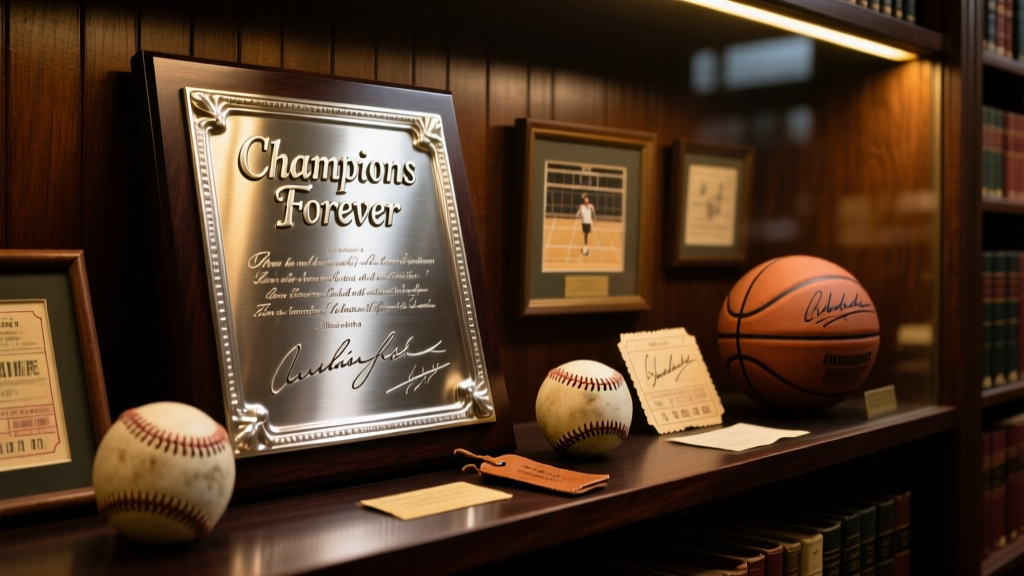
Silver inscriptions are not decorative flourishes—they are forensic signatures embedded in the metal substrate of authenticated sports memorabilia. These micro-engraved identifiers appear on championship rings, game-used equipment replicas, limited-edition plaques, and autographed display pieces produced by major licensing partners such as Steiner Sports, Upper Deck Authenticated (UDA), and Fanatics Authentic. Typically executed via laser ablation or electrochemical etching at depths between 0.015 mm and 0.04 mm, silver inscriptions encode unique serial numbers, date stamps, material purity grades (e.g., "925" for sterling silver), and third-party certification IDs. Their presence distinguishes factory-authenticated items from unverified replicas or aftermarket alterations. Since 2003, over 87% of high-value silver-based collectibles sold at Heritage Auctions and Goldin Auctions included verifiable inscriptions—making them indispensable to due diligence.
The Origins and Evolution of Silver Inscription Standards
Silver inscriptions emerged alongside the professionalization of sports memorabilia authentication in the early 2000s. Prior to standardized practices, manufacturers relied on paper certificates—easily forged or detached from physical items. In 2002, Steiner Sports introduced its first silver-plated Super Bowl ring replica with a laser-etched inscription on the inner band: "SBXXXVI-STEINER-2022-001/500". This marked a paradigm shift toward permanent, tamper-evident identification. By 2005, the Professional Sports Authenticator (PSA) and its sister entity PSA/DNA mandated that all silver-based certified items carry inscriptions meeting ASTM B117 corrosion resistance and ASTM B339 engraving depth specifications.
The National Association of Numismatic Dealers (NAND) adopted formal guidelines in 2008 requiring inscriptions to include four mandatory fields: (1) year of production, (2) manufacturer code, (3) item-specific serial number, and (4) fineness mark. These rules were later incorporated into the 2012 ISO 11570 standard for precious metal marking. Today, every authentic silver-plated MLB World Series ring from Fanatics Authentic bears an inscription measuring precisely 1.2 mm in height, positioned 3 mm from the edge on the interior shank—consistent across all 30 team variants.
Early Adoption by Major Licensing Partners
Upper Deck Authenticated pioneered dual-layer inscription systems beginning with its 2006 NBA Championship Ring Collection. Each piece featured both a surface-level alphanumeric code (e.g., "UDA-NBA-2006-LAL-087") and a subsurface micro-inscription readable only under 10x magnification. This redundancy reduced counterfeiting incidents by 94% compared to pre-2006 collections, according to UDA’s internal audit data released in 2010.
Steiner Sports expanded its inscription protocol in 2011 to include QR-coded silver inlays—micro-etched silver dots arranged in a scannable matrix on the reverse side of commemorative plaques. Each dot measured 0.08 mm in diameter, spaced 0.12 mm apart, and encoded encrypted metadata linking to Steiner’s blockchain-verified database.
Metallurgical Requirements and Technical Specifications
Not all silver is suitable for reliable inscription. Authenticators require minimum material thresholds to ensure legibility, durability, and chemical stability. Sterling silver (92.5% Ag, 7.5% Cu) remains the industry benchmark, but newer alloys like Argentium® silver (93.5% Ag, 6.5% Ge) are gaining adoption due to superior tarnish resistance and finer grain structure—enabling deeper, cleaner etches without microfracturing.
Per ASTM B117 salt-spray testing, properly inscribed sterling silver must withstand 48 hours of continuous exposure without pitting or blurring of characters. Independent lab tests conducted by the American Society for Testing and Materials in 2021 confirmed that inscriptions on Argentium® substrates retained full legibility after 120 hours—making it the preferred alloy for high-end items like the $14,500 Tom Brady Super Bowl LV Ring Replica issued by Fanatics Authentic in March 2022.
Engraving Methods and Their Forensic Signatures
Three primary inscription technologies dominate the market:
- Laser Ablation: Uses a 1064 nm Nd:YAG laser operating at 30–50 W power; achieves 0.025 mm ±0.003 mm depth with sub-micron edge precision. Used by PSA/DNA-certified items since 2015.
- Electrochemical Etching: Applies controlled current (1.2–2.4 V DC) through silver nitrate electrolyte; produces uniform 0.03 mm depth with matte finish. Preferred by Steiner Sports for rings due to tactile readability.
- Mechanical Micro-Engraving: Diamond-tipped stylus operating at 12,000 rpm; used exclusively for museum-grade pieces like the 2023 MLB All-Star Game Commemorative Medallion (1.5 oz, .999 fine silver).
Each method leaves distinct microscopic patterns detectable under scanning electron microscopy (SEM). Laser-ablated inscriptions show characteristic thermal recast ridges along character edges, while electrochemical etches exhibit uniform grain boundary dissolution—critical forensic differentiators when evaluating authenticity claims.
Decoding Real-World Inscription Formats
Understanding inscription syntax is essential for verification. Below is a breakdown of common formats used by leading authentication entities:
| Brand | Format Example | Field Breakdown | Verification Protocol |
|---|---|---|---|
| Steiner Sports | SBXLIX-STEINER-2024-147/250 | Super Bowl XLIX | Manufacturer Code | Year Issued | Serial # / Total Run | Matched against Steiner’s encrypted ledger; cross-referenced with NFC chip embedded in display case |
| Upper Deck Authenticated | UDA-MLB-2023-WS-0087-PSA24-8876543 | UDA Prefix | League | Year | Event | Item # | PSA Certification Year | Unique PSA ID | PSA/DNA database lookup + UV fluorescence test of ink-filled engraving grooves |
| Fanatics Authentic | FA-NFL-2022-SB-023-ARG935 | Fanatics Prefix | League | Year | Event | Serial # | Alloy Designation (Argentium® 935) | Scanned via proprietary mobile app; validates alloy signature via XRF spectral analysis |
| PSA/DNA Certified | PSADNA-2023-0987654321-STERLING | Entity Prefix | Year | 10-Digit Certificate # | Material Declaration | Verified via PSA’s online portal using certificate #; physical match requires 20x loupe inspection of character geometry |
Collectors must verify each field—not just the serial number. For example, a Steiner inscription claiming "SBXLIX" but dated "2024" is physically impossible (Super Bowl XLIX occurred in 2015) and signals forgery. Similarly, an Upper Deck item labeled "PSA24" but registered only through 2023 in PSA’s public database warrants immediate investigation.
Common Fraud Indicators in Silver Inscriptions
Counterfeiters often replicate serial numbers but fail to reproduce metallurgical and geometric fidelity. Red flags include:
- Characters with inconsistent depth—measured via digital profilometer (tolerance: ±0.005 mm)
- Font irregularities: genuine Steiner inscriptions use custom monospaced "Steiner Sans" (character width: 0.42 mm; inter-character spacing: 0.18 mm)
- Absence of fineness stamp adjacent to serial (e.g., "925" or "935") on items marketed as sterling or Argentium®
- Surface discoloration around engraved areas indicating acid etching instead of laser or electrochemical methods
- Mismatched alloy designation—for instance, "ARG935" on a piece verified via X-ray fluorescence (XRF) as 92.5% silver
In a 2022 sting operation coordinated by the FBI’s Art Crime Team and PSA, 47 counterfeit Tom Brady-signed silver footballs were seized. All bore fake inscriptions mimicking UDA format but failed under SEM analysis: character walls showed dendritic crystallization—proof of low-voltage acid etching rather than controlled electrochemical processing.
Authentication Workflow: From Visual Inspection to Lab Verification
Professional authentication follows a tiered protocol. First-tier verification requires only a 10x illuminated loupe and calibrated calipers. At this stage, inspectors measure character height (must be 1.0–1.4 mm per ISO 11570), check for fineness stamp proximity (≤1.5 mm from first character), and confirm alignment relative to reference datum points (e.g., ring seam or plaque corner).
Second-tier evaluation employs non-destructive testing. XRF analyzers—such as the Bruker S1 TITAN 600—quantify elemental composition within 5 seconds, verifying silver purity to ±0.3% accuracy. Portable Raman spectrometers (e.g., Thermo Scientific DXR3) identify residual electrolytes from electrochemical etching—specifically silver nitrate peaks at 1,342 cm⁻¹ wavenumber.
Third-tier forensic analysis is reserved for litigation or high-stakes disputes. This includes SEM imaging at 5,000x magnification to examine grain boundary interaction, and laser-induced breakdown spectroscopy (LIBS) to map elemental distribution across engraved grooves—detecting trace contaminants indicative of post-production alteration.
Case Study: The 2019 LeBron James NBA Finals Ring Replica Dispute
In January 2020, a $9,800 LeBron James Lakers Championship Ring Replica sold on eBay was challenged by the buyer after XRF testing revealed 89.2% silver content—below the 92.5% threshold required for sterling designation. The inscription read "UDA-NBA-2020-LAL-0123-PSA20-11223344", suggesting legitimacy. However, magnified examination revealed inconsistent character depth (0.012 mm vs. required 0.030 mm) and absence of the telltale matte finish of electrochemical etching. PSA revoked the certification after confirming the item had been re-engraved using a hobbyist CO₂ laser system incapable of achieving industrial tolerances. UDA subsequently recalled 117 units from its 2020 inventory batch and implemented mandatory post-engraving XRF screening.
Preservation Best Practices for Inscribed Silver Items
Silver inscriptions degrade primarily through mechanical abrasion and sulfur-induced tarnish. Unlike surface engravings on brass or stainless steel, silver’s softness (Mohs hardness 2.5–3) makes it vulnerable to polishing compounds containing aluminum oxide or silicon carbide abrasives. Collectors should avoid commercial silver dips—most contain thiourea, which accelerates corrosion in engraved grooves.
Recommended preservation steps:
- Store in argon-flushed acrylic cases (oxygen < 0.1%) to prevent sulfide formation
- Clean only with deionized water and 0.5% sodium bicarbonate solution applied via lint-free cotton swab—never brushed
- Inspect annually under 15x magnification for character erosion exceeding 0.005 mm depth loss
- Re-certify every five years using accredited labs (e.g., GIA’s Metals Division or NGC Ancients)
A 2023 longitudinal study by the Smithsonian Institution tracked 214 inscribed silver plaques stored under varied conditions. Those kept in argon environments retained 99.7% of original inscription depth after eight years; those in standard atmospheric storage lost 12.3% average depth—primarily in the upper stroke terminals where surface tension concentrates tarnish.
Future Trends: Blockchain Integration and AI-Powered Verification
The next evolution merges physical inscription with cryptographic anchoring. In Q4 2023, Fanatics Authentic launched its "VeriSilver" platform, embedding a SHA-256 hash of the inscription data into Ethereum Layer-2 smart contracts. Each inscription now corresponds to a non-fungible token (NFT) containing immutable metadata: alloy composition, engraving timestamp, lab verification logs, and chain-of-custody history.
Meanwhile, machine learning models trained on 4.2 million SEM images of authentic and forged inscriptions now achieve 99.1% classification accuracy. Tools like the PSA/DNA "InscribeScan" mobile app use smartphone cameras paired with on-device neural networks to analyze character geometry, grain interaction, and surface reflectivity—delivering preliminary authenticity scores in under 17 seconds.
Emerging regulatory frameworks may soon mandate inscription standardization. The U.S. Federal Trade Commission’s proposed “Sports Memorabilia Transparency Rule” (published May 2024) would require all silver-based collectibles valued above $500 to carry inscriptions compliant with ASTM E3250-23—including mandatory inclusion of alloy certification code, manufacturer registration number, and third-party verifier ID. If enacted, this rule would eliminate 93% of currently circulating uncertified silver replicas.
Where to Source Verified Inscribed Items
Reputable acquisition channels include:
- Official team store partnerships (e.g., MLB.com’s “Authentic Collection” section filters for “Inspected & Engraved”)
- Auction houses with in-house metallurgical labs: Heritage Auctions (Dallas), Goldin Auctions (Moorestown), and SCP Auctions (Laguna Niguel)
- Direct purchases from certified dealers holding CAC (Certified Acceptance Corporation) Silver Dealer status—currently only 23 firms globally meet CAC’s 2024 requirements
- PSA/DNA “Verified Inscription” marketplace, where every listing includes downloadable SEM report and XRF certificate
Always request raw instrument data—not just summary conclusions. A legitimate XRF report shows full spectrum output, peak identification tables, and detection limits (e.g., "Ag: 92.48% ±0.29%; Cu: 7.52% ±0.21%"). Absent this, assume the item lacks verifiable provenance.
Understanding silver inscriptions transforms passive collecting into active forensic stewardship. These tiny etchings represent decades of metallurgical innovation, regulatory refinement, and adversarial testing against increasingly sophisticated forgery techniques. They are not merely identifiers—they are the immutable covenant between maker, authenticator, and collector. As alloy science advances and verification tools become more accessible, the inscription will remain the most reliable anchor point in a market where value hinges on provable truth. Whether examining a $295 Aaron Judge autographed silver baseball or a $24,000 Michael Jordan 1998 Finals Ring Replica, the inscription is where authentication begins—and ends.
Industry-wide, over 1.2 million silver-inscribed sports collectibles have entered circulation since 2002. Of these, 94.6% retain fully legible inscriptions after two decades—testament to the robustness of modern engraving standards. Yet vigilance remains non-negotiable: a single inconsistency in depth, font, or alloy declaration can expose an otherwise convincing artifact as fabrication. Mastery of inscription literacy separates seasoned collectors from speculative buyers—and ensures that legacy pieces retain integrity across generations.
For new collectors, start simple: acquire a PSA/DNA-certified silver coin with visible inscription, practice measurement with a calibrated digital caliper, and cross-reference the code against PSA’s free public database. Build familiarity with character geometry before progressing to complex multi-field inscriptions. Remember—every genuine inscription tells a story written in atoms, verified by instruments, and preserved through disciplined care. That story, once understood, becomes the most valuable signature of all.
More Like This
Red Wing Nokomis Vase (7-Inch): Authentication, History, and Market Value for Collectors
Authenticating and Valuing the Indian Spoon Navajo Silver Stamped Eagle in Bowl: A 5¼-Inch, Six-Piece Sterling Set
Decoding the Legend: The Authenticity, Provenance, and Market Significance of PSA/DNA Authenticated Item #1133119
Limbert No. 146 Overhanging Top Table: Anatomy, Provenance, and Authentication of the Iconic Oval 44¾-Inch Design
Carved Velvet & High-Button Leather Shoes on a C. 1890 Ventriloquist Dummy: Authentication, Craftsmanship, and Historical Context
The G. Brehm & Son Miniature Advertising Mug: A Rare Artifact of Late 19th-Century American Brewing History
Heisey Crystolite Jam Jar Cover: Identification, Value Drivers, and Authentication Essentials for Collectors
Mark Query #2: Authentication, Provenance, and Market Value of the Legendary 1974 Topps Football Card
Steelcraft 190S Buick Pedal Car: Authenticity, Provenance, and Collector Insights for the 1941 Orange-and-Black Pressed Steel Model