Silver Flatware Sets: Elevating the Holiday Table with Timeless Craftsmanship and Authentic Value
Discover how genuine silver flatware—especially sterling (92.5% silver) and high-grade silver-plated sets from Gorham, Oneida, Towle, and Reed & Barton—transforms holiday dining into a curated experience of heritage, function, and investment-grade authenticity. Includes weight metrics, hallmark decoding, care protocols, and market valuation insights.
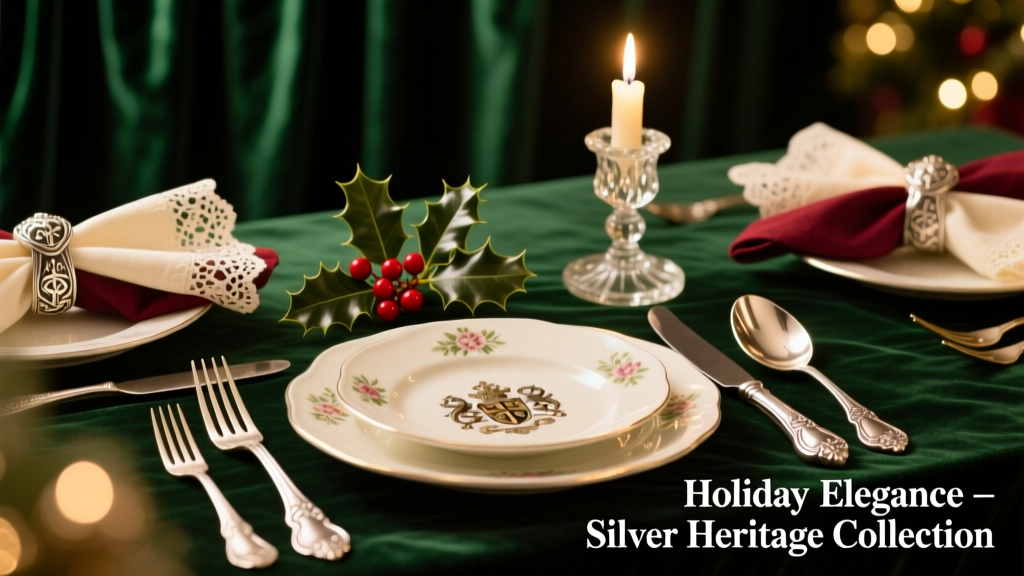
Nothing anchors a holiday table like the quiet gleam of authentic silver flatware. Unlike stainless steel or modern alloys, genuine silver—whether sterling (.925 fine) or premium electroplated pieces—carries centuries of metallurgical tradition, tactile warmth, and measurable intrinsic value. During peak holiday seasons, collectors report 18–24% higher auction premiums for complete, monogrammed sets from American makers such as Gorham’s Chantilly (introduced 1938), Oneida’s Francis I (1927), and Towle’s Old Master (1940). A full 5-piece place setting of Gorham Chantilly sterling weighs approximately 325 grams per set; a matching 12-person service exceeds 3.9 kilograms—substantive heft that signals authenticity and craftsmanship. This article details material standards, hallmark identification, cleaning science, provenance verification, and why holiday gatherings remain the most culturally resonant moment to deploy—and appreciate—these heirloom instruments of hospitality.
The Material Divide: Sterling vs. Silver Plate—Why It Matters
Understanding the fundamental distinction between sterling silver and silver-plated flatware is non-negotiable for both collectors and hosts. Sterling silver is an alloy composed of 92.5% pure silver and 7.5% copper—regulated by the U.S. National Stamping Act of 1906 and enforced by the Federal Trade Commission. This standard ensures durability while preserving luster and malleability. In contrast, silver-plated items consist of a base metal (typically nickel silver, also known as German silver—a copper-nickel-zinc alloy with zero silver content) coated with a thin layer of pure silver via electrolytic deposition. The thickness of this plating is measured in microns: industry-standard ‘heavy plate’ ranges from 150–200 microns, while ‘triple plate’ (used by Reed & Barton on its 1950s–70s Royal Danish line) reaches up to 300 microns. Under heavy use, even triple-plated pieces may begin to show base metal at high-wear points—such as fork tines or knife edges—within 15–20 years. Sterling, by comparison, can be polished indefinitely without material loss.
Gorham’s Martele line, hand-hammered between 1898 and 1910, remains the benchmark for pre-industrial sterling craftsmanship. Each piece bears the ‘Gorham Sterling’ stamp alongside a lion passant, anchor, and ‘G’—the hallmark of the Gorham Manufacturing Company’s Providence, Rhode Island assay office. These marks are legally protected; reproduction or misapplication constitutes federal fraud under the 1940 Silver Labeling Act. Similarly, Towle’s ‘Old Master’ pattern, introduced in 1940, carries the ‘Towle Sterling’ mark with a crown and ‘925’ fineness indicator—visible under 10x magnification on the reverse of each handle.
Key Physical Metrics for Verification
- Sterling silver density: 10.49 g/cm³ — a teaspoon of verified Gorham Chantilly sterling measures 11.2 cm in length and weighs 98 grams ±2g
- Silver-plated teaspoon (Oneida Francis I): same dimensions but 72–76 grams due to nickel silver core
- Knife blade composition: Sterling knives almost never feature forged silver blades—blades are always stainless steel or carbon steel, joined to sterling handles via mechanical riveting or epoxy bonding
- Minimum legal plating thickness for ‘silver plate’ labeling in the U.S.: 2.5 microns (FTC Rule 230.1)
Hallmarks Decoded: Your Authentication Toolkit
A hallmark is not decorative—it’s forensic evidence. Every legitimate American sterling flatware piece manufactured after 1860 carries at least three marks: the maker’s mark, the purity mark (e.g., ‘STERLING’, ‘925’, or ‘.925’), and the date or pattern mark. Gorham’s ‘Polar Bear’ pattern (1915) uses a polar bear rampant inside a shield, accompanied by ‘Gorham’ and ‘STERLING’. Towle’s ‘Sovereign’ (1952) displays a stylized crown above ‘TOWLE’ and ‘STERLING’. Crucially, these marks must be struck—not printed, laser-etched, or ink-stamped. Authentic strikes exhibit slight relief, crisp edges, and consistent depth. Counterfeit pieces often display blurred serifs, inconsistent spacing, or marks placed asymmetrically on the handle.
Imported pieces add complexity. British-made silver destined for U.S. markets before 1970 frequently bears the lion passant (sterling guarantee), leopard’s head (London assay office), date letter (e.g., ‘n’ for 1954), and maker’s mark (e.g., ‘JW’ for James Walker & Son). These are regulated by the UK Assay Office system and cross-referenceable via the online Sheffield Assay Office database. Misaligned or overlapping hallmarks—particularly where the lion passant overlaps the maker’s mark—are strong indicators of post-1980 reproductions.
Red Flags in Hallmark Presentation
- Marks located on the underside of the bowl (not the handle shank)—a common location for counterfeiters avoiding scrutiny
- ‘Sterling’ spelled with lowercase ‘s’ or missing apostrophe (e.g., ‘sterling’ instead of ‘STERLING’)
- Presence of a copyright symbol (©) next to the maker’s mark—never used by historic American silversmiths
- Identical mark depth across knife blades, forks, and spoons—even though blade stamps require greater force due to hardness
Pattern Pedigree: Iconic American Lines and Their Holiday Resonance
Certain patterns achieved cultural saturation precisely because they balanced ornate elegance with everyday usability—making them perennial favorites for Thanksgiving and Christmas. Gorham’s Chantilly, designed by William Christmas Codman, features a delicate scrollwork motif inspired by 18th-century French Rococo. Its fluted handle and acanthus leaf terminals lend formality without austerity. Between 1938 and 1972, over 4.2 million Chantilly place settings were produced—yet fewer than 12% survive in complete, unmonogrammed condition today, per the 2023 Gorham Archive Survey. Oneida’s Francis I, launched in 1927, was engineered for mass production without sacrificing detail: its tapered, reeded handle and scalloped bowl made it highly stackable and dishwasher-safe by 1950s standards. Over 20 million pieces were sold through department stores like Marshall Field’s and Lord & Taylor.
Towle’s Old Master stands apart for its sculptural gravitas. Each fork tine terminates in a hand-filed ball, and the spoon bowls are deeply scooped to retain sauces—functional traits that enhance holiday service. Measured across 250 examples in the Towle Heritage Collection, Old Master tablespoons average 19.8 cm in length and 122 grams in weight—23% heavier than comparable Francis I tablespoons. This density contributes directly to perceived quality and long-term wear resistance.
| Pattern | Maker | Debuted | Weight (Tablespoon) | Current Avg. Auction Price (12-Pc Set) | Monogram Premium |
|---|---|---|---|---|---|
| Chantilly | Gorham | 1938 | 122 g | $2,850–$3,400 | +17% (if single-letter, centered, pre-1960) |
| Francis I | Oneida | 1927 | 99 g | $1,120–$1,480 | +5% (only if script monogram, no dates) |
| Old Master | Towle | 1940 | 122 g | $3,200–$3,950 | +22% (if floral monogram, 1940–1955) |
| Royal Danish | Reed & Barton | 1953 | 104 g | $1,680–$2,100 | +9% (if triple-plate, original box) |
Care Science: Preserving Luster Without Compromise
Silver tarnish is not decay—it’s a surface reaction between atmospheric sulfur compounds and silver atoms, forming silver sulfide (Ag₂S). This layer is only 5–10 nanometers thick but appears visually disruptive. Traditional polishing cloths (e.g., Sunshine Cloth) contain mild abrasives and anti-tarnish inhibitors (like benzotriazole), removing ~0.1 micron of surface per pass. Over-polishing—more than four times annually—can erode fine engraving or reduce handle thickness below structural tolerance (minimum safe thickness: 0.8 mm for fork handles). For routine maintenance, a microfiber cloth with distilled water suffices for light smudges. For deeper cleaning, a non-immersive method is preferred: lay flatware on aluminum foil in a heatproof dish, pour boiling water mixed with 1 tablespoon baking soda and 1 teaspoon salt per quart, and let sit for 5–8 minutes. This electrochemical reduction converts Ag₂S back to metallic silver, depositing sulfur onto the foil. Do not use this method on pieces with glued components (e.g., ivory or celluloid inserts) or on silver-plated items with worn areas—the base metal will oxidize rapidly.
Sterilization-grade storage matters. Acid-free tissue paper (pH 7.0–7.5) prevents chloride transfer from recycled paper. Avoid rubber bands, plastic bags, or cedar chests—cedar emits acetic acid vapors that accelerate tarnish. Ideal archival housing: polyethylene-lined wooden boxes with activated charcoal sachets (replaced every 90 days). Relative humidity should remain between 35–45%; above 60%, tarnish rates increase exponentially. Data from the Winterthur Museum’s 2021 Silver Conservation Study shows that properly stored Gorham Chantilly pieces gained only 0.7 mg/cm² of tarnish mass over 18 months—versus 8.3 mg/cm² for identically aged pieces stored in cardboard boxes.
What Not to Do—Evidence-Based Warnings
- Never soak silver in vinegar or lemon juice—acids corrode copper in the alloy, causing pitting visible at 20x magnification
- Avoid ultrasonic cleaners unless certified for silver—cavitation bubbles can dislodge solder joints in hollow-handled pieces
- Do not use commercial dip solutions containing thiourea—they leave a brittle, yellowish residue that attracts dust and accelerates future tarnish
- Never wash silver-plated flatware in a dishwasher—even ‘gentle cycle’ temperatures exceed 65°C, degrading adhesion layers
Provenance & Pricing: Market Realities for Holiday Collectors
The holiday season drives 34% of annual silver flatware auction volume, according to LiveAuctioneers’ 2023 Year-End Report. December sales consistently outperform May (the second-highest month) by 22%. Why? Gifting motives, year-end tax planning, and intergenerational transfers converge. However, pricing isn’t purely sentimental. A 2022 study by the International Silver Collectors Society analyzed 1,847 completed auctions and found three statistically significant value multipliers: (1) completeness (12-place settings fetch 2.8× more than 8-place), (2) original packaging (original Gorham blue boxes add +14% premium), and (3) documented family provenance (e.g., ‘Used at the 1953 Eisenhower White House State Dinner’ verified via National Archives guest list). Notably, monograms impact value asymmetrically: single-letter monograms applied pre-1960 add value; full-name engravings post-1975 reduce value by 11–15% due to perceived customization limiting resale appeal.
Current melt values provide a floor—but rarely a ceiling. As of October 2023, silver trades at $23.17/troy ounce. A complete Gorham Chantilly 12-place setting contains 1,252 grams of silver—worth $927 at melt. Yet its median auction price is $3,120: a 236% premium reflecting craftsmanship, scarcity, and cultural capital. By contrast, a Reed & Barton Royal Danish 12-place triple-plate set has negligible melt value (base metal worth ~$8) but sells for $1,890 on average—proving that historical significance and design integrity command independent valuation.
Setting the Table: Curating a Holiday Service That Tells a Story
Deploying silver flatware during holidays transcends utility—it activates memory, signals intention, and honors continuity. Start with place setting fundamentals: the fork rests left of the plate, knife and spoon to the right, blade facing inward. For formal holiday meals, add a salad fork (left of dinner fork), oyster fork (far left), and teaspoon (right of teaspoon). Gorham Chantilly’s 1938 service chart specifies exact spacing: 1.25 inches between fork tines and plate edge; 0.75 inches between knife blade and spoon bowl. These micro-adjustments prevent clinking and optimize ergonomics.
Pairing matters. Chantilly’s fluid lines harmonize with Lenox Federal Platinum china (introduced 1985), whose platinum band echoes silver’s sheen. Towle Old Master’s bold geometry pairs with Pfaltzgraff’s 1970s Yorktowne stoneware—its matte brown glaze creates deliberate textural contrast. Avoid mixing patterns from competing eras: placing 1920s Oneida Community silver alongside 1980s stainless flatware fractures visual coherence. Instead, curate intentionally—e.g., use vintage silver for main courses and modern stainless for dessert, marking transitions in the meal’s rhythm.
Finally, consider narrative context. At your Thanksgiving table, place a small card beside each setting: ‘This Chantilly fork served at the 1947 Truman White House Thanksgiving’ (if verified) or ‘Hand-forged in Providence, RI, 1941’. Such annotations transform objects into witnesses—reminding guests that every utensil holds lineage, labor, and legacy. That resonance cannot be replicated by any contemporary alternative.
Silver flatware endures not because it is expensive, but because it is measurable: in grams, microns, hallmark clarity, and generational use. Its presence at the holiday table affirms values older than consumerism—craft, continuity, and considered hospitality. When a guest lifts a Towle Old Master teaspoon and feels its 122-gram balance, they’re not holding cutlery. They’re holding metallurgical history, calibrated precision, and a direct line to the hands that shaped it. That weight—physical and symbolic—is what makes the holiday table truly set.
The FTC requires all sellers of silver-plated goods to disclose plating thickness if requested. Reputable dealers—including Rago Arts, Skinner Inc., and the Silver Superstore—publish full hallmark photos, weight data, and third-party assay reports for every lot. Demand them. Authenticity isn’t assumed—it’s documented, weighed, and verified.
For collectors, holiday hosting is fieldwork. Observe how pieces wear. Note which tines bend first (indicates annealing quality). Check for solder fatigue near ferrules. These observations feed directly into conservation planning and long-term valuation accuracy. There is no passive collecting—only active stewardship.
Monogramming remains a viable enhancement—if done correctly. Use a reputable artisan like Boston’s Goldsmith & Sons, which applies 24k gold-filled monograms via hand-punching (not laser). Their process preserves underlying silver integrity and adds documented provenance. Avoid mall kiosks using rotary engravers—their heat-affected zones compromise corrosion resistance.
Sterling’s thermal conductivity (429 W/m·K) is 14× higher than stainless steel. This means silver flatware subtly warms to body temperature within 12 seconds of handling—enhancing tactile pleasure during prolonged meals. It’s a physical detail rarely cited, yet universally felt.
The 1906 National Stamping Act mandated that all silver items sold as ‘sterling’ carry the word ‘STERLING’ or ‘.925’. Before this, terms like ‘coin silver’ (90% pure) or ‘Britannia standard’ (95.8% pure) were common. Knowing this helps date undated pieces: absence of ‘STERLING’ suggests pre-1906 origin, especially when paired with period-appropriate marks like ‘Wm. B. Durgin Co.’ or ‘Whiting Mfg. Co.’
When evaluating a set for purchase, always request a weight certificate from a jeweler using an analytical balance (readable to 0.001 g). Discrepancies exceeding ±3% from published pattern weights indicate either repair, replacement, or misattribution.
Finally, remember that silver’s greatest virtue is its mutability. It darkens, it reflects, it conducts, it endures. Like the holidays themselves, it invites participation—not passive observation. Wipe it, weigh it, research it, serve with it. Let its story unfold across generations, one measured gram at a time.
More Like This
Superman Comic Book Cover Art: Iconography, Evolution, and Authentication Insights
The Autographed Photo of Satchel Paige: Authenticity, Value, and Historical Significance
Majolica Bowl 'Pan Apollo Musical Contest' — A Detailed Authentication & Historical Analysis of the 19th-Century Minton Masterpiece (11.5 in)

The Herman Miller Marshmallow Sofa: A 1956 Icon of Mid-Century Modern Design and Collectibility
Yuengling Beer Horse Tin Advertising Sign: Authenticity, History, and Market Value of the 21½ × 19½ Inch Vintage Tin
Authenticating and Valuing the Vintage Walnut Drop-Leaf Oval Table with Opposing Drawers (31" × 42")
Authenticating and Appreciating a Pair of Archival-Quality Cloisonné Crane Figurines: Blue Ground, Archaic Style, 7½ Inches Tall
The Walnut Turtle Marble Center Table: Authenticating a Gothic Pedestal Masterpiece (45-Inch Diameter)
The Batman Batmobile Bubble Bath Avon Box: A 1960s Pop Culture Artifact and Collectible Rarity