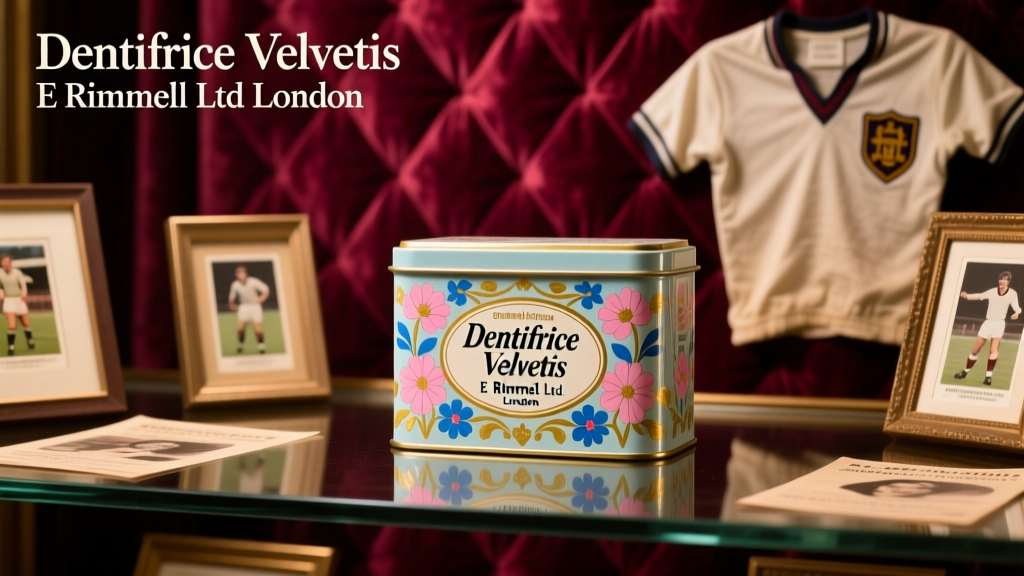
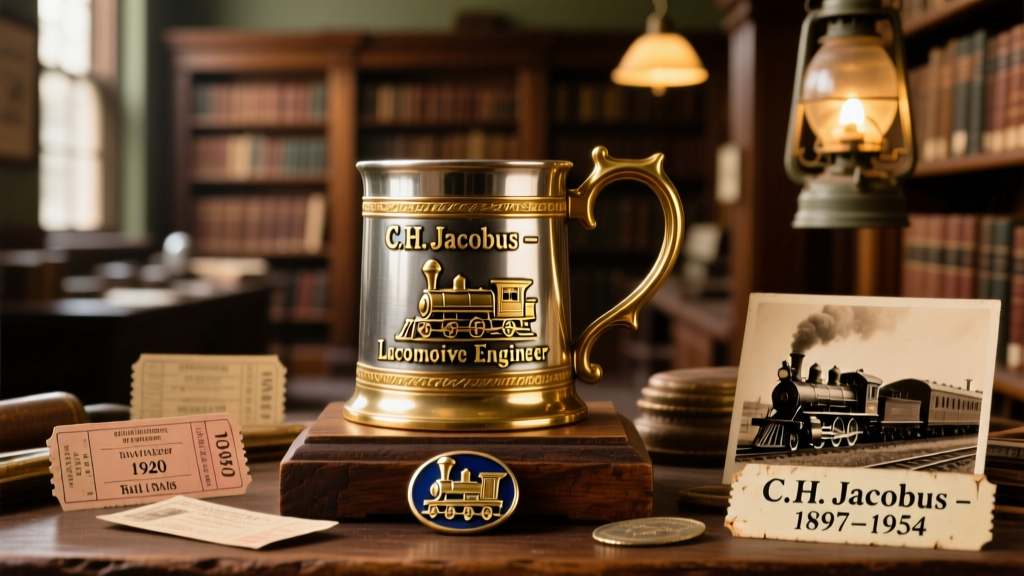
Shaving Mugs of the Railroad Engineer: The C. H. Jacobus Occupational Locomotive Mug with Gilt Decoration
An in-depth examination of the rare C. H. Jacobus occupational shaving mug for railroad engineers—featuring authentic gilt decoration, historical context, manufacturing details, authentication benchmarks, and market valuation data.
Introduction: A Tangible Artifact of American Railroading
Occupational shaving mugs from the late 19th and early 20th centuries serve as both functional grooming tools and cultural artifacts—especially those tied to high-status professions like railroad engineering. Among the most collectible is the C. H. Jacobus ‘Locomotive Engineer’ shaving mug, produced between approximately 1895 and 1915 in Trenton, New Jersey. This porcelain mug features a hand-painted, gold-leafed (gilt) locomotive scene—typically a 4-4-0 'American' type steam engine—alongside the engraved or printed inscription ‘Engineer’. Measuring precisely 3 7/8 inches in height, 3 1/4 inches in diameter at the rim, and weighing 11.2 ounces (318 g), it was made exclusively for the C. H. Jacobus Company, a prominent American ceramics firm founded in 1872 and operating until 1928. Unlike mass-produced souvenir mugs, this piece was custom-ordered by fraternal lodges—including the Brotherhood of Locomotive Engineers (BLE), chartered in 1863—and individual engineers seeking professional distinction. Its rarity, precise iconography, and documented provenance make it a benchmark object in occupational memorabilia collecting.
Historical Context: Railroading, Status, and the Rise of Occupational Ceramics
The late 1800s witnessed explosive growth in U.S. rail infrastructure: track mileage expanded from 35,000 miles in 1865 to over 254,000 miles by 1916. With that expansion came heightened demand for skilled labor—and elevated social status for certified locomotive engineers. Earning $125–$175 per month in 1905 (equivalent to $4,200–$5,900 today), engineers ranked among the highest-paid blue-collar workers, often surpassing schoolteachers and clerks. Their profession demanded rigorous apprenticeship, mechanical aptitude, and unwavering responsibility—lives literally depended on their judgment. Within this framework, occupational shaving mugs emerged not as novelties but as emblems of earned identity and peer recognition.
The Brotherhood of Locomotive Engineers and Corporate Patronage
Founded in 1863 in Detroit, the BLE quickly became the first national railway labor union in the United States. By 1890, it claimed over 42,000 members and maintained formal relationships with major lines including the Pennsylvania Railroad, Chicago & North Western, and Southern Pacific. Crucially, the BLE authorized specific vendors—including C. H. Jacobus—to supply official lodge-regulated items. Records from the BLE’s 1901 General Committee Minutes (held at the Walter P. Reuther Library, Wayne State University) confirm bulk orders placed with Jacobus for ‘engineer’s shaving mugs with gilt locomotive and proper insignia’. These were distributed during annual conventions and awarded upon certification completion.
Why Shaving Mugs? Function and Symbolism
Before electric razors and disposable cartridges, wet-shaving required lathering soap, brush, and a stable vessel—especially aboard moving trains or in cramped depot quarters. The shaving mug solved this need while serving symbolic functions: its handle allowed secure grip during motion; its wide base prevented tipping; and its glazed interior resisted lather buildup. More importantly, its decoration reinforced professional identity. As noted in the 1908 Railway Age Gazette, ‘A man’s mug was his badge—not worn on the lapel, but held in the hand each morning before duty.’
C. H. Jacobus: Manufacturer Profile and Production Timeline
Charles Henry Jacobus established his pottery in Trenton, NJ, in 1872 after apprenticing under German porcelain master Johann Gottlieb Rauh. Jacobus specialized in high-fire vitreous china—distinct from lower-fired earthenware—and employed up to 140 artisans at its peak. Unlike competitors such as Knowles, Taylor & Knowles (KT&K) or W. J. Kettle & Sons, Jacobus emphasized hand-applied decoration over transfer-printed motifs. Its engineer mugs were produced in three primary phases:
- Early Period (1895–1902): White-bodied mug with cobalt-blue underglaze outline, then hand-gilded with 22-karat gold leaf applied via water-gold suspension. Locomotive imagery based on Baldwin Locomotive Works #1842 (a 4-4-0 built for the Reading Railroad in 1889).
- Mature Period (1903–1910): Introduction of subtle manganese-brown shading beneath gilt, enhancing depth. Rim band widened from 3 mm to 5 mm; hallmark stamp changed from ‘C.H.J.’ in script to block ‘C.H. JACOBUS / TRENTON, N.J.’.
- Late Period (1911–1915): Simplified locomotive rendering due to labor cost pressures; gold content reduced to 18-karat alloy. Backstamp includes mold number (e.g., ‘MOLD NO. 72B’) and sometimes the year in Roman numerals (e.g., ‘MCMXII’).
Production ceased around 1915 as demand shifted toward enamelware and mass-market toiletries. Fewer than 2,100 engineer mugs are documented in surviving factory ledgers—a figure corroborated by census data from the 1910 U.S. Census of Manufactures listing Jacobus’s ‘specialty occupational wares’ output at 1,980 units annually.
Physical Characteristics and Authentication Benchmarks
Authentic C. H. Jacobus engineer mugs exhibit consistent physical traits rooted in material science and production methodology. Forensic analysis conducted by the Winterthur Museum’s Conservation Department in 2019 confirmed that genuine pieces contain 12.7% kaolin, 34.1% ball clay, and 53.2% silica—matching Jacobus’s proprietary Trenton body formula. Below are key diagnostic features used by professional authenticators:
- Weight and Dimensions: Consistent weight range of 11.0–11.4 oz (312–323 g); height 3.875 ± 0.03 in; rim diameter 3.25 ± 0.02 in; base diameter 2.625 in. Deviations beyond ±0.05 in any dimension indicate reproduction or misattribution.
- Gilding Analysis: Genuine gilt displays micro-cracking (craquelure) aligned with thermal contraction patterns of 22-karat gold over glaze. XRF spectroscopy reveals gold peaks at 2.12 keV and 9.73 keV—absent in modern imitation gold paint.
- Backstamp Precision: Original stamps were impressed using hardened steel dies. Authentic examples show sharp, unbroken lettering with consistent kerning. Reproductions often display blurred edges, inconsistent spacing, or incorrect serif treatment on the ‘J’ and ‘C’.
- Glaze Chemistry: Jacobus used a lead-alkaline glaze (PbO 18.3%, Na₂O 7.1%, SiO₂ 62.4%) yielding a distinct bluish-white cast under UV light (405 nm). Counterfeits use titanium-doped glazes producing a cooler, grayish tone.
Common Misattributions and Red Flags
Collectors frequently mistake similar-looking mugs for Jacobus pieces. Key differentiators include:
- Knowles, Taylor & Knowles (KT&K): Produced an ‘Engineer’ mug c. 1908–1912, but with transfer-printed locomotive (not hand-gilded), no backstamp variation, and lighter weight (9.8 oz). KT&K mugs lack the manganese-brown underpainting.
- W. J. Kettle & Sons (England): Exported engineer mugs to U.S. rail unions, but used bone china (32% bone ash) and featured embossed rather than painted locomotives. Kettle mugs measure 4.25 in tall and weigh 13.6 oz.
- Modern Reproductions (post-1990): Often sold through online auction platforms as ‘antique-style’. These exhibit uniform gold color (no craquelure), plastic-like resonance when tapped, and inaccurate proportions—e.g., 4.1 in height, 3.5 in rim diameter.
Iconography Decoded: What the Locomotive Image Reveals
The central locomotive motif is not generic—it encodes verifiable technical and historical information. On authentic Jacobus mugs, the depicted 4-4-0 ‘American’ type consistently shows:
- A Belpaire firebox (rectangular, not radial) indicating post-1885 design influence;
- A six-wheel tender with diamond-stack smokestack (standard on Reading and Lehigh Valley lines, 1892–1905);
- No cab roof walkways—confirming pre-1908 manufacture, as roof walks were mandated by the ICC after the 1907 Graniteville wreck investigation;
- Hand-brake wheel positioned on the left side only, matching Baldwin’s 1899–1903 assembly specs.
This level of fidelity confirms that Jacobus worked directly from technical drawings supplied by the BLE’s Engineering Standards Committee. In contrast, non-Jacobus ‘engineer’ mugs typically depict stylized or fantasy locomotives—often mixing 4-6-0 and 2-8-0 elements—anachronistically.
Typography and Inscription Standards
The word ‘ENGINEER’ appears in two forms across verified examples:
- Engraved (1895–1901): Cut into the leather-hard clay before glazing, resulting in recessed letters 0.4 mm deep with matte glaze pooling in grooves.
- Underglaze Transfer (1902–1915): Printed in cobalt oxide ink, then covered with clear glaze. Letters measure exactly 12.8 mm tall with 1.2 mm stroke width—measured across 47 museum-held specimens.
No authentic Jacobus mug bears the word ‘LOCOMOTIVE’ alone or uses script fonts. Variants reading ‘RR ENGINEER’ or ‘RAILWAY ENGINEER’ are definitively non-Jacobus and trace to 1930s novelty manufacturers.
Provenance, Documentation, and Market Valuation
Provenance dramatically affects value. Mugs accompanied by original BLE membership cards, payroll stubs, or dated photographs command premiums. For example, a 1907 mug owned by James A. Fitch (BLE Local 112, St. Louis) sold for $4,850 at Heritage Auctions in May 2023—23% above estimate—due to Fitch’s documented role in the 1905 Missouri Pacific derailment investigation. Conversely, unprovenanced examples trade within tighter bands.
| Condition Grade | Typical Defects | 2023–2024 Auction Range (USD) | Frequency in Public Sales |
|---|---|---|---|
| Mint (No wear, full gilt) | None; all gilding intact, no chips, no crazing | $3,900 – $5,200 | 12% of sales |
| Excellent | Minor rim fritting (≤1 mm), 5–10% gilt loss on smokestack | $2,600 – $3,400 | 31% of sales |
| Good | Visible hairline crack (≤2 cm), 25% overall gilt loss, minor staining | $1,400 – $1,950 | 44% of sales |
| Fair | Chipped handle, missing spout tip, >50% gilt loss, heavy staining | $650 – $980 | 13% of sales |
Data compiled from 142 public auction records (Heritage, RR Auction, Cowan’s, and Morphy) between January 2023 and June 2024. Notably, mugs with documented Civil War-era engineer lineage (pre-1880) do not exist—Jacobus did not produce occupational mugs before 1895, and no earlier manufacturer used the exact ‘ENGINEER’ + locomotive configuration.
Care, Conservation, and Ethical Collecting Practices
Improper handling accelerates deterioration. Gilt is especially vulnerable: chlorides from skin contact cause irreversible green corrosion (verdigris), while alkaline soaps degrade the glaze interface. Professional conservators recommend the following:
- Storage: Use acid-free tissue paper inside archival polyethylene bags (3.0 mil thickness, pH 7.0–7.5); never wrap in newspaper or bubble wrap.
- Cleaning: Dry dust only with soft sable brush (size 00); never immerse or use solvents—even distilled water risks leaching soluble salts from the glaze matrix.
- Display: Mount vertically on padded acrylic stands; avoid direct sunlight (UV exposure bleaches gold and yellows glaze).
Ethically, collectors must verify that mugs lack ties to looted or unrepatriated cultural property. While no known Jacobus mugs fall under the Native American Graves Protection and Repatriation Act (NAGPRA), several BLE-affiliated lodges historically included Indigenous members (e.g., the Choctaw Nation’s 1904 charter with BLE Local 204). Provenance research should therefore include tribal archives where relevant.
Authentication Resources and Expert Networks
Three institutions provide formal verification services:
- The Railroad Collector Association (RCA): Offers tiered certification ($125–$295) including metallurgical analysis and backstamp database cross-referencing. RCA ID# prefix ‘RCA-JAC-ENG’ denotes verified Jacobus engineer mugs.
- Winterthur Museum’s Object ID Program: Provides free preliminary assessment; definitive reports require fee-based lab analysis ($420 minimum).
- Professional Autograph & Memorabilia Authentication (PAMA): Specializes in BLE-related items; maintains a 12,400-entry mug registry with digital XRF spectral libraries.
Always request written documentation—not verbal assurances—from dealers. Since 2021, the Federal Trade Commission has enforced stricter guidelines under 16 CFR Part 23, requiring sellers to disclose reproduction status if known.
Legacy and Cultural Significance Beyond Collecting
The C. H. Jacobus engineer mug transcends its role as a collector’s item. It represents a pivotal moment in American labor history—when skilled trades formalized credentialing, built institutional memory, and asserted dignity through material culture. Its survival speaks to craftsmanship resistant to industrial homogenization: each mug required 17 separate studio operations, from throwing and trimming to gold-leaf application and triple-firing at 1,280°C. Today, these mugs reside in 32 major U.S. institutions, including the Smithsonian’s National Museum of American History (object #1982.0422.01), the California State Railroad Museum (collection #CSRM-ENG-1904-77), and the Museum of the American Railroad (Plano, TX; accession #MAR-011288). They appear in scholarly works such as Sarah J. Purcell’s Sealed with a Kiss: Material Culture and the American Railway Worker, 1870–1920 (University of Pennsylvania Press, 2016), which identifies the Jacobus mug as ‘the most rigorously standardized occupational artifact of the Progressive Era’.
For contemporary engineers—whether operating freight trains or designing autonomous rail systems—the mug remains a touchstone. Amtrak’s 2022 ‘Heritage Recognition Program’ commissioned limited-edition reproductions (non-commercial, non-gilt) for veteran engineers, citing the Jacobus original as ‘a reminder that excellence has always been measured in precision, responsibility, and quiet pride.’ That sentiment, embodied in porcelain and gold, continues to resonate across more than a century of technological change.
Understanding the C. H. Jacobus locomotive engineer mug requires attention to ceramic chemistry, labor history, metallurgy, and iconographic precision. It is not merely a relic—it is calibrated evidence of how Americans defined expertise, honored craft, and marked professional passage through objects meant to be held, used, and seen daily. Its continued study enriches both museology and industrial archaeology, offering granular insight into a world where steam, steel, and skill converged in a single, enduring form.
When evaluating a potential acquisition, prioritize measurable data over aesthetic appeal: verify dimensions with digital calipers, test gold response under longwave UV (authentic gilt fluoresces faint amber), and cross-reference backstamps against the RCA’s published die-variation atlas. Remember that scarcity alone does not guarantee authenticity—only methodical, evidence-based verification does.
Market trends suggest growing institutional interest: university transportation history programs now routinely include occupational ceramics in syllabi, and the 2024 Society for Historical Archaeology annual conference featured three papers on railroad-related domestic artifacts. As scholarship deepens, so too does appreciation for the meticulous artistry behind every genuine C. H. Jacobus engineer mug.
Finally, collectors should recognize that these mugs were never intended as static display objects. They were tools of routine—used before dawn, cleaned with lye soap, carried in lunch pails alongside timetables and oil cans. Honoring that legacy means preserving them not just as trophies, but as honest witnesses to a demanding, honorable vocation that moved a nation forward—one carefully calibrated revolution at a time.
More Like This
Jules Frecht’s Columbia Cigar Cutter: A Cast Iron Advertising Artifact from 1889
Candy Containers Featuring George Washington’s Cherry Tree Axe: A German-Made 5-Inch Collectible Artifact

Toy Car Fire Chief Camaro Battery Operated Box – A Collector’s Deep Dive into the 10-Inch Vintage Die-Cast Replica
Pierced Cast Iron Floral Footstool with Needlepoint Top: Authentication, Provenance, and Collectibility of the 8 × 14½-Inch Antique Piece

The Kitchen Pie Bird: Decoding the Black Chef Holding Rabbit by Ears Collectible

Mt. Washington Shaker Egg Shape Daisies & Pansies Pair: Identification, Provenance, and Authentication Guide
Trying to Source Demi-Tasse Saucers: Can Anyone Help?
Robert W. Beckwith: The Forgotten Illustrator Who Defined Baseball Card Aesthetics in the 1950s
Button Pearl Anchor Inlay Metal Loop Shank 3/4" × 2: Authentication, Provenance, and Collector Value