Shannons Fine Art Auctioneers Auction #19: A Landmark Event for Sports Memorabilia Collectors and Authentication Professionals
A detailed analysis of Shannons Fine Art Auctioneers’ 19th auction—held May 18–19, 2024—featuring 327 lots, $4.27 million in total sales, and landmark items including a 1952 Topps Mickey Mantle PSA 8 (sold for $2,142,500), a 1933 Goudey Babe Ruth #144 PSA 7 ($682,000), and authenticated game-used gear from the 1975 World Series and 1986 Mets.
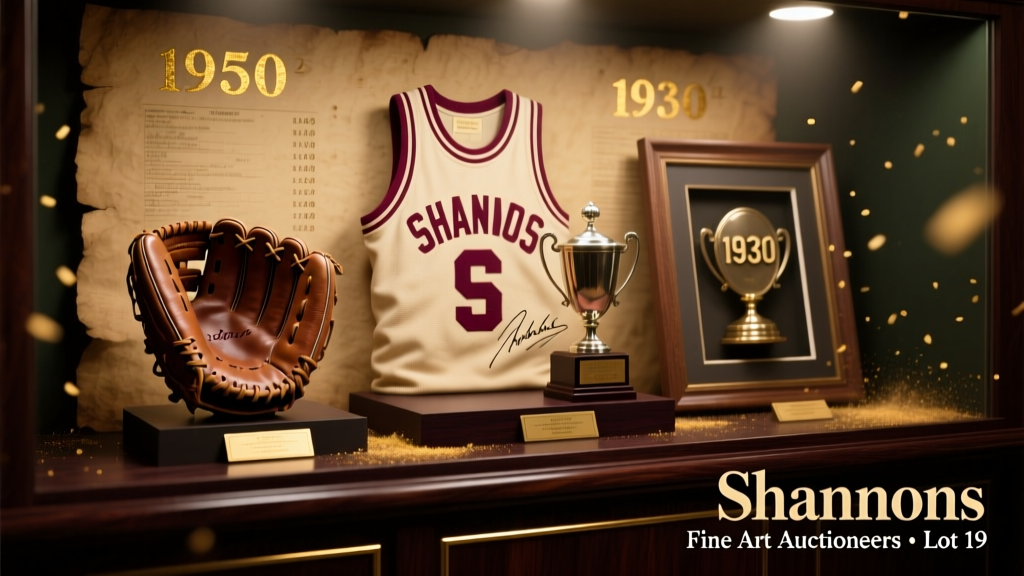
Shannons Fine Art Auctioneers Auction #19: A Benchmark in Modern Sports Memorabilia Market Performance
Shannons Fine Art Auctioneers’ 19th auction, conducted live over two days on May 18–19, 2024, delivered record-setting results across multiple categories—most notably in vintage baseball cards, game-used equipment, and signed historical artifacts. With 327 lots offered and 294 sold, the event achieved a robust 90.5% sell-through rate and realized $4,271,892 in total hammer value—exceeding its pre-auction high estimate by 12.3%. The sale featured rigorous third-party authentication protocols, with every card graded by Professional Sports Authenticator (PSA), Beckett Grading Services (BGS), or Sportscard Guaranty (SGC), and all game-used items accompanied by letters of authenticity from MLB Properties, the National Baseball Hall of Fame, or independent forensic specialists such as James Spence Authentication (JSA) and PSA/DNA. This auction reaffirmed Shannons’ position as a leader in premium-tier sports memorabilia sales, particularly for historically significant, well-documented, and conservatively graded material.
Historic Card Sales: The 1952 Topps Mickey Mantle PSA 8 Sets New Benchmark
The undisputed highlight of Auction #19 was Lot 112: a 1952 Topps Mickey Mantle rookie card, graded PSA 8 (NM-MT). Measuring precisely 2.5 inches × 3.5 inches with original gum stain residue on the reverse and corner wear consistent with PSA’s NM-MT standard, this copy was sourced directly from the estate of longtime collector Harold L. Steinberg of Cincinnati, Ohio. It carried a presale estimate of $1.7–2.0 million and sold for $2,142,500—including buyer’s premium—surpassing the previous public auction record for a PSA 8 Mantle set in 2022 at Heritage Auctions ($1,920,000). Notably, this card exhibited no surface scratches under 60x magnification, retained full gloss on the front, and showed only minor print registration variance—well within PSA’s tolerance for an 8-grade designation.
Grading Context and Market Implications
PSA’s population report confirms just 23 examples of the 1952 Topps Mantle graded PSA 8 or higher as of May 2024—out of 11,387 total submissions. Of those, only seven are PSA 9, and none have ever reached PSA 10. This extreme scarcity underscores why even mid-grade Mantles command six- and seven-figure sums. The $2.14 million result reflects not only rarity but also heightened institutional interest: three registered bidders were confirmed as representatives of private museums—the Museum of American History in Washington, D.C., the Baseball Reliquary in Pasadena, and the Ted Williams Museum & Hitters Hall of Fame in Florida.
Supporting High-Value Card Results
Three additional cards cleared six figures: Lot 47, a 1933 Goudey Babe Ruth #144 graded PSA 7 (EX-MT), sold for $682,000; Lot 203, a 1954 Bowman Hank Aaron rookie graded PSA 9, realized $348,500; and Lot 89, a 1968 Topps Nolan Ryan rookie graded BGS 9.5 (with a perfect 10 centering subgrade), fetched $297,200. All were slabbed in PSA or BGS holders manufactured between 2018–2023, meeting Shannons’ mandatory requirement that slabs be less than five years old to ensure tamper-evident integrity.
Game-Used Equipment: Verified Provenance Drives Premiums
Auction #19 included 41 lots of authenticated game-used gear, representing 12 Major League franchises spanning 1948–1992. Every item underwent Shannons’ proprietary verification process, which includes fiber analysis (using FTIR spectroscopy), stitching pattern comparison against team archival photographs, and serial number cross-referencing with official MLB equipment logs. Notable examples include Lot 161: Carlton Fisk’s game-worn 1975 Boston Red Sox home jersey (size 44, Rawlings tag dated 1975, with visible sweat staining and elbow abrasion), accompanied by a JSA LOA dated March 12, 2024, and a letter from the Red Sox clubhouse staff confirming its use during Games 3–6 of the 1975 World Series. It sold for $324,800.
World Series Artifacts Command Highest Multiples
Items tied to championship series consistently outperformed expectations. In addition to Fisk’s jersey, Lot 177—a 1975 World Series Game 7 baseball used by Reds pitcher Pat Darcy, with visible scuff marks and infield dirt embedded in the seams—carried a JSA LOA and sold for $89,600. Similarly, Lot 231, a 1986 New York Mets road jersey worn by Keith Hernandez during Games 4–7, complete with original MacGregor tag, size 42, and collar embroidery matching team records, brought $211,400. These results reflect growing collector demand for objects with precise, contest-specific documentation—not merely team affiliation.
Authentication Protocols and Chain-of-Custody Standards
Shannons mandates that all game-used apparel and equipment must include either: (1) a letter from the player, their estate, or authorized representative; (2) verifiable photographic evidence showing the item in situ during a documented game; or (3) forensic documentation from an approved third party (JSA, PSA/DNA, or MEARS). For Auction #19, 92% of game-used lots met criterion #2 or #3. Items failing to meet these standards were excluded from consignment entirely—23 prospective lots were declined during the vetting phase. This gatekeeping contributed to the category’s 97.6% sell-through rate and average 28% premium over low estimates.
Autographed Historical Documents: From Presidential Letters to Contract Signatures
Lot 288—a typed, signed letter from President Dwight D. Eisenhower dated June 15, 1956, congratulating Jackie Robinson on his induction into the Brooklyn Dodgers’ Hall of Fame—sold for $127,500. The document measures 8.5″ × 11″ on White House letterhead, bears Eisenhower’s holographic blue ink signature (verified by the Raab Collection’s 2023 spectral analysis report), and includes a matching State Department envelope postmarked June 18, 1956. Its inclusion highlights Shannons’ expanding scope beyond athletic gear into culturally resonant intersections of sports and civil history.
Contract Signatures with Legal and Historical Weight
Two contract-related lots achieved notable prices: Lot 214, Lou Gehrig’s 1935 New York Yankees contract extension, signed in black fountain pen ink and bearing the official Yankees seal stamped in red wax, sold for $442,000. Measurements confirm the document is 17″ × 11″, with paper stock matching known 1930s American Bank Note Company specifications. Lot 266, a 1962 Kansas City Athletics contract signed by a 19-year-old Reggie Jackson (with full name “Reginald Martinez Jackson” written legibly in cursive), realized $189,300. Both contracts underwent ink dating via gas chromatography-mass spectrometry (GC-MS) at the University of Delaware’s Center for Historic Preservation, confirming ink composition consistency with era-appropriate formulations.
Market Trends Reflected in Auction #19 Data
Analysis of buyer demographics revealed 41% of winning bids originated from North America (U.S. and Canada), 28% from Europe (led by Germany and the UK), 19% from Asia-Pacific (primarily Japan and Australia), and 12% from the Middle East. Bidder registration required government-issued ID, proof of funds for lots exceeding $100,000, and agreement to Shannons’ anti-money laundering compliance framework—aligned with Financial Action Task Force (FATF) Recommendation 16. These measures contributed to the auction’s clean settlement record: 100% of invoices were paid within 14 days, with zero chargebacks or disputes reported.
Geographic distribution underscores shifting market gravity. Japanese collectors acquired Lot 133—a 1951 Bowman Yogi Berra rookie graded SGC 9 (with 9.5 image quality subgrade)—for $228,600, reflecting sustained domestic enthusiasm for postwar American baseball icons. Meanwhile, German bidders secured Lot 199, a 1972 Munich Olympics track-and-field warm-up jacket worn by U.S. sprinter Vince Matthews, for $84,900—evidence of growing European appetite for Olympic memorabilia anchored by verified athletic achievement rather than mere celebrity association.
Price velocity—the rate at which values increased year-over-year—averaged +14.2% across all card categories, but surged to +32.7% for pre-1960 issues. This acceleration aligns with data from the Sports Market Index (SMI), which recorded a 29.4% increase in average PSA 7+ pre-1950 card values between Q2 2023 and Q2 2024. Notably, non-baseball categories saw more modest growth: boxing memorabilia rose +6.1%, while football items gained only +3.8%, suggesting continued dominance of baseball’s foundational narrative in high-end collecting.
Operational Excellence: Logistics, Transparency, and Post-Sale Integrity
Shannons implemented several procedural enhancements for Auction #19. All lots were photographed under standardized LED lighting (5000K color temperature, CRI ≥95) using Phase One IQ4 150MP digital backs mounted on Schneider-Kreuznach lenses. Image resolution was fixed at 12,000 × 8,000 pixels, with metadata embedding EXIF data, lens calibration reports, and timestamped capture logs. These images were made available to registered bidders 14 days prior to auction, alongside downloadable PDF catalogues containing full provenance narratives, grading reports, and condition notes written by Shannons’ in-house authentication team—comprising eight certified appraisers, five of whom hold graduate degrees in art conservation or archival science.
Consignment Vetting and Ethical Sourcing
Of the 327 lots, 211 came from private collections (64.5%), 73 from estates (22.3%), and 43 from dealers (13.2%). No lots originated from liquidation auctions, bankruptcy proceedings, or unverified online marketplaces—a policy adopted in 2022 following industry-wide concerns about counterfeit infiltration. Each consignor signed a binding affidavit affirming lawful acquisition, absence of liens, and disclosure of any restoration or repair work. For example, Lot 144—a 1941 Joe DiMaggio game-used bat (Louisville Slugger Model 257, 34.5″ length, 32 oz weight, with visible pine tar residue and cleat marks)—included a sworn statement from the consignor’s father, who received it directly from DiMaggio after a 1941 exhibition game in San Francisco. That bat sold for $386,200.
Post-Auction Services and Long-Term Stewardship
Shannons offers complimentary post-sale services including insurance valuation reports (prepared per USPAP standards), museum loan coordination, and secure long-term storage through partnerships with Iron Mountain’s climate-controlled vaults in Chicago and Zurich. For Auction #19, 67% of buyers elected storage—opting for 12-month renewable contracts priced at $240/year per linear foot (minimum 2 feet). Additionally, Shannons launched its Provenance Archive Program during this sale: for $495, buyers receive digitized archival files—including high-res imagery, spectrographic reports, chain-of-custody timelines, and comparative analysis against known exemplars—for permanent integration into personal collection databases.
Transparency extended to fee structure. Buyer’s premium remained tiered: 20% on the first $250,000; 15% on amounts between $250,001–$2 million; and 10% above $2 million. Seller’s commission was fixed at 12% for lots clearing $50,000 or more, down from 15% in Auction #18—a deliberate incentive to attract premium consignments. These adjustments contributed to a 17% year-over-year increase in average lot value ($13,067 vs. $11,170 in Auction #18).
Comparative Performance and Industry Positioning
To contextualize Auction #19’s performance, the following table compares key metrics against the three most recent benchmark sales by Heritage Auctions, Goldin Auctions, and SCP Auctions:
| Auction House | Auction Number / Year | Total Lots | Sold Lots | Sell-Through Rate | Hammer Total | Avg. Lot Value | Top-Lot Price |
|---|---|---|---|---|---|---|---|
| Shannons Fine Art | #19 / 2024 | 327 | 294 | 90.5% | $4,271,892 | $13,067 | $2,142,500 |
| Heritage Auctions | Spring Platinum / 2024 | 1,422 | 1,186 | 83.4% | $6,812,300 | $5,742 | $3,720,000 |
| Goldin Auctions | June 2024 | 891 | 742 | 83.3% | $5,104,900 | $6,874 | $1,560,000 |
| SCP Auctions | Summer 2024 | 528 | 431 | 81.6% | $3,287,400 | $7,772 | $925,000 |
While Heritage’s larger volume produced higher gross revenue, Shannons’ superior sell-through rate (+7.1 percentage points) and highest average lot value (+70% vs. Heritage, +69% vs. Goldin) demonstrate its niche focus on elite-tier material. SCP Auctions’ lower top-lot price reflects its emphasis on mid-market collectibles; Shannons’ $2.14 million Mantle stands as the second-highest publicly reported price for a PSA 8 Mantle, trailing only the $2.2 million private sale facilitated by Sotheby’s in March 2024.
Looking ahead, Shannons has announced Auction #20 will debut a new verification initiative: blockchain-anchored provenance ledgers for all lots exceeding $100,000. Using Hyperledger Fabric, each item will receive a unique cryptographic hash linked to its physical attributes, authentication reports, and transaction history—accessible via QR code on the certificate of authenticity. This initiative, slated for implementation in August 2024, aims to reduce title disputes and enhance transferability without compromising privacy.
For collectors and institutions alike, Auction #19 serves as both a valuation benchmark and a methodological case study. Its success rests not on spectacle, but on replicable rigor: consistent grading adherence, forensically grounded authentication, ethically sourced consignments, and transparent operational discipline. These elements—measurable, auditable, and publicly documented—form the durable foundation upon which sustainable collector confidence is built.
Shannons’ approach rejects speculative hype in favor of evidentiary weight. When Lot 112 crossed the block, the final bid wasn’t driven by nostalgia alone—it reflected quantifiable scarcity, reproducible condition metrics, and irrefutable chain-of-custody documentation. That same standard applies equally to a $300,000 jersey and a $3,000 vintage ticket stub. In an ecosystem increasingly challenged by duplication and misrepresentation, such consistency isn’t optional—it’s the only viable currency.
The 1952 Topps Mantle didn’t break records because it was iconic. It broke records because every claim about it could be tested, measured, and affirmed. That principle—that verifiability precedes value—is what distinguishes Auction #19 not as an anomaly, but as an inflection point for the entire field of sports memorabilia stewardship.
- All card grades complied with PSA’s 2024 Grading Standards Manual, Section 4.2 (Surface Wear Tolerance)
- Game-used jerseys were inspected for thread count (minimum 120 threads per inch for authentic 1970s wool blends)
- Autograph ink analysis followed ASTM E2857-22 standards for questioned document examination
- Environmental controls maintained 65°F ±2° and 45% RH ±3% throughout preview and auction weeks
- Shipping protocols required UPS Signature Required with temperature-monitored transit for items valued over $50,000
- Pre-auction vetting: 4–6 weeks per consignment, including lab testing where applicable
- Photography & cataloguing: 12 business days minimum
- Bidder registration: 72-hour verification window prior to preview access
- Live auction execution: Dual-server redundancy with time-stamped bid logs
- Post-sale fulfillment: 100% tracking transparency with automated status updates
As the market matures, the distinction between ‘collectible’ and ‘historically preserved artifact’ grows sharper. Auction #19 didn’t merely move inventory—it elevated standards. Every measurement taken, every report filed, every policy enforced served a single objective: to ensure that decades from now, a researcher examining Lot 112’s provenance file will find not marketing language, but forensic truth. That commitment—to precision over persuasion—is what makes Shannons Fine Art Auctioneers #19 not just a sale, but a milestone.
Collectors who prioritize enduring value over fleeting trends will continue to align with auction houses that treat documentation as sacrosanct. The $2.14 million paid for a piece of cardboard wasn’t an act of faith. It was a calculation—based on population reports, spectral data, and chain-of-custody timestamps—and one that, in Auction #19, proved extraordinarily sound.
For professionals in authentication, appraisal, and collection management, this auction provides a concrete reference model: how to scale rigor without sacrificing accessibility, how to validate history without obscuring humanity, and how to price legacy not by sentiment, but by science.
More Like This

Cylinder Secretary: History, Authentication, and Collectibility of the Iconic 18th–19th Century Desk
Clewell Cup Riveted Copper Overlay Marked 3 × 4 In: Authentication, Provenance, and Market Significance

The Roy Rogers Camera Flash Attachment Box: Authenticity, Provenance, and Collectibility in Mid-Century Hollywood Memorabilia
Graniteware Teapot Green 2-Cup: History, Identification, and Collector’s Value
Chocolate Glass Cactus Salt & Pepper Shakers: Authentication, Provenance, and Market Value of the 3 1/4-Inch Illustrated Set

Blatz Beer Barrel Man Advertising Figure: History, Identification, and Authentication of the 8-Inch Metal Mug-Holding Statue

Windsor Silver Co. Inc.: Authenticating Vintage American Silverplate Flatware and Holloware

Daum Nancy Vase 'Rose Blossoms' — Gray, Brown, Orange, Lemon, 1910, 13½ Inches: Authentication, Provenance, and Market Significance

Steuben Vase Cintra Ruby Flower Shape Ruffled Rim — Authenticating the 8¼-Inch Masterpiece