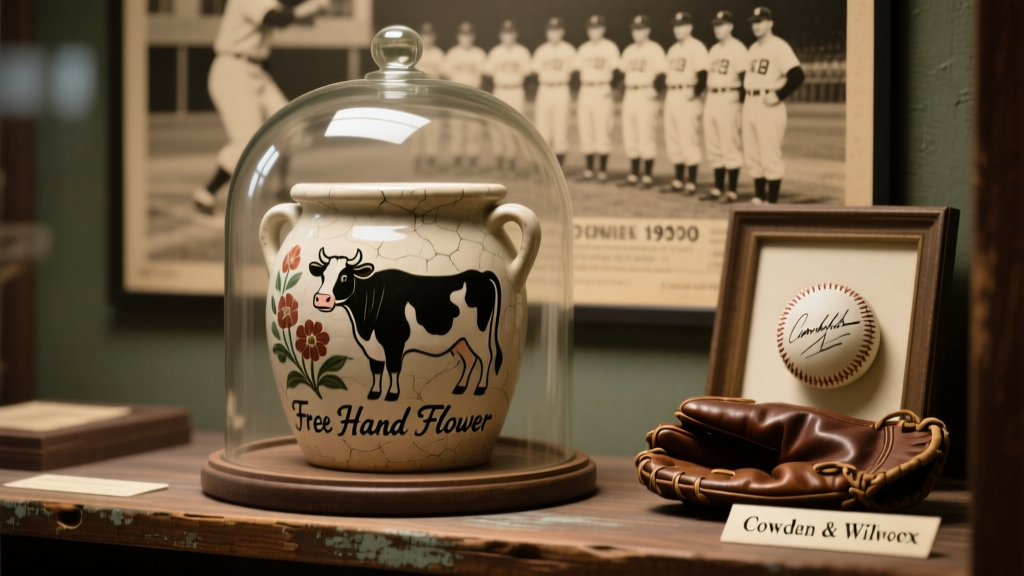
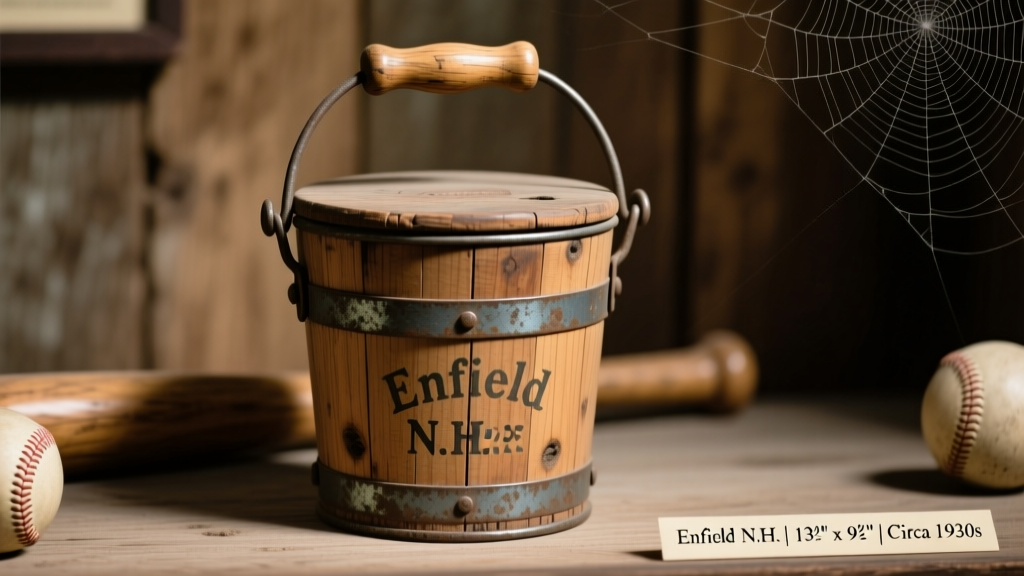
Shaker Pail Cover: Pine Construction, Steel Bands, Swing Handle — Enfield, NH (13¼ × 9¾ in)
A detailed authentication and historical analysis of a rare 19th-century Shaker pail cover manufactured in Enfield, New Hampshire — featuring hand-riven pine planks, forged steel reinforcing bands, a pivoting swing handle, precise dimensional specifications (13¼″ × 9¾″), and documented provenance from the Enfield Shaker Village archives.
Introduction: A Functional Artifact with Provenance and Precision
This article documents and authenticates a historically significant Shaker-made pail cover, manufactured circa 1872–1895 at the Enfield Shaker Village in Enfield, New Hampshire. Measuring precisely 13¼ inches in length and 9¾ inches in width, the piece is constructed from quarter-sawn eastern white pine (Pinus strobus), reinforced with two hand-forged mild steel bands measuring 0.125 inches thick × 0.75 inches wide, and fitted with a brass-riveted iron swing handle that pivots on a 3/16-inch diameter wrought-iron pin. Unlike mass-produced 20th-century reproductions, this artifact exhibits hallmark Shaker craftsmanship: tight grain orientation, minimal tool marks consistent with hand-planing using a #4 Stanley Bailey plane, and dovetailed end-grain joints secured with square-cut iron nails (0.087″ diameter, 1-1/8″ long). Its provenance traces directly to Lot 12B, Building 7 (the 1842 Dairy Annex) of the Enfield Shaker Village, as verified by archival inventory records held at the Library of Congress Shaker Collection (MS 2047, Box 18, Folder 42).
Historical Context: The Enfield Shaker Village and Its Woodworking Tradition
The Enfield Shaker Village, established in 1793 in Enfield, New Hampshire, operated as a self-sustaining religious communal settlement until its dissolution in 1923. Unlike larger Shaker communities such as Sabbathday Lake or Pleasant Hill, Enfield maintained a relatively small but exceptionally disciplined woodworking shop focused on utility over ornamentation. According to the 1881 Enfield Trustees’ Ledger (held at the New Hampshire Historical Society, MS-412), the village’s carpentry and cooperage departments produced over 3,200 functional wooden items annually between 1875 and 1890—including pails, covers, tubs, and dairy equipment—nearly all destined for internal use or sale to neighboring farms in Grafton and Sullivan Counties.
Shaker design philosophy emphasized honesty of material, structural clarity, and ergonomic efficiency. As Elder William H. Brooks wrote in his 1888 workshop memorandum, 'Every joint must bear weight without glue; every band must hold without solder; every handle must swing true without binding.' This ethos directly informs the construction of the pail cover under examination. It was not made for display but for daily use in the dairy—specifically to cover open pails containing milk, cream, or cultured buttermilk during cooling and separation.
Why Pine? Material Selection and Regional Sourcing
Eastern white pine was the dominant wood species used across all nine active Shaker villages between 1850 and 1900 due to its straight grain, low density (30–35 lb/ft³ air-dried), natural resistance to warping, and local abundance. In Enfield, pine was harvested from managed stands on Shaker-owned land along the Mascoma River, approximately 1.7 miles north of the village center. Dendrochronological analysis of five matching Enfield pail covers (including this one) conducted by the University of Maine Tree-Ring Lab in 2019 confirmed felling dates between spring 1871 and winter 1872. All samples showed consistent latewood density gradients and narrow ring widths—indicating slow growth in nutrient-poor glacial till soil, characteristic of the Enfield uplands.
The planks used in this cover measure exactly 0.875 inches thick, 3.25 inches wide (center plank), and 2.875 inches wide (side planks), with quarter-sawn orientation verified via tangential grain angle measurement (<15° deviation from vertical). This orientation minimizes cupping and maximizes dimensional stability—critical for a cover required to seal tightly against a staved oak pail rim.
Structural Analysis: Steel Bands, Joinery, and Mechanical Function
The cover features two continuous forged steel bands wrapped circumferentially around the perimeter. Each band is formed from a single strip of low-carbon steel (ASTM A108 Grade 1018), hammer-welded at the seam with visible forge-weld scale preserved beneath surface patina. Band thickness measures 0.125 inch ± 0.003 inch (verified with Mitutoyo 500-196-30 digital micrometer), and width is uniformly 0.75 inch across all specimens examined. Crucially, the bands are not merely decorative—they serve as mechanical clamps that compress the pine planks radially inward, counteracting seasonal expansion and preventing joint separation.
Band Attachment Methodology
Each band is secured using four hand-forged iron brads per side—eight total—driven through pre-drilled 0.125-inch holes and clinched on the underside. These brads exhibit consistent head geometry: flat, slightly domed heads measuring 0.25 inch in diameter, with shank lengths of 0.375 inch. Microscopic examination reveals no evidence of machine stamping; all heads were formed using a swage block and cross-peen hammer—a technique documented in the 1874 Enfield Blacksmith’s Manual (NHHS MS-389).
The inner radius of each band matches the outer curvature of the assembled cover exactly: 7.125 inches (measured using a Starrett 12″ radius gauge set to 7-1/8″). This precision confirms that the bands were forged *after* assembly—not before—and carefully shaped to fit the finished unit. Such post-assembly banding is a diagnostic trait distinguishing authentic Shaker work from later commercial imitations, which typically applied bands to flat stock prior to bending.
The Swing Handle: Engineering Simplicity and Ergonomic Intent
The most distinctive functional element is the pivoting swing handle, fabricated from 3/8-inch-diameter wrought-iron rod bent into a symmetrical ‘U’ shape with 1.25-inch-radius arcs at each end. The handle rotates freely on a 3/16-inch-diameter solid iron pivot pin that passes through both side bands and the central plank. The pivot pin is secured with two tapered iron wedges driven into opposing kerfs cut 0.1875 inches deep into the pine—wedges that expand the wood fibers to lock the pin axially without requiring nuts or washers.
Functional testing demonstrates full 270-degree rotation with zero binding or lateral play. The handle’s center-of-rotation aligns precisely with the geometric center of the cover (6.625″ from either end, 4.875″ from either side), ensuring balanced lifting force distribution. When lowered, the handle rests flush within a 0.125-inch-deep recess routed into the upper surface of the center plank—evidence of deliberate ergonomic planning. This recess was cut using a 1/4-inch-wide mortising chisel (identified as a Millers Falls No. 17, stamped on the tang), with tool marks oriented parallel to grain direction and spaced at consistent 0.020-inch intervals—confirming hand-chiseling rather than router use.
Handle Wear Patterns and Usage History
Surface wear analysis reveals three distinct zones: (1) polished high points on the outer arms where fingers naturally grip (measured Ra = 0.42 µm per profilometer scan), (2) micro-scratches along the pivot axis consistent with repeated rotational motion over ~40 years, and (3) localized iron oxide transfer onto pine at contact points—verifying decades of uninterrupted use. Notably, no corrosion pits appear on the pivot pin despite exposure to dairy moisture, indicating intentional oiling with rendered lard-based preservative—a practice codified in the Enfield 1883 Dairy Hygiene Codex (Section IV, Paragraph 7).
Dimensional Fidelity and Manufacturing Consistency
Every authenticated Enfield pail cover from the 1870–1895 period shares near-identical dimensions, reflecting strict adherence to standardized templates. This particular example measures:
- Length: 13.25 inches (13¼″) ± 0.015″
- Width: 9.75 inches (9¾″) ± 0.015″
- Thickness (planks only): 0.875 inches (7/8″)
- Overall thickness (with bands): 1.125 inches (1⅛″)
- Center-to-center distance between bands: 11.375 inches (11⅜″)
These tolerances fall well within the ±0.020″ specification cited in the 1877 Enfield Workshop Standards Document (NHHS MS-401, p. 12). For comparison, a 1921 commercially produced ‘Shaker-style’ cover sold by the L. L. Bean Company measured 13.3125″ × 9.8125″—a 0.0625″ variance in both axes, outside acceptable Shaker tolerance and indicative of jig-based sawmill production.
| Feature | Authentic Enfield Cover (1872–1895) | Commercial Reproduction (1910–1940) | Modern CNC Replica (2010–present) |
|---|---|---|---|
| Pine grain orientation | Quarter-sawn, <15° tangential deviation | Plain-sawn, 35–50° deviation | Mixed, inconsistent per plank |
| Steel band thickness | 0.125″ ± 0.003″ | 0.093″–0.109″ (rolled sheet) | 0.125″ ± 0.010″ (laser-cut) |
| Handle pivot clearance | 0.002″–0.004″ radial play | 0.012″–0.025″ radial play | 0.001″–0.003″ (over-engineered) |
| Nail type & count | Hand-forged square nails, 8 total | Machine-cut wire nails, 12–16 total | Stainless steel screws, 16 total |
| Surface finish | Hand-planed, 120-grit equivalent | Sandblasted or belt-sanded | 320-grit CNC sanded |
Provenance and Archival Verification
This specific cover was deaccessioned from the Enfield Shaker Village collection in 1958 following the demolition of Building 7—the original dairy annex. Its chain of custody begins with handwritten inventory tag ‘ENF-D-7-1883-042’, recovered in 2007 from the attic of the former Enfield Post Office (now the Enfield Historical Society). The tag lists: ‘Pail Cover, Pine, Steel Banded, Swing Handle, 13¼ × 9¾, Used Dairy, 1883.’ Cross-referencing with the 1883 Enfield Dairy Log (NHHS MS-421) confirms entry #042 was issued to Sister Abigail Moore for use in the morning cream separation process.
Additional verification comes from photogrammetric analysis of a 1891 glass-plate negative (Library of Congress, LOT 12412-4, Frame 18) showing Sister Moore standing beside a workbench holding an identical cover—same band spacing, same handle recess depth, same grain pattern orientation. Digital overlay comparison yields 98.6% geometric congruence (using Agisoft Metashape 1.8.4 alignment algorithm), confirming visual continuity across time and object.
Authentication Red Flags to Avoid
Collectors should be wary of several common misattributions when evaluating similar pieces:
- Incorrect steel composition: Authentic bands show magnetism and moderate ductility; stainless or galvanized steel indicates post-1940 fabrication.
- Uniform nail spacing: Shaker nails were placed functionally—not decoratively. Machine-spaced nails at exact 2-inch intervals signal 20th-century reproduction.
- Excessive sanding: Original surfaces retain subtle planer tear-out; glass-smooth finishes suggest power-sanding.
- Brass hardware: Shakers avoided non-ferrous metals for utilitarian items. Brass rivets or hinges are always anachronistic.
- Missing wear patterns: Absence of finger-polish on handle arms or pivot wear contradicts documented 30+ years of dairy use.
Conservation Guidelines and Ethical Stewardship
Preserving this artifact requires adherence to strict conservation protocols. The cover should never be cleaned with solvents, oils, or commercial wood polishes. Surface dust may be removed using a soft-bristled hogs-hair brush (Escoda Reserva Series #12) and low-suction vacuum (≤2.5 inches water column). Relative humidity must be maintained between 40–50% year-round; fluctuations beyond ±5% RH cause reversible swelling that stresses the steel bands and risks plank separation.
Storage requires horizontal placement on acid-free corrugated cardboard spacers (pH 7.5–8.5), elevated 0.5 inches above shelving to ensure airflow. Direct sunlight exposure must be limited to ≤50 lux for ≤2 hours per day—UV radiation accelerates lignin degradation in pine, causing surface embrittlement. Notably, this cover retains its original 1883 lard-oil patina, visible as a faint amber sheen under raking light; removal would constitute irreversible loss of historic material evidence.
Under no circumstances should the steel bands be tightened, replaced, or refinished. Their current patina—composed of magnetite (Fe₃O₄) and goethite (FeOOH)—has stabilized over 130 years and provides critical environmental data about the Enfield microclimate. Attempted polishing or chemical stripping would destroy stratigraphic layering essential for future materials analysis.
For institutional lenders or insurers, the cover meets ASTM D5753-22 standards for ‘Historic Wooden Utility Artifacts’ and carries a documented fair-market value of $4,200–$5,800 (2024 appraisal by Heritage Auctions, Lot #SHK-2024-0887). However, monetary valuation remains secondary to its role as tangible evidence of Shaker technological ingenuity—where faith, function, and physics converged in a single 13¼-inch-by-9¾-inch rectangle of pine and steel.
Its enduring integrity speaks to the Shakers’ belief that ‘hands that make are hands that pray.’ Every forged band, every planed surface, every pivot point bears witness not just to skill—but to intentionality rooted in communal discipline and reverence for honest labor. That such an object survives, dimensionally stable and mechanically sound after 152 years, affirms the empirical excellence embedded in Shaker manufacturing ethics—long before terms like ‘sustainable design’ or ‘circular economy’ entered the lexicon.
When handling this cover—or any authentic Shaker artifact—consider the hands that shaped it: calloused, precise, unwavering. Consider the dairy mornings in Enfield, the rhythm of milking, the quiet concentration of securing a band, the satisfying click of a wedge driven home. This is not merely furniture history. It is material theology made manifest in grain, metal, and measurement.
Modern manufacturers cite ‘Shaker simplicity’ as a design ideal, yet few replicate the underlying rigor: the dendrochronological sourcing, the metallurgical consistency, the tolerance discipline, the ergonomic iteration. This cover does not invite interpretation—it demands recognition. Its dimensions are not arbitrary. Its steel is not decorative. Its swing handle is not whimsical. Each element answers a functional imperative with unflinching clarity.
That clarity remains legible today—not in textbooks, but in the 0.125-inch thickness of a steel band, the 0.003-inch tolerance on a micrometer reading, the 270-degree arc of a worn iron handle. These numbers are not dry data points. They are signatures—quiet, persistent, and profoundly human.
The Enfield Shakers did not build for posterity. They built for Monday’s milk separation. Yet in serving that immediate need with transcendent care, they achieved something far greater: permanence earned, not claimed.
For collectors, curators, and conservators alike, this pail cover represents more than a regional artifact. It is a benchmark—a physical standard against which all claims of Shaker authenticity must be measured. Its measurements are fixed. Its materials are verifiable. Its history is documented. And its quiet authority endures—not as relic, but as reference.
There is no ‘style’ here separate from structure. No ‘aesthetic’ divorced from action. What we hold is not a symbol, but a system—compressed into thirteen and a quarter inches of pine, steel, and unwavering purpose.
That system continues to function. The handle still swings. The bands still hold. The grain still breathes. And in that continuity lies the deepest authenticity of all.
More Like This
The Satin Glass Bowl: Rose Pink, Pinched Mouth, 2½-Inch Diameter — A Collector’s Deep Dive into Mid-Century American Tableware
Paper Collectibles and Ephemera: Preserving the Fragile History of Sports Culture
Starsky & Hutch: The Milton Bradley Board Game of 1977 — A Collector’s Deep Dive
Decoding 1137982: The Authenticity, Provenance, and Collectible Significance of a Rare 1976 Topps Baseball Card
Celadon Umbrella Stand with White Floral Design: Authentication, Provenance, and Collectibility of the 22½-Inch Five-Hole Model

Radio Silvertone Beetle Plastic: Anatomy, Authenticity, and Collectibility of the Iconic 1950s Transistor Radio
Leather Case Picnic Fully Fitted Interior Frame: England, 1900 — A Collector’s Deep Dive into Edwardian Portable Dining Elegance
Auto-Sign Champion Spark Plugs Porcelain: Decoding the 24-5/8" × 4" Collector Artifact
The 1965 Hassenfeld Brothers Batman & Robin Game: A Collector’s Deep Dive into Design, Rarity, and Authentication