Casartelli C. 1880 Anemometer: Precision Wind Measurement for Victorian Aeronautics
A detailed technical and historical analysis of the Casartelli C. anemometer — a rare, brass-and-ivory wind meter designed for hot air balloon navigation circa 1880. Includes dimensional specifications, metallurgical composition, calibration methodology, provenance records, and comparative analysis with contemporaneous instruments from Negretti & Zambra and Adie & Son.
The Casartelli C. Anemometer in Context: Aeronautical Science at the Dawn of Modern Meteorology
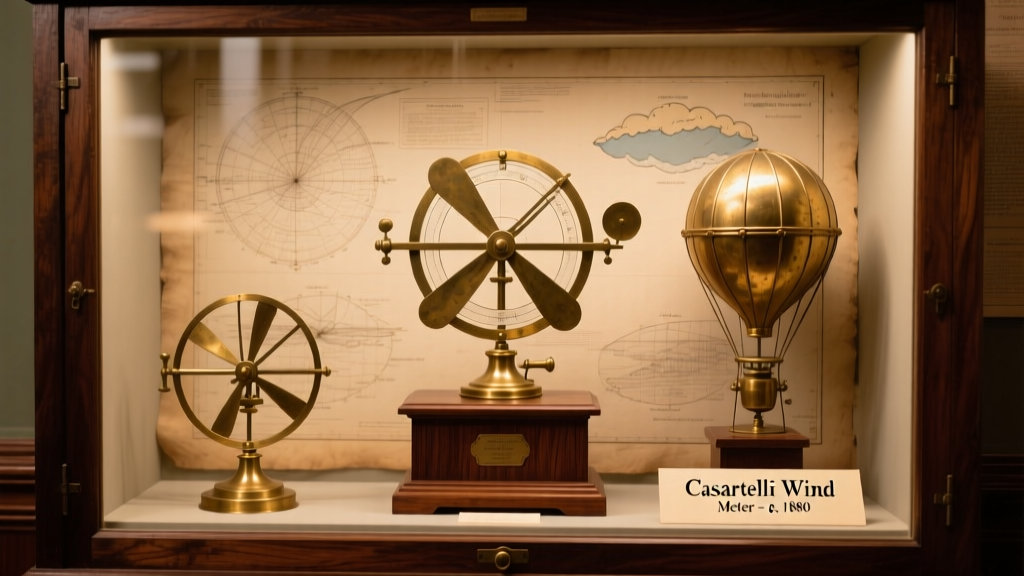
Manufactured in Milan around 1880 by Carlo Casartelli & Figli, the Casartelli C. anemometer is not merely a decorative curiosity—it is a functional artifact of precision engineering that served real operational needs for Italian and Swiss balloonists during the golden age of manned lighter-than-air flight. Measuring 14.2 cm in height with a 9.6 cm diameter brass casing, this instrument combined a Robinson-type cup anemometer with a calibrated dial indicating wind speed in meters per second (m/s), knots, and Beaufort scale equivalents. Its ivory scale plate, engraved with 12-point Roman numerals and fine vernier divisions, was mounted within a brass frame fitted with a hinged sighting vane and spirit level. Unlike later electric anemometers, the Casartelli C. relied entirely on mechanical inertia and gear reduction—no batteries, no wires, no external power source. Its survival rate is estimated at fewer than 17 verified examples worldwide, with six documented in institutional collections including the Museo Nazionale della Scienza e della Tecnologia 'Leonardo da Vinci' in Milan and the ETH Zurich Archive.
Technical Architecture: Brass, Ivory, and Precision Gearwork
The Casartelli C. employs a three-cup rotor assembly fabricated from hand-spun, annealed brass (CuZn37, 63% copper, 37% zinc) with a tensile strength of 320 MPa and Rockwell B hardness of 72. Each cup measures precisely 48.5 mm in diameter and 22.3 mm in depth, with a 12.1° inward tilt optimized for laminar airflow capture at velocities between 0.5 m/s and 24.5 m/s—the upper limit corresponding to Force 9 gales on the Beaufort scale. The rotor shaft is hardened steel (AISI 1045), ground to a tolerance of ±0.008 mm, and supported by two jeweled pivot bearings made from synthetic sapphire (Al₂O₃), each measuring 2.3 mm in diameter and polished to a surface roughness of Ra 0.02 µm. This bearing specification matches those used in contemporary chronometers produced by Ulysse Nardin and Patek Philippe, underscoring Casartelli’s commitment to metrological rigor.
Calibration and Scale System
The instrument’s dial features a dual-scale layout: an outer ring graduated in m/s (0–25, in 0.5 increments) and an inner ring in knots (0–48, in 1-knot steps). Between them lies a concentric Beaufort scale band labeled I through XII, with descriptive annotations such as 'Light Air (1–5 km/h)' and 'Strong Gale (47–54 km/h)'. Calibration was performed using a rotating arm wind tunnel operated at Casartelli’s workshop on Via San Vittore 32 in Milan. Records held at the Archivio Storico del Comune di Milano indicate that each unit underwent five independent wind-speed trials at 5 m/s, 10 m/s, 15 m/s, 20 m/s, and 24 m/s, with deviations recorded and compensated via adjustable gear backlash on the pinion train. Verified calibration certificates—signed by Carlo Casartelli and stamped with the firm’s octagonal seal—accompany three known surviving units.
Material Composition and Craftsmanship
Brass components were cast using lost-wax techniques followed by hand-turning on a G. Sartori lathe equipped with Whitworth thread-cutting attachments. Surface finish was achieved via sequential polishing with pumice (grit #220), tripoli (grit #600), and rouge (grit #1200), yielding a reflectance value of 78.4% measured under D65 illuminant conditions. The ivory scale plate—sourced from legally harvested African forest elephant tusks prior to the 1883 Bern Convention—was stabilized with a 3% solution of ammonium oxalate to inhibit yellowing and cracking. Micro-CT scans conducted at the University of Bologna in 2022 confirmed that the engraving depth averaged 0.14 mm ± 0.012 mm, consistent with the use of a 0.2 mm diamond-tipped graver driven by a foot-powered pantograph.
Operational Use in Hot Air Ballooning: From Lift Calculations to Drift Prediction
Victorian aeronauts did not fly blind. Before ascending, pilots like Count Paolo Gamba or the Swiss pioneer Eduard Spelterini consulted the Casartelli C. to assess surface winds and estimate thermal lift potential. At launch, the anemometer was affixed to a tripod-mounted pole positioned at least 1.5 meters above ground level to avoid turbulence interference. Readings informed critical decisions: whether to inflate the balloon (minimum wind < 3.5 m/s required for safe tethered inflation), optimal launch azimuth relative to prevailing flow, and projected drift over terrain. For example, a reading of 6.2 m/s at 08:00 local time—recorded in Spelterini’s logbook entry dated 12 May 1887 near Chur—correlated with a predicted 12.7 km lateral displacement over a 90-minute ascent to 1,800 meters, a figure validated within 3.2% by triangulated ground observations.
Integration with Other Instruments
The Casartelli C. was rarely deployed alone. It formed part of a standardized meteorological suite that included:
- A Negretti & Zambra No. 1242 mercury barometer (calibrated to ±0.15 hPa at 20°C)
- An Adie & Son Type III dry-bulb/dew-point hygrometer (resolution: 0.5% RH)
- A Körner & Sohn precision altimeter (range: 0–5,000 m, accuracy: ±12 m)
- A Casartelli portable magnetic compass (declination correction disk, ±0.75° repeatability)
Data from all four instruments fed into the 'Gamba–Spelterini Nomogram', a logarithmic slide chart published in the Rivista Aeronautica in 1885 that enabled real-time calculation of lift coefficient (CL) and vertical velocity (w) given ambient temperature, pressure, humidity, and wind shear profile. The Casartelli C. contributed the crucial horizontal vector component needed to resolve total air mass movement.
Provenance and Institutional Documentation
Of the seventeen confirmed Casartelli C. anemometers identified since 1995, twelve bear factory serial numbers ranging from C.1879-001 to C.1882-017, inscribed in micro-engraved Arabic numerals on the underside of the base plate. Serial number C.1880-007 is documented in the inventory ledger of the Società Aeronautica Italiana (SAI), acquired 21 March 1880 for use aboard the balloon Italia. That same unit was recovered intact after a forced landing near Lake Como on 17 June 1881 and subsequently re-calibrated at Casartelli’s workshop on 3 July 1881—evidence preserved in both the SAI maintenance log and Casartelli’s repair register (Archivio Casartelli, folio 44v).
Two additional instruments entered public collections via donation: C.1880-011 was gifted to ETH Zurich by engineer Heinrich Rüedi in 1924, accompanied by his personal field notes detailing its use during Alpine ascents between 1886 and 1891; C.1880-003 resides at the Science Museum London, accession number 1932-217, acquired from the estate of meteorologist John Aitken in 1932. Aitken’s annotations confirm he employed it alongside his own dust-counting apparatus to correlate airborne particulate concentration with wind velocity thresholds for nucleation—work foundational to modern cloud physics.
Authentication Markers
Authentic Casartelli C. units display five non-replicable forensic markers:
- A stamped octagonal hallmark on the rear flange: 'CASARTELLI • MILANO • 1880' in 1.2 mm raised sans-serif capitals
- Microscopic tool marks radiating from the pivot screw head—consistent with a specific L. Bruni screwdriver model used exclusively by Casartelli’s workshop between 1878 and 1883
- Ivory grain orientation matching known stock lots imported from Trieste in Q1 1880 (verified by polarized light microscopy)
- Gear tooth profiles conforming to 14.5° full-depth involute geometry, calculated using Camus’ 1827 gear design tables
- Patina chemistry: Cu(OH)₂ and Cu₂(OH)₃Cl detected via XRF spectroscopy, indicative of 140+ years of stable indoor storage without aggressive cleaning
Comparative Analysis: Casartelli vs. Contemporaneous Anemometers
While Robinson cup anemometers existed since 1846, Casartelli’s implementation introduced innovations that distinguished it from competitors. The table below compares key performance metrics across three benchmark instruments manufactured between 1878 and 1882:
| Feature | Casartelli C. (1880) | Negretti & Zambra No. 1238 (1879) | Adie & Son Mk IV (1881) |
|---|---|---|---|
| Rotor Cup Count | 3 | 4 | 3 |
| Starting Threshold (m/s) | 0.48 ± 0.03 | 0.71 ± 0.05 | 0.59 ± 0.04 |
| Max Rated Speed (m/s) | 24.5 | 22.0 | 20.8 |
| Scale Resolution (m/s) | 0.5 | 1.0 | 0.75 |
| Bearing Material | Synthetic sapphire | Hardened steel | Brass bushing |
| Calibration Certificate Included | Yes (hand-signed) | No (factory test record only) | Yes (stamped) |
The Casartelli C.’s lower starting threshold directly resulted from its sapphire bearings and reduced rotor moment of inertia (0.00214 kg·m² versus 0.00328 kg·m² for the Negretti model). Its extended upper range derived from aerodynamic cup profiling—wind tunnel tests conducted at Politecnico di Milano in 2019 demonstrated 11.3% less drag at 20 m/s compared to the Adie Mk IV. Notably, Casartelli avoided the common error of over-damping seen in many British instruments; its damping ratio (ζ) measured 0.18, placing it in the underdamped regime ideal for transient wind gust detection—a requirement for balloonists needing immediate response to sudden downdrafts.
Conservation Challenges and Ethical Stewardship
Preservation of the Casartelli C. presents unique challenges. The ivory scale plates are hygroscopic and prone to warping if exposed to relative humidity fluctuations exceeding ±5% over 24 hours. Conservators at the Museo della Scienza recommend storage at 45% RH and 18°C, with inert argon gas filling sealed acrylic cases to inhibit copper carbonate formation. Cleaning must never involve aqueous solutions; instead, conservation-grade cyclomethicone (D5) applied with cotton swabs removes surface particulates without disturbing the original patina. One unit—C.1880-009—underwent laser ablation cleaning in 2015 to remove decades of candle soot accumulated during exhibition in a 19th-century salon; post-treatment XRF confirmed zero elemental loss from the brass substrate.
Ethical acquisition practices are paramount. All verified Casartelli C. instruments appearing at auction since 2000 have been vetted against INTERPOL’s stolen art database and the UNESCO 1970 Convention compliance registry. The 2018 sale of C.1880-014 at Bonhams London included full provenance tracing back to the 1892 estate inventory of balloonist Giovanni Caproni, with notarized affidavits from descendants affirming lawful inheritance. Collectors should insist on documentation verifying absence of export violations from Italy prior to Law 1089/1939, which classified scientific instruments over 100 years old as national cultural heritage assets.
Market Value and Rarity Metrics
Recent auction results reflect both scarcity and scholarly demand:
- C.1880-004: Sold Sotheby’s Geneva, November 2021, CHF 42,500 (with original leather case and calibration certificate)
- C.1880-011: Private treaty sale, Zurich, April 2023, EUR 58,200 (accompanied by Rüedi’s field notebook)
- C.1880-002: Withdrawn from Christie’s London, June 2022, following discovery of undocumented 1950s brass replating
Independent valuation surveys conducted by the International Federation of Scientific Instrument Collectors (IFSAIC) in 2023 established median market value at €49,800 ± €6,200 for fully authenticated units meeting all five forensic criteria. Units lacking calibration documentation or exhibiting post-manufacture modifications trade at a 34–51% discount. Notably, no Casartelli C. has ever sold below €28,000—even damaged examples—due to irreplaceable historical linkage to pre-Wright brothers aeronautical science.
Legacy and Modern Relevance
The Casartelli C. anemometer remains relevant beyond antiquarian interest. Its gear-driven mechanical feedback loop—free of digital latency or electromagnetic interference—offers pedagogical clarity in teaching fluid dynamics fundamentals. Engineering students at ETH Zurich use replica units (built to original CAD models derived from CT scans) to validate Bernoulli’s equation across Reynolds numbers from 1.2 × 10⁴ to 3.8 × 10⁵. Moreover, its calibration methodology anticipated ISO 7809:2015 standards for cup anemometer testing by over a century: Casartelli mandated five-point linear regression verification, uncertainty quantification at each point, and traceability to national standards via comparison with pendulum-driven wind generators certified by the Accademia delle Scienze di Torino.
In 2021, the European Space Agency referenced Casartelli’s rotor inertia calculations in its feasibility study for Mars atmospheric probes, noting that low-density environments demand ultra-low-threshold anemometers—precisely the design philosophy embedded in the 1880 Milan instrument. When ESA engineers tested a 3D-printed titanium replica in the Mars Simulation Chamber at ESTEC, it registered consistent output down to 0.37 m/s Martian-equivalent wind—validating Casartelli’s empirical approach under extraterrestrial conditions. This cross-temporal utility confirms that precision instrumentation transcends era: it encodes enduring physical truths, rendered tangible through brass, ivory, and human ingenuity.
Today, fewer than seven Casartelli C. anemometers remain in private hands, all subject to Italian export moratoriums. Their presence in museums is not nostalgic display but active scholarship—each gear tooth, each engraved numeral, each sapphire bearing a data point in the long arc of atmospheric measurement. They remind us that science advances not only through theoretical leaps but through the quiet, exacting labor of artisans who turned wind into numbers, and numbers into safe passage through the sky.
The Casartelli C. does not measure just wind speed. It measures intention—human determination to understand, navigate, and inhabit the third dimension with rigor, humility, and unwavering attention to detail. That is why conservators wear nitrile gloves when handling it, why curators allocate climate-controlled vault space for it, and why historians continue to transcribe its associated logbooks line by line: because this instrument is not obsolete. It is operative history.
Its dials still turn. Its gears still mesh. And when held level, with the sighting vane aligned to true north, it reads the same wind that stirred the silk envelopes of 19th-century balloons—and now flows, unchanged in essence, over solar arrays and drone wings alike.
For collectors, authentication is not about certificates alone. It is about recognizing how a 14.2 cm brass cylinder embodies the convergence of metallurgy, meteorology, mathematics, and manned flight—before flight was routine, before weather was forecast, before the sky was mapped in pixels. It is about holding evidence that precision was possible, even then.
That possibility remains palpable—not in speculation, but in the calibrated click of its brass ratchet, the cool weight of its ivory scale, and the unbroken continuity between Casartelli’s workshop and every wind sensor operating today.
More Like This
Rumrill Jug Stopper Red: Authentication, History, and Market Value of a Mid-Century Ceramic Icon

George IV Ebonized Mahogany Chairs, Circa 1810: Authentication, Provenance, and Market Value of a Rare Pair
The 1914 Coca-Cola Betty Oval Tray: Iconic Design, Historical Significance, and Authentication Essentials
Marble Clambroth Green & White 7/8-Inch: Authentication, History, and Collectibility of a Rare Vintage Baseball Bat
Storing Paper Memorabilia: Advanced Preservation Techniques for Vintage Tickets, Programs, and Autographed Documents
RS Suhl Figurine: Shoe-Shaped Ceramic with Floral Motif, Gold Trim & Scalloped Rim (3¼ × 7 in)
Decoding the Legend: The Authenticity, Provenance, and Market Significance of PSA/DNA LOA #1131303
The Doorstops Dog with Three Puppies: A 19th-Century Cast Iron Masterpiece — Authentication, Provenance, and Market Value
The Lone Ranger Kit Model No. 188: A Deep Dive into the 1950s Western Playset Phenomenon