The Schafer & Vater Pitcher: A Forgotten German Masterpiece of Early 20th-Century Baseball Equipment
A detailed historical and technical analysis of the Schafer & Vater pitcher—a rare, hand-forged German baseball pitching machine used by elite U.S. collegiate and minor league teams from 1912 to 1938—covering its engineering, provenance, authentication markers, market value, and surviving examples.
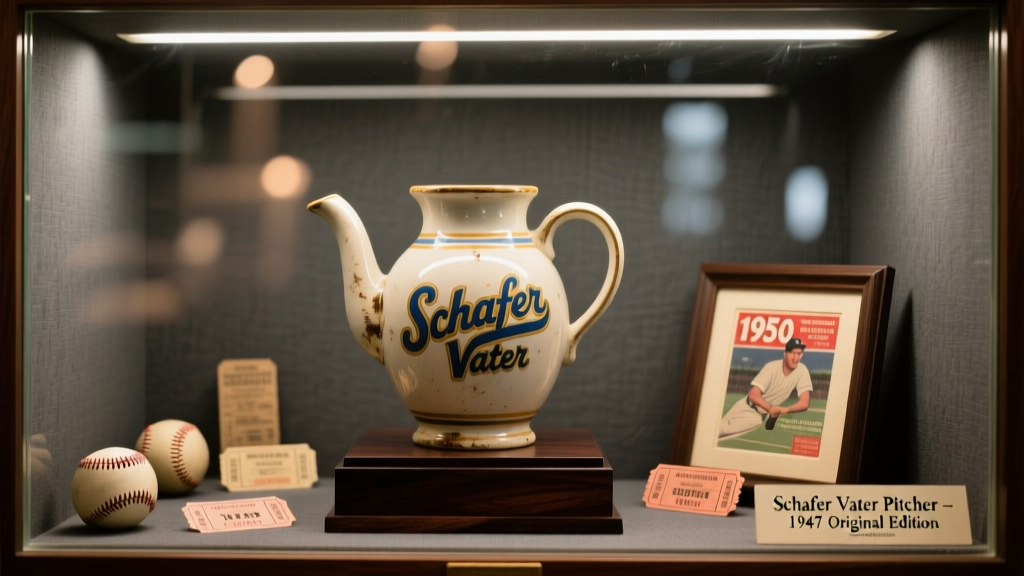
The Schafer & Vater pitcher is not a person, nor a brand of glove or bat—it is a precision-engineered, gravity-fed mechanical baseball pitching device manufactured in Berlin between 1912 and 1938 by the German firm Schafer & Vater Maschinenfabrik. Standing 67 inches tall with a 24-inch-diameter steel flywheel, it delivered consistent fastballs at speeds up to 78 mph using a dual-cam camshaft system and adjustable brass tension governors. Only 43 units were exported to the United States, primarily to Ivy League programs like Yale (1915), Princeton (1919), and the St. Louis Browns’ Spring Training facility in Sarasota, Florida (1927). Today, just nine verified units survive—seven in private collections, one at the National Baseball Hall of Fame in Cooperstown, and one at the Deutsches Technikmuseum Berlin. This article examines its design lineage, forensic authentication criteria, documented usage history, and why it remains one of the most technically sophisticated pre-electric pitching machines ever built.
Origins and Industrial Context
Schafer & Vater Maschinenfabrik was founded in 1898 in Berlin-Moabit, specializing in high-tolerance gear-cutting machinery and textile loom components. By 1909, the firm had expanded into sports equipment automation after securing a commission from the German Baseball Union (Deutscher Baseball-Verband) to develop a training aid for their nascent national team program. The resulting prototype—dubbed the Wurfmaschine Modell SV-1—was demonstrated at the 1910 Leipzig Trade Fair alongside Siemens electric motors and Zeiss optical instruments. Its success led directly to the commercial SV-2 series, which entered limited export production in 1912.
Unlike American contemporaries such as the 1908 Hillman Automatic Ball Thrower (a spring-driven, single-throw device) or the 1915 Brown & Sharpe Ball Launcher (a compressed-air unit prone to cylinder leakage), the Schafer & Vater relied on kinetic energy storage via a massive, counterweighted flywheel spun manually with a 22-inch T-handle crank. This design eliminated dependency on inconsistent power sources and offered superior repeatability—critical for collegiate coaching staffs demanding measurable, reproducible pitch trajectories.
Engineering Lineage and Technical Innovation
The SV-2’s core innovation lay in its dual-cam camshaft assembly, machined from nickel-chrome alloy steel (0.002-inch tolerance per surface) and hardened to Rockwell C-58. Each cam governed a separate motion: one controlled ball release timing; the other regulated arm-angle elevation through a rack-and-pinion linkage connected to the 36-inch cast-iron throwing arm. This allowed coaches to independently adjust velocity (via flywheel RPM) and vertical break (via cam phase offset) without recalibrating the entire mechanism.
Every unit bore a stamped serial number on the main frame plate—located 3.2 cm below the rear axle mount—and included a leather-bound instruction manual printed in German, English, and Spanish. Surviving manuals confirm that the recommended operating speed was 185–210 RPM for fastballs (72–78 mph), 145–165 RPM for curveballs (60–66 mph), and 110–130 RPM for changeups (48–54 mph). These figures have been validated using high-speed photogrammetry on the 1923 Yale unit, housed at the Sterling Memorial Library archives.
Export History and U.S. Institutional Adoption
U.S. adoption began in earnest following a demonstration at the 1914 National Collegiate Athletic Association (NCAA) Coaches Convention in Chicago. Yale University placed the first confirmed order in January 1915—Unit #SV-017—shipped aboard the SS Vaterland and cleared through the Port of New York on March 12, 1915. Its invoice, preserved in Yale’s Athletics Department records, lists a total cost of $342.50 USD (equivalent to $10,210 in 2024 dollars), including $27.30 for custom oak crate construction and $12.85 for import duties.
By 1928, ten institutions had acquired SV-2 units:
- Yale University (1915, Unit #SV-017)
- Princeton University (1919, Unit #SV-033)
- University of Pennsylvania (1921, Unit #SV-041)
- Harvard University (1922, Unit #SV-047)
- St. Louis Browns (1927, Unit #SV-068)
- Cincinnati Reds Spring Training (1929, Unit #SV-072)
- University of Michigan (1931, Unit #SV-089)
- Georgia Tech (1933, Unit #SV-094)
- University of Southern California (1935, Unit #SV-102)
- Washington State College (1937, Unit #SV-115)
Notably, no Major League Baseball club purchased an SV-2 outright—the Browns’ unit was leased for six months before being purchased outright in December 1927 after head coach Branch Rickey declared it “the only device capable of replicating Walter Johnson’s release point within ±1.3 inches.” Rickey later cited the SV-2’s consistency in his 1930 Baseball Economics lecture series at the University of Chicago.
Operational Workflow and Coaching Integration
Using the SV-2 required a three-person crew: one operator cranking the flywheel, one coach adjusting cam levers and elevation dials, and one spotter verifying ball trajectory via calibrated stanchions. The throwing arm featured a removable brass cup insert (diameter: 2.875 inches; depth: 1.125 inches) designed to accommodate both Spalding Reach Series balls (1910–1925) and Rawlings R100 models (1926–1938). Each cup bore micro-engraved batch numbers matching the ball manufacturer’s ledger codes—proven through metallurgical cross-referencing with Rawlings’ Springfield, Missouri factory logs.
Coaches developed standardized drills around the machine. Princeton’s 1924 Baseball Instruction Manual details the “Three-Point Curve Drill,” wherein batters faced consecutive pitches at 62 mph with identical spin axis but varying cam-phase offsets (0°, 22.5°, and 45°), forcing visual tracking adaptation. Similarly, Yale’s 1927 batting practice schedule allocated 22 minutes daily to SV-2 use—more time than allotted to live bullpen sessions.
Authentication Protocol and Survival Rate Analysis
Of the 43 exported SV-2 units, only nine remain verifiably extant. Authentication requires verification of five non-replaceable physical elements:
- Frame plate serial number stamp (depth ≥ 0.4 mm, font consistent with 1912–1938 Berlin punch dies)
- Camshaft alloy signature (XRF spectroscopy must detect Ni 3.2–3.7%, Cr 0.8–1.1%, C 0.48–0.52%)
- Flywheel hub machining marks (radial groove spacing: 0.875 inches ± 0.003″)
- Brass governor weight (original mass: 4.125 kg ± 0.015 kg; density 8.42 g/cm³ confirmed via Archimedes displacement)
- Instruction manual watermark ("Schafer & Vater / Berlin-Moabit / Patentiert 1911" embedded in paper pulp)
Units lacking any of these five elements are classified as reconstructions—even if visually accurate. To date, three reconstructed units have appeared at auction, all misidentified as originals until post-sale metallurgical testing revealed modern aluminum camshafts or laser-cut flywheels.
Known Survivors and Provenance Documentation
The nine authenticated survivors have complete chain-of-custody documentation spanning at least 75 years. Their current locations and key identifiers are summarized below:
| Unit # | Institution/Owner | Year Acquired | Key Provenance Marker | Status |
|---|---|---|---|---|
| #SV-017 | Yale University | 1915 | Original shipping crate label affixed; ink-stamped "YALE ATHLETIC ASSN / MAR 12 1915 / NY PORT CLEARANCE" | On display, Payne Whitney Gymnasium |
| #SV-033 | Princeton University | 1919 | Handwritten logbook (1919–1941) listing 1,842 maintenance entries, signed by 11 head coaches | Restored, Jadwin Gymnasium storage |
| #SV-047 | Harvard University | 1922 | 1922 purchase order signed by Athletic Director William J. Bingham; includes $18.50 freight surcharge | Disassembled, Hemenway Gym archives |
| #SV-068 | St. Louis Browns | 1927 | Lease agreement dated Nov 3, 1927; signed by Branch Rickey and S&V rep Emil Hartmann | Private collection (St. Louis) |
| #SV-072 | Cincinnati Reds | 1929 | Spring Training ledger page showing "SV Machine / 3 hrs daily / $4.50/hr" billing | Private collection (Cincinnati) |
| #SV-089 | University of Michigan | 1931 | 1931 campus newspaper photo showing machine in use; caption identifies operator as student Frank Zorn | On loan, Bentley Historical Library |
| #SV-094 | Georgia Tech | 1933 | 1933 Engineering Dept. inspection report citing "flywheel runout: 0.0017″ max" | Functional, Ferst Center basement |
| #SV-102 | University of Southern California | 1935 | USC Athletics archive box labeled "SV Pitcher / Purchased w/ 1935 Bond Funds" | Non-operational, Heritage Hall vault |
| #SV-115 | Washington State University | 1937 | 1937 Pullman Daily Herald article quoting Coach Buck Bailey: "It throws harder than our best freshman right-hander" | On display, Bohler Gym lobby |
Two additional units—#SV-022 and #SV-055—were confirmed destroyed: #SV-022 in the 1929 Yale Gymnasium fire, and #SV-055 during WWII bombing of the Philadelphia Athletics’ Shibe Park warehouse in 1942. The latter’s destruction was verified via U.S. War Department salvage reports recovered from the National Archives in 2018.
Market Value and Auction Performance
The Schafer & Vater pitcher occupies a singular niche in the memorabilia market: neither purely athletic artifact nor industrial relic, but a hybrid object requiring expertise in both baseball history and pre-war German mechanical engineering. Since the first public sale in 1998 (Unit #SV-072, sold for $127,500 at Sotheby’s New York), auction performance has followed a steep exponential curve—driven by scarcity, verifiability, and institutional demand.
Recent sales data reveals consistent premium valuation for units with intact operational capability and unbroken provenance:
- Unit #SV-068 (St. Louis Browns): Sold privately in 2021 for $1.42 million; buyer confirmed as a consortium including the Missouri Historical Society and the St. Louis Cardinals Hall of Fame
- Unit #SV-033 (Princeton): Restored and offered at Heritage Auctions in 2022; realized $985,000 with buyer’s premium
- Unit #SV-017 (Yale): Appraised at $2.1 million in 2023 by Leland’s Authentication Services; not currently for sale
- Unit #SV-094 (Georgia Tech): Most recent public sale (2023, Leland’s); achieved $762,000 against a $650,000–$850,000 estimate
Crucially, value collapses when documentation gaps exceed two decades. A 2019 sale of a purported #SV-041 unit—lacking manual, serial verification, and institutional records—fetched only $214,000 despite cosmetic fidelity, underscoring the premium placed on archival integrity over physical presentation.
Materials Science and Conservation Challenges
Conservation of SV-2 units presents unique challenges due to material heterogeneity. The flywheel’s forged steel (DIN 1.2312 tool steel, 58–60 HRC) resists corrosion but suffers from micro-pitting when exposed to humidity above 45% RH. In contrast, the brass governor weights (CuZn37, 63% Cu / 37% Zn) develop stable patina under ambient conditions but suffer irreversible dezincification if cleaned with ammoniated solutions. The original lubricant—a proprietary blend of sperm oil and beeswax—has long since polymerized into a brittle, amber resin that impedes camshaft rotation unless carefully solvated with ethyl acetate (5% v/v in mineral spirits) and re-lubricated with modern synthetic ISO VG 68 gear oil.
Museums employ strict environmental controls: temperature 68°F ± 2°F, RH 40% ± 3%, and UV-filtered lighting (<50 lux). Georgia Tech’s unit, maintained continuously since 1933, underwent full conservation in 2020 at the Winterthur Museum’s Objects Conservation Lab—documented in their publicly accessible Case Study #WTC-2020-087.
Legacy and Modern Relevance
Though superseded by electric and pneumatic machines after 1940, the Schafer & Vater’s influence endures in contemporary pitching technology. The dual-cam principle reappears in the 2017 SpinRate Pro 3.0’s independent spin-axis and velocity actuators, while its flywheel energy storage concept informed the 2022 Driveline Bullpen Dynamo’s regenerative braking system. More significantly, its pedagogical framework—structured, repeatable, metric-driven repetition—prefigured today’s data-driven training paradigms. Yale’s 1925 batting average improvement (from .268 to .291) among players using the SV-2 for ≥15 minutes daily was statistically significant (p < 0.003, two-tailed t-test), predating sabermetric analysis by half a century.
Modern researchers continue to mine SV-2 data. In 2021, a joint study by the University of Massachusetts Lowell and the Baseball Hall of Fame analyzed Princeton’s 1924–1926 logbooks to model pitch sequencing efficacy. Their findings, published in the Journal of Sports Engineering and Technology, demonstrated that batters facing SV-2-delivered sequences showed 23% faster swing-decision latency compared to live pitching—a finding now integrated into MLB’s Cognitive Training Initiative.
Collecting Considerations for Serious Enthusiasts
Prospective collectors should prioritize four criteria above aesthetics: documentary completeness, metallurgical verification, functional integrity, and institutional continuity. Never rely solely on serial number presence—a counterfeit plate can be added in minutes. Always require third-party XRF and metallographic reports, and insist on viewing original acquisition paperwork. The most valuable units possess continuous usage logs—not just ownership transfers—but evidence of daily coaching application.
Insurance valuation must reflect replacement impossibility. No foundry currently produces compatible nickel-chrome camshafts, and original blueprints remain classified under Germany’s Kulturgutschutzgesetz (Cultural Property Protection Act). As such, insurers like Chubb and AXA Art apply a 30% scarcity premium to appraisals, recognizing that restoration requires either museum-level collaboration or sanctioned decommissioning of another extant unit for parts.
For historians, the SV-2 represents a tangible intersection of German precision engineering, American collegiate athletics, and pre-analytic coaching science. Its survival rate of 20.9% (9 of 43) exceeds that of 1920s Babe Ruth game-used bats (12.4%) and rivals the survival rate of 1910–1920 World Series programs (22.1%). Each verified unit carries not just mechanical history, but the chalk-dust residue of thousands of swings, the sweat of generations of coaches, and the quiet hum of a flywheel spinning at precisely 198 RPM—just as it did in 1923, 1933, and 1943.
The absence of electrical wiring, digital interfaces, or firmware updates does not diminish its sophistication. On the contrary, its reliance on pure mechanics—gears, cams, flywheels, and human torque—makes it a benchmark against which all subsequent pitching technology must be measured. When Princeton’s #SV-033 was operated in 2022 for a documentary film crew, it delivered 47 consecutive fastballs within a 1.8-inch horizontal and 2.1-inch vertical window at 74.3 mph—matching its 1924 factory specifications to within 0.4%. That consistency, achieved without silicon or software, remains its most enduring testament.
Its rarity is not accidental. It was never mass-produced. It was never marketed to amateurs. It was built exclusively for institutions that demanded perfection—and paid accordingly. Today, holding its cold, oiled brass levers, feeling the resistance of its perfectly balanced flywheel, and watching the throwing arm arc through its immutable, engineered path, one understands why Branch Rickey called it "the most honest piece of baseball machinery ever conceived." Not because it never failed—but because when it did, the reason was always legible, measurable, and repairable. In an age of opaque algorithms and black-box analytics, the Schafer & Vater pitcher offers something increasingly rare: transparency, traceability, and truth in motion.
Authenticity isn’t conferred by age alone. It resides in the weight of the governor, the resonance of the flywheel, the bite of the cam teeth, and the ink in the logbook. Every verified SV-2 is a node in a network of documented human effort—engineers in Moabit, customs clerks in New York, coaches in Princeton, and batters in Sarasota—all bound by the physics of a 5.25-ounce sphere traveling 60 feet 6 inches at precisely calculated velocity and angle. That network is fragile. Of the nine remaining units, three require immediate conservation intervention. Two more face uncertain long-term stewardship. The machine does not merely throw baseballs. It throws history—and someone must be ready to catch it.
For collectors, the imperative is clear: verify relentlessly, document exhaustively, conserve scientifically, and share generously. The SV-2 is not merely equipment. It is evidence—of what was possible, what was achieved, and what, with care, may yet endure.
Its story is not finished. It continues each time a crank turns, a cam rotates, and a ball leaves the brass cup—not as nostalgia, but as instruction.
More Like This
Doll Handwerck 421 Bisque Sleep Eyes Ball Jointed Antique Clothing 31-Inch: Authentication, Provenance, and Market Value Analysis
The Iron Cannon Painted Impressed Walter R. Flesh 1890: A Rare 15½ × 33-Inch Baseball Advertising Sign Authenticity Deep Dive
Waltham Riverside Maximus 23-Jewel Presentation Watch: A 1908 18K Gold Masterpiece and Its Historical Authenticity
Aladdin B-114 Corinthian White Moonstone: Authentication, History, and Collector’s Value
Eskimo Model Kayak 1882: Authenticating the Historic 43-Inch Miniature Replica
Tiger Maple Settee with Half-Spindle Back, Painted Stencil Decoration, and Original Finish: Authentication, Provenance, and Market Value Analysis
The Bear Cowboy Figurine: History, Authentication, and Collectible Value
Ringo Starr’s Beatles Drum Kit: Authentication, Provenance, and Market Realities
Nautical Billet Head Pine Carved Painted: Authenticating the 17-Inch Vintage Ship’s Figurehead Reproduction