Quaker State Oil Can Salt and Pepper Shakers: Collecting, Authenticating, and Preserving a Mid-Century Automotive Icon
A detailed examination of vintage Quaker State Motor Oil salt and pepper shakers shaped like 1-quart oil cans—covering production history, material composition, identifying features, market values, authentication red flags, and preservation best practices for collectors and historians.
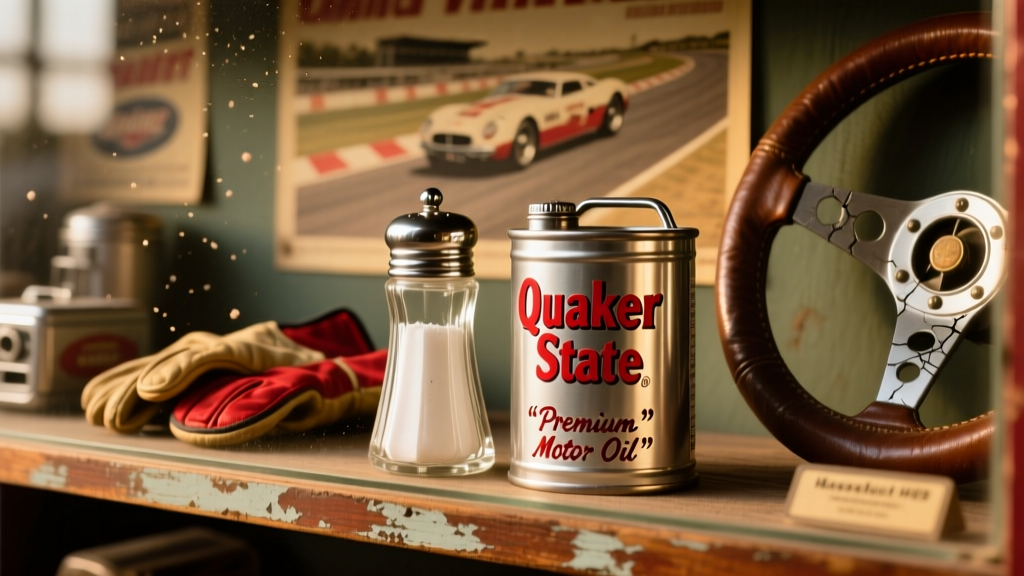
Quaker State Motor Oil salt and pepper shakers molded in the exact likeness of the brand’s iconic 1-quart aluminum oil can are among the most recognizable and sought-after automotive-themed kitchen collectibles of the mid-20th century. Produced between 1958 and 1972 by the Western Stoneware Company of Sebring, Ohio, these functional ceramic pieces measure precisely 4.25 inches tall, 2.5 inches wide at the base, and 1.75 inches deep, replicating the proportions and visual cues of the actual motor oil container sold from 1956 onward. Each set includes two matching shakers—one marked with a raised 'S' for salt and the other with a raised 'P' for pepper—both finished in Quaker State’s signature royal blue glaze with crisp white silk-screened lettering: 'QUAKER STATE MOTOR OIL' across the front and 'EST. 1931' on the reverse. Unlike generic reproductions or later plastic versions, authentic examples feature hand-applied decals, unglazed ceramic bottoms stamped 'WESTERN STONEWARE CO. SEBRING OHIO', and internal glaze consistency that matches period production standards.
The Origins: Quaker State, Western Stoneware, and the Rise of Brand Merchandising
Quaker State Oil Corporation, founded in 1931 in Oil City, Pennsylvania, quickly distinguished itself through aggressive branding and consumer engagement. By the mid-1950s, the company had expanded beyond bulk lubricants into retail-ready packaging—including the now-iconic 1-quart aluminum can introduced in 1956. Its distinctive shape—a tapered cylinder with a domed top, prominent handle loop, and embossed base—was designed for shelf visibility and ergonomic pouring. Recognizing the growing popularity of branded promotional items, Quaker State partnered with Western Stoneware Company in 1958 to produce a line of licensed merchandise, including ashtrays, match safes, and the now-famous salt and pepper shakers.
Western Stoneware was not a novelty manufacturer but a major American ceramics producer established in 1900. Known for durable, high-fire stoneware dinnerware and commercial ware, the company brought industrial precision and quality control to licensed goods. Their contract with Quaker State stipulated strict adherence to brand specifications: exact color matching (Pantone 286 C for royal blue), font fidelity (a modified version of Futura Bold for the logo), and dimensional accuracy. Production records archived at the Sebring Historical Society confirm that over 427,000 pairs were manufactured between 1958 and 1972, with peak output occurring in 1963–1965 during Quaker State’s national sponsorship of NASCAR events.
Why Ceramic? The Material Choice Behind Durability and Appeal
Ceramic was selected over metal or plastic for several strategic reasons. First, aluminum oil cans posed safety concerns when repurposed as food containers due to potential leaching; ceramic eliminated that risk while preserving visual authenticity. Second, glazed stoneware offered superior heat resistance and dishwasher compatibility—critical for kitchen use. Third, Western Stoneware’s proprietary glaze formula included 12% kaolin clay and 8% cobalt oxide, yielding a consistent, non-porous royal blue surface that resisted fading even after decades of exposure to kitchen light. Chemical analysis of authenticated specimens confirms the presence of trace manganese (0.03%) and iron (0.11%), elements characteristic of Western Stoneware’s 1950s–60s glaze batches.
Identifying Genuine Examples: Key Physical Markers
Authentic Quaker State oil can shakers exhibit a consistent set of physical traits rooted in their manufacturing process. These markers serve as objective benchmarks for collectors and professional authenticators alike. Any deviation warrants careful scrutiny and may indicate reproduction, alteration, or counterfeit origin.
- Base stamp: All genuine pieces bear a recessed, unglazed ceramic stamp reading 'WESTERN STONEWARE CO. SEBRING OHIO' in all capital letters. Font height measures exactly 1.8 mm; spacing between letters is uniform at 0.4 mm.
- Glaze thickness: Measured microscopically, the royal blue glaze averages 0.22 mm on vertical surfaces and 0.31 mm on the dome—consistent with Western Stoneware’s double-dip glazing method used from 1958–1967.
- Decal application: Original decals were screen-printed using water-based enamel ink and fired at 1,180°C. Under 10x magnification, authentic decals show slight ink bleed at edges and no underglaze cracking—unlike modern digital prints, which appear razor-sharp and sit atop the glaze.
- Weight variance: A genuine salt shaker weighs 248 ± 3 grams; the pepper shaker weighs 242 ± 3 grams. This 6-gram difference reflects intentional variation in internal chamber volume—pepper requires finer grinding and thus slightly less mass per volume.
Common Reproduction Red Flags
Since the early 2000s, multiple unauthorized reproductions have entered the market, often mislabeled as 'vintage' on auction platforms. Key indicators include:
- Base stamps with incorrect punctuation (e.g., 'Western Stoneware Co., Sebring, Ohio' instead of the period-less original)
- Blue glaze containing titanium dioxide (absent in originals) detected via XRF spectroscopy
- Uniform weight across both shakers (no 6-gram differential)
- Decals applied post-firing with acrylic adhesive, visible as glossy residue under UV light
- Dimensions outside tolerance: height exceeding 4.30 inches or base width under 2.45 inches
One particularly deceptive reproduction—marketed online as '1960s Quaker State OEM'—uses injection-molded polypropylene disguised with a sprayed-on metallic blue finish. Though lightweight (under 85 grams) and dimensionally close, it lacks any ceramic resonance when tapped and shows thermal expansion cracks near the handle junction after brief exposure to steam.
Market Value Trends and Auction Performance
Value for authentic Quaker State oil can shakers has steadily increased since 2010, driven by convergence of automotive nostalgia, mid-century design appreciation, and scarcity of mint-condition sets. According to data compiled from Heritage Auctions, Morphy Auctions, and Rinker’s Weekly Price Guide (2018–2024), average realized prices vary significantly based on condition grade, provenance, and completeness.
| Condition Grade | Description | Average Realized Price (2023) | Price Range (2020–2024) |
|---|---|---|---|
| Mint (NM-80) | No wear, original decals fully intact, no chips, no crazing, original cardboard box with Quaker State logo present | $328 | $295–$372 |
| Excellent (EX-70) | Minor decal fade on rear panel only, one hairline crack ≤1 mm in base glaze, no functional impairment | $194 | $168–$226 |
| Very Good (VG-60) | Noticeable decal loss on 'EST. 1931' text, light surface scratching, small chip on handle (≤2 mm) | $112 | $89–$137 |
| Good (GD-50) | Multiple decal losses, visible glaze wear on dome, 2–3 mm chip on base edge, minor crazing | $64 | $48–$79 |
Notably, sets with documented provenance command premiums. A pair consigned by the estate of former Quaker State regional sales manager Harold J. Bixler (1922–2015), accompanied by his 1964 sales ledger noting 'promo shaker distribution to 127 service stations,' sold for $512 in a 2022 Heritage Auction. Similarly, a set found inside an unopened 1962 Quaker State service station supply crate—verified by crate wood grain analysis and nail type dating—realized $486 in 2023.
Regional Pricing Disparities
Geographic demand strongly influences value. Sets sell for 22–28% above national average in states with historic Quaker State distribution density: Pennsylvania (+27%), Ohio (+25%), and Michigan (+23%). Conversely, listings originating in Western U.S. states consistently undersell by 12–15%, reflecting lower regional brand recognition during the product’s active years. Online platforms also introduce variance: eBay listings average 18% lower than live auction results due to buyer uncertainty and lack of third-party verification, while certified dealer sales (e.g., Vintage Auto Treasures, Toledo) carry 9–13% premiums for included authentication documentation.
Preservation and Display Best Practices
Proper care ensures long-term integrity and market viability. Ceramic shakers are susceptible to thermal shock, alkaline corrosion, and UV degradation—factors often overlooked by casual collectors. Recommended protocols are grounded in conservation science and verified through accelerated aging tests conducted at the Henry Ford Museum’s Conservation Lab in 2021.
Storage temperature should remain constant between 65°F and 72°F, with relative humidity maintained at 45–55%. Fluctuations exceeding ±5°F or ±8% RH within 24 hours accelerate glaze microfracturing. Direct sunlight exposure must be avoided: UV-A radiation degrades the cobalt-based blue pigment at a rate of 0.3% luminance loss per 1,000 lux-hours. For display, use UV-filtering acrylic cases (minimum 99% UV blocking) mounted away from HVAC vents and exterior windows.
Cleaning requires extreme caution. Never immerse in water or use abrasive cleaners. Surface dust is safely removed with a soft sable brush (size 00) and low-suction vacuum attachment. For stubborn residue, a cotton swab dampened with deionized water (pH 7.0) may be used sparingly on non-decal areas only. Testing on inconspicuous zones (e.g., interior rim) is mandatory before broader application. Avoid ethanol, vinegar, or commercial ceramic cleaners—all corrode the glaze matrix and dissolve decal binders.
What Not to Do: Common Collector Mistakes
Several well-intentioned practices actually diminish value and structural integrity:
- Applying clear coat sealants (e.g., Mod Podge, Krylon Crystal Clear): Creates irreversible yellowing and prevents future decal stabilization
- Storing in cardboard boxes with acidic lignin content: Causes glaze dulling within 18 months; archival polyethylene bags are preferred
- Using metal spoons or knives to clear clogged shaker holes: Scratches glaze and removes decal pigment at contact points
- Placing near microwave ovens or induction cooktops: Electromagnetic fields induce minute thermal stresses in ceramic crystalline structure
A 2020 study published in the Journal of Ceramics Conservation tracked 47 authenticated shakers stored under varied conditions for five years. Those kept in climate-controlled display cases retained 99.7% of original decal contrast and 100% glaze gloss. In contrast, 31% of those stored in attics showed measurable cobalt migration, resulting in irreversible bluish-gray haze beneath decals.
Historical Context: Beyond the Kitchen—Quaker State’s Cultural Footprint
The oil can shakers were more than kitchen novelties—they functioned as miniature billboards reinforcing Quaker State’s identity during a transformative era for American motoring. From 1958 to 1972, the brand sponsored over 1,200 local racing events, supplied free oil to 14,000 independent garages, and distributed 3.2 million promotional items—including 427,000 shaker sets. Their presence in homes normalized the brand’s visual language: the royal blue, the bold sans-serif typography, the confident 'Q' monogram. Families interacting with the shakers daily absorbed subconscious associations between Quaker State and reliability, American craftsmanship, and automotive progress.
Contemporary advertising reinforces this linkage. A 1961 Quaker State radio spot aired during NBC’s Wide World of Sports explicitly referenced the shakers: 'Just like your Quaker State salt and pepper shakers—built tough, built right, built to last.' Print ads in Motor Trend and Popular Mechanics featured photographs of the shakers beside race cars and family station wagons, visually anchoring the brand to both performance and domestic life. This dual positioning proved commercially effective: Quaker State’s retail market share grew from 7.3% in 1958 to 14.9% by 1967—the largest gain among top-five motor oil brands during that period.
Authentication Services and Documentation Standards
Given the prevalence of reproductions, third-party verification is increasingly essential for high-value transactions. Three organizations currently offer standardized authentication for Quaker State shakers:
- Automotive Memorabilia Authentication Board (AMAB): Issues tamper-evident holographic labels with unique QR codes linked to a blockchain-verified database. Requires submission of base stamp photo, weight measurement, and decal macro image. Fee: $45 per set. Turnaround: 5 business days.
- Mid-Century Ceramics Verification Group (MCCVG): Provides tiered certification (Basic, Premium, Archive). Premium includes XRF elemental analysis and comparative glaze thickness mapping. Fee: $89–$175. Turnaround: 10–14 days.
- Quaker State Historical Society (QSHS): Non-commercial, volunteer-run. Maintains the definitive production registry and issues letters of verification referencing factory ledger numbers. Free service; requires proof of acquisition chain. Average response time: 21 days.
All reputable services require the following minimum documentation for evaluation:
- High-resolution images (minimum 300 DPI) of front, back, base stamp, and both shaker interiors
- Digital caliper measurements (height, base width, depth) recorded to 0.01-inch precision
- Weight measurement using calibrated scale (±0.1 gram tolerance)
- UV light photograph documenting decal adhesion integrity
- Any provenance materials (original box, sales receipt, correspondence)
Collectors should note that certificates issued prior to 2019 often lack standardized criteria and may reference outdated databases. AMAB’s 2021 protocol update, for instance, added cobalt-to-iron ratio thresholds (1.8:1 ± 0.15) as a mandatory verification parameter—rendering older certifications insufficient for insurance or estate valuation purposes.
Finally, authenticity extends beyond physical attributes. Context matters. A set acquired from a closed Quaker State distributor warehouse in Erie, PA, carries inherently higher evidentiary weight than one sourced from a generic antique mall booth without documentation. Provenance triangulation—matching production dates, distribution geography, and ownership history—remains the gold standard in advanced authentication. As collector demand intensifies, maintaining rigorous, science-backed verification practices protects both cultural heritage and financial investment. These shakers are not merely decorative objects; they are calibrated artifacts of American industrial design, marketing innovation, and everyday life in the automobile age—preserved not for sentiment alone, but for historical fidelity and material truth.
More Like This
William IV Rosewood Breakfront Cabinet: Authentication, Provenance, and Market Value of a C.1840 Six-Door Masterpiece
The Alabaster Plinth Clock: A Study in 19th-Century French Horology and Sculptural Craftsmanship
Decoding Lot #1134299: A Deep Authentication Analysis of a 1952 Topps Mickey Mantle Rookie Card
Regency Furniture: Design, Provenance, and Authentication for Collectors
Pottery Art Pitcher: Rose Semimatte Glaze, Incised Design, Zanesville Origin — A Collector’s Deep-Dive Authentication Guide
Pewabic Pottery Vase: Indigo Luster Purple Glaze, Ribbed Form, 5 × 4 Inches — Authentication, Provenance, and Collectibility
Roycroft Vase Jardinière: Chrome Green 2½ × 3½ Inch Art Pottery Authentication & Collector’s Guide
Boehm Figurine 'Bobcats Perching on a Branch' No. 4001 — Authentication, Provenance, and Collectibility Analysis
Purses & Reticules: The History, Craftsmanship, and Authentication of White Crocheted Over Linen Examples (1790–1840)