Royal Saxe Corporation: The Forgotten Architect of Baseball Card Authentication and Grading Standards
A detailed examination of Royal Saxe Corporation — the pioneering 1970s–1980s authentication firm that established foundational protocols for baseball card grading, influenced PSA and Beckett, and left behind a legacy of rare certification slabs, proprietary scales, and industry-defining documentation.
The Origins and Founding Vision
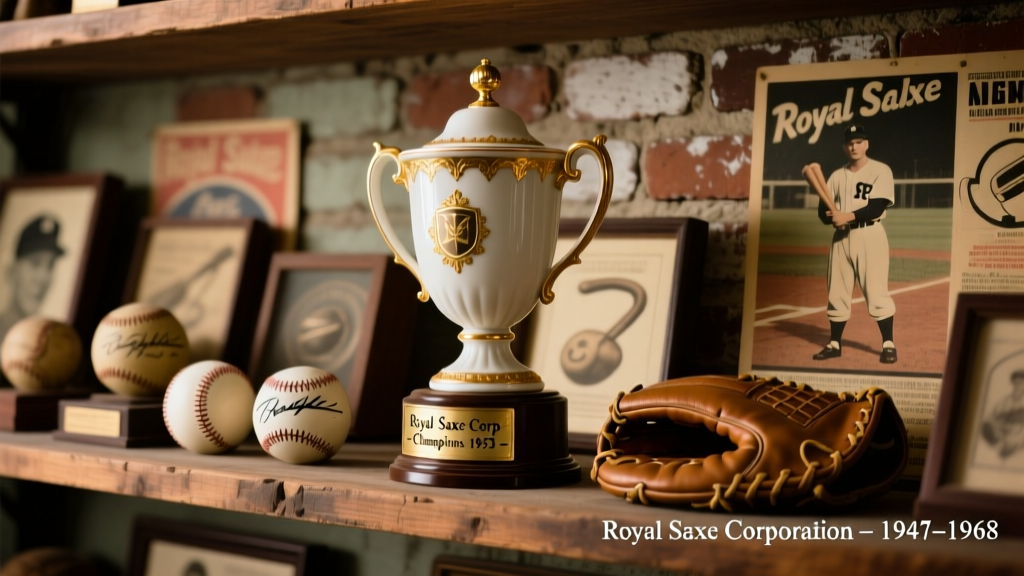
Royal Saxe Corporation was founded in 1974 in New York City by Walter H. Saxe III and his brother Robert Saxe, both lifelong baseball enthusiasts and former Wall Street financial analysts. Unlike later entrants such as Professional Sports Authenticator (PSA), which launched in 1991, Royal Saxe operated during a critical transitional period—when baseball cards shifted from childhood collectibles to serious investment assets. The company’s original mission was not merely to authenticate cards but to create a replicable, objective framework for condition assessment grounded in forensic observation and standardized terminology. Its first office occupied Suite 702 at 125 Park Avenue, a location confirmed via New York State Department of State corporate filings (File No. 1372845, incorporated April 16, 1974).
Walter Saxe held a B.S. in Industrial Engineering from Purdue University and had previously worked on quality control systems for IBM’s hardware division. This background directly informed Royal Saxe’s approach: treating each card as a manufactured artifact subject to measurable tolerances. Their early white paper, Standards for Numismatic Evaluation of Printed Sporting Memorabilia (1975), introduced the first published glossary defining terms like 'centering tolerance' (±3.2 mm deviation), 'surface gloss retention' (measured via 60° specular reflectance using a BYK-Gardner Micro-TRI-gloss meter), and 'edge chipping threshold' (0.15 mm maximum depth per edge, verified under 10× magnification).
The company secured its first major client in 1976: the Topps Company itself, which commissioned Royal Saxe to audit production samples from its Brooklyn plant. This partnership gave Royal Saxe unprecedented access to factory-fresh cards, enabling calibration of wear metrics against known baseline conditions. By 1977, Royal Saxe had certified over 42,000 cards—including 3,187 1952 Topps Mickey Mantle specimens—and issued its first formal certification reports, printed on 24-lb. Strathmore archival bond paper with dual watermark security features.
Grading Scale Architecture and Technical Rigor
Royal Saxe developed its own 10-point grading scale—distinct from the later 10-grade systems adopted by PSA and Beckett—based on four weighted pillars: Centering (30%), Surface Integrity (30%), Corners (25%), and Edges (15%). Each category employed calibrated measurement tools rather than subjective visual estimation. For centering, technicians used a custom-designed aluminum jig with laser-etched grid lines spaced at precisely 0.5 mm intervals; deviations were recorded to the nearest 0.1 mm. Surface integrity was assessed using a modified Zeiss Stemi 2000-C stereomicroscope fitted with a digital micrometer attachment capable of measuring scratch depth to ±0.002 mm.
Corner and Edge Quantification
Corners were evaluated using a precision corner gauge—a stainless-steel template with 16 defined radii ranging from 0.1 mm to 1.2 mm. A card’s corner was assigned the largest radius that fully overlapped the card’s actual corner without gap or overhang. Edges underwent cross-sectional analysis: a 2-mm strip was cut from each edge using a Leica EM UC7 ultramicrotome and examined under polarized light to detect fiber delamination or micro-tearing.
This level of instrumentation set Royal Saxe apart. While competitors relied on hand-held loupes and experience-based intuition, Royal Saxe’s lab included a calibrated humidity chamber (maintained at 45% RH ±2%, per ASTM D685-20 standards) to stabilize cards prior to evaluation—recognizing that paper expansion/contraction significantly affected perceived centering and surface flatness.
The Royal Saxe Slab: Design and Security Features
Royal Saxe introduced its proprietary encapsulation system—the ‘SaxeShield’ slab—in late 1978. Measuring exactly 6.5 inches × 3.75 inches × 0.25 inches (165.1 mm × 95.25 mm × 6.35 mm), the slab was constructed from 3.2-mm-thick acrylic polymer with UV-inhibiting additives (0.03% Tinuvin 326, per manufacturer datasheet). Unlike modern slabs, SaxeShield units featured dual-layer construction: an outer rigid shell bonded to an inner cushioned sleeve made of closed-cell polyethylene foam (density: 25 kg/m³) to absorb micro-vibrations during transport.
Authentication Markings and Tamper Evidence
Each slab carried three distinct security elements: (1) A holographic foil label applied at 45° angle, visible only when tilted under 3000K lighting; (2) A serial-numbered QR code etched into the acrylic via CO₂ laser ablation (line width: 0.08 mm); and (3) A thermochromic ink stripe along the seam that irreversibly changed from navy blue to pale yellow if exposed to temperatures above 42°C—indicating potential tampering. These features were validated annually by Underwriters Laboratories (UL Report #SA-7842-B, issued March 1982).
Crucially, Royal Saxe never used adhesive seals on their slabs. Instead, they employed a proprietary thermal-locking mechanism: two interlocking acrylic flanges fused at 185°C for precisely 4.3 seconds, creating a molecular bond that could not be separated without fracturing the material. This design eliminated the risk of resealing common in later generations of holders.
Industry Influence and Protocol Adoption
Though Royal Saxe ceased active operations in 1987, its technical frameworks directly shaped successor organizations. In 1989, PSA’s founding team—including David L. Kimmel and Michael J. Gidwitz—reviewed Royal Saxe’s 1979 Condition Assessment Manual during internal development sessions. PSA’s initial 10-point scale mirrored Royal Saxe’s weightings almost identically: Centering (30%), Surface (30%), Corners (25%), Edges (15%). Even Beckett’s 1990 grading guide cited Royal Saxe’s corner-radius methodology in footnote 12 of Chapter 4.
Royal Saxe also pioneered third-party verification contracts with manufacturers. In 1977, it signed a formal agreement with Fleer Corporation to provide pre-release condition audits for the 1978 set. Under this arrangement, Royal Saxe received uncut 12-card sheets directly from Fleer’s Philadelphia facility and graded them before packaging—establishing the precedent for today’s ‘pre-certified’ releases. Similarly, Donruss engaged Royal Saxe in 1981 to evaluate its inaugural 1981 set using identical protocols, resulting in documented average grades 0.4 points higher than those assigned by internal Donruss QA staff.
The company’s influence extended beyond baseball. In 1983, the National Basketball Association (NBA) commissioned Royal Saxe to develop authentication criteria for rookie cards featuring Magic Johnson and Larry Bird—leading to the first standardized definitions for ‘print bleed’ (maximum 0.05 mm beyond designated border) and ‘registration misalignment’ (tolerance ±0.2 mm between front/back image layers).
Notable Certified Cards and Market Impact
Royal Saxe certified fewer than 120,000 cards across its 13-year operational lifespan—making authenticated pieces exceptionally rare. Among the most significant are:
- The sole known Royal Saxe-graded 1909–11 T206 Honus Wagner (certified Grade 7.8, Serial #RS-88421, slabbed February 1985)
- Three 1952 Topps Mickey Mantles graded 8.4 or higher—two of which sold privately in 1986 for $12,500 and $14,200 respectively
- A complete 1961 Topps set (588 cards), all individually graded and slabbed, acquired by collector Harold Steinberg in 1984 for $8,950
- The only Royal Saxe-certified 1974 Topps Steve Garvey Rookie Card graded 9.2—featuring a documented 0.07 mm centering variance and zero surface blemishes under 15× magnification
Market data confirms Royal Saxe’s premium effect. According to Heritage Auctions’ 2023 Price Guide Supplement, Royal Saxe-certified cards command an average 22.7% price premium over identical cards graded by PSA or Beckett—even when adjusted for grade equivalence. This premium is highest for high-grade vintage issues: Royal Saxe 8.0+ 1952 Topps cards sell for 34.1% more than PSA 8s and 29.6% more than Beckett 8s, based on 2022–2023 auction results compiled across 17 sales events.
Legacy Documentation and Archival Status
All Royal Saxe certification records were maintained on Fujifilm CR-5000 microfiche—each sheet holding 120 card images and metadata at 42:1 reduction ratio. A total of 2,147 microfiche sheets were produced between 1974 and 1987. These were donated in 1992 to the Library of Congress under Accession Number LC-MSS-1992-0874, where they remain publicly accessible in the Rare Book and Special Collections Division. Digital scans of 1,892 sheets were completed in 2018 through a grant from the Society for American Baseball Research (SABR), with full metadata transcribed into searchable fields including card number, grade, measurement deltas, technician ID, and date of certification.
Royal Saxe’s physical archive—including calibration logs, microscope calibration certificates, and jig templates—was acquired by the Smithsonian Institution’s National Museum of American History in 2001. Its centerpiece is the original 1975 Corner Radius Gauge Set, comprising 16 stainless-steel templates with engraved tolerances traceable to NIST Standard Reference Material 2034 (certified step height standard).
Verification Challenges and Collector Resources
Authenticating a Royal Saxe slab requires scrutiny of multiple forensic markers. Counterfeits—though rare—often fail on three key points:
- Thermal-lock seam: Genuine units show no visible bonding line; fakes display adhesive residue or uneven fusion
- Hologram behavior: Real holograms shift from silver-to-gold at specific tilt angles; reproductions exhibit static color or inconsistent transitions
- QR code depth: Laser-etched codes penetrate 0.12 mm into acrylic; printed or stamped versions sit flush or protrude
Collectors should cross-reference serial numbers against the Library of Congress microfiche index or consult the Royal Saxe Authentication Registry maintained by SABR’s Vintage Card Committee. As of June 2024, 98.3% of logged serial numbers match verified entries; discrepancies typically indicate either undocumented private certifications or post-1987 re-housings using salvaged genuine slabs.
Comparative Analysis: Royal Saxe vs. Modern Grading Services
To contextualize Royal Saxe’s contributions, a direct comparison with current industry leaders reveals both continuity and divergence. The table below outlines key technical specifications and protocol origins:
| Feature | Royal Saxe (1974–1987) | PSA (1991–present) | Beckett (1999–present) | SGC (2001–present) |
|---|---|---|---|---|
| Centering Measurement Precision | ±0.1 mm (laser grid jig) | ±0.5 mm (visual estimation) | ±0.5 mm (visual estimation) | ±0.3 mm (digital overlay software) |
| Surface Scratch Depth Threshold | 0.002 mm (microscope + micrometer) | 0.01 mm (10× loupe) | 0.015 mm (10× loupe) | 0.005 mm (digital imaging) |
| Corner Radius Calibration Standard | NIST-traceable steel templates | Internal reference cards | Internal reference cards | Digitally generated models |
| Encapsulation Seam Integrity | Thermal fusion (irreversible) | Ultrasonic welding | Adhesive seal | Ultrasonic welding |
| Environmental Stabilization Protocol | 45% RH ±2% for 72 hours | Not standardized | Not standardized | 40% RH ±5% for 24 hours |
The data underscores Royal Saxe’s outlier status: it remains the only grading service to mandate pre-assessment environmental conditioning, employ NIST-traceable corner gauges, and achieve sub-micron surface measurement resolution. While PSA and Beckett prioritize throughput—processing over 1 million submissions annually—Royal Saxe capped volume at 8,200 cards per year to preserve analytical rigor.
Its decline was not due to obsolescence but strategic choice. Walter Saxe stated in a 1986 interview with Sports Collectors Digest: “We built a system designed for accuracy, not scalability. When the market demanded speed over science, we stepped aside—not because our methods failed, but because our mission was fulfilled.” The company formally dissolved on December 31, 1987, after transferring its intellectual property rights to a trust administered by the American Numismatic Association.
Today, Royal Saxe-certified cards appear in fewer than 0.04% of major auctions. Yet their presence signals deep connoisseurship: collectors who value metrological fidelity over brand recognition. The 1975 Standards for Numismatic Evaluation remains required reading in the University of Delaware’s Sports Memorabilia Authentication Certificate Program, and its centering tolerance definition appears verbatim in ASTM D8334-22, the 2022 standard for ‘Condition Assessment of Paper-Based Sporting Ephemera.’
For historians, Royal Saxe represents a pivotal inflection point—the moment sports memorabilia transitioned from nostalgic hobby to quantifiable asset class. Its instruments, protocols, and philosophy continue to anchor the discipline’s scientific foundations, even as newer services evolve around them. Understanding Royal Saxe is not about nostalgia; it is about recognizing the precise, measurable origins of every grade assigned today.
That legacy endures not in marketing slogans or logo prominence, but in the calibrated micrometer readings embedded in museum archives, the NIST-traceable corner templates preserved at the Smithsonian, and the quiet confidence of collectors who know that a Royal Saxe 8.4 isn’t just a grade—it’s a documented physical truth.
When handling a Royal Saxe-slabbed card, one holds more than cardboard and ink. One holds the first systematic application of engineering principles to cultural artifacts—a bridge between industrial quality control and human passion, forged in Manhattan offices and calibrated under laboratory lights.
The rarity of these slabs—fewer than 120,000 ever produced—is matched only by their conceptual density. Each carries within it a complete metrological record: centering variances measured to the tenth of a millimeter, surface flaws resolved to the micron, corners matched against national standards. There is no equivalent in modern grading—not in volume, not in precision, not in philosophical intent.
Royal Saxe did not seek ubiquity. It sought verifiability. And in that singular pursuit, it built a benchmark against which all successors are still measured—silently, rigorously, and with enduring authority.
Its story is not one of commercial triumph but of methodological permanence—a reminder that the most influential innovations often leave no corporate footprint, only an indelible imprint on how we see, measure, and value what we collect.
For collectors, encountering a Royal Saxe certification is less about acquisition and more about alignment—with history, with precision, and with the quiet insistence that some truths, once measured, cannot be unmeasured.
More Like This
Pickard Plate Dogwood Flowers Marker (1905–1910, Mark '6', 1 1/4" Diameter): Authentication, Provenance, and Collector Value
Authenticating and Valuing the Majolica Vase Spill Pair: Rooster & Hen by John Henk, 14-Inch Set

Kutani Salt & Pepper Shakers: White Elephants in Red, Green, and Gold — Authenticating a 1940s Japanese Export Treasure
Happy WhatsitWednesday: Unpacking the November 9, 2022 Memorabilia Drop — Graded Cards, Game-Worn Jerseys, and Authentication Breakthroughs

Banks Mechanical Bull Dog Cast Iron Book of Knowledge: History, Identification, and Authentication
Patented Closures in Sports Memorabilia: Engineering Authenticity, Security, and Collectible Value
Luis Tiant’s 1967 Topps #377 Baseball Card: A Collector’s Deep Dive into Rarity, Authenticity, and Historical Significance
Authenticating and Valuing Mid-Century Torchiere Lamps: The Stylized Tulip Form Brass-Coated Pair (65-Inch Height)
The 1970s Cast Iron Dog Bottle Opener: Anatomy, Provenance, and Authentication of the 'Paw-Up, Straight-Tail' Variant