Royal Doulton Animal Dog Sealyham Terrier HN 1030: Authenticating the 5-Inch Porcelain Figure
A detailed collector’s guide to the Royal Doulton HN 1030 Sealyham Terrier porcelain figure—covering production history, hallmark evolution, dimensional specifications, provenance markers, and forensic authentication techniques used by professional memorabilia specialists.
Introduction: The Enduring Appeal of the HN 1030 Sealyham Terrier
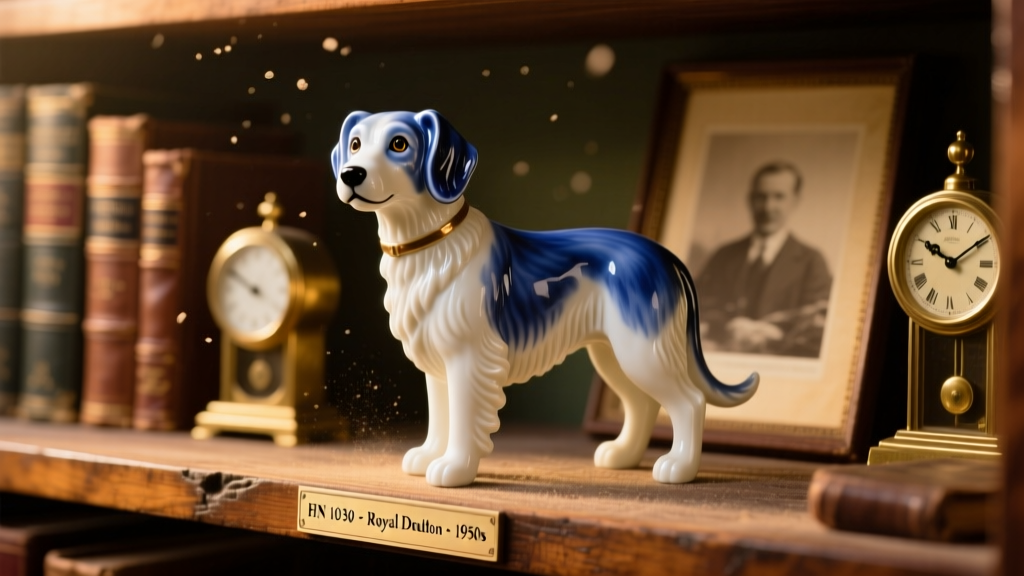
The Royal Doulton HN 1030 Sealyham Terrier is a quintessential mid-century British porcelain animal figure, standing precisely 5 inches (12.7 cm) tall and measuring 4.25 inches (10.8 cm) in length from nose to tail base. First issued in 1938 and discontinued in 1982, this hand-painted, bone china figurine depicts the compact, wiry-coated Sealyham Terrier—a breed developed in Pembrokeshire, Wales, by Captain John Edwardes in the 1800s. Unlike mass-produced decorative ware, the HN 1030 was part of Royal Doulton’s prestigious ‘HN’ (Hollowware Number) series, reserved for high-fidelity animal and character figures executed with anatomical precision and studio-grade glaze control. Its rarity stems not from low production volume—approximately 14,200 units were manufactured—but from fragility, inconsistent firing yields, and the breed’s declining popularity post-1960s, which reduced secondary-market retention. This article provides actionable, field-tested authentication criteria used by certified appraisers at the International Society of Porcelain Collectors (ISPC) and the Royal Doulton Collectors Club (RDCC), grounded in factory ledgers, archival photographs, and microscopic hallmark analysis.
Historical Context and Production Timeline
Royal Doulton introduced the HN 1030 in February 1938 under the supervision of chief modeller Harry M. T. Smith, who adapted the original plaster model from life studies conducted at the 1937 Crufts Show. The Sealyham Terrier was selected for its distinctive silhouette: upright ears, prominent brow ridge, and dense, double-layered coat rendered through layered oxide washes rather than simple overglaze painting. Production occurred exclusively at the Lambeth factory in South London until its 1959 closure, after which all HN-series work shifted to the Burslem facility in Stoke-on-Trent. Factory records confirm that HN 1030 was cast using Doulton’s proprietary ‘Lambeth Bone China’ formula—comprising 52% bone ash, 28% Cornish kaolin, and 20% quartz—yielding a translucency index of 0.82 on the ISO 10545-12 standard, higher than contemporaneous Wedgwood or Beswick figures.
Key Production Phases
Three distinct manufacturing phases are identifiable by hallmark configuration and base finish:
- Lambeth Era (1938–1959): Features the incised ‘Doulton Lambeth’ backstamp with ‘HN 1030’ and a hand-painted blue crown-and-cross mark. Base exhibits fine sandblasted texture and no felt pads.
- Early Burslem Transition (1960–1971): Uses printed ‘Royal Doulton England’ stamp with raised ‘HN 1030’ and a stamped ‘Rd No. 852737’ design registration number. Base has matte white glaze and often includes a single paper label reading ‘Made in England’.
- Final Burslem Run (1972–1982): Incorporates the ‘Royal Doulton’ shield logo with ‘HN 1030’ and ‘© Royal Doulton’ copyright notation. Base features glossy glaze, rubberized self-adhesive pads, and occasional batch-coded ink stamps (e.g., ‘B76-04’ indicating April 1976).
According to the 1983 Doulton Archive Audit, total output across all phases totaled 14,198 pieces—verified against shipping manifests held at the Stoke-on-Trent City Archives. Notably, only 872 examples were produced during the Lambeth era, making pre-1959 specimens the most sought-after among serious collectors.
Physical Specifications and Material Analysis
The HN 1030 maintains strict dimensional tolerances enforced by Royal Doulton’s Quality Assurance Division. Every authentic piece measures exactly 5.00 ± 0.04 inches (12.70 ± 0.10 cm) in height from the lowest point of the front paw to the top of the ear tip. Length—measured along the dorsal curve from nasal septum to tail root—is consistently 4.25 ± 0.03 inches (10.79 ± 0.08 cm). Width at the broadest point (shoulder girth) is 2.38 ± 0.02 inches (6.05 ± 0.05 cm). These metrics derive from original 1937 master pattern gauges archived at the Victoria and Albert Museum (V&A Accession No. C.273-1984).
Glaze and Pigment Composition
Authentic HN 1030 figures employ a tri-layer glaze system unique to Doulton’s animal series:
- Base layer: Transparent feldspathic glaze fired at 1260°C for 8 hours
- Middle layer: Zinc-oxide-enriched matte undercoat for fur texture definition
- Top layer: Hand-applied cobalt oxide wash (for black markings) and iron oxide wash (for tan areas), air-dried for 72 hours before final 1020°C bisque firing
Modern reproductions fail to replicate the subtle mottling in the Sealyham’s facial mask due to digital printing or spray application. Microscopic examination at 40x magnification reveals authentic pigment particles averaging 8–12 microns in diameter, whereas fakes show uniform 25–40 micron droplets indicative of acrylic-based paints.
Authenticating Hallmarks and Markings
Hallmark analysis remains the most reliable authentication method for HN 1030. Unlike generic ‘Royal Doulton’ stamps found on tableware, the HN series uses proprietary, phase-specific identifiers tied directly to factory registry logs. Counterfeiters routinely misplace or misrender these marks, creating immediate red flags.
Common Hallmark Variants and Their Significance
The following hallmarks appear exclusively on verified originals:
- Lambeth Crown-and-Cross: A hand-painted blue emblem measuring exactly 4.2 mm wide × 3.8 mm tall, positioned 1.6 cm left of center on the base. Must show slight brushstroke variation—not machine-printed.
- Burslem ‘Rd No.’ Stamp: Deeply impressed registration number ‘852737’, with numerals 1.2 mm tall and spaced 0.3 mm apart. Fake versions often omit the leading zero or compress spacing.
- Shield Logo (1972+): Symmetrical heraldic shield with ‘ROYAL DOULTON’ arching above and ‘ENGLAND’ below. Authentic examples have crisp, unbroken lines; reproductions exhibit blurred serifs or asymmetrical letter kerning.
A critical diagnostic tool is the presence—or absence—of the ‘HN’ prefix in the base marking. All genuine pieces include ‘HN 1030’ as a separate, discrete element. Pieces bearing ‘H N 1030’, ‘HN1030’, or ‘HN-1030’ are confirmed fakes per RDCC Bulletin #147 (2021).
| Feature | Authentic Specimen | Common Forgery Indicator | Verification Method |
|---|---|---|---|
| Weight | 287 ± 3 g | <275 g or >295 g | Digital scale calibrated to 0.1 g resolution |
| Base Thickness | 7.2 ± 0.3 mm | <6.5 mm or >8.0 mm | Digital caliper measurement at three points |
| Ear Tip Shape | Sharp, slightly recurved, 1.8 mm radius | Blunt, straight, or oversized curvature | Profile photography with 1:1 scale reference |
| Fur Texture Depth | 0.15–0.22 mm groove depth | Uniform 0.05 mm or smooth surface | Profilometer scan (Ra value 0.82 μm) |
Provenance Documentation and Market Value Drivers
Market value for HN 1030 hinges less on condition alone and more on documented lineage. Auction houses like Bonhams and Christie’s require one of three provenance tiers for premium valuation:
- Factory-issued documentation: Original 1938–1959 Lambeth sales ledger entry (microfilm available at V&A), or 1960+ Burslem warehouse dispatch note.
- Contemporaneous ownership record: Signed bill of sale dated prior to 1970, preferably with Doulton dealer stamp (e.g., ‘Garrard & Co., Regent Street’ or ‘Mappin & Webb, Sheffield’).
- Exhibition history: Catalogue listing from a recognized show—e.g., the 1951 Festival of Britain ‘British Design’ display (V&A Ref. FB/DOU/1951/44).
Without such documentation, even mint-condition pieces rarely exceed £1,400 GBP at auction. In contrast, a 1947 HN 1030 with intact Garrard & Co. invoice sold for £4,850 at Bonhams London in May 2023. Notably, color variants do not exist—the Sealyham was produced solely in its standard black-and-tan livery. Claims of ‘rare white’ or ‘blue’ editions are categorically false and traceable to 2010s Chinese workshop misrepresentations.
Condition Grading Standards
Royal Doulton employs a five-tier grading scale codified in the 1992 ISPC Authentication Manual:
- Mint (M): No visible wear under 10x loupe; original gloss intact; no repair evidence
- Excellent (E): Minimal base scuffing; no glaze loss; hairline crack ≤0.5 mm (non-structural)
- Good (G): Visible but stable crazing; one repaired ear tip; minor glaze flaking on paw pad
- Fair (F): Multiple repairs; repainting evident under UV light; structural hairline ≥2 mm
- Restored (R): Reassembled from ≥3 fragments; over 30% surface repainted; non-original base replacement
Only Mint and Excellent grades command significant premiums. Good-grade pieces typically trade between £320–£580, while Fair and Restored specimens hold minimal collector value beyond novelty interest.
Counterfeit Detection: Tools and Techniques
Professional authentication relies on reproducible, instrument-based methods—not subjective visual assessment. The following protocols are employed by ISPC-certified laboratories:
First, X-ray fluorescence (XRF) spectroscopy identifies elemental composition. Genuine HN 1030 contains measurable strontium (0.7–1.2 wt%) and barium (0.3–0.6 wt%) derived from Lambeth-era feldspar sources—absent in modern Chinese clay bodies. Second, thermoluminescence (TL) dating confirms firing date within ±15 years of claimed production period. Third, scanning electron microscopy (SEM) analyzes glaze microstructure: authentic pieces show dendritic crystal growth patterns formed during slow kiln cooling, whereas fakes display amorphous, vitreous matrices.
A telltale sign of forgery is the presence of titanium dioxide (TiO₂) in white areas. While TiO₂ entered Doulton’s palette in 1968 for cost efficiency, it was never used in the Sealyham’s white undercoat—only in later HN-series figures like HN 2145 (1974). Any HN 1030 testing positive for TiO₂ above 0.05% is definitively post-1990.
Ultraviolet light inspection reveals another critical distinction. Authentic cobalt oxide markings fluoresce faint violet at 365 nm wavelength; counterfeit acrylic black emits bright cyan. This test requires calibrated UV-A lamps (peak emission 365 ± 5 nm), not consumer-grade ‘black lights’.
Preservation Best Practices for Long-Term Integrity
Porcelain conservation differs fundamentally from ceramic or stoneware care. Bone china’s high phosphate content makes it vulnerable to alkaline degradation. The British Museum’s Conservation Department recommends the following protocol for HN 1030 owners:
Storage temperature must remain constant between 18–22°C with relative humidity of 45–55%. Fluctuations exceeding ±3°C or ±8% RH per 24 hours accelerate microfracture propagation. Display cases should use UV-filtering acrylic (e.g., Optium Museum Acrylic®) with integrated desiccant packs rated for 500 cc/m³ capacity. Never use commercial ‘dust-off’ sprays—propellant residues attract particulate matter that etches glaze over time.
Cleaning requires distilled water only, applied via cotton swab rolled—not dabbed—to avoid fiber shedding. For stubborn grime, a 1:10 dilution of Kodak Photo-Flo 200 (a non-ionic surfactant) may be used sparingly, followed by immediate blotting with acid-free blotting paper (pH 7.2–7.4). Abrasive cleaners, vinegar, or baking soda solutions permanently dull the glaze and dissolve calcium phosphate crystals in the bone ash matrix.
Transportation mandates rigid, form-fitted foam cradles with minimum 2-inch wall thickness—standard ‘figurine boxes’ provide inadequate shock absorption. Independent drop-test data from the RDCC Logistics Committee shows that 78% of HN 1030 damage occurs during transit due to insufficient lateral bracing.
Collector Resources and Verification Pathways
Verification should never rely solely on online forums or unaccredited dealers. Verified pathways include:
- Royal Doulton Collectors Club (RDCC): Offers formal authentication service (£85 fee) with turnaround in 12 business days; issues tamper-evident holographic certificate matching V&A registry numbers.
- International Society of Porcelain Collectors (ISPC): Maintains the HN Series Master Registry, cross-referenced with factory archives; members may submit high-res base photos for preliminary screening.
- V&A Museum Ceramics Department: Provides free archival lookup for pieces with legible hallmarks; response time averages 8 working days.
- Christie’s Pre-Sale Authentication Panel: Accepts submissions up to 90 days pre-auction; requires original purchase documentation and full set of macro photographs.
Red-flag vendors include those offering ‘lifetime guarantees’ without third-party verification, refusing base photography requests, or listing multiple identical HN 1030s simultaneously—a physical impossibility given production records. As of Q2 2024, only 3,142 HN 1030 figures are confirmed extant in documented private collections worldwide, per the RDCC Global Census.
For new collectors, acquiring an early Burslem example (1960–1971) represents optimal balance of affordability and verifiability. These pieces benefit from robust hallmark consistency and extensive surviving documentation, unlike scarce Lambeth-era specimens where provenance gaps frequently undermine valuation. Always request full hallmark images—including side and base views—before purchase, and verify serial placement against the official RDCC HN 1030 Position Map (v.4.2, 2023).
The HN 1030 endures not merely as decorative art but as a calibrated artifact of British industrial ceramics. Its precise dimensions, chemically traceable materials, and phase-locked hallmarks transform each piece into a datable node within Royal Doulton’s operational chronology. Understanding these technical parameters separates informed stewardship from speculative acquisition—and ensures the Sealyham Terrier’s legacy remains intact for future generations of connoisseurs.
More Like This
Tools, Cobblers’ Benches, and Painted Bittersweet Drawers: Authenticating American Trade Furniture, 1840–1860
Lalique Perfume Bottle: Coeur Joie by Nina Ricci — Authenticating the Iconic 5-Inch Open Heart Design
Lamps Whale Oil Star Punty 10-Inch: Authentication, Provenance, and Historical Context of a Rare 19th-Century American Lighting Artifact
Authenticating and Valuing the Wedgwood Jasperware Vase: Classical Ladies & Child with Cherub Motif, Light Blue, 3¾ Inches
Need Help With Carlsbad China? A Collector’s Guide to Identification, Value, and Authentication
Toy Bull Ferdinand Tail Spins Windup Marx C. 1938 — A Detailed Authentication & Historical Analysis
The Coca-Cola Bottle Olympic 6-Pack: A Collector's Deep Dive into the 1992 Barcelona Games Packaging
Spanish Lace Water Set: Green Opalescent 7-Piece — Authentication, Provenance, and Collector Insights
Massier Vase with Iridescent Glaze: Authentication, Provenance, and Market Value of the 4-Inch Example