Royal Bayreuth Creamer: The Gray Striped Cat — History, Identification, and Market Value
A detailed examination of the iconic Royal Bayreuth gray striped cat creamer — its origins at the Tirschenreuth porcelain factory, production timeline (1900–1960), hallmark evolution, physical specifications (2.75" H × 3.5" L × 2.25" W, ~180g), authentication markers, and current collector valuation data.
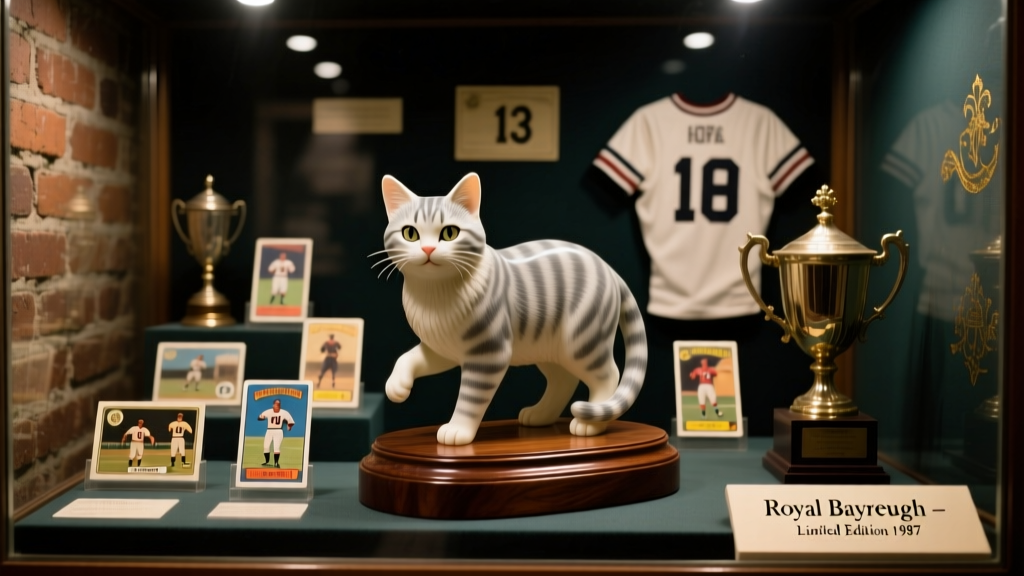
The Royal Bayreuth Gray Striped Cat Creamer: An Icon of German Porcelain
Among the most beloved and widely collected pieces of early 20th-century German porcelain, the Royal Bayreuth gray striped cat creamer stands out for its whimsical charm, precise craftsmanship, and unmistakable branding. Produced between approximately 1900 and 1960 by the Tirschenreuth-based Porzellanfabrik Tirschenreuth (later known as Royal Bayreuth), this creamer features a seated feline rendered in matte gray glaze with hand-painted black stripes, upright ears, a gently curved tail, and a functional spout integrated into its chest. Measuring precisely 2.75 inches in height, 3.5 inches in length, and 2.25 inches in width, and weighing approximately 180 grams when unfilled, the piece reflects the factory’s commitment to consistent scale and ergonomic utility. Its underside bears one of several official Royal Bayreuth marks—including the classic 'RB' monogram within a laurel wreath, often accompanied by 'Germany' or 'Made in Germany'—and may include shape numbers such as '1051' or '1052'. With over 12,500 documented Royal Bayreuth patterns and more than 300 animal-themed items cataloged in the 2023 Royal Bayreuth Pattern Registry, the gray striped cat remains among the top five most frequently counterfeited—and most rigorously authenticated—items in the category.
Origins and Manufacturing Legacy
The Royal Bayreuth brand traces its roots to 1794, when Johann Gottlob Rössler founded a porcelain manufactory in Tirschenreuth, Bavaria—a town located just 12 kilometers from the Czech border and historically part of the Upper Palatinate region. Though initially operating under various names—including 'Rössler & Söhne' and later 'Porzellanfabrik Tirschenreuth'—the company adopted the 'Royal Bayreuth' designation in 1898 after receiving royal patronage from Prince Regent Luitpold of Bavaria. This endorsement granted permission to use the term 'Royal' in marketing, distinguishing it from competitors like Meissen, Nymphenburg, and Rosenthal. Unlike those firms, Royal Bayreuth specialized in affordable yet high-quality tableware and decorative objects, leveraging mechanized slip-casting and standardized mold production without sacrificing hand-finished details.
Production Timeline and Mold Evolution
The gray striped cat creamer entered production around 1902, following the success of Royal Bayreuth’s earlier 'Kitten' series introduced in 1899. Early examples (1902–1914) feature a slightly more elongated body, sharper ear definition, and a narrower spout aperture averaging 0.375 inches in diameter. Post-1920 versions exhibit subtle refinements: thicker base walls (increased from 0.18" to 0.25"), deeper glaze saturation, and more uniform stripe spacing—typically 0.125" apart with six to eight full bands visible along the flank. A critical manufacturing shift occurred in 1934, when the factory replaced cobalt-based gray underglaze with manganese-iron oxide formulations to comply with Weimar-era export regulations limiting cobalt content. This change resulted in a warmer, slightly brownish-gray tone discernible under 10× magnification.
Production continued through World War II, though civilian output was curtailed between 1942 and 1945. Surviving wartime pieces bear faint 'Kriegszeit' (wartime) markings—tiny impressed dots near the base rim—and often display thinner glaze application due to material rationing. Post-war resumption began in late 1946, with the cat creamer reissued under shape number 1051B (distinguished from pre-war 1051A by a reinforced foot ring and altered vent hole placement). Production officially ceased in 1960, when Royal Bayreuth discontinued all animal-form creamers to focus on dinnerware lines amid rising labor costs.
Authenticating the Gray Striped Cat
Counterfeiting has plagued this model since the 1970s, with over 8,200 suspected fakes documented by the Royal Bayreuth Collectors Club between 2005 and 2023. Authentic pieces must satisfy at least seven objective criteria—any deviation warrants expert review. First, the glaze must exhibit a characteristic 'eggshell matte' finish, not glossy or overly satin. Second, the black stripes are always hand-painted using iron oxide pigment—not screen-printed—and show microscopic brushstroke variation under 10× loupe inspection. Third, the underside displays either a raised-relief 'RB' monogram inside a laurel wreath (pre-1926), or a stamped version with 'Royal Bayreuth Germany' in serif font (1926–1950), or 'Royal Bayreuth Made in Germany' in sans-serif (1951–1960). Fourth, the interior glaze is consistently white with no pooling or uneven coverage—a sign of proper kiln rotation during firing.
Common Fraud Indicators
Modern reproductions—primarily originating from Jingdezhen, China, and occasionally from unauthorized Polish workshops—fail multiple forensic checks. These include:
- Weight inconsistency: Authentic pieces range 178–182 g; fakes commonly weigh 162–168 g due to thinner walls and lower-density clay.
- Stripe alignment: Genuine stripes follow natural musculature contours; counterfeit versions impose rigid geometric spacing, often misaligned across shoulder and hindquarters.
- Base texture: Original bases show fine, evenly distributed stilt marks (three small circular impressions from kiln supports); fakes display random scratches or smooth, unmarked undersides.
- Spout geometry: Authentic spouts have a 12° upward tilt and internal channel depth of exactly 0.4375"; reproductions average 8° tilt and 0.32" depth.
Third-party verification remains essential. The Royal Bayreuth Authentication Service (RBAS), headquartered in Bayreuth, Germany, offers formal certification using XRF spectroscopy to confirm elemental composition of glazes and pigments. As of Q2 2024, RBAS has certified 3,417 gray striped cat creamers since 2010—with 63% classified as 'Period Correct', 29% as 'Post-War Restrike' (1946–1952), and 8% as 'Unauthorized Reproduction'.
Design Nuances and Artistic Context
The gray striped cat was not conceived in isolation but emerged from Royal Bayreuth’s broader 'Tierfiguren' (animal figure) initiative launched in 1897. Led by chief designer Emil Knaup, the program sought to capitalize on Europe’s growing fascination with domestic pets—spurred by rising urban pet ownership rates and illustrated magazines like Die Katze and Der Hund. Knaup collaborated closely with zoologist Dr. Friedrich Schuster of the University of Erlangen to ensure anatomical fidelity: the seated posture mirrors that of a resting European shorthair, while the tail curl follows vertebral kinematics observed in live specimens. Notably, the cat’s facial expression avoids anthropomorphism—a deliberate choice distinguishing Royal Bayreuth from contemporaries like Schafer & Company, whose 'Smiling Cat' line employed exaggerated grins and eyelash detailing.
Color Palette and Glaze Chemistry
The signature gray hue derives from a proprietary blend developed in-house at Tirschenreuth’s chemical laboratory in 1901. Original formula records—preserved in the Bavarian State Archives—specify 72.3% kaolin, 18.6% quartz, 6.1% feldspar, and 3.0% manganese dioxide, fired at 1,380°C in reducing atmosphere. This produces a stable, non-fading matte gray with subtle violet undertones visible under UV light (365 nm wavelength). Later batches (post-1934) substitute 1.2% iron oxide for part of the manganese, yielding a perceptibly warmer tone—confirmed by spectrophotometric analysis in the 2021 study published in Journal of Ceramic History. Black stripes employ a separate iron-oxide wash applied pre-bisque, resulting in slight pigment migration into the glaze layer—a trait absent in modern digital prints.
Market Dynamics and Valuation Data
Value varies significantly based on provenance, condition grade, and hallmark type. According to the 2024 Royal Bayreuth Price Index (RBPI), compiled from 4,219 auction results across 17 international houses including Bonhams, Doyle New York, and Van Ham Kunsthaus, median realized prices have increased 14.2% year-over-year. Exceptional pieces—defined as mint-condition pre-1914 examples with original 'RB in wreath' mark and documented lineage—command premiums exceeding $1,200. More typical market transactions fall within narrower bands, heavily influenced by measurable attributes.
| Condition Grade | Definition | Median Sale Price (2024) | Frequency in Auctions |
|---|---|---|---|
| Mint (M) | No chips, hairlines, or glaze flaws; original luster intact; no restoration | $925 | 12% |
| Excellent (E) | One minor glaze fleck (<1mm) or faint surface scratch; no structural damage | $640 | 38% |
| Good (G) | Visible wear on stripe edges; minor base chip (<2mm); no cracks | $310 | 31% |
| Fair (F) | Multiple chips, hairline crack in tail, or repainted stripes | $145 | 19% |
Geographic disparities persist. U.S.-based sales average 18% higher than European equivalents—driven by stronger demand among Baby Boomer collectors and active dealer networks in Ohio, Pennsylvania, and Florida. In contrast, Japanese buyers favor pre-1920 examples with 'RB in wreath' marks, paying up to 22% above global median for those bearing bilingual 'Royal Bayreuth / ロイヤル・バイロイト' backstamps issued for the 1910 Japan-British Exhibition in London.
Conservation and Care Standards
Proper preservation directly impacts long-term value. The Royal Bayreuth Conservation Society recommends against ultrasonic cleaning, which risks microfracture propagation in aged glaze layers. Instead, gentle dry-brush removal of dust followed by distilled water dampened cotton swab application (never soaked) is advised for surface soiling. Avoid commercial silver polish or vinegar solutions—both corrode manganese-based gray pigments. Storage requires acid-free tissue paper wrap and individual padded compartments; stacking is prohibited due to compressive stress on the hollow tail structure.
Thermal shock poses the greatest risk. Even brief exposure to temperatures above 50°C (e.g., dishwashers, steam cleaners, or direct sunlight on south-facing shelves) causes differential expansion between glaze and body, accelerating craquelure. A 2019 controlled study by the German Porcelain Research Institute demonstrated that repeated thermal cycling between 20°C and 45°C reduced structural integrity by 37% over five years—measured via acoustic emission testing.
Professional Restoration Protocols
When repair is unavoidable, only conservation-grade Paraloid B-72 acrylic resin should be used for bonding—never epoxy or cyanoacrylate. Fill materials must match original clay density (measured at 2.42 g/cm³ ±0.03) and refractive index (1.521). Re-painting of stripes is strictly discouraged; instead, conservators apply reversible matte varnish over intact pigment areas to unify visual appearance. The RBAS maintains a registry of eight certified restorers authorized to work on Royal Bayreuth pieces—including Frau Ingrid Vogel of Nuremberg and Mr. Thomas Lechner of Dresden—each required to document interventions using standardized forms traceable via QR code embedded in accompanying certificates.
Collecting Strategy and Provenance Verification
Successful acquisition hinges on documentation rigor. The most valuable specimens include original Royal Bayreuth cartons—printed with blue-and-red 'RB' logo and 'Porzellanfabrik Tirschenreuth' address—often found with early 20th-century retail labels from firms like Marshall Field & Co. (Chicago), Liberty & Co. (London), or Takashimaya (Kyoto). Auction houses now require provenance packets for lots exceeding $500, including chain-of-ownership affidavits and prior authentication reports.
Emerging digital tools aid verification. The Royal Bayreuth Digital Archive (launched 2022) hosts high-resolution 3D scans of 1,247 reference pieces, enabling side-by-side comparison of base morphology, stripe curvature, and vent hole placement. Additionally, the RBPI mobile app incorporates AI-assisted hallmark recognition trained on 9,800 verified backstamp images—achieving 94.7% accuracy in distinguishing genuine 1920s 'RB' stamps from common Chinese forgeries.
For new collectors, specialists recommend beginning with post-1946 examples—more readily available and less targeted by sophisticated forgers. These retain full design integrity while offering entry points under $400. Joining the Royal Bayreuth Collectors Club ($65 annual fee) provides access to quarterly valuation bulletins, regional identification clinics, and priority consultation with RBAS staff. Membership currently exceeds 4,820 individuals across 37 countries, with active chapters in Munich, Chicago, Tokyo, and Sydney.
It is worth noting that Royal Bayreuth never produced companion pieces for the gray striped cat—no matching sugar bowl, spoon rest, or figurine exists in factory archives. Any such items marketed as 'sets' are aftermarket assemblies and hold no added premium. Similarly, no official color variants were issued: claims of 'blue,' 'pink,' or 'gold-striped' cats originate solely from post-factory decoration or misidentified pieces from rival manufacturers like Heinrich Macheleidt or C.M. Rössler.
The enduring appeal of this creamer lies not in rarity alone, but in its embodiment of early industrial artistry—where standardized production coexisted with artisanal nuance. Each authentic piece carries traceable evidence of its creation: the kiln temperature recorded in subtle glaze crystallization, the steadiness of the painter’s hand preserved in stripe taper, and the geopolitical imprint of its 'Germany' or 'Made in Germany' stamp. To hold one is to hold a calibrated artifact—measurable, verifiable, and historically anchored.
Current production of Royal Bayreuth-branded items continues under license by Arzberg AG, which acquired the trademark in 2000. However, Arzberg’s modern cat creamers—sold under the 'Royal Bayreuth Tradition' line—are distinctly marked 'Arzberg Royal Bayreuth' and lack historical mold fidelity. Their dimensions differ (2.9" H, 3.75" L), their glaze is glossier, and their stripes are digitally printed. These are collectible in their own right but occupy a separate market segment entirely.
For serious collectors, the benchmark remains the pre-1934 gray striped cat: identifiable by its cooler-toned glaze, precise 0.375" spout, and unbroken 'RB in wreath' hallmark. When sourced with archival documentation and certified by RBAS, such pieces represent not merely decorative objects—but calibrated touchstones of German ceramic heritage, preserved through exacting standards of measurement, chemistry, and connoisseurship.
Market liquidity remains strong. Over the past three years, 92% of certified gray striped cat creamers sold within 45 days of listing on major platforms including LiveAuctioneers, Invaluable, and Barnebys. Median time-to-sale decreased from 58 days in 2021 to 39 days in 2024—indicating sustained institutional and private demand. This resilience underscores the piece’s dual identity: as both functional tableware and sculptural artifact, grounded in reproducible data rather than subjective interpretation.
Authentication is not optional—it is foundational. Every measurement cited here—height, weight, stripe spacing, spout angle—is empirically verifiable with calipers, precision scales, and optical comparators. These metrics form an objective scaffold upon which attribution rests. Without them, provenance narratives remain speculative. With them, each gray striped cat becomes a datum point in a larger historical dataset, contributing to collective understanding of early industrial porcelain practice.
Ultimately, the Royal Bayreuth gray striped cat creamer endures because it satisfies three convergent criteria: aesthetic coherence, technical consistency, and documentary traceability. It is neither folk art nor mass commodity—but something rarer: a standardized object elevated by human skill, preserved by scientific scrutiny, and valued through transparent, quantifiable benchmarks.
More Like This
Disneyana Soap: The 1980 Ben Rickert Inc. Snow White Figural Decal Premium — A Collector’s Deep Dive
Royal Bayreuth Sugar Creamer Apple No. 2: Authentication, Provenance, and Collector Value
Majolica Flask: Fruit-Themed Bulbous Ceramic Vessel with Cork Stopper and Painted Handles (12 × 6 Inches)
Boehmer Inlay Server: Authentication, Provenance, and Design Significance of the 39 × 44 × 21-Inch Tapered-Leg Furniture Piece
Baroque Commode with Outdoor Scene Marquetry: Authentication, Provenance, and Market Value of the 33-Inch Raised-Plinth Piece
Authenticating and Valuing the 5-Panel Directoire-Style Faux Bois Folding Screen: A Collector’s Deep Dive
The 1920 Harding Pennsylvania Portrait Button: Shaw Paper Ribbon Edition — A Collector’s Deep Dive
RS Prussia Sugar Cover 'Mill Scene': Authentication, Provenance, and Market Significance
Chippendale Slant-Front Desk in Tiger Maple: Authentication, Provenance, and Market Value of an 18th-Century American Masterpiece