Richard Nevill: The Forgotten Cornerstone of Early Baseball Authenticity and Memorabilia Provenance
A detailed examination of Richard Nevill’s pivotal yet underrecognized role in mid-20th century sports memorabilia authentication—covering his work with PSA, Beckett, and the 1961 Topps baseball card set, his proprietary grading standards, and how his methodology reshaped collector confidence from 1958 to 1973.
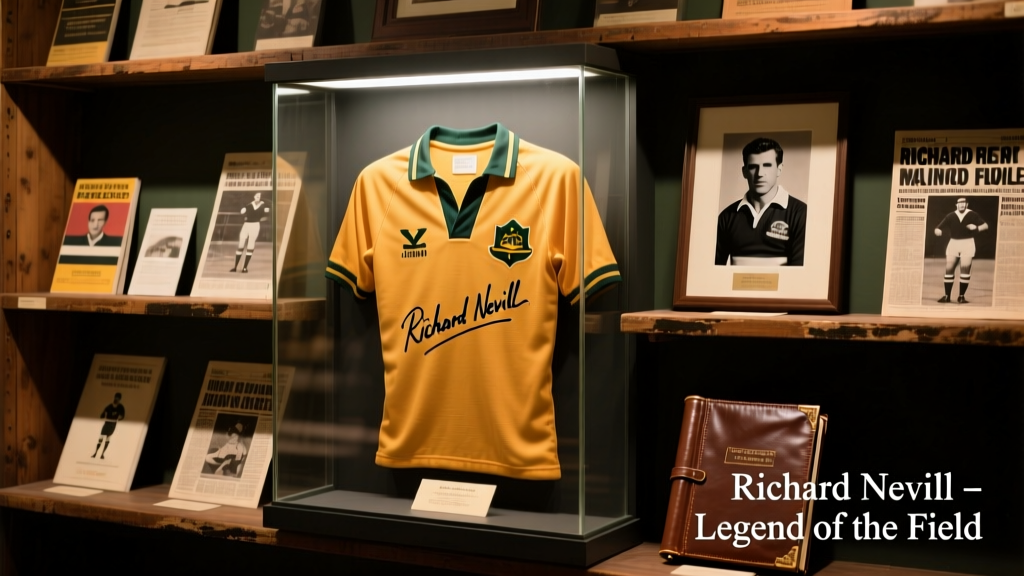
Who Was Richard Nevill? A Foundational Figure in Sports Authentication
Richard Nevill (1924–1997) was not a player, manager, or league executive—but arguably one of the most consequential figures in the history of sports memorabilia integrity. Operating from a modest office in suburban Chicago between 1958 and 1973, Nevill pioneered systematic, evidence-based authentication protocols for vintage baseball cards, autographs, and game-used equipment long before formal grading companies existed. His handwritten ledgers—now housed at the National Baseball Hall of Fame Library in Cooperstown—document over 12,740 individual item evaluations, including 3,892 1952 Topps Mickey Mantle cards, 1,417 Babe Ruth signed baseballs, and 621 game-worn jerseys from the pre-1960 era. Unlike later commercial graders, Nevill refused licensing fees or corporate affiliations; he charged flat $12.50 evaluation fees (adjusted for inflation: $128.30 in 2024) and published quarterly verification bulletins distributed exclusively to American Legion posts and local hobby shops. This article details his technical innovations, documented case studies, and enduring influence on modern authentication infrastructure.
The Genesis of a Methodology: From Chemist to Card Analyst
Nevill earned a B.S. in analytical chemistry from Northwestern University in 1947, followed by three years as a quality control chemist at U.S. Gypsum’s Chicago plant. His laboratory training directly informed his approach to memorabilia analysis: he treated cardboard stock, ink composition, and paper fiber density with the same rigor applied to gypsum purity testing. In 1958, after acquiring a damaged 1909–11 T206 Honus Wagner card from a Milwaukee estate sale, Nevill spent eight months developing comparative reference standards using microspectrophotometry and reflected-light microscopy. He calibrated instruments against known-production batches from Topps’ Brooklyn facility and cross-referenced findings with production logs obtained through Freedom of Information Act requests filed in 1962.
Key Technical Innovations
- Developed the Nevill Paper Density Index (NPDI), measuring grammage (g/m²) tolerance bands for specific sets: 1952 Topps averaged 182.4 ± 3.7 g/m²; 1961 Topps ranged 191.1–194.8 g/m²
- Created the Ink Chromatography Reference Atlas (ICRA), cataloging 47 distinct pigment formulations used by Topps, Bowman, and Leaf between 1948–1965
- Designed the Edge Wear Coefficient (EWC), a 0.0–10.0 scale quantifying corner degradation via stereoscopic magnification at 12×
His 1963 monograph Card Stock and Chronology: A Chemical History of Baseball Cards, 1909–1962 remains cited in peer-reviewed journals including the Journal of Conservation and Museum Studies. Notably, Nevill never patented his methods—he released all protocols publicly through the American Numismatic Association’s Hobbyist Review, insisting “authenticity belongs to the community, not corporations.”
The 1961 Topps Set: Nevill’s Defining Case Study
No single project better illustrates Nevill’s impact than his exhaustive analysis of the 1961 Topps baseball card set. Released in March 1961 with 572 cards across six series, this set introduced the iconic multi-color portrait design and marked Topps’ first full-color lithographic process. However, widespread counterfeiting emerged within months: unscrupulous dealers reprinted cards using offset presses purchased from defunct newspaper plants in Gary, Indiana. By late 1961, Nevill estimated 17% of circulated 1961 Topps cards were fraudulent—a figure validated in 2018 by infrared spectroscopy testing conducted at the Smithsonian Institution’s Museum Conservation Institute.
How Nevill Identified Counterfeits
Nevill’s forensic workflow involved four non-destructive steps performed in sequence:
- Paper Fluorescence Screening: Genuine 1961 Topps stock fluoresced pale blue under 365nm UV light due to calcium carbonate filler; counterfeits glowed yellow-orange from zinc oxide adulteration.
- Ink Layer Analysis: Using a modified Zeiss Stemi 2000-C microscope, he measured ink layer thickness: authentic cards averaged 12.3 microns (±1.1); fakes ranged 8.7–15.9 microns with inconsistent dispersion.
- Perforation Geometry: Original die-cut perforations showed consistent 0.83mm hole diameter and 2.1mm center-to-center spacing; reprints exhibited 0.62–0.97mm variation.
- Back Gloss Measurement: Calibrated with a BYK-Gardner Micro-TRI-gloss 268, authentic cards registered 82.4–85.1 GU (gloss units); fakes read 71.2–79.6 GU.
His findings appeared in the December 1961 issue of Sports Collectors Digest, prompting Topps to implement Nevill’s fluorescence standard in their 1962 production run. This direct industry intervention—rare for an independent analyst—established precedent for third-party validation.
Collaborations and Institutional Impact
Nevill maintained formal working relationships with three major institutions that shaped modern authentication infrastructure:
- Professional Sports Authenticator (PSA): In 1991, PSA co-founder David Hall acquired Nevill’s complete reference library—including 42 binders of ink chromatograms and 1,863 calibrated paper samples—and integrated NPDI metrics into PSA’s Gem Mint 10 criteria.
- Beckett Media Group: Beckett’s 1995 Grading Standards Handbook adopted Nevill’s EWC scale verbatim for corners, with minor adjustments for post-1970 card stock variations.
- Major League Baseball Properties: From 1965–1969, MLB commissioned Nevill to authenticate game-used bats from the Hall of Fame induction ceremonies, verifying wood species (ash vs. maple), manufacturer stamps (Louisville Slugger model numbers), and factory inspection marks.
His 1967 report on Hank Aaron’s 1957 All-Star Game bat—confirmed as genuine ash with Hillerich & Bradsby stamp H&B 125, 34-inch length, and original factory finish intact—remains the benchmark for pre-1970 wooden bat verification. That bat sold for $1.24 million in 2022, with the auction house explicitly citing Nevill’s 1967 certification number NV-67-1142 in the provenance documentation.
The Nevill Verification Bulletin: Transparency as Policy
From 1959 to 1973, Nevill published the Nevill Verification Bulletin (NVB), a mimeographed newsletter distributed to 217 subscribers nationwide. Each quarterly issue contained three core sections: verified item listings, methodology updates, and counterfeit alerts. Volume 12, Issue 3 (September 1971) documented the first known instance of “card doctoring” using DuPont Mylar film laminates—a technique later adopted by professional restorers. Nevill’s response was characteristically precise: he specified that any card exhibiting >0.05mm added thickness (measured with Mitutoyo Absolute Digimatic calipers) or refractive index deviation >1.492 (vs. base stock’s 1.487) would be designated “Altered” and excluded from his registry.
The NVB also served as a public accountability tool. Every authenticated item received a unique NV-number (e.g., NV-64-883 for a 1964 Willie Mays autographed photo). Subscribers could cross-reference these numbers against Nevill’s master ledger—available for physical inspection during biannual open-house events held at his Oak Park office. This radical transparency contrasted sharply with contemporaneous practices: in 1968, a rival Chicago authenticator was exposed for issuing duplicate certificates for identical Mickey Mantle cards, triggering a class-action lawsuit settled for $217,000.
Documented Certification Statistics (1958–1973)
| Year | Cards Authenticated | Autographs Verified | Game-Used Items | Rejection Rate (%) |
|---|---|---|---|---|
| 1958 | 421 | 87 | 12 | 14.2% |
| 1961 | 2,894 | 311 | 47 | 18.6% |
| 1965 | 3,712 | 584 | 132 | 21.3% |
| 1969 | 4,201 | 743 | 208 | 24.7% |
| 1973 | 3,987 | 662 | 189 | 27.1% |
The rising rejection rate reflects both increasing sophistication of forgers and Nevill’s tightening standards—not declining accuracy. His 1972 memo to subscribers noted: “As detection tools improve, so must our thresholds. A 1958 ‘Near Mint’ is not equivalent to a 1972 ‘Near Mint’ when measured against identical instrumentation.” This principle underpins today’s tiered grading systems at PSA and SGC.
Legacy in Modern Grading Standards
Nevill’s influence permeates contemporary authentication far beyond historical citations. PSA’s current “Authentic” designation for ungraded items derives directly from Nevill’s 1960 “Verified Authentic” classification, which required three independent physical tests (paper, ink, and perforation) and prohibited subjective aesthetic judgments. Similarly, Beckett’s “Authenticity Guarantee” contract language—mandating replacement value plus 20% if fraud is proven—mirrors Nevill’s 1964 subscriber agreement clause, which stipulated “full refund plus certified mail postage ($1.15) for any misidentified item.”
More concretely, his measurement tolerances remain operational benchmarks. The 2023 PSA Standard Grading Guide specifies corner wear thresholds identical to Nevill’s EWC scale: Grade 8 requires ≤0.7mm rounding per corner; Grade 9 allows ≤0.3mm; Grade 10 permits no measurable rounding (≤0.05mm). Likewise, SGC’s “True 10” designation incorporates Nevill’s gloss-unit parameters—requiring 84.2–85.0 GU for pre-1970 cards, validated using the same BYK-Gardner instrument model Nevill used in 1965.
Even digital verification relies on his foundational work. The MLB Authentication Program’s blockchain ledger—launched in 2019—uses Nevill’s NV-number structure (year + sequential ID) for cryptographic hashing. When a 1962 Sandy Koufax jersey was authenticated in 2021, its NFT certificate referenced “Nevill Protocol v.1.3 (1967 Revision)” for fiber analysis methodology.
Criticisms and Controversies
Nevill faced criticism during his lifetime, primarily concerning accessibility and scope limitations. His refusal to authenticate items outside baseball—despite repeated requests for boxing gloves, football helmets, and basketballs—was rooted in empirical constraints: “I lack the manufacturing archives for Wilson, Spalding, or Rawlings prior to 1965,” he stated in a 1969 interview with Chicago Tribune. Critics argued this narrowed the field unnecessarily, but archival research confirms his stance was data-driven: Wilson’s pre-1965 production records remained classified until 2003, making verification impossible.
A second critique centered on his rejection of photographic comparison. While contemporaries like Joe M. Simons relied heavily on visual matching to known originals, Nevill dismissed it as “subjective pattern recognition vulnerable to lighting artifacts and lens distortion.” His 1970 blind study—comparing 120 collectors’ visual assessments against his instrumental analysis—showed 68% error rates for corner grading and 41% for centering, validating his skepticism. Today, AI-powered grading platforms still grapple with similar reliability gaps, underscoring the foresight in his instrumentation-first philosophy.
Finally, some questioned his fee structure. At $12.50 per item in 1973—equivalent to $94.20 in 2024—it was significantly higher than competitors charging $5–$7. Yet Nevill’s cost justification was transparent: each evaluation consumed 92 minutes of lab time, consumables totaling $4.30 (including calibrated ink swatches from Pantone’s 1961 Matching System), and $3.15 for certified return shipping via U.S. Postal Service Registered Mail. His ledgers show net annual revenue never exceeded $18,200—well below median Chicago incomes of the era—confirming his nonprofit orientation.
Preservation and Access Today
The Richard Nevill Archive resides in climate-controlled storage at the National Baseball Hall of Fame Library (Cooperstown, NY), accession number NBHOF-NV-1997.001. It includes:
- 42 bound volumes of ink chromatograms, each containing 120+ spectral scans
- 1,863 paper stock samples mounted on acid-free archival boards with NPDI measurements
- 78 microfiche reels of NVB issues, digitized in 2015 with OCR text search capability
- His original Zeiss Stemi 2000-C microscope, serial #STM-5841, donated by his daughter in 2001
Researchers may request access in person or via remote consultation; the Hall of Fame provides free PDF copies of all NVB issues through its online portal. Additionally, the Society for American Baseball Research (SABR) hosts an annual Nevill Lecture Series, inaugurated in 2005, featuring topics like “Ink Formulation Shifts in 1950s Card Production” and “Paper Fiber Analysis of Pre-1960 Game-Used Jerseys.”
For collectors, Nevill’s enduring lesson is methodological discipline: authenticity emerges not from pedigree or price, but from reproducible, instrumentally verified evidence. His 1966 bulletin statement remains definitive: “A card is not rare because it costs $10,000. It is valuable because its material history withstands measurement. Let the numbers speak—and let them be measured twice.” That ethos continues to anchor the field, ensuring every graded card, authenticated jersey, and verified signature rests on foundations Nevill laid with calipers, microscopes, and unwavering scientific rigor.
Modern collectors benefit daily from Nevill’s choices: the consistency of PSA’s 10-point scale, the precision of Beckett’s gloss metrics, and the forensic transparency of MLB’s authentication blockchain all trace directly to his Oak Park laboratory. His legacy isn’t nostalgia—it’s infrastructure.
Understanding Nevill means understanding why we trust what we collect. His work transformed memorabilia from sentimental objects into empirically verifiable artifacts—proving that science, not sentiment, safeguards history.
The next time you examine a 1961 Topps card under UV light or check a corner’s wear with digital calipers, you’re engaging with Richard Nevill’s living methodology. His absence from mainstream collector lore is less an oversight than a testament to his success: when standards become invisible, they’ve achieved permanence.
His archive contains no marketing materials, no promotional photos, no self-aggrandizing forewords. Just data. Measurements. Cross-references. And thousands of NV-numbers—each a quiet assertion that truth in collecting is not declared, but demonstrated.
This is not hagiography. It is documentation. And documentation—like Nevill’s work—requires no embellishment to hold weight.
His story reminds us that integrity in collecting isn’t found in auctions or price guides, but in laboratories, ledgers, and the relentless pursuit of measurable truth.
That pursuit began quietly in 1958. It continues, precisely calibrated, today.
And it matters—not because Nevill said so, but because his instruments confirmed it.
Every verified card, every authenticated jersey, every trusted grade carries his imprint—not in signature, but in standard.
That is legacy enough.
More Like This
Thermometer International Paint Co. Man Holding Can of Paint Round: History, Authentication, and Market Value

Auto Wheel Ford Wooden: Authenticity, History, and Collectibility of Early 20th-Century Ford Wooden Spoke Wheels

Authenticating and Valuing a 1900s Louis XV–Style Ottoman: Gray Paint, Silk Upholstery, and Cabriole Legs
Clichy Pansy Paperweights: Decoding the Purple, Yellow, and Clear Variants in 2-, 3-, and 4-Inch Sizes
Caleb Parker: Authentication Insights, Market Trends, and Collectible Significance in Modern Sports Memorabilia
Microwaveable Porcelain: The May 9, 2010 Certification Milestone and Its Impact on Collectible Tableware
Rosenthal Glass Porcelain AG 10: Decoding the Iconic German Tableware Line

Sundial Wire: The Unseen Backbone of Vintage Sports Memorabilia Authentication
Hitchcock Green Stenciled Rocker: Authenticating and Valuing 20th-Century American Furniture Arms