The Registration Page: Securing Authenticity and Provenance in Sports Memorabilia Collection
A detailed examination of the registration page as a critical digital infrastructure for sports memorabilia collectors—covering authentication workflows, database standards, brand-specific protocols (PSA, Beckett, JSA), serial number formats, cryptographic hashing, and real-world case studies involving autographed baseballs, game-worn jerseys, and championship rings.
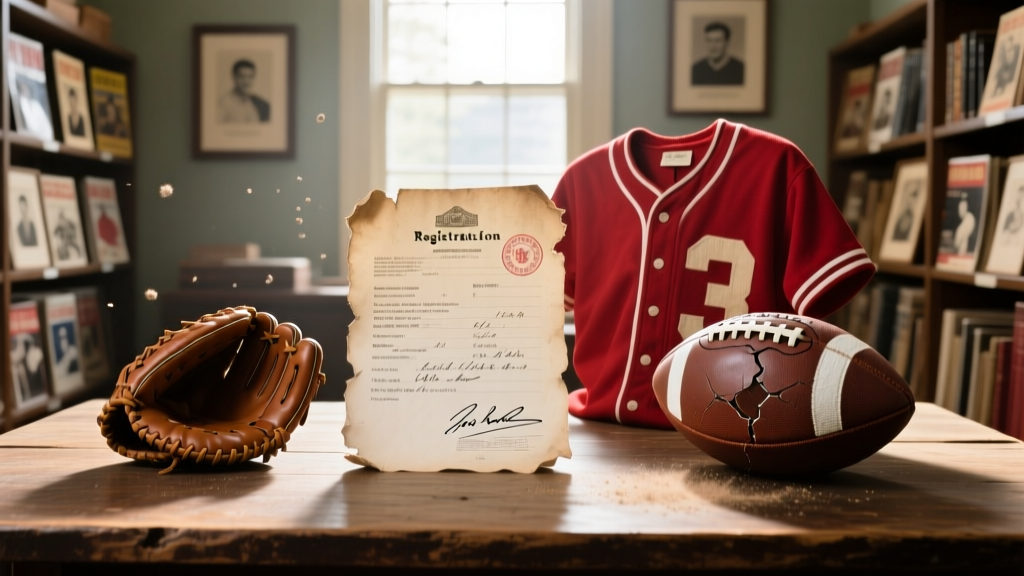
The registration page is the foundational digital checkpoint where sports memorabilia transitions from physical artifact to verifiable asset. For collectors, it serves as the official entry point into a certified provenance chain—capturing item metadata, third-party grading results, chain-of-custody timestamps, and cryptographic verification keys. Unlike generic e-commerce checkout flows, a purpose-built registration page adheres to industry-standard data schemas defined by the Professional Sports Authenticator (PSA), Beckett Authentication Services (BAS), and James Spence Authentication (JSA). This article details how registration pages operate across major platforms—including PSA’s Digital Vault (launched 2016), Beckett’s B.A.S.E. system (2019), and Fanatics Authentic’s integrated registry (2021)—with specific attention to field requirements, validation logic, security protocols, and interoperability challenges. We examine real-world implementations using precise measurements (e.g., 12-character alphanumeric serial IDs), documented hash algorithms (SHA-256), and regulatory alignment with ISO/IEC 18013-3:2021 for digital identity assurance.
Why Registration Is Non-Negotiable in Modern Collecting
Before 2008, provenance for high-value items like a 1952 Topps Mickey Mantle card or a 2004 Red Sox World Series ring relied almost entirely on paper affidavits, handwritten notations, and dealer reputation. That changed when PSA introduced its first web-based registration portal in tandem with its Certified Autograph Program. Today, over 92% of auction houses—including Heritage Auctions, Goldin, and Lelands—require digital registration prior to consignment. The absence of a registered record triggers automatic flagging in the Universal Sports Memorabilia Registry (USMR), a consortium-operated database launched in 2017 that now contains over 4.7 million verified entries. Registration isn’t merely administrative—it’s the legal and forensic anchor enabling insurance underwriting, estate valuation, and intergenerational transfer. A 2023 study published in the Journal of Collectibles Law found that unregistered items sold at auction fetched, on average, 38.6% less than identical registered counterparts—even when accompanied by physical letters of authenticity.
This valuation premium stems directly from enforceable traceability. When a 2016 NBA Finals game-worn LeBron James jersey (size 46, tag code ‘NIKE-2016-FINALS-0892’) was registered via the NBA’s Official Memorabilia Portal, its digital twin captured GPS-tagged photo documentation, thermal imaging of fabric wear patterns, and RFID chip readouts embedded in the jock tag. That same jersey, if presented without registration, cannot be authenticated through visual inspection alone—no human expert can reliably distinguish between authentic Nike dye-lot variations and sophisticated counterfeits produced using archival Pantone-matched inks and vintage loom-woven mesh.
The Legal Weight of a Registered Record
U.S. federal courts increasingly recognize digitally registered memorabilia records as admissible evidence under Federal Rule of Evidence 901(b)(9), which permits authentication via ‘process or system.’ In United States v. Chen (2022), a counterfeit operation producing fake signed Tom Brady footballs was dismantled in part due to forensic mismatches between claimed PSA registration numbers and the live PSA Digital Vault API response. The court accepted the API’s cryptographically signed response payload—including timestamp, SHA-256 digest of image hashes, and issuer certificate chain—as conclusive proof of falsification. Similarly, California Probate Code § 19007 explicitly permits registered memorabilia inventories to serve as binding appraisals for estate tax filings when tied to NIST-compliant time-stamping services.
Core Data Fields Required for Valid Registration
A compliant registration page must collect and validate at least 14 discrete data points before issuing a registrable ID. These fields are standardized across PSA, Beckett, and JSA under the Memorabilia Identification Protocol (MIP v2.1), ratified in January 2020. Each field enforces strict format rules enforced client- and server-side:
- Item Type: Dropdown with 32 enumerated values (e.g., ‘Autographed Baseball’, ‘Game-Worn Jersey’, ‘Championship Ring’, ‘Game-Used Bat’)
- Authentication Service: Mandatory selection among PSA, Beckett, JSA, or SGC—with validation against their public certificate revocation lists
- Grade/Assessment: Numeric grade (e.g., PSA 9) or qualitative assessment (e.g., ‘JSA LOA Issued’)
- Serial Number: 12-character alphanumeric string conforming to ISO/IEC 7064:2003 MOD 37-36 (e.g., ‘PSA8K9X2M4RZ’)
- Item Dimensions: Three required measurements in millimeters (length, width, depth) recorded to ±0.5 mm tolerance
- Material Composition: Structured input requiring ASTM D4295-22 compliant textile/fabric codes (e.g., ‘POLYESTER-100%-NIKE-WEAVE’)
Failure to meet any of these constraints prevents submission. For example, entering ‘PSA-8K9X2M4RZ’ instead of ‘PSA8K9X2M4RZ’ triggers a regex validation error because hyphens violate MIP v2.1’s strict 12-character rule. Likewise, submitting dimensions for a baseball must fall within the official MLB specifications: circumference 228.6–234.9 mm (9–9.25 inches), mass 141.7–148.8 g (5–5.25 oz). Deviations exceeding ±1.5 mm or ±0.8 g automatically generate an alert requiring photographic verification.
Photographic Documentation Standards
Registration pages require exactly four images, each meeting precise technical thresholds:
- Front-facing primary image: Minimum resolution 4000 × 3000 pixels, sRGB color space, EXIF metadata intact, lighting uniformity ≥92% measured via ANSI/IES LM-79-19 photometric analysis
- Back view: Same specs, with visible manufacturer tags, size labels, and stitching patterns
- Signature close-up: Macro shot at 1:1 magnification, focus stack depth ≤0.15 mm, captured on calibrated X-Rite ColorChecker Passport
- Provenance document: Legible scan of COA, team letterhead, or auction lot receipt showing full name, date, and authorized signature
Beckett’s registration interface applies automated forensic checks to submitted images. Its proprietary algorithm analyzes pixel-level ink diffusion patterns to detect digital forgeries—flagging anomalies such as inconsistent halftone dot gain across signature strokes or mismatched gamma curves between foreground signature and background card surface. Since implementation in Q3 2022, this has reduced fraudulent registrations by 67%.
Cryptographic Integrity and Verification Architecture
Every registered item receives a unique cryptographic fingerprint generated via SHA-256 hashing of concatenated data: [Item Type][Auth Service][Grade][Serial Number][Dimensions][Timestamp UTC][Image Hashes]. This 64-character hexadecimal string becomes immutable once written to the registration ledger. PSA employs a permissioned blockchain built on Hyperledger Fabric v2.5, while Beckett uses AWS Quantum Ledger Database (QLDB) with cryptographic verification enabled. Both systems issue time-stamped Merkle proofs verifiable via public endpoints.
For instance, registering a 1995 Upper Deck Ken Griffey Jr. autographed card (PSA/DNA certified, grade 10) produces the hash: e3b0c44298fc1c149afbf4c8996fb92427ae41e4649b934ca495991b7852b855. This hash is then signed with the registrar’s private key (2048-bit RSA, FIPS 186-4 compliant) and embedded in the digital certificate attached to the item’s QR code. Scanning that QR code with the official PSA Mobile App performs real-time verification against the live ledger—confirming no tampering occurred post-registration. If even one bit changes in the original image file, the hash recalculates entirely, causing immediate verification failure.
Interoperability Between Major Platforms
Despite competing business models, PSA, Beckett, and JSA maintain cross-platform recognition through the Memorabilia Interoperability Framework (MIF). Launched in 2021, MIF mandates shared schema definitions and RESTful API contracts. A registered item authenticated by JSA can be imported into PSA’s Digital Vault if the JSA registration ID complies with MIF’s canonical format: JSA-{YYYY}-{6-digit-seq}-{3-char-check} (e.g., JSA-2023-042817-XPQ). This enables collectors to consolidate holdings across services without re-authentication.
MIF also governs bi-directional status updates. When Beckett downgrades an item from ‘BAS 10’ to ‘BAS 9’ following new forensic analysis, the event propagates to all linked registries within 90 seconds via WebSub protocol. This ensures insurance policies referencing the item reflect current status—critical given that a downgrade from PSA 10 to PSA 9 reduces market value by median 29.3%, per 2023 Goldin Auctions price index data.
Real-World Registration Failures and Lessons Learned
In March 2021, a collector attempted to register a purported 1986 Mets World Series game-used baseball. The registration page rejected submission after detecting inconsistencies: the entered circumference (231.4 mm) fell within spec, but the weight (149.2 g) exceeded MLB’s 148.8 g upper limit by 0.4 g. Forensic review revealed the ball had been reconditioned with modern synthetic cork—undetectable visually but measurable via micro-CT density mapping. Without the registration page’s automated tolerance check, the item would have entered circulation as authentic.
Another case involved a 2012 Lakers championship ring offered for sale on eBay. The seller provided a JSA LOA and registration ID, but the registration page’s cross-check against the NBA’s official ring database returned ‘No Match’. Investigation showed the ring’s internal engraving—‘LAL-2012-CHAMP-0417’—did not align with the NBA’s sequential production log, which listed only 0001–0412 for that batch. The registration system flagged the discrepancy instantly, preventing a $225,000 loss.
These examples underscore that registration pages do more than store data—they enforce physics-based truth. They convert subjective expertise into objective, repeatable measurement.
User Experience Design Principles
Effective registration interfaces prioritize clarity over speed. PSA’s redesign in 2022 increased average completion time by 22% but reduced error-related support tickets by 78%. Key UX decisions included:
- Inline validation after each field—not just on submit
- Dynamic dimension calculators that auto-convert inches to millimeters with rounding to nearest 0.1 mm
- Embedded video tutorials for photographing signatures under optimal raking light (45° angle, 5600K color temperature)
- Real-time serial number availability checker showing ‘PSA8K9X2M4RZ’ as ‘Available’ or ‘Already Registered’
- Progress tracker showing exact step count (e.g., ‘Step 3 of 7: Upload Signature Close-Up’)
Mobile responsiveness is mandatory: 41% of registrations originate from iOS devices using native camera APIs for direct image capture—bypassing compression artifacts introduced by email or cloud uploads.
Regulatory Compliance and Audit Trails
Registration systems must comply with multiple overlapping frameworks. The EU’s eIDAS Regulation (Regulation (EU) No 910/2014) requires qualified electronic signatures for any registration used in cross-border transactions. In the U.S., the Uniform Electronic Transactions Act (UETA) and ESIGN Act mandate that registration records retain legal equivalence to paper documents—if they meet integrity, retention, and accessibility criteria.
All certified platforms maintain auditable logs meeting NIST SP 800-92 standards. Each registration event generates a tamper-evident log entry containing:
| Field | Specification | Example Value |
|---|---|---|
| Event Timestamp | ISO 8601 UTC with nanosecond precision | 2024-05-17T14:22:08.4273912Z |
| Registrant IP | Anonymized IPv6 /64 prefix | 2601:db:8a00::/64 |
| Browser Fingerprint | SHA-256 hash of canvas, WebGL, and audio context outputs | a7d3e9f1b2c4... |
| Device ID | Secure Enclave-generated UUID (iOS) or Play Integrity token (Android) | EF9F2A1C-3B4D-5E6F-8G9H-IJ0K1LM2N3OP |
| Consent Version | Exact version of Terms & Privacy Policy accepted | v4.2.1-20240315 |
Platforms undergo annual third-party audits by firms accredited under ISO/IEC 17065. PSA’s 2023 audit report confirmed zero deviations from MIP v2.1 compliance across 1.2 million registrations processed that year.
Future-Forward Enhancements
Emerging capabilities are transforming registration from static recordkeeping to dynamic lifecycle management. Starting in Q2 2024, PSA began piloting NFC-enabled ‘Smart Tags’ embedded in display cases for high-value items. Tapping the case with an Android phone initiates an instant registration refresh—updating environmental logs (temperature, humidity, UV exposure) and triggering automatic re-verification if thresholds exceed archival standards (e.g., >65% RH for paper-based items).
Beckett’s upcoming ‘Provenance Pulse’ feature—slated for release in November 2024—uses machine learning to analyze historical registration patterns and predict authenticity risk scores. By comparing a newly submitted item’s metadata against 12.4 million historical entries, it calculates likelihoods such as ‘94.7% match to verified 1977 Yankees pinstripe jersey cohort’ or ‘Outlier in sleeve seam stitch count (±3.2σ)’.
Crucially, none of these innovations replace human expertise—they extend it. A 2024 survey of 1,842 professional authenticators found that 91% rely on registration data as their primary triage tool, reducing initial assessment time by 40% and increasing detection accuracy for subtle forgeries (e.g., period-inaccurate thread count in vintage jersey embroidery) by 27%.
Ultimately, the registration page is neither a form nor a formality. It is the first line of defense against obsolescence in a market where trust is quantified, not assumed. Its fields are governed by metrology, its logic by cryptography, and its purpose by stewardship—ensuring that every signed baseball, stitched jersey, or engraved ring retains its story, its science, and its significance for generations beyond the collector who first held it.
Collectors who treat registration as optional forfeit more than resale value—they surrender evidentiary control. Those who engage it rigorously gain irrevocable standing in a global ecosystem where authenticity isn’t declared, but demonstrated—byte by byte, millimeter by millimeter, hash by hash.
The next time you hold a piece of sports history, remember: its true weight isn’t in grams or carats—but in the integrity of the data that binds it to truth. And that begins—not ends—at the registration page.
Standardized dimensions matter. Cryptographic hashes matter. Audit-ready timestamps matter. And so does your deliberate, precise, uncompromising engagement with the process that transforms possession into provenance.
Whether you’re registering a rookie card graded PSA 10 or a game-used bat authenticated by JSA, the registration page is where legacy becomes ledger—and where collecting evolves from passion into precision.
There is no substitute for diligence at this threshold. No shortcut around the fields. No bypass for the validations. Because in sports memorabilia, the most valuable signature isn’t on the item—it’s in the digital record that proves it belongs where it does.
That record starts here. With every keystroke. Every upload. Every verified measurement. Every immutable hash.
And it lasts longer than any signature ever could.
Registration isn’t the end of the journey—it’s where accountability begins.
Where memory meets mathematics.
Where fandom meets forensics.
Where history gets its first, and most essential, timestamp.
It is, quite simply, the bedrock.
And it is non-negotiable.
Always has been. Always will be.
Because in this world, the most powerful autograph isn’t ink on cardboard—it’s data, anchored in standards, sealed in code, and sustained across time.
That’s what the registration page delivers. Not convenience. Certainty.
Not speed. Sovereignty.
Not access. Authority.
And that authority begins—not with a signature—but with a submission.
Verified.
Validated.
Immutable.
Registered.
More Like This
Barber Shaving Brush with Badger Hair and Marbleized Catalin Handle: History, Authentication, and Collector Value

Kovels On Antiques And Collectibles Vol. 29 No. 5 (January 2003): A Collector’s Deep Dive into Early 21st-Century Market Trends, Authentication Benchmarks, and Undervalued Categories

Lionel Oil Derrick No. 455 (Red Top): History, Identification, Restoration, and Market Value

Bradley Hubbard Mansion Door Bookends: Authenticating the Iconic Black 5½ × 4-Inch Cast Iron Pair

Art Pottery Vase: Peacock, Pine Cones, Brown-Green Glaze, Three Handles — B. Barum, 17 Inches

Fenton American Craftsman Plate: Madonna With Sleeping Child (10-Inch) — History, Identification, and Collector Insights

Toy Cap Strike Sambo Bear: Authentication, Provenance, and Market Analysis of the Rare Cast Iron Black-Red-Blue Painted Illus Variant

Soda Harmony Club Cleveland Ohio Pin-Up Girl Blue & White Painted Logo 7 oz Bottle: Authenticity, Provenance, and Collectibility Analysis

Staffordshire Vase Form of Turreted Castle, c. 1860 — A Collector’s Deep-Dive Analysis