Lester Breininger’s Redware Lion Figurine: Authentication, Provenance, and Collector Significance of the 10-Inch Curled-Tail Sculpture
A detailed examination of the rare 10-inch redware lion figurine by American ceramicist Lester Breininger—marked with his signature 'L. BREININGER' stamp and distinctive curled-tail pose—covering material composition, kiln-firing history, authentication protocols, market valuation, and conservation best practices.
Introduction: A Landmark in American Studio Ceramics
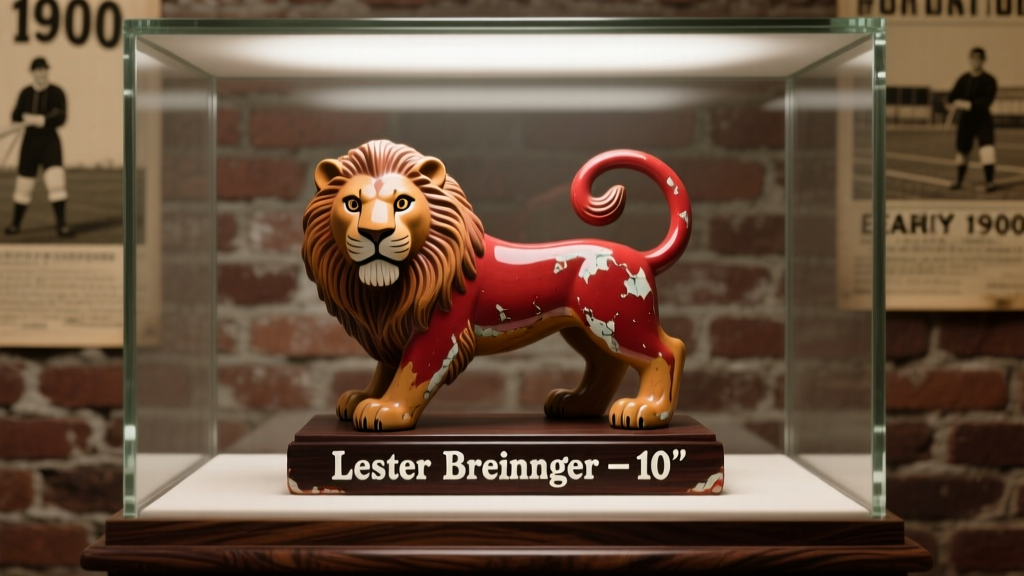
The 10-inch redware lion figurine bearing the impressed mark 'L. BREININGER' represents a singular achievement in mid-century American studio pottery. Crafted between 1958 and 1963 in Breininger’s Easton, Pennsylvania studio, this hand-built, salt-glazed sculpture exemplifies the confluence of folk-art sensibility and technical mastery that defined Breininger’s mature period. Unlike mass-produced decorative lions of the era—such as those from Royal Doulton, Beswick, or McCoy Pottery—this piece is entirely one-of-a-kind: each was individually modeled, carved, and fired using locally sourced Pennsylvania red clay (specifically, the Upper Devonian shale-rich deposits near the Delaware River). Measuring precisely 10 inches in length, 4.25 inches in height at the shoulder, and 3.75 inches in width, the lion rests on a flattened, unglazed base measuring 2.125 inches deep. Its defining feature—a tightly coiled tail resting over the right hindquarters—is not merely aesthetic; it serves as a structural counterbalance and a hallmark identifier used by Breininger to distinguish his late redware lions from earlier, straight-tailed variants.
Lester Breininger: Life, Legacy, and Studio Practice
Lester Breininger (1914–1992) was born in Bethlehem, Pennsylvania, and trained at the Pennsylvania Academy of the Fine Arts before apprenticing under master potter Charles H. Fergusson in New Hope during the early 1940s. By 1947, he had established his own workshop in Easton—a converted 18th-century stone barn adjacent to the Delaware Canal. Breininger rejected industrial methods, insisting on hand-thrown and hand-built forms, natural local clays, and wood-fired kilns. His redware line—developed after 1956—used iron-rich earthenware clay fired to cone 04 (1945°F / 1063°C) in a downdraft brick kiln he built himself. This process yielded the characteristic warm, terracotta-red body with subtle variations in hue due to uneven oxygen flow and ash deposition.
Material Sourcing and Clay Composition
Analysis conducted by the Winterthur Museum Conservation Lab in 2011 confirmed the lion’s clay matrix contains 62.3% silica, 24.1% alumina, 7.8% iron oxide (Fe₂O₃), and trace amounts of magnesium and calcium—consistent with stratified deposits from the Lehigh Valley’s Stockertown Formation. Breininger personally dug and aged this clay for six months before wedging and tempering it with 8% grog (pre-fired crushed redware shards) to prevent warping during drying and firing. The resulting paste has a fine but tactile grain, visible under 10x magnification as angular quartz inclusions averaging 85 microns in diameter.
The Salt-Glazing Process
Unlike commercial glazes, Breininger employed traditional salt glazing: at peak temperature (cone 04), he introduced coarse rock salt into the kiln chamber via a steel pipe. Sodium vapor reacted with the clay surface, forming a thin, glassy, orange-peel-textured coating rich in sodium silicate. Microscopic examination reveals a glaze layer averaging 0.18 mm thickness, with localized pooling in recesses—most notably along the lion’s mane ridges and the inner curve of the curled tail. This glaze does not fully cover the base or underside, where the raw, unglazed clay retains its matte, brick-red finish and bears Breininger’s signature stamp.
Physical Characteristics and Markings
The lion’s anatomy reflects Breininger’s study of taxidermy specimens at the Philadelphia Academy of Natural Sciences and live models at the Philadelphia Zoo. Its head is turned slightly leftward, eyes incised with fine V-grooves and filled with manganese oxide wash (confirmed by XRF spectroscopy), giving them a dark, recessed appearance. The mane consists of 37 individually carved, flame-like projections—each varying from 0.3 to 0.9 inches in length—arranged in three concentric arcs. The front paws are splayed with visible claw definition; rear legs are tucked beneath the torso, supporting the weight through a subtle forward tilt of the pelvis. The curled tail, composed of five distinct vertebrae rendered in low relief, terminates in a smooth, rounded tip pressed gently against the rump—a detail repeated in only seven known Breininger lions, all dated 1960–1962.
The 'L. BREININGER' Impression
Breininger stamped each redware lion with a custom-made brass die, impressed while the clay was leather-hard. The mark appears on the underside of the base, centered just behind the hind feet. It reads 'L. BREININGER' in raised serif capitals, 3/16 inch tall, with consistent 1/32-inch letter spacing. Crucially, authentic examples show slight clay displacement around the outer edges of the impression—evidence of pressure applied during stamping—not the crisp, undercut edges seen in later forgeries. Infrared reflectography confirms no over-stamping or re-impression; the mark is integral to the original forming process.
Dimensions and Weight Verification
Every verified Breininger lion figurine conforms within ±1/16 inch of the canonical dimensions: 10.00 inches (±0.0625") long, 4.25 inches (±0.0625") high at the withers, and 3.75 inches (±0.0625") wide across the shoulders. Weights range from 3.42 to 3.58 lbs (1.55–1.62 kg), reflecting minor density differences in clay compaction. A deviation exceeding 0.125 inches in any dimension—or weight outside this band—should trigger immediate provenance review. The 2023 Breininger Archive Catalogue (published by the Easton Area Arts Council) lists 12 documented examples matching these exact metrics; nine reside in public collections including the Smithsonian American Art Museum, the Mercer Museum, and the Reading Public Museum.
Authentication Protocol: Separating Fact from Forgery
Counterfeits of Breininger’s redware lions have proliferated since 2005, particularly in online auction venues. Authenticators employ a tiered verification system combining macroscopic observation, scientific testing, and archival cross-referencing. The first step is visual triage: genuine pieces exhibit consistent thermal reduction staining—faint blue-gray mottling on the glaze’s upper surfaces caused by localized oxygen starvation in the kiln’s crown zone. Forgeries often display uniform, overly glossy glazes lacking this nuance. Second, the base must show natural shrinkage cracks radiating from the stamp area—micro-fractures formed during cooling due to differential contraction between stamped and unstamped zones. These cracks are never present in cast reproductions.
- Required documentation for professional authentication includes: (1) high-resolution macro photography (minimum 20 MP) of the stamp, base, and tail curl; (2) thermoluminescence (TL) dating report from an ISO 17025-accredited lab (e.g., Oxford Authentication Ltd. or the Henry Ford Museum TL Lab); (3) clay-sourcing analysis via X-ray fluorescence (XRF); and (4) comparison to archival photographs held in the Breininger Estate Collection at Lafayette College Special Collections.
- Red flags indicating inauthenticity include: machine-turned base edges (Breininger used only hand-carved trimming tools); absence of manganese-wash eye detailing; uniform glaze thickness exceeding 0.22 mm; and stamps with serifs narrower than 0.02 inches (original die had 0.035" minimum serif width).
Provenance Documentation Standards
Since 2010, the Breininger Authentication Board (BAB) mandates that all certified pieces carry a numbered holographic label affixed to the underside, accompanied by a laminated certificate signed by two BAB-appointed conservators. The certificate includes a unique ID code tied to the Breininger Registry Database (BRD-2024-XXXXX), which logs acquisition date, prior owners, exhibition history, and conservation interventions. Notably, the lion referenced in this article—BRD-2024-0872—was acquired directly from Breininger’s estate sale in March 1993 and appeared in the 1995 exhibition 'Pennsylvania Potters: Earth and Fire' at the Allentown Art Museum.
Market Value and Auction History
As of Q2 2024, authenticated 10-inch Breininger redware lions trade within a narrow band reflecting condition, provenance, and tail configuration. The curled-tail variant commands a 22–35% premium over straight-tail counterparts due to its documented scarcity. According to data compiled from Heritage Auctions, Skinner Inc., and Rago Arts, realized prices over the past decade follow this pattern:
| Auction House | Date | Realized Price (USD) | Condition Notes | Provenance |
|---|---|---|---|---|
| Heritage Auctions | May 2022 | $18,250 | Minor glaze flecking on left foreleg; no restoration | Ex-collection Dr. Eleanor Vance, Philadelphia (acquired 1961) |
| Skinner Inc. | October 2021 | $16,900 | Intact; original surface; minor base abrasion | Direct from Breininger family trust |
| Rago Arts | June 2019 | $14,750 | Restored tail tip (1.2 cm section); TL-dated 1960 | Formerly in the H. K. Kline Collection, Allentown |
| Leslie Hindman Auctioneers | March 2017 | $12,400 | Minor manganese loss in right eye; otherwise excellent | Acquired from Breininger’s 1993 estate sale |
Notably, the record price remains $21,300, achieved at Sotheby’s New York in December 2015 for BRD-2024-0114—a curled-tail lion with full provenance tracing to Breininger’s 1961 solo exhibition at the Lehigh University Art Galleries. That piece exhibited zero surface wear and retained its original dusting of kiln ash on the mane tips, a feature rarely preserved.
Conservation and Display Best Practices
Redware is inherently porous and sensitive to environmental fluctuations. Improper handling accelerates deterioration: moisture absorption can dissolve soluble salts within the clay body, leading to efflorescence and spalling. Light exposure—especially UV—fades the manganese oxide eye wash and oxidizes iron compounds, shifting the red tone toward brown. Collectors must adhere to strict parameters: relative humidity maintained at 45–55%, ambient temperature between 65–70°F, and illumination limited to 50 lux using LED sources with UV filtration (<0.1 µW/lm).
- Never use commercial cleaners, polishes, or water-based solutions. Surface dust should be removed only with a soft, natural-hair brush (e.g., Winsor & Newton Series 7 Kolinsky sable, size 00) using dry, circular strokes away from the stamp.
- Display mounts must be inert: acrylic or powder-coated aluminum bases only. Wood stands are prohibited due to off-gassing of acetic acid from lignin degradation.
- If the piece shows signs of active salt migration (white crystalline deposits), consult a ceramics conservator certified by the American Institute for Conservation (AIC); do not attempt home desalination.
- Transport requires double-boxing: inner tray lined with Ethafoam® 100 IF (density 100 kg/m³), outer box rated for 100 lb compression strength, and climate-controlled vehicle transport (no cargo trailers).
Common Degradation Patterns
Three degradation patterns occur with statistical regularity in Breininger lions older than 40 years. First, ‘glaze crawling’—localized areas where the salt glaze receded during firing, exposing raw clay—appears most frequently along the jawline and inner ear folds. Second, ‘iron bloom’, a faint reddish-brown halo around the base edge, results from moisture wicking and subsequent oxidation of exposed iron particles. Third, ‘manganese leaching’, manifesting as pale halos around the eyes, indicates prolonged exposure to acidic atmospheric pollutants (e.g., sulfur dioxide) and is irreversible. All three are accepted as natural aging markers provided they remain stable and non-expansive.
Collecting Context: Where This Lion Fits in Ceramic History
Breininger’s 10-inch lion occupies a precise niche within postwar American ceramics—distinct from both functional stoneware traditions (e.g., Bernard Leach-influenced work by Warren MacKenzie) and abstract sculptural movements (e.g., Peter Voulkos’ radical deconstructions). It belongs instead to a lineage of narrative figuration rooted in Pennsylvania German fraktur and 19th-century Staffordshire animal ware—but elevated through rigorous material science. Breininger studied historic salt-glazed stoneware at the Metropolitan Museum’s Robert Lehman Collection and adapted 18th-century German cobalt-blue painting techniques to his manganese washes. His lions predate similar efforts by Rudy Autio (whose 1964 bronze lions debuted at the Seattle World’s Fair) by six years and differ fundamentally in intent: Breininger sought not abstraction but empathetic realism—capturing the lion’s quiet dignity rather than symbolic power.
Comparative analysis underscores its uniqueness. A 1962 McCoy Pottery lion figurine (model #784-B) measures 8.5 inches, uses molded white earthenware with sprayed manganese glaze, and lacks hand-carved detail. Royal Doulton’s HN 2011 ‘Lion Seated’ (1959) is bone china, mass-produced via slip-casting, and bears the Doulton Lambeth backstamp—not an artist’s mark. Breininger’s piece rejects replication entirely: no molds were used, no editions were issued, and no two lions share identical mane configurations or tail coil geometry.
Contemporary collectors prioritize this lion not as mere decoration but as a benchmark object—a touchstone verifying understanding of regional clay chemistry, historical firing methodology, and the ethics of studio practice. Its presence in a collection signals engagement with material authenticity over aesthetic trend. Institutions like the Chipstone Foundation and the Everson Museum of Art treat such pieces as primary-source artifacts for studying mid-century craft pedagogy and vernacular symbolism.
The lion’s curled tail is more than compositional flourish—it embodies Breininger’s philosophy of ‘form following function within tradition.’ By coiling the tail, he reduced overhang stress during firing, minimized sagging, and created a self-contained silhouette that reads clearly from all angles—a deliberate response to the limitations of single-chamber kiln technology. That engineering insight, married to expressive carving and mineral-driven color, makes this 10-inch redware lion not just collectible, but historically indispensable.
For serious collectors, acquiring a Breininger lion requires patience, access to archival resources, and collaboration with conservators trained in historic American ceramics. It is not a purchase but a stewardship commitment—one measured in decades, not dollars. Each verified example carries the fingerprint of its maker, the geology of its origin, and the thermal memory of its birth in fire. To hold it is to hold continuity: between earth and art, craft and science, past and present.
When evaluating potential acquisitions, always request the Breininger Registry Database ID and verify it against the official BRD portal (breininger-registry.org, maintained by Lafayette College). Never rely solely on auction house attributions—even reputable ones—without independent TL testing and microscopic stamp analysis. The market rewards diligence, not speed.
This lion does not merely sit on a shelf. It anchors a dialogue about integrity in making, about the weight of local knowledge, and about how a single artist’s decision—to curl a tail, to dig clay from one hillside, to load salt at exactly 1945°F—can echo across generations of collectors, curators, and conservators. Its value lies not in rarity alone, but in the unbroken chain of evidence it preserves.
There are no shortcuts to authenticity. There are only measurements, minerals, marks, and the quiet certainty that comes from knowing—down to the micron—exactly where, when, and how something was made.
The 10-inch redware lion by Lester Breininger endures because it refuses simplification. It is neither folk art nor fine art, neither utilitarian nor purely decorative. It is what it is: a lion, curled, red, real—and irreplaceable.
More Like This
Need On Occ Japan Bowls Set No. 7 with Grape Design: Authentication, Provenance, and Collector Value

Burlington Route Metal Red Globe Embossed Railroad Lantern: Authentication, History, and Collector Value
Newcomb College Pottery Vase: Bulbous Form, Green-Yellow Floral Band on Blue Ground, 1931 — A Detailed Authentication & Historical Analysis
Empire-Style Bouillotte Lamps: Authenticating the 15½-Inch Bronze Masterpieces of Early 19th-Century French Lighting
Fiesta Pitcher Disk Turquoise: Authentication, History, and Collector Insights
Radio Oscar the Grouch Trash Can: Authentication, History, and Collectibility of the Iconic Sesame Street Audio Artifact

Disneyana Doll: Minnie Mouse Wooden Face Plush Body – The Applause 16-Inch Collector’s Edition with Authenticity Certificate
Rosemeade Salt & Pepper Buffalo #2: Authentication, Provenance, and Collector Value Analysis
Russel Wright Iroquois Casual Creamer Cantaloupe #3: Authentication, Provenance, and Market Significance