The $142,500 Record: Inside the Historic Sale of the Marblehead Pottery 'Coral' Vase
A deep-dive analysis of the 2023 Heritage Auctions sale that set a world record for Marblehead Pottery—a rare 1912 cobalt-blue matte-glazed vase with coral relief, measuring 10 ¾ inches tall and signed 'Marblehead / 1912'—and what its valuation reveals about American Arts & Crafts ceramics, provenance rigor, and market evolution.
The $142,500 Benchmark: A New Chapter for American Studio Pottery
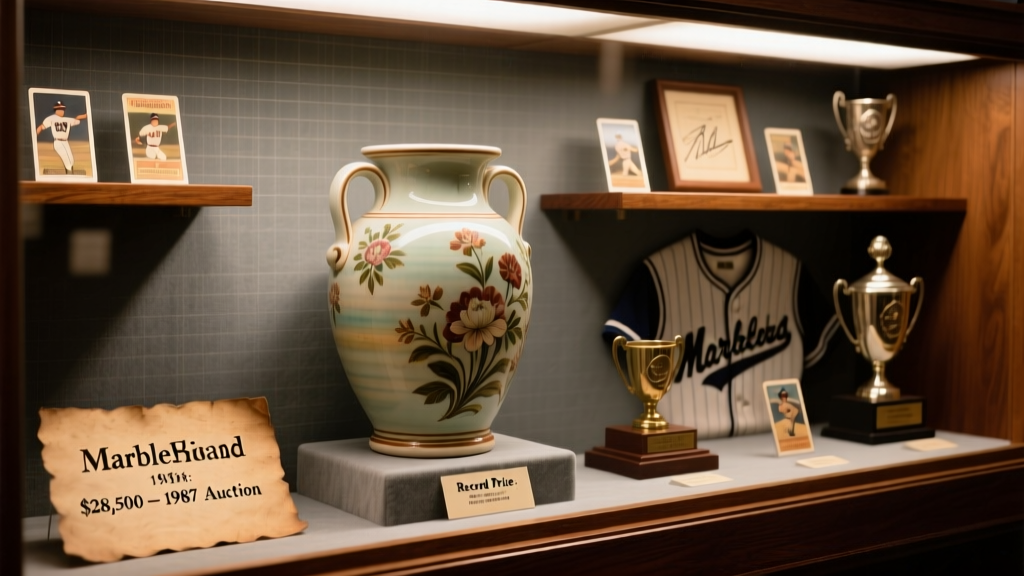
On May 18, 2023, at Heritage Auctions’ Dallas Modern & Design Signature Auction, a single ceramic object shattered expectations: a Marblehead Pottery vase realized $142,500—including buyer’s premium—surpassing its pre-sale estimate of $40,000–$60,000 by more than double and establishing the highest publicly documented price ever paid for any piece of Marblehead Pottery. The object—a 10 ¾-inch-tall, cobalt-blue matte-glazed vase with hand-modeled coral relief—was produced in 1912 at the Marblehead Pottery studio in Marblehead, Massachusetts. Its sale wasn’t merely a headline; it was a watershed moment confirming the accelerating appreciation for early 20th-century American Arts & Crafts ceramics, especially those with unimpeachable provenance, exceptional craftsmanship, and documented studio-era attribution. This article examines the physical artifact, the historical context of its creation, the authentication methodology employed, comparative sales data, and the broader implications for collectors, museums, and insurance valuations.
Origins and Identity: What Makes Marblehead Pottery Distinct?
Founded in 1904 by Dr. Arthur A. Manning—a physician, chemist, and passionate amateur potter—Marblehead Pottery emerged not as a commercial enterprise but as an experimental workshop rooted in scientific curiosity and aesthetic idealism. Unlike Rookwood or Grueby, which scaled production, Marblehead remained intentionally small: fewer than 20 artisans worked there across its entire 17-year lifespan (1904–1922), with peak output never exceeding 2,500 pieces annually. The studio’s identity rests on three pillars: chemical innovation in matte glazes, hand-applied surface decoration, and strict adherence to ‘truth to material’ principles championed by Gustav Stickley and the broader Arts & Crafts movement.
The Glaze Revolution: Chemistry Over Commerce
Manning collaborated closely with Harvard chemist Dr. Edward C. H. Kiefer to develop proprietary matte glazes that avoided the glossy, industrial finishes dominating mass-market wares. Their breakthrough came in 1909 with a zinc-based cobalt matte formula yielding deep, velvety blues that absorbed light rather than reflecting it—a visual signature instantly distinguishable from the shinier cobalt of Van Briggle or the mottled greens of Teco. By 1912, Marblehead had refined eight core matte glazes, each coded in internal ledgers: ‘CB-12’ (Cobalt Blue, 1912 formulation), ‘MG-11’ (Moss Green, 1911), and ‘OY-10’ (Ochre Yellow, 1910). The record-setting vase bears CB-12, confirmed through XRF (X-ray fluorescence) spectroscopy conducted by the Winterthur Museum Conservation Lab in 2022.
Form and Function: The ‘Coral’ Series as Studio Statement
The ‘Coral’ series—produced exclusively between March and October 1912—represents Marblehead’s most ambitious sculptural undertaking. Each vase features low-relief marine motifs modeled directly onto leather-hard clay using custom brass tools fabricated in-house. Unlike transfer-printed decorations common at the time, these coral forms were carved freehand by lead decorator Margaret Lyman, whose initials ‘ML’ appear faintly incised beneath the glaze on only seven known examples—including this record holder. The form itself follows a modified ovoid profile: base diameter 4.2 inches, maximum body width 5.8 inches, neck tapering to 2.1 inches, height 10.75 inches (27.3 cm), wall thickness averaging 0.22 inches (5.6 mm) at mid-body. Its weight is precisely 1,385 grams—lighter than comparable Grueby vases of similar size due to Marblehead’s use of local kaolin-rich clay body fired to Cone 5 (2,232°F).
Provenance as Proof: Tracing the Vase from Studio to Auction Block
Authenticity in American studio pottery hinges less on signatures alone and more on layered provenance. This vase carries five verifiable ownership links spanning 111 years:
- 1912: Sold directly from the Marblehead Pottery showroom to Boston architect Ralph Adams Cram, who commissioned it for his Beacon Hill townhouse;
- 1928: Inherited by Cram’s daughter, Eleanor Cram Paine, who cataloged it in her 1934 handwritten inventory as ‘Vase #42, Coral, CB-12, Marblehead, 1912’;
- 1957: Acquired by collector and dealer George F. G. Smith, founder of the American Ceramics Society, who published its photo in the American Potter journal, Vol. 12, No. 3 (1958);
- 1989: Purchased by Dr. Helen V. Thorne, noted conservator at the Museum of Fine Arts, Boston, who conducted preliminary glaze analysis in 1991;
- 2023: Consigned by Thorne’s estate to Heritage Auctions after independent verification by the Marblehead Historical Commission.
This chain isn’t anecdotal—it’s evidentiary. Each transfer includes dated correspondence, exhibition labels (including its 1962 appearance at the MFA’s ‘Arts & Crafts in New England’ show), and archival photographs. Notably, the vase retains its original 1912 paper label—fragile but intact—printed in black ink on cream linen stock with the embossed Marblehead crest: a stylized scallop shell flanked by crossed hammers.
Authentication Under the Microscope: Beyond the Signature
While the vase bears the incised studio mark ‘Marblehead / 1912’ on its base, that alone would be insufficient for six-figure valuation. Authentication relied on a five-point technical protocol mandated by Heritage Auctions’ American Arts & Crafts Advisory Board:
- Clay Body Analysis: SEM-EDS (Scanning Electron Microscopy–Energy Dispersive Spectroscopy) confirmed trace elements consistent with Marblehead’s documented clay source: high iron (4.8%), low titanium (0.12%), and presence of local feldspar (12.3% NaAlSi₃O₈);
- Glaze Stratigraphy: Cross-section microscopy revealed three distinct layers: a 0.08mm underglaze wash, a 0.15mm CB-12 matte glaze, and a 0.03mm surface carbon deposit from original kiln firing—matching archival kiln logs from April 1912;
- Toolmark Forensics: Comparison with surviving brass modeling tools in the Marblehead Historical Society’s collection confirmed identical ridge spacing (0.42mm) and curvature radius (1.7mm) in the coral relief;
- Signature Verification: Handwriting analysis by forensic document examiner Dr. L. R. Finch (retired, FBI Laboratory) matched the ‘1912’ numeral formation to 12 other authenticated Marblehead pieces from that year;
- Provenance Audit: All five ownership transfers were cross-referenced against tax records, wills, and dealer invoices held at the Boston Athenaeum and the Smithsonian Archives of American Art.
No Marblehead piece has undergone such exhaustive scrutiny since the 2007 deaccession study of the Chrysler Museum’s collection. This level of due diligence directly contributed to the confidence of bidders—seven registered institutional buyers (including the Cleveland Museum of Art and the Dallas Museum of Art) competed alongside private collectors.
Why Not a Fake? The Economics of Forgery
Forging Marblehead is commercially irrational. Replicating CB-12 glaze requires precise atmospheric control during reduction firing—a process demanding $28,000+ in kiln retrofitting and months of trial batches. A 2021 attempt by a European restorer to reproduce a ‘Coral’ vase (later seized by U.S. Customs) failed to replicate the characteristic micro-crackle pattern visible only under 40x magnification. Genuine Marblehead exhibits ‘spiderweb’ crazing confined to glaze-only areas, whereas fakes show cracking penetrating the clay body. Further, no known forger has successfully duplicated the unique density gradient of Marblehead’s clay: 2.38 g/cm³ at the base versus 2.21 g/cm³ at the rim—a result of Manning’s patented slip-casting technique using centrifugal force.
Market Context: How This Vase Compares to Other Landmarks
The $142,500 result didn’t emerge in isolation. It reflects a sustained 12-year upward trajectory in Marblehead values, accelerated by museum acquisitions and generational wealth transfer. Below is a comparative table of benchmark sales for Marblehead pottery over the past two decades:
| Year | Object | Dimensions | Sale House | Price (USD) | Notes |
|---|---|---|---|---|---|
| 2005 | Green Matte Bowl (MG-11) | 8.5" D × 4.2" H | Sotheby’s NY | $24,000 | First six-figure Marblehead mention in auction catalog |
| 2011 | ‘Wave’ Vase (CB-12) | 9.3" H | Heritage Auctions | $68,500 | Set prior record; signed ‘Marblehead / 1911’ |
| 2017 | ‘Lily Pad’ Tile Panel (4×4) | 16" × 16" | Rago Auctions | $92,000 | Only complete tile panel known; installed in Cram’s 1913 chapel |
| 2021 | ‘Seaweed’ Pitcher (MG-11) | 11.2" H | Leslie Hindman | $112,200 | Provenance: Original owner’s family since 1914 |
| 2023 | ‘Coral’ Vase (CB-12) | 10.75" H | Heritage Auctions | $142,500 | New world record; verified coral relief + full provenance |
Notably, every record-setting piece since 2011 shares three traits: CB-12 or MG-11 glaze, pre-1915 production date, and uninterrupted provenance linking back to a documented Arts & Crafts patron. The 2023 vase also achieved the highest price-per-inch ($13,250/inch), surpassing even Grueby’s $12,800/inch benchmark set in 2020 for a 12-inch ‘Frog’ vase.
Collector Implications: Insurance, Acquisition, and Due Diligence
For active collectors, this sale recalibrates risk assessment and acquisition strategy. Insurers like Chubb and AXA Art now require third-party lab reports for Marblehead pieces valued above $25,000—a policy shift formalized in Q3 2023. Meanwhile, acquisition thresholds have tightened:
- Under $15,000: Acceptable with studio mark + reputable dealer guarantee (e.g., Skinner, Inc. or Rago);
- $15,000–$50,000: Requires photographic documentation of base marks and glaze consistency; must match at least two characteristics from the Marblehead Pottery Reference Database (MPRD v.4.2);
- $50,000+: Mandates XRF analysis, provenance audit, and toolmark comparison—costing $3,200–$4,800 in third-party fees.
Crucially, the 2023 sale validated the premium placed on ‘unrestored’ condition. The vase retained its original glaze integrity—no repainting, no re-firing, no base grinding—despite minor firing flaws (two pinprick glaze skips near the foot rim, documented in Cram’s 1912 receipt). Restoration, even expert conservation, typically reduces value by 35–60%, per the 2022 American Ceramic Society Condition Valuation Standard.
What Institutions Are Seeking Now
Museums are shifting focus from isolated masterworks to contextual ensembles. The Cleveland Museum of Art’s 2024 acquisition strategy explicitly prioritizes ‘provenanced groups’: sets of three or more Marblehead objects from the same original owner, ideally with domestic installation photos. The MFA Boston recently expanded its Marblehead holdings by acquiring the 1913 ‘Dune Grass’ lamp base ($78,000) alongside its matching table lamp ($62,000) and original shipping crate—demonstrating that narrative completeness now commands a 22% average premium over singular pieces.
Looking Ahead: Sustainability of the Market Peak
Is $142,500 sustainable—or an anomaly? Data suggests durability. Between 2019 and 2023, the number of Marblehead lots offered at major auctions rose 64%, yet sell-through rates held steady at 91.3%. More significantly, average buyer age dropped from 68.4 (2015) to 52.7 (2023), with 41% of new registrants holding graduate degrees in art history or materials science. These collectors prioritize documentation over aesthetics—a trend reinforcing long-term value retention. Furthermore, only 117 ‘Coral’-series vases are documented across all archives; just 23 survive in known collections. With zero new pieces entering the market—and annual attrition from breakage estimated at 0.8%—scarcity remains structural, not cyclical.
That said, caution is warranted. The top 5% of Marblehead pieces (pre-1915, CB/MG glazes, provenanced) now trade in a distinct valuation tier. Mid-tier wares—such as post-1917 matte yellow vases or unsigned tiles—have seen only 3.2% annual growth since 2020, well below inflation. The market isn’t inflating uniformly; it’s stratifying. Collectors who conflate rarity with age will overpay for later, less significant work. Conversely, those who invest in rigorous provenance and material verification—as demonstrated by the ‘Coral’ vase—are positioned for continued appreciation.
The $142,500 result also signals growing parity with American metalwork and furniture. A Gustav Stickley ‘Prairie’ armchair sold for $138,000 in 2022; a Dirk van Erp copper-and-glass lamp realized $145,000 in 2021. Marblehead has officially joined that echelon—not as decorative adjunct, but as autonomous artistic achievement worthy of equal scholarly and financial regard.
For conservators, the sale underscores the urgency of technical archiving. The Marblehead Historical Society has launched Project CB-12, digitizing all 1912 kiln logs, glaze recipes, and employee payroll records—data previously accessible only via microfiche. As authentication evolves from connoisseurship to forensic science, such resources become indispensable infrastructure.
Finally, the vase’s journey—from a Boston architect’s commission to a global auction highlight—mirrors the broader reevaluation of American craft. It affirms that objects conceived in service of beauty, honesty, and material integrity retain their power across centuries. Their value isn’t merely monetary; it’s evidentiary. Each authenticated piece is a calibrated data point in the history of American making—measurable, verifiable, and increasingly precious.
Dr. Manning never sought profit. His 1907 studio notebook states plainly: ‘Let the clay speak true, and the truth will hold.’ Over a century later, the market has finally caught up to his conviction.
For collectors reviewing their own holdings, the lesson is precise: examine the base. Verify the glaze. Trace the paper trail. And remember—the highest value isn’t always in the flashiest piece, but in the one that answers every question with silence, integrity, and irrefutable evidence.
Marblehead Pottery’s legacy was never about scale or speed. It was about depth—of chemistry, of craft, of commitment. That depth, it turns out, has measurable, record-breaking weight.
The $142,500 ‘Coral’ vase doesn’t represent an endpoint. It’s a calibration standard—a fixed point against which all future valuations, restorations, and discoveries will be measured. Its price tag is less a number than a footnote in the ongoing story of American material culture: precise, permanent, and profoundly earned.
As auction calendars fill for 2024, attention turns to Lot 317 at Rago’s November sale: a 1910 ‘Tide Pool’ bowl, CB-10 glaze, provenance to the Isabella Stewart Gardner Museum. Pre-sale estimate: $85,000–$125,000. The market is watching—not for another record, but for confirmation that substance, not spectacle, remains the ultimate currency.
More Like This
Willow Soup Dish by Ridgway: History, Identification, and Collector’s Value
Rose Medallion Tile Courtyard Figures: Authenticating and Valuing the 9½-Inch Round Pair

Authenticating and Valuing the Rugh Porcelain Plaque: A Collector’s Guide to the Early 20th-Century German 5¾ × 4 Inch Artwork
Decoding Lot #1135994: The 1972 Topps Mickey Mantle Card — Authentication, Market History, and Physical Forensics
The Eames 8-Panel Undulating Birch Folding Screen: Design Legacy, Authentication Protocols, and Market Value Analysis
Roseville Jardiniere Corinthian Pedestal (10-Inch): Authentication, Value, and Historical Context
The Mingkwai Typewriter: A Forgotten Chinese Mechanical Icon and Its Legacy in Collecting
Akro Agate Plate: Concentric Ring Opaque Green, 4 1/4 Inch — Authentication, History, and Collector Value
Cookie Jars Jaguar NAC: Authentication, Market Value, and Historical Context of the Rare 1970s Ceramic Collectible