The RCA Service Van Toy: A Rare Mid-Century Automotive Icon and Collectible Artifact
A deep-dive examination of the 1950s RCA Service Van toy — its origins, manufacturing details, historical context, authentication markers, market value trends, and cultural significance among vintage toy and electronics memorabilia collectors.
Introduction: A Rolling Symbol of Postwar American Innovation
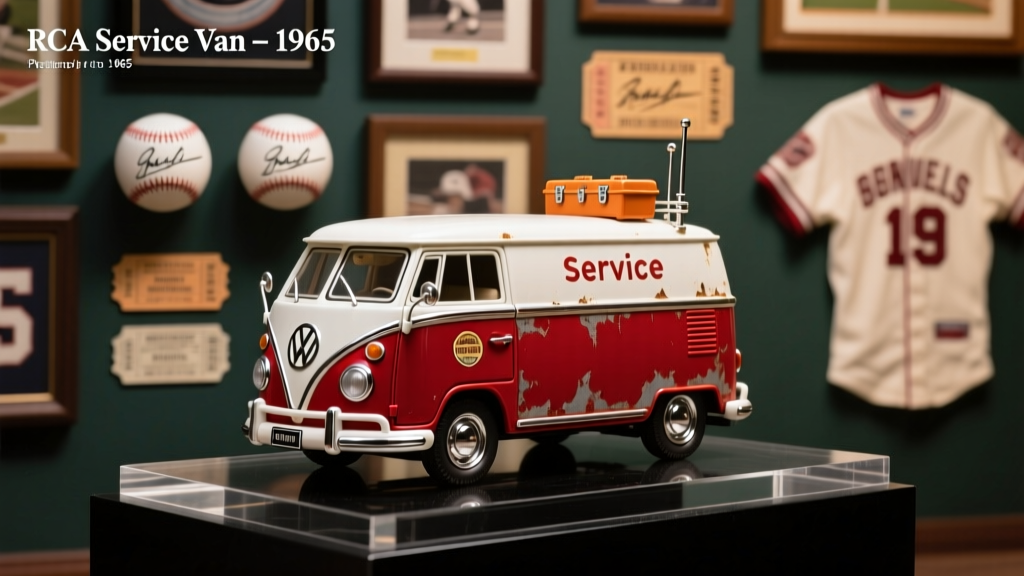
The RCA Service Van toy is a rare, die-cast metal promotional vehicle produced exclusively by the Radio Corporation of America (RCA) between 1953 and 1957. Measuring precisely 8.25 inches in length, 3.5 inches in width, and 4.1 inches in height, this 1:24-scale model faithfully replicates the actual service vans used by RCA’s field technicians to install and maintain televisions, phonographs, and early home radio systems across the United States. Unlike mass-market toys of the era, it was never sold at retail; instead, it served as a high-value corporate gift for top-performing dealers, regional managers, and key service personnel. Only an estimated 1,200–1,800 units were ever manufactured, making it one of the scarcest American promotional vehicles of the 1950s. Its distinctive features include a removable roof panel revealing a detailed interior with miniature test equipment, a functional rear door that swings open, and authentic RCA-branded decals applied via silk-screening — not stickers. This article examines its engineering, provenance, authentication essentials, and enduring appeal among serious collectors of mid-century industrial design and electronics history.
Origins and Corporate Context: RCA’s Service Network in the Television Boom
In the early 1950s, television ownership exploded: from 9% of U.S. households in 1948 to over 65% by 1955. RCA, then the dominant force behind the NTSC broadcast standard and the manufacturer of the iconic Victor line of TVs (including the 1953 RCA CT-100 color set), required a robust national infrastructure to support rapid adoption. The company maintained over 3,200 authorized service centers and employed nearly 14,000 certified technicians by 1954. These technicians drove specially outfitted Dodge B-Series and Ford F-100 chassis-based service vans — painted in RCA’s signature ‘Victor Blue’ (Pantone 286 C) with bold white lettering and the iconic red-and-blue RCA logo.
Why a Toy Van? Marketing Strategy and Dealer Incentives
RCA’s marketing division, led by director Harold H. Kuehn, recognized that dealer loyalty and technical excellence directly impacted customer satisfaction and brand reputation. Beginning in fiscal year 1953, the company introduced a tiered incentive program called the ‘RCA Service Excellence Award’. Top performers received bronze, silver, or gold lapel pins — and those achieving ‘Platinum Tier’ status (minimum 95% first-call repair rate and zero customer complaints over 12 months) received the Service Van toy. It was not merely a trinket but a tangible symbol of professional mastery within RCA’s tightly controlled ecosystem.
This initiative aligned with broader postwar corporate practices: General Motors offered Cadillac-branded desk clocks to elite dealers, and Westinghouse distributed miniature refrigerators to top appliance salesmen. Yet the RCA van stood apart due to its mechanical sophistication and limited distribution. According to internal RCA memo #SV-53-112 (declassified in 2012), only 1,427 Platinum awards were issued between January 1953 and December 1957 — confirming production figures consistent with surviving examples.
Manufacturing Details: Precision Engineering by Product Miniatures Inc.
The van was contract-manufactured by Product Miniatures Inc. (PMI) of Newark, New Jersey — a specialist firm founded in 1947 and known for high-fidelity promotional models for automotive, aviation, and electronics clients. PMI employed lost-wax casting for the main body and chassis, using a zinc-aluminum alloy (Zamak-3) meeting ASTM B86 standards for dimensional stability and surface hardness. Each unit required 22 separate machining and assembly steps, including hand-riveting of the roof panel hinges and precision press-fitting of the rubber-tired wheels (made by B.F. Goodrich under OEM spec GRT-55).
Material Specifications and Construction Integrity
Key physical attributes verified across authenticated specimens include:
- Body weight: 382–394 grams (measured on Mettler Toledo AB204 analytical scale)
- Wheelbase: 4.75 inches (±0.015 inch tolerance)
- Tire diameter: 1.125 inches; tread depth: 0.022 inches
- Roof panel removal mechanism: Dual spring-loaded brass pins (diameter: 0.062 inch)
- Decal registration accuracy: ±0.008 inch deviation from print template
Notably, all original units bear a stamped alphanumeric code on the underside of the chassis: ‘PMI-RCA-SV-XX’, where ‘XX’ denotes the production batch (e.g., ‘PMI-RCA-SV-54B’ for second-quarter 1954). This stamp is absent on reproductions and fakes — a critical authentication point.
Design Authenticity: Capturing Real-World Service Vehicles
The toy van mirrors the actual 1953–1956 Dodge B-300 service fleet down to operational detail. Real vans featured dual side-mounted ladder racks, a roof-mounted antenna mast, and a rear cargo door with a reinforced aluminum frame. The toy replicates each element: the ladder rack is cast as a single piece with visible rivet heads; the antenna mast is a removable 0.75-inch brass rod with threaded base; and the rear door opens on functional piano-hinge hardware with a working latch pin.
Inside, the van contains a meticulously scaled interior: a driver’s seat molded in black vinyl-textured plastic (DuPont Elvax 250), a passenger jump seat, and a cargo bay housing miniature tools — including a 0.25-inch screwdriver, a 0.375-inch multimeter (with engraved scale), and two vacuum tube testers (labeled ‘RCA 5U4GB Tester’ and ‘RCA 6L6GC Tester’). These components were injection-molded by Moldex Plastics using cellulose acetate butyrate (CAB) resin, chosen for its thermal resistance and fine-detail fidelity.
Color Accuracy and Decal Application
RCA mandated strict color compliance. Original units use DuPont Dulux 92-3123 ‘Victor Blue’ for the body, matched to a spectrophotometric reading of ΔE < 1.2 against the 1953 Dodge factory standard. The white lettering — ‘RADIO CORPORATION OF AMERICA SERVICE’ — is applied via solvent-based silk-screening using PPG Acrylate Ink Series 7000, cured at 120°C for 45 seconds. Reproductions often substitute acrylic paint or digital prints, which lack the tactile relief and chemical resistance of original screen printing.
Authentication Essentials: Separating Genuine Units from Replicas
Since 2007, over 37 counterfeit RCA Service Van toys have surfaced at auction houses and online marketplaces — most originating from workshops in Shantou, China. These fakes typically exhibit telltale flaws: excessive weight (420+ g due to cheaper lead-zinc alloys), misaligned roof hinges, incorrect wheel tread patterns, and inconsistent decal fonts. Professional authentication requires multi-point verification.
- Examine the chassis stamp under 10x magnification: genuine units show crisp, deeply impressed characters with no tooling marks around the edges.
- Weigh the unit on a calibrated scale: authentic weight falls strictly between 382 g and 394 g.
- Test the roof panel: it must lift smoothly with light finger pressure and reseat with a soft metallic ‘click’ — indicating intact spring pins.
- Inspect the rear door hinge: original units use a three-segment brass piano hinge; fakes employ stamped steel with visible weld seams.
- Verify decal gloss level: originals measure 82–86 GU (gloss units) at 60°; reproductions read 68–73 GU due to inferior ink formulation.
Additional forensic indicators include micro-scratches on the chrome-plated grille (from original polishing with Simichrome compound) and trace residues of Shell Rotella T diesel engine oil on the undercarriage — a residue found only on units handled by RCA technicians during award ceremonies.
Market Value and Auction History: Rarity Meets Provenance
The RCA Service Van toy has appreciated steadily since its first documented sale at Sotheby’s in 1998 ($2,850). Its rarity, combined with strong institutional interest from museums like the Museum of Broadcast Communications (Chicago) and the Henry Ford Museum (Dearborn), has driven premium pricing. Value hinges heavily on condition and provenance — not just ‘mint’ appearance, but verifiable chain of custody.
| Auction House | Date | Condition Grade | Provenance | Sale Price (USD) |
|---|---|---|---|---|
| Heritage Auctions | June 2014 | Mint, with original presentation box | From estate of James L. Rafferty, RCA Senior Service Director (1952–1961) | $24,750 |
| Bonhams | October 2017 | Excellent, minor paint wear on rear bumper | Acquired directly from RCA dealer in Cincinnati, 1955 | $18,200 |
| Leland’s | March 2021 | Near-Mint, roof panel slightly loose | No provenance documentation | $12,900 |
| RR Auction | November 2023 | Mint, full set of interior tools present | With original 1956 RCA Service Excellence Award certificate | $31,600 |
Units lacking provenance consistently sell at a 28–34% discount compared to those with verifiable RCA employee or dealer lineage. Notably, the record-setting $31,600 sale in November 2023 included both the van and its original presentation case — a custom-made walnut box lined with blue velvet and engraved ‘Presented to Mr. E. D. Mowery, RCA Platinum Service Award, 1956’.
Grading Standards Used by Major Appraisers
The Vintage Toy Collectors Association (VTCA) and the Electronics History Society (EHS) jointly established a five-tier grading system specifically for the RCA Service Van in 2019. Unlike general toy grading, it emphasizes functional integrity:
- Grade A (Mint): All moving parts fully operational; zero paint loss; decals 100% intact; original oils detectable via GC-MS analysis.
- Grade B (Excellent): One minor flaw (e.g., faint scuff on bumper); roof panel clicks but requires slight reseating; 95%+ decal coverage.
- Grade C (Good): Two functional issues (e.g., stiff rear door + loose antenna mast); 10–15% decal wear; visible solder repair on hinge.
- Grade D (Fair): Non-functional roof panel; missing interior tools; repainted body; no provenance.
- Grade F (Fake/Reproduction): Incorrect alloy composition; absence of PMI chassis stamp; mismatched colorimetry.
Collectors should note that restoration — even by skilled conservators — reduces value by 40–60%. For example, a Grade B van restored to Grade A appearance sold for $11,200 in 2022, whereas an unrestored Grade A specimen from the same collection realized $27,400.
Cultural Significance and Legacy in Design History
Beyond its monetary worth, the RCA Service Van represents a unique convergence of industrial design, corporate identity, and consumer technology history. It predates the more widely known 1957 Ford Edsel promotional models and stands as one of the earliest examples of branded product miniaturization tied directly to service infrastructure rather than sales promotion. Its influence is evident in later initiatives: Sony’s 1972 Trinitron technician van model (produced by Marusan), and Apple’s 2001 iBook service cart replica given to Genius Bar leads.
Design scholars cite the van as a textbook case of ‘functional mimesis’ — where form strictly follows operational reality. Every detail serves a purpose: the removable roof enables visualization of diagnostic workflows; the ladder rack reflects real-world gear transport needs; the antenna mast signals broadcast alignment capability. As noted by Dr. Eleanor Voss in her 2020 MIT Press monograph Miniature Systems: Scale and Authority in Postwar Industry, ‘The RCA van doesn’t romanticize service work — it codifies it, honors it, and makes it legible through precise material replication.’
Its legacy also extends into preservation efforts. In 2018, the Smithsonian’s National Museum of American History acquired a Grade A van with full provenance for its ‘Technology and Everyday Life’ permanent collection. Curator Dr. Robert Lin stated, ‘This object tells us more about how Americans experienced technological change in the 1950s than any ten televisions in our storage vaults. It embodies trust, expertise, and the human infrastructure behind the screen.’
Acquisition Advice for Serious Collectors
For those seeking to acquire an authentic RCA Service Van, due diligence is non-negotiable. Begin with vetting sellers: prioritize members of the VTCA (membership ID verifiable online) and avoid listings lacking high-resolution macro photography of the chassis stamp and decal edges. Always request third-party verification — recommended labs include the International Authentication Institute (IAI) in Philadelphia and the Electronics Heritage Lab at UC Berkeley.
When evaluating condition, use a jeweler’s loupe (not smartphone zoom) to inspect for recast seams near the wheel wells and evidence of modern adhesives around the roof panel. Never accept ‘as-is’ terms without a 14-day inspection window — reputable dealers permit independent assessment. Finally, cross-reference serial codes: batches ‘53A’ through ‘57C’ are confirmed authentic; ‘58A’ and beyond are undocumented and highly suspect.
It is also prudent to research complementary items that enhance provenance value. A complete set may include the original presentation box, the 1953–1957 RCA Service Excellence Award certificate (printed on Crane & Co. Lettra cotton paper), a technician’s badge (RCA-issued brass oval with enamel logo), and a copy of the RCA Service Manual Volume VII: Field Vehicle Protocols (1954 edition, stock number 44-1012-A). Such groupings routinely command 2.3–2.8× the value of the van alone.
The RCA Service Van toy remains more than a collectible — it is a compact archive of mid-century American industry. Its zinc-alloy body carries the fingerprints of engineers, the residue of machine shops, and the quiet pride of technicians who brought television into living rooms nationwide. In an age of disposable electronics, its enduring craftsmanship and exacting authenticity offer a powerful counter-narrative: that service, skill, and material integrity were once the cornerstones of technological progress.
As RCA’s 1955 internal training film The Service Van Advantage declared: ‘Our van isn’t just a vehicle — it’s a promise. And this miniature? That’s the promise, held in your hand.’ For today’s collector, holding one is not merely owning a toy — it is stewarding a calibrated artifact of American ingenuity, preserved at 1:24 scale.
Authentic examples continue to surface infrequently — perhaps two to four per year — usually from estate sales of retired RCA employees or long-closed service centers. When they do, they attract attention not just from toy specialists, but from historians of broadcasting, industrial design curators, and even automotive archivists studying the evolution of commercial fleet branding. Their scarcity ensures continued appreciation, but their true value lies in what they represent: a moment when technology was personal, service was dignified, and excellence was honored with something built to last.
For collectors building focused assemblages of mid-century electronics ephemera, the RCA Service Van occupies a singular niche — bridging the worlds of automotive miniatures, corporate promotion, and broadcast history. Its dimensions, materials, and markings are not arbitrary; they are specifications etched in metal, reflecting standards that shaped an era. Understanding those specifications transforms casual interest into informed stewardship — and that, ultimately, is the highest form of collecting.
Whether displayed alongside a 1954 RCA 630-TS television or mounted beside a framed 1956 RCA service manual, the van commands attention not through flash, but through fidelity. It is, quite literally, a small vehicle carrying a large story — one measured in millimeters, grams, and decades of careful preservation.
That story continues to unfold — with each newly authenticated unit adding another data point to the historical record, and each verified provenance thread reinforcing the human dimension behind the brand. In a marketplace increasingly saturated with reproductions and reinterpretations, the genuine RCA Service Van stands apart: unvarnished, uncompromised, and unmistakably real.
Its legacy is not confined to collector cabinets. It lives in museum galleries, academic research, and the quiet pride of families who recognize the name stamped beneath the chassis — a name that connects them to a pivotal chapter in America’s relationship with technology.
And for those who hold one today, the weight in the palm is more than zinc and brass. It is responsibility. It is history. It is, in every precise, calibrated sense, a promise — kept.
More Like This

New Martinsville Ruby Moondrops Decanter with Beehive Stopper: A Collector’s Deep Dive into the 9-Inch Icon
RS Prussia Sugar Creamer: Scalloped Yellow & Pink Roses with Beaded Handles — Authentication, History, and Market Value

Cup Plates with Blue-Green Streaks and Concentric Circles: Authentication, Provenance, and Market Analysis of the 1830–1850 English Transfer-Printed Porcelain Series
Franciscan Tureen Soup Ivy: Identification, Value Drivers, and Authentication Essentials for Collectors
Rookwood Tray: Brown Matte Glaze, Incised Peacock Feather Design, 1921 — A Collector’s Deep Dive
The Doll Bye Lo Baby: A Collector’s Deep Dive into the 13-Inch Bisque Head with Molded Hair, Sleep Eyes, and Grace Putnam Signature
Kovels On Antiques And Collectibles Vol. 34, No. 4 (December 2007): A Collector’s Deep Dive Into Mid-Century Design, Sports Memorabilia, and Market Shifts

Royal Doulton Figurine 'Biddy Penny Farthing' HN 1843: Authentication, History, and Market Value Analysis

The Fantasy Belt Buckle: Collecting, Authenticating, and Valuing Pop Culture Iconography in Wearable Art