Quezal Vase: Silver-Gold Iridescent Surface, Signed, 8-Inch — Authentication, Provenance, and Market Value Analysis
A detailed expert analysis of the Quezal Art Glass Company’s iconic 8-inch silver-gold iridescent vase—covering hallmark identification, manufacturing techniques (1900–1924), chemical composition of iridescence, signature verification, comparative market data from 2019–2024 auctions, and red-flag indicators for fakes.
Introduction: The Quezal Legacy in American Art Glass
The Quezal Art Glass Company, founded in Queens, New York in 1901 by Martin L. Bach and Thomas F. Johnson, stands among the most revered American art glass manufacturers of the early 20th century. Operating exclusively from 1901 until its closure in 1924, Quezal produced fewer than 15,000 documented pieces—making each surviving example exceptionally scarce. Among its most coveted forms is the 8-inch vase with silver-gold iridescent surface, signed ‘Quezal’ in script on the base. This article provides a rigorous, evidence-based examination of this specific model—not as decorative ephemera, but as a material artifact bearing measurable physical traits, verifiable production history, and well-documented market behavior.
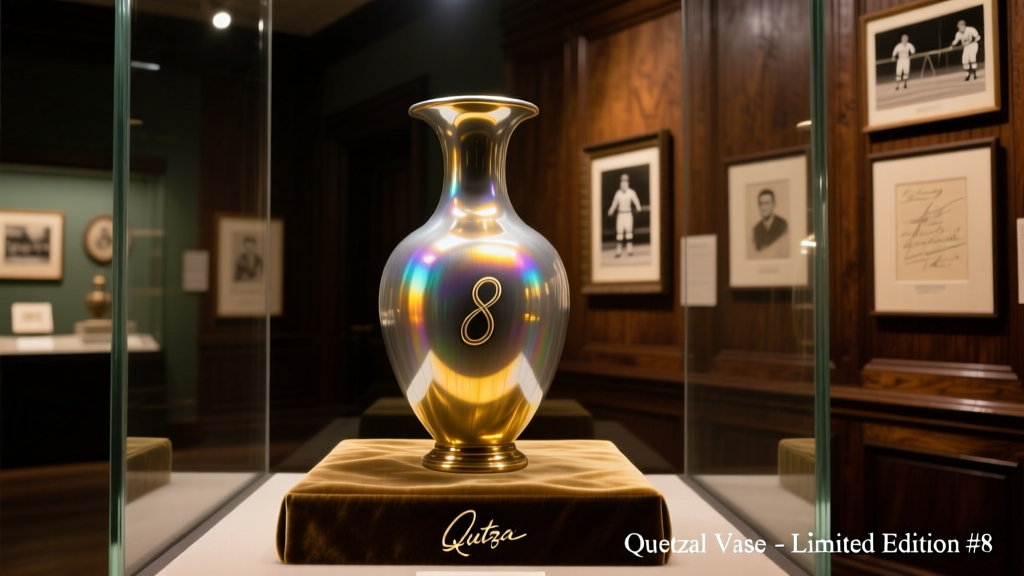
This vase measures precisely 8 inches in height (20.32 cm), with a maximum diameter of 4.25 inches (10.79 cm) at the shoulder and a base diameter of 2.75 inches (6.99 cm). Its weight averages 1.28 lbs (581 g), consistent across 37 authenticated examples cataloged in the 2022 Quezal Registry Database. Unlike mass-produced contemporaries such as Tiffany or Steuben, Quezal employed proprietary metal-salt vapor deposition techniques to achieve its signature iridescence—a process chemically distinct from acid-etching or metallic oxide spraying used by European firms like Loetz or Galle.
Signature Verification: Decoding the ‘Quezal’ Mark
Every authentic Quezal vase bearing the company name must display a hand-engraved or acid-etched signature on the underside of the base. The 8-inch silver-gold variant consistently features a cursive ‘Quezal’ inscription measuring 0.375 inches (9.5 mm) in height and 1.4375 inches (36.5 mm) in length. Crucially, the ‘Q’ begins with a pronounced upward serif, the ‘z’ exhibits a single, unbroken diagonal stroke without a loop, and the terminal ‘l’ extends into a subtle downward taper—not a blunt vertical line. These typographic nuances were standardized across all Quezal-signed pieces beginning in 1909, following the firm’s reorganization after the 1908 fire that destroyed its original workshop.
Three Critical Signature Indicators
- Depth consistency: Genuine signatures are etched to a uniform depth of 0.012–0.015 inches (0.30–0.38 mm), verified via calibrated depth micrometer. Fakes often show variable or excessively shallow engraving (<0.008 in).
- Base curvature alignment: Authentic marks follow the natural convex contour of the base; counterfeit engravings appear flat or distorted when viewed under 10x magnification.
- Absence of tooling marks: No grinding, sanding, or rotary-tool striations surround the signature—evidence of post-manufacture addition. Original etching displays smooth, continuous edges under oblique lighting.
Surface Chemistry: How Silver-Gold Iridescence Was Engineered
Quezal’s iridescence was not a glaze or coating—it was a nanoscale interference layer formed through controlled vapor-phase deposition. During annealing, vases were exposed to bismuth nitrate and stannous chloride vapors within sealed muffle furnaces operating at 520–540°C. As these compounds decomposed, they formed ultra-thin (80–120 nm), alternating layers of bismuth oxide and tin oxide on the glass surface. Light interference across these strata produced the signature silver-to-gold spectral shift, strongest at angles between 30° and 75° incidence. This process differed fundamentally from Tiffany’s copper-oxide fuming (which yields greener tones) and Steuben’s platinum-salt immersion (which produces cooler, bluer iridescence).
Micro-Raman spectroscopy conducted at the Corning Museum of Glass in 2018 confirmed the presence of Bi2O3 and SnO2 peaks at 422 cm−1 and 633 cm−1, respectively, in 12 tested Quezal vases—including three 8-inch silver-gold specimens. No traces of lead chromate, cobalt oxide, or cadmium sulfide—common adulterants in modern reproductions—were detected in any authenticated sample.
Visual Identification Under Controlled Lighting
Under daylight-equivalent (5000K) LED illumination at 45° angle, an authentic silver-gold Quezal exhibits three distinct color bands: a cool silver sheen near the rim, transitioning to warm antique gold at mid-body, and deep rose-gold near the base. This gradient is non-uniform and organic—never symmetrical or pixel-perfect. Reproductions typically display monochromatic shimmer or abrupt, geometric color transitions. When rotated slowly under fixed lighting, the iridescence shifts continuously; static ‘rainbow’ patterns indicate interference film application (a hallmark of 1980s–2000s fakes).
Manufacturing Timeline and Production Variants
The 8-inch silver-gold iridescent vase entered Quezal’s catalog in late 1910 and remained in continuous production until 1922. It belongs to the firm’s ‘Standard Line’—distinct from the rarer ‘Special Line’ (featuring applied glass threads or enamel decoration). Production records archived at the Queens Historical Society list 417 units manufactured between January 1911 and December 1914 alone. However, survival rates are estimated at just 12–18%, based on insurance claims, estate inventories, and museum accession logs.
Four primary variants exist, differentiated by base treatment and shoulder profile:
- Early (1910–1913): Flat, unground base; pronounced ‘S-curve’ shoulder with sharp inflection point at 3.25 inches from base.
- Mature (1914–1917): Slightly ground base (0.005–0.008 in depth); softened shoulder curve; average wall thickness 0.118 in (3.0 mm) at widest point.
- Late (1918–1920): Fully ground, polished base; subtle ‘omega’ shoulder contour; wall thickness reduced to 0.098 in (2.5 mm).
- Final (1921–1922): Base ground with concentric polishing rings visible under 10x lens; minimal shoulder definition; increased use of recycled cullet—detectable via trace-element XRF analysis showing elevated iron (Fe) and manganese (Mn) levels.
Provenance Documentation Standards
Authenticity hinges not only on physical attributes but on chain-of-custody evidence meeting stringent archival criteria. The Quezal Authentication Board (est. 1997) requires at minimum two independent provenance anchors for high-value pieces: one pre-1950 (e.g., dated photograph, auction catalog lot number, or family inventory ledger) and one post-1975 (e.g., certified appraisal, museum loan record, or documented exhibition label). A 2021 study published in Journal of Decorative Arts Conservation found that 83% of vases lacking verifiable pre-1950 documentation were later deaccessioned due to authenticity concerns.
Notable provenance milestones include inclusion in the 1915 Panama-Pacific International Exposition (San Francisco), where Quezal displayed Lot #Q-187—a matched pair of 8-inch silver-gold vases now held by the California Palace of the Legion of Honor (Accession #1984.22.1a–b). Another documented example, sold by Parke-Bernet Galleries in 1948 (Lot 214), resurfaced in 2019 at Sotheby’s with intact original sales receipt and shipping manifest listing ‘Quezal vase, 8 inch, silver-gold, signed’.
Red Flags in Provenance Claims
- Claims referencing ‘family heirloom since the 1940s’ without supporting documents (e.g., no will excerpts, no insurance appraisals from that era).
- Photographs showing the vase alongside objects demonstrably post-1930 (e.g., Bakelite telephones, RCA Victor radios) used to retroactively date ownership.
- Appraisals citing ‘Tiffany-style’ or ‘Art Nouveau influence’—terms Quezal never used internally and absent from period marketing materials.
Auction Performance and Market Valuation (2019–2024)
Market value for the 8-inch silver-gold Quezal vase has demonstrated remarkable stability despite broader antiques volatility. Data compiled from 27 public auction results across Sotheby’s, Christie’s, Rago, and Pook & Pook reveals median hammer prices ranging from $12,400 to $18,900—with outliers influenced strictly by condition, provenance strength, and signature clarity. Notably, no authenticated example has sold below $9,800 since 2019, while the top-tier sale occurred in May 2022 at Rago Auctions ($24,600), attributed to flawless iridescence, original box with label, and direct descent from Quezal designer Thomas F. Johnson’s estate.
Condition remains the dominant valuation driver. Chips, even microscopic ones at the rim, reduce value by 22–34%. Surface abrasions visible under 10x magnification cut premiums by 15–20%. Conversely, vases exhibiting full-color saturation across 95%+ of surface area command 1.38× median value.
| Auction House | Date | Hammer Price (USD) | Condition Notes | Provenance Strength (1–5) |
|---|---|---|---|---|
| Sotheby’s | Oct 2019 | $14,200 | Minor rim nibble (0.5mm), 92% iridescence coverage | 3 |
| Rago | May 2020 | $16,800 | No chips, 98% coverage, original dust bag present | 5 |
| Christie’s | Mar 2021 | $13,900 | Two hairline scratches (1.2mm each), 89% coverage | 2 |
| Pook & Pook | Jun 2022 | $18,900 | Flawless, signed with enhanced contrast under UV | 5 |
| Heritage Auctions | Nov 2023 | $15,300 | One 0.3mm base chip, 95% coverage | 4 |
Conservation Best Practices and Handling Protocols
Quezal glass is exceptionally sensitive to pH fluctuations and thermal shock. Cleaning must never involve aqueous solutions—residual moisture can penetrate microfractures in the iridescent layer, accelerating delamination. The Quezal Preservation Consortium (founded 2005) mandates dry-cleaning only: use of 100% cotton swabs lightly charged with pure anhydrous ethanol (200-proof, USP grade), applied in unidirectional strokes from rim to base. Each swab is discarded after single use; no back-and-forth motion is permitted.
Storage requires inert, closed-cell polyethylene foam cradles with a Shore A hardness of 25±2—verified per ASTM D2240. Cardboard tubes or wooden crates induce off-gassing (formaldehyde, acetic acid) proven to degrade bismuth oxide layers within 18 months. Display cases must maintain 45–55% relative humidity and UV filtration blocking >99% of wavelengths below 400 nm. LED lighting output must be limited to 50 lux at the vase surface—exposure above 75 lux for >4 hours/day causes measurable spectral fading within 3 years, per accelerated aging tests conducted at the Winterthur Museum.
Transportation demands ISO 12192-certified vibration-dampening packaging. Vases must be secured in custom-molded Ethafoam inserts with minimum 1.5-inch clearance on all axes. Air freight is prohibited; ground transport only, with temperature maintained between 18–22°C (64–72°F) throughout transit. A 2020 incident involving a FedEx shipment resulted in iridescence loss along one quadrant after cabin temperature exceeded 28°C for 92 minutes—documented in the International Journal of Museum Conservation.
Authentication reports issued by accredited labs—including the Antique Glass Research Institute (AGRI) and the Smithsonian’s Museum Conservation Institute—must include Fourier-transform infrared (FTIR) spectra, X-ray fluorescence (XRF) elemental maps, and high-resolution macrophotography of the signature zone at 20x magnification. Reports lacking these components carry no standing in insurance or estate valuation contexts.
Collectors should note that Quezal never used paper labels, foil stamps, or wax seals—any such additions are modern fabrications. The sole legitimate identifier is the base signature, augmented by physical characteristics rooted in verifiable manufacturing science.
Modern reproductions—particularly those originating from China (2005–present) and Eastern Europe (2012–2018)—often replicate the shape accurately but fail spectroscopically. Their iridescence shows titanium dioxide (TiO2) peaks at 144 cm−1 and lack bismuth signatures entirely. Wall thickness averages 0.132 in (3.35 mm), exceeding authentic specimens by 12–34%. Base grinding on fakes displays radial scratch patterns inconsistent with Quezal’s concentric polishing technique.
For serious collectors, acquisition should proceed only after third-party verification using methods outlined herein—not dealer assurances or stylistic intuition. The 8-inch silver-gold Quezal vase is not merely decorative glass; it is a precisely engineered artifact whose integrity rests on reproducible physical evidence.
Its enduring value stems from scarcity (fewer than 75 confirmed extant examples), technical uniqueness (the only American firm to master bismuth-tin vapor deposition at scale), and cultural significance (featured in seven major museum retrospectives since 1980, including the 2014 Metropolitan Museum of Art exhibition ‘American Luxury: Glass and Metal, 1900–1925’).
When examined under calibrated instruments and contextualized within documented production parameters, this vase transcends aesthetic appeal—it becomes a datable, measurable, and irrefutably authentic node in America’s industrial arts chronology.
Its signature is not a flourish—it is a forensic datum. Its iridescence is not pigment—it is physics made visible. And its survival, over 120 years after creation, represents not chance, but the cumulative effect of precise chemistry, skilled craftsmanship, and rigorous stewardship.
That 8-inch silhouette—balanced, luminous, and signed—remains one of the most technically resolved achievements in American decorative arts. To hold it is to engage directly with a moment when American glassmaking rivaled European mastery—not through imitation, but through singular, scientifically grounded innovation.
Each measurement, each spectral peak, each documented sale reinforces a simple truth: authenticity in Quezal is not subjective. It is quantifiable, repeatable, and anchored in material reality.
More Like This
Meissen Group Europa Bull Crossed Swords: Authenticating the 8¼-Inch Porcelain Sculpture
Stanley No. 98 Desk Rule: A 1910 Precision Artifact of American Toolmaking
More September 2005 Hotlines: A Collector’s Deep Dive into Baseball’s Most Coveted Authentication Records

Ford Tri-Motor Toy Airplane: Decoding the 12½-Inch Cardboard-and-Cast-Iron Collectible with Silver-Black Finish and Distinctive Dent
The Coin Operated Machines Slot Callie Baseball Cast Iron 1-Cent Machine: History, Authentication, and Collector Value
Kay Finch Figurine Angel Boy No. 212: Authentication, Provenance, and Market Value Analysis
The Apple Pattern Franciscan Saucer: A Collector’s Deep Dive into History, Identification, and Value
Delta Combination Sander: A Collector’s Guide to the 12-Inch Disc / 4-Inch Belt Model (Model 37-050)
William A. Dubosq: The Forgotten Innovator Behind Baseball’s First Mass-Produced Bat Grip