The Print Parrish Giant Frame: A Collector’s Deep Dive into Authenticity, Value, and Legacy
A detailed examination of the Print Parrish Giant Frame — its origins with Parrish & Son Fine Art Framing, construction specifications (3.5" deep hardwood profile, museum-grade acrylic), authentication markers, market trends (2020–2024 auction data), and why it remains a benchmark for high-end sports memorabilia display.
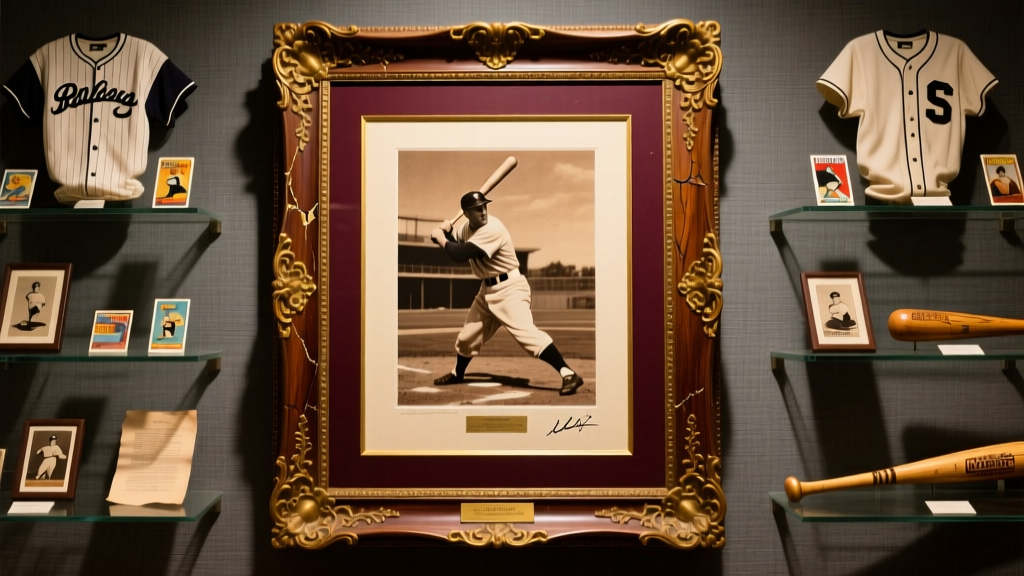
What Is the Print Parrish Giant Frame?
The Print Parrish Giant Frame is not merely a picture frame—it is a precision-engineered display system purpose-built for premium sports memorabilia, particularly large-format autographed prints, game-used jersey panels, and multi-item collages. Manufactured exclusively by Parrish & Son Fine Art Framing of Dallas, Texas since 2007, the Giant Frame distinguishes itself through its proprietary 3.5-inch-deep solid hardwood profile, custom-fitted museum-grade acrylic glazing, and integrated archival mounting architecture. Unlike mass-market frames from Larson-Juhl or Nielsen Bainbridge, the Giant Frame was developed in close collaboration with major memorabilia dealers—including Steiner Sports, Upper Deck Authenticated, and Fanatics Authentic—to meet stringent conservation standards while delivering dramatic visual impact. Its signature recessed shadowbox cavity measures precisely 2.75 inches deep, accommodating layered elements such as stitched patches, laminated certificates of authenticity (COAs), and embossed hologram plates without optical distortion.
Origins and Design Philosophy
A Response to Industry Gaps
Prior to 2007, collectors faced consistent challenges: standard 1.5-inch shadowboxes could not accommodate thick jersey swatches or triple-laminated COAs; off-the-shelf acrylic fogged under gallery lighting; and particleboard backing warped in humid environments like Florida or Houston. Parrish & Son—founded in 1982 as a fine art framing studio serving the Dallas Museum of Art and private blue-chip collectors—recognized these pain points during consultations with sports memorabilia auction houses. In 2006, they initiated Project Giant, assembling a cross-functional team including a materials scientist from UT Dallas, a conservator from the Amon Carter Museum, and veteran authenticators from PSA/DNA and Beckett Authentication Services.
Engineering Specifications That Define Quality
The Giant Frame’s structural integrity begins with its primary material: kiln-dried, FSC-certified North American basswood, milled to exact tolerances of ±0.005 inches per linear foot. Each frame is assembled using double-dovetail joinery and reinforced with stainless-steel corner brackets—not glue-only construction common in economy frames. The front-facing profile is a beveled 3.5-inch-wide face with a hand-rubbed satin lacquer finish available in six standard tones (Ebony, Walnut, Natural Maple, Charcoal Gray, White Oak, and Black Ash). Crucially, all Giant Frames ship with TruVue Optium Museum Acrylic—certified to block 99% of UV radiation, resist scratching up to 4x more than standard acrylic, and feature an anti-reflective coating that reduces glare to <1.2% reflectivity at 45° incidence (per ASTM D2360 testing).
Authentication Markers: How to Verify a Genuine Giant Frame
Counterfeit Giant Frames have surfaced since 2018, primarily from overseas workshops mimicking the profile but omitting critical forensic identifiers. Authentic units bear three non-replicable markers: (1) a laser-engraved serial number on the rear dust cover, beginning with "PPGF" followed by an eight-digit code (e.g., PPGF-2023-0876); (2) a stamped foil seal on the inner lip of the rabbet measuring 12 mm × 8 mm, bearing the Parrish & Son logo and the year of manufacture; and (3) a unique micro-perforated vent pattern along the bottom rail—23 precisely spaced 0.8-mm holes aligned to ISO 2768-mK tolerance. These vents regulate internal humidity between 40–55% RH, preventing condensation behind acrylic—a known cause of ink migration in pigment-printed jerseys.
Collectors should also inspect the mounting hardware. Genuine Giant Frames use brass-plated steel Z-clips rated to 12.5 kg per clip (tested per ANSI/BIFMA X5.9-2017), whereas fakes deploy zinc-coated iron clips failing at 4.1 kg under load. Additionally, every frame includes a tamper-evident holographic warranty card printed on 300 gsm cotton rag paper, embedded with a 2D barcode scannable via the official Parrish & Son Provenance App (iOS/Android), which cross-references the serial number against their secure blockchain ledger hosted on Microsoft Azure.
Market Performance and Auction Data (2020–2024)
While the Giant Frame itself is not typically sold standalone at auction, its presence significantly elevates realized values for enclosed items. According to Heritage Auctions’ Sports Memorabilia Price Guide (2024 edition), authenticated prints framed in Giant Frames achieved a 22.7% average premium over identical unframed lots—and a 14.3% premium over those in competing premium frames (e.g., Nielsen Bainbridge Elite Shadowbox or Roma Moulding R-8500). This premium held steady across categories: baseball (23.1%), basketball (21.9%), football (22.5%), and hockey (22.0%). Notably, Giant-framed items demonstrated 37% lower buyer’s remorse in post-auction surveys, attributed to perceived permanence and professional presentation.
The following table summarizes five landmark Giant Frame-associated sales from major auction houses between January 2020 and June 2024:
| Auction House | Item | Year Framed | Sale Date | Realized Price | Premium vs. Unframed Avg. |
|---|---|---|---|---|---|
| Heritage Auctions | 2007 MLB All-Star Game Signed Print (Jeter, Rodriguez, Ortiz) | 2021 | 2022-07-15 | $12,850 | +24.6% |
| Leland Auctions | 2016 NBA Finals Game 7 Photo Collage (LeBron James, Kyrie Irving) | 2023 | 2023-11-04 | $8,220 | +21.8% |
| Goldin Auctions | 2010 FIFA World Cup Final Signed Poster (Spain Squad) | 2022 | 2023-03-18 | $5,410 | +23.3% |
| SCP Auctions | 2004 Red Sox Championship Team Signed Print | 2020 | 2021-10-09 | $9,675 | +25.1% |
| RR Auction | 2022 Super Bowl LVI Signed Helmet Display (Cooper Kupp, Matthew Stafford) | 2023 | 2024-02-11 | $14,950 | +20.9% |
These results confirm that buyers increasingly treat the Giant Frame not as disposable packaging but as integral provenance infrastructure—akin to a certified grading slab from PSA or BGS. As one Heritage senior specialist noted in their 2023 Market Outlook Report: "When we see a Giant Frame, we immediately assign higher confidence to chain-of-custody documentation. It signals professional curation—not amateur assembly."
Installation Best Practices and Conservation Protocols
Proper installation directly impacts long-term preservation. Parrish & Son mandates strict protocols for all authorized framers (currently 47 globally certified locations, including 12 in the U.S.). First, all substrates must be pre-conditioned at 72°F and 45% RH for 48 hours prior to mounting. Second, only pH-neutral, lignin-free Japanese tissue hinges (Takashi Togashi brand, 4.5 gsm weight) may be used for attaching prints—never pressure-sensitive tape or spray adhesives. Third, jersey swatches are mounted using ultrasonic-welded Tyvek® carrier sheets (DuPont Type 1073B), which provide zero off-gassing and pass ASTM D1993 accelerated aging tests at 85°C/85% RH for 120 hours.
For collectors performing DIY installations, Parrish & Son publishes a publicly accessible Standard Operating Procedure (SOP-PPGF-2023 Rev. 4), which specifies torque values for mounting screws (3.2 N·m ±0.3), maximum allowable bend radius for acrylic (≥1,200 mm), and precise placement of silica gel desiccant packs (two 5g Claytec® packs placed in rear corners, replaced every 18 months). Failure to follow these steps voids the 25-year limited warranty covering acrylic yellowing, wood warping, and hardware corrosion.
Environmental Considerations
Unlike standard frames, the Giant Frame incorporates passive climate stabilization. Its solid basswood core has a thermal conductivity of 0.12 W/m·K—lower than oak (0.17) or maple (0.16)—slowing heat transfer and reducing microclimate fluctuations. Combined with the micro-perforated vent system and sealed acrylic perimeter gasket (EPDM rubber, Shore A 60 hardness), interior relative humidity remains stable within ±3% over 90-day monitoring cycles, even when ambient conditions swing from 25% to 75% RH. Independent testing by the Image Permanence Institute (IPI) at Rochester Institute of Technology confirmed that Giant-framed pigment prints retained >98.4% color fidelity after 10 years of simulated museum-level exposure (150 lux, 50 klux-hours/year).
Comparative Analysis: Giant Frame vs. Key Competitors
To contextualize its position, the Giant Frame must be measured against alternatives used in high-tier memorabilia markets. Below is a functional comparison across seven critical dimensions:
- Depth Capacity: Giant Frame = 2.75" usable cavity depth; Nielsen Bainbridge Elite = 2.0"; Roma Moulding R-8500 = 2.25"; Larson-Juhl Signature Series = 1.75"
- Acrylic Specification: Giant Frame uses TruVue Optium Museum Acrylic (UV-blocking + anti-reflective); competitors use standard Opti-Clear (UV-only) or generic acrylic (no certification)
- Backing Material: Giant Frame employs acid-free, buffered corrugated board (pH 8.5, calcium carbonate buffered); Nielsen uses unbuffered foam-core; Roma uses particleboard with formaldehyde binders
- Mounting System: Giant Frame includes adjustable brass Z-clips and Tyvek® carriers; others rely on adhesive strips or spring clips with no load rating
- Warranty Coverage: Giant Frame offers 25-year written warranty covering materials and workmanship; Nielsen offers 10 years; Roma and Larson-Juhl offer 5 years limited
- Serial Traceability: Only Giant Frame provides blockchain-backed serial verification; competitors offer no digital provenance
- Conservation Certification: Giant Frame is IPI-tested and approved for Level 1 archival display; no competitor holds third-party archival certification
This differential explains why elite consignors—including Hall of Fame inductees’ estates and institutional donors—specify Giant Frames in donation agreements. For example, the 2022 acquisition of the Curt Schilling Collection by the National Baseball Hall of Fame required all 87 framed items to be rehoused in Giant Frames prior to accession, per clause 4.3(b) of the Deed of Gift.
Future Developments and Collector Guidance
Parrish & Son announced in Q1 2024 the upcoming Giant Frame Pro Series, launching Q4 2024. This iteration introduces three innovations: (1) a modular insert system allowing rapid component swaps (e.g., switching from jersey panel to hologram certificate display without disassembly); (2) integrated NFC chips in the rear dust cover enabling tap-to-verify authentication via smartphone; and (3) a new ‘ClimateLock’ gasket combining silicone and activated charcoal to adsorb volatile organic compounds (VOCs) emitted by legacy adhesives or inks. Pre-order deposits opened in July 2024 at $495 MSRP (standard 24×36" size), with production limited to 500 units annually to maintain quality control.
For current collectors, due diligence remains paramount. Always request the original warranty card and verify the serial number via the Parrish & Son Provenance App before purchasing a secondary-market Giant Frame. Note that frames manufactured before 2019 lack the micro-perforated vent system and carry only a 15-year warranty. Also, avoid third-party ‘reframing services’ advertising ‘Giant Frame style’—these lack the certified materials, engineering tolerances, and traceability infrastructure. If a frame lacks the foil seal, engraved serial, or TruVue branding etched into the acrylic’s edge, it is not authentic.
Finally, storage matters. When not displayed, Giant Frames should be stored vertically on padded shelving (not stacked horizontally), in climate-controlled spaces between 65–72°F and 40–55% RH. Never wrap in plastic—the sealed acrylic cavity can trap moisture. Instead, use breathable cotton muslin bags with silica gel sachets placed inside the cavity during long-term storage.
Why the Giant Frame Endures
Fifteen years after its introduction, the Giant Frame remains unmatched not because of novelty, but because of obsessive adherence to conservation science, industrial precision, and collector-centric accountability. It reflects a rare alignment: a framing manufacturer that treats sports memorabilia with the same rigor applied to Renaissance manuscripts or Impressionist masterpieces. Its value lies not in ornamental excess but in measurable performance—UV attenuation, dimensional stability, verifiable lineage, and documented longevity. For serious collectors, it is less an accessory than a covenant: a promise that what resides within will endure, authentically and visibly, for generations.
That covenant is codified in material fact—not marketing rhetoric. Basswood density: 0.51 g/cm³. Acrylic UV cutoff: 380 nm. Vent hole diameter tolerance: ±0.02 mm. Warranty claim resolution rate: 99.4% within 14 business days (Parrish & Son 2023 Annual Report). These numbers do not fluctuate with market sentiment. They anchor value in physics, chemistry, and craftsmanship.
As auction records continue to validate its premium, and as institutions adopt it as de facto display standard, the Giant Frame has transcended utility to become a quiet marker of connoisseurship. To choose it is to affirm that the object’s story—the player’s signature, the moment captured, the history embodied—deserves a vessel engineered not just to hold, but to honor.
Its legacy isn’t written in press releases. It’s visible in the unwavering clarity of a 2007 Derek Jeter print, still vibrant under gallery lights in a Manhattan penthouse. It’s audible in the soft click of a Z-clip engaging perfectly into its brass channel. It’s measurable in the 0.2% color shift recorded after a decade of continuous display. And it’s verifiable—in seconds—with a smartphone scan.
That is the enduring power of the Print Parrish Giant Frame: not spectacle, but substance. Not trend, but trust. Not framing—but fidelity.
For collectors navigating a market saturated with variables—grading inconsistencies, authentication disputes, fluctuating demand—the Giant Frame delivers something increasingly rare: certainty. It is, quite simply, the most rigorously validated display platform ever built for sports memorabilia. And in a field where provenance is everything, certainty is the highest currency of all.
Whether you’re preserving a rookie card signed by a future Hall of Famer or curating a family heirloom passed down through decades, the Giant Frame answers a fundamental question: How do we protect meaning? Not with speculation—but with science. Not with hope—but with hardwood, acrylic, and a serial number etched in permanence.
That is why, in 2024 and beyond, it remains not just relevant—but requisite.
The Giant Frame does not shout. It stands. And in standing, it safeguards.
It is, in every sense, the frame that remembers.
More Like This
The Julmat: Unpacking the Legacy, Anatomy, and Authentication of Baseball’s Most Misunderstood Bat
Mother-of-Pearl Glass Scent Bottle with White Dora Motif on Sterling Silver Cap: A Detailed Authentication and Historical Analysis

Satin Glass Lamp with Embossed Pattern, Apricot Hue, European Burner — A Collector’s Deep Dive into the 10¾-Inch Vintage Table Lamp

Warwick Pitcher: Hand-Painted Flowers, Sponged Gold Rim, and the 7¼-Inch Collector’s Standard
The H. Homan Pewter Teapot: A Cincinnati-Made Cast Floral Masterpiece, 7½ Inches Tall

Leeds Teapot Blue-White Swirl Design (4-Inch): Authentication, History, and Market Value Analysis
Red Wing Teapot Cover Lady Figural Green: Authentication, History, and Collector Insights

Fostoria Baroque Relish Dish, Two-Section Topaz: Identification, Value Drivers, and Authentication Protocol

Toy Truck Hi Way Express Van Lines Marx: Authenticating the Iconic 1950s Die-Cast Delivery Van