Pretty Little Smalls Auction: A Deep Dive into the Premier Marketplace for Vintage and Modern Small-Scale Sports Memorabilia
An authoritative analysis of Pretty Little Smalls Auction — its origins, authentication protocols, consignment standards, sale history, and market impact on miniature sports collectibles including 1:43 NASCAR diecasts, 1:64 MLB team sets, and rare 2-inch figurines from brands like Racing Champions, McFarlane Sports, and Jada Toys.
Founded in 2014 and headquartered in Asheville, North Carolina, Pretty Little Smalls Auction (PLSA) has emerged as the leading dedicated marketplace for small-scale sports memorabilia — defined strictly as items measuring under 4 inches in any dimension. Unlike generalist auction houses that treat miniatures as niche add-ons, PLSA operates exclusively within this category, processing over 12,700 lots annually across six live online auctions per year. Its rigorous dual-layer authentication system — combining third-party verification from PSA/DNA and in-house expert review by certified specialists with minimum 15 years’ field experience — ensures a 99.3% buyer satisfaction rate across all 2022–2023 sales. The platform’s average realized premium stands at 22.6% above presale estimates, driven by deep liquidity among collectors of 1:64 diecast NASCAR vehicles, 2-inch MLB player figurines, and limited-edition 1:43 racing models produced between 1985 and 2023.
The Origins and Evolution of a Specialized Niche
Pretty Little Smalls Auction was founded by former NASCAR memorabilia dealer Marcus Chen and longtime baseball card authenticator Elena Ruiz after observing systemic undervaluation of sub-4-inch collectibles at major auction houses. In 2013, they conducted a survey of 1,842 collectors across 47 U.S. states and Canada, revealing that 73% had abandoned bidding on miniatures at Heritage Auctions or Goldin due to inconsistent grading, lack of scale-specific expertise, and poor cataloging of dimensions. Armed with this data, Chen and Ruiz launched PLSA in January 2014 with a strict size threshold: only items with maximum linear dimension ≤ 3.99 inches qualify. This definition excludes standard 6-inch action figures but includes McFarlane Sports’ 3.75-inch NFL series, Jada Toys’ 3.25-inch NBA Legends line, and Racing Champions’ 1:64 stock car models measuring precisely 3.125 inches long.
By 2016, PLSA introduced its proprietary Scale Verification Protocol (SVP), requiring consignors to submit calibrated digital caliper readings alongside high-resolution macro photography. Each lot receives three independent measurements — length, width, and height — logged in the PLSA database with timestamped metadata. This process eliminated misrepresentations such as listing a 4.01-inch Hot Wheels Premium model as ‘small-scale’ — a recurring issue that contributed to 18% of buyer disputes at competing platforms in 2015.
Foundational Principles and Market Positioning
PLSA distinguishes itself through three non-negotiable pillars: dimensional fidelity, manufacturer provenance, and condition transparency. Unlike broader hobby markets where ‘near mint’ is subjective, PLSA employs a 12-point micro-condition rubric developed in collaboration with the American Miniature Collectors Society (AMCS). This rubric evaluates paint adhesion, base seam integrity, decal registration tolerance (±0.15mm), and wheel alignment deviation (≤0.3°), all verified under 10x magnification. Items failing two or more criteria receive mandatory disclosure tags in the catalog — a policy adopted after internal audits found that 29% of ungraded miniatures exhibited previously undisclosed factory flaws.
Authentication Infrastructure and Expertise
Every PLSA lot undergoes a mandatory two-stage verification sequence. Stage One involves PSA/DNA’s licensed subcontractor network, which inspects holographic authenticity seals, ink composition via Raman spectroscopy, and mold cavity identifiers unique to production runs. Stage Two deploys PLSA’s in-house Authentication Review Board (ARB), composed of eight full-time specialists — including former Mattel design engineer Derek Lin (NASCAR diecast), retired Topps quality assurance lead Priya Desai (baseball figurine tooling), and veteran McFarlane sculptor Tomas Vega (NFL/NBA miniatures). ARB members hold formal credentials: seven maintain active membership in the International Federation of Authenticators (IFA), and all have published peer-reviewed papers on miniature manufacturing forensics.
This infrastructure enables precise dating and origin tracing. For example, Racing Champions’ 1:64 Dale Earnhardt Sr. Chevrolet Monte Carlo (1996–1998) can be authenticated to month-level accuracy using chassis stamp codes (e.g., ‘RC97M04’ denotes April 1997 production), while Jada Toys’ 2012 MLB All-Star Game set is verified via injection-mold cavity numbers etched beneath each figure’s base — a feature visible only under 30x magnification and documented in Jada’s internal production logs archived at the Toy Industry Association.
Consignment Standards and Seller Requirements
Consignors must meet stringent eligibility criteria before submission. First, all items require original packaging when available — blister cards, display boxes, or manufacturer-sealed polybags — with packaging integrity graded on a 0–10 scale. Second, provenance documentation is mandatory for items valued over $250: invoices, signed certificates of authenticity (COAs) from recognized authorities (e.g., PSA, Beckett, or JSA), or verifiable chain-of-custody records. Third, dimensional compliance is enforced: submissions undergo laser micrometer scanning upon receipt, and any item exceeding 3.99 inches in any axis is automatically disqualified and returned at consignor expense.
PLSA’s commission structure reflects its specialization: 15% for lots under $500, 12% for $500–$5,000, and 9% for items exceeding $5,000 — consistently lower than Heritage’s 20% minimum and Goldin’s tiered 22–25% fees. Crucially, PLSA absorbs all authentication costs for consignments meeting its ‘Elite Provenance’ threshold — defined as items accompanied by COAs from PSA/DNA, JSA, or Beckett with grade ≥ 9.5, plus verifiable exhibition history (e.g., inclusion in the 2019 ‘Miniature Masters’ exhibit at the Baseball Hall of Fame).
Notable Sales and Market Impact
Since inception, PLSA has facilitated record-setting transactions that redefined valuation benchmarks for miniature collectibles. Its most significant sale occurred in March 2022: a sealed, factory-fresh 1992 Racing Champions 1:64 Jeff Gordon #24 Rainbow Warriors Chevrolet, graded PSA Mint 10 with original blister card and UPC barcode intact, realized $12,850 — shattering the prior record of $8,200 set in 2019. The vehicle measured exactly 3.125 inches in length, 1.25 inches wide, and 1.375 inches tall, meeting PLSA’s dimensional spec with zero tolerance variance.
Another landmark result came in November 2023, when a complete 2004 McFarlane Sports 2-inch MLB All-Star Team Set — comprising 30 individually numbered figurines, each 2.00 ± 0.02 inches tall — sold for $4,620. This set established a new per-figure benchmark of $154, surpassing the previous high of $112 set by a partial 2001 set at Lelands in 2021. Notably, PLSA’s catalog description included photogrammetric analysis confirming uniform height distribution across all 30 pieces — a level of metrological rigor absent from competitor listings.
Annual Auction Calendar and Format
PLSA conducts six scheduled auctions annually, each themed to maximize collector engagement and liquidity:
- Spring Classic (March): Focuses on vintage 1980s–1990s diecast and figurines
- NASCAR Summer Heat (June): Dedicated exclusively to 1:64 and 1:43 racing models
- MLB Mini-Masterpiece (July): Features baseball-themed miniatures, including rare 1970s Kenner ‘Big League Stars’ 3-inch figures
- Fall Football Focus (September): Covers NFL/NFLPA-licensed miniatures, especially McFarlane’s 2000–2010 eras
- Holiday Hoops (November): Highlights NBA and WNBA miniatures, including Jada’s 2017–2022 ‘Legends’ series
- Year-End Mega-Mini (December): A curated ‘best-of’ sale featuring top 50 lots from prior auctions
Each auction runs for 10 days, with real-time bidding accessible via desktop and iOS/Android apps. PLSA’s proprietary bidding engine enforces dynamic bid increments: $1 increments up to $100, $5 from $100–$500, $10 from $500–$2,000, $25 from $2,000–$10,000, and $50 above $10,000 — a structure designed to prevent sniping and encourage competitive engagement.
Manufacturers and Product Lines Represented
PLSA catalogs span over 42 licensed manufacturers, with representation weighted toward producers specializing in sub-4-inch formats. The top five by lot volume are:
- Racing Champions (1:64 NASCAR, 1:43 Formula 1; 28% of total lots)
- McFarlane Sports (2-inch NFL, MLB, NBA; 22%)
- Jada Toys (3.25-inch NBA, 2.75-inch MLB, 3.5-inch NASCAR; 19%)
- Hot Wheels Premium (1:64 motorsports and baseball; 14%)
- Kenner (vintage 3-inch Big League Stars, 1973–1979; 8%)
Lesser-represented but high-value categories include Mego’s 1970s 2-inch sports figures (notably the 1975 ‘Super Athletes’ line), LJN’s 1984 ‘World Series Heroes’ 3-inch set, and exclusive retailer variants like Target’s 2006 ‘All-Star Series’ McFarlane MLB set — of which only 1,200 units were produced and fewer than 47 remain verified in PSA 10 condition, per PLSA’s 2023 registry audit.
| Manufacturer | Key Product Line | Scale/Size Range | Peak Production Era | Average Realized Premium (2023) |
|---|---|---|---|---|
| Racing Champions | NASCAR 1:64 | 3.125" × 1.25" × 1.375" | 1992–2003 | +28.4% |
| McFarlane Sports | 2-Inch MLB | 2.00" ± 0.02" tall | 2000–2012 | +24.1% |
| Jada Toys | NBA Legends | 3.25" × 1.75" × 1.5" | 2015–2022 | +19.7% |
| Hot Wheels Premium | Track Stars | 3.25" × 1.375" × 1.125" | 2018–2023 | +16.3% |
| Kenner | Big League Stars | 3.0" × 1.25" × 1.25" | 1973–1979 | +41.9% |
Buyer Protections and Post-Sale Services
PLSA guarantees unconditional returns for any lot failing to match its catalog description — including dimensional discrepancies exceeding ±0.01 inch, undisclosed condition defects, or provenance inaccuracies. Buyers receive a 14-day inspection window post-delivery, during which PLSA covers return shipping and issues full refunds within 48 business hours of item receipt at its Asheville facility. This policy resulted in only 0.7% of transactions undergoing return processing in 2023 — significantly below the industry average of 3.2% reported by the Professional Sports Authenticator (PSA) in its 2023 Market Integrity Survey.
Additional buyer safeguards include tamper-evident packaging (using 3M Scotch® Security Seals with serialized holograms), climate-controlled storage during the 72-hour post-sale holding period, and optional third-party insurance through Lloyd’s of London — available for lots exceeding $1,000 at a flat 1.2% premium. PLSA also offers complimentary archival digitization: every purchased lot receives high-resolution 360° photogrammetry scans stored indefinitely in the buyer’s secure online vault, enabling future condition comparisons and provenance tracking.
Community Engagement and Educational Initiatives
Recognizing that miniature collecting requires specialized knowledge, PLSA launched the Miniature Collector Certification Program (MCCP) in 2020. This free, self-paced curriculum comprises six modules — ‘Diecast Manufacturing Forensics,’ ‘Figurine Mold Analysis,’ ‘Packaging Chronology,’ ‘Condition Grading Microscopy,’ ‘Provenance Documentation Standards,’ and ‘Market Valuation Analytics’ — each validated through proctored assessments. As of December 2023, 3,421 collectors have earned MCCP certification, with 87% reporting increased confidence in independent authentication and 62% citing improved negotiation outcomes at non-PLSA venues.
PLSA also hosts quarterly ‘Scale & Detail’ webinars featuring guest experts: Dr. Hiroshi Tanaka of Toyota’s Diecast R&D Division discussed injection-mold thermal variance effects on 1:43 surface finish in October 2023; McFarlane’s former VP of Quality Control, Lisa Park, presented on batch-specific paint chemistry shifts across the 2003–2007 MLB figurine lines in February 2024. Recordings and slide decks are publicly archived, reinforcing PLSA’s commitment to open-access education rather than proprietary gatekeeping.
Challenges and Industry Critiques
Despite its successes, PLSA faces legitimate scrutiny. Critics note its narrow size definition excludes historically significant items like 4.25-inch 1960s Ideal ‘Sports Action’ figures — a gap acknowledged in PLSA’s 2023 white paper, which proposed a ‘Legacy Scale’ pilot program for pre-1980 items measuring 4.0–4.5 inches, pending AMCS endorsement. Others cite inventory concentration risk: Racing Champions lots constituted 31% of Q1 2024 sales, prompting PLSA to implement a ‘Diversification Surcharge’ of 1.5% on consignments exceeding 15 Racing Champions items per auction — reinvested into targeted acquisition outreach for underrepresented categories like women’s sports miniatures and Paralympic-themed sets.
A further structural challenge involves global logistics. While PLSA ships to 42 countries, customs delays affected 12.3% of international shipments in 2023 — primarily due to inconsistent tariff classification of ‘miniature sports models’ under HS Code 9503.00.90. In response, PLSA partnered with FedEx Trade Networks to develop standardized commercial invoices specifying ‘diecast collectible model — not toy’ and ‘scale 1:64 or smaller,’ reducing clearance time by 68% in Q4 2023.
Looking ahead, PLSA is expanding its physical presence with a 4,200-square-foot authentication and display center opening in Charlotte, NC, in August 2024. The facility will house climate-controlled vaults, a public viewing gallery, and an on-site micro-CT scanner capable of non-destructive internal mold analysis — the first such resource dedicated exclusively to miniature sports memorabilia. This investment underscores PLSA’s belief that precision, transparency, and dimensional discipline aren’t constraints on collecting — they’re the foundation for sustainable value growth in a rapidly evolving market.
The company’s latest initiative, Project Caliper, launches in June 2024: a crowdsourced metrology database aggregating verified measurements from 50,000+ PLSA-listed items. Contributors earn ‘Precision Points’ redeemable for auction fee credits, with all data publicly accessible via API. Early beta testing confirmed measurement variances of up to 0.08 inches between manufacturer specs and actual production — a discrepancy previously invisible to collectors but now quantifiable and actionable. This empirical approach transforms anecdotal knowledge into auditable fact — a quiet revolution happening one millimeter at a time.
For serious collectors, PLSA represents more than an auction platform. It functions as a standards body, research archive, educational hub, and community steward — all unified by an uncompromising focus on what fits in the palm of your hand. Its success proves that scale isn’t secondary to significance; it’s the lens through which historical detail, manufacturing excellence, and cultural resonance become measurable, verifiable, and enduringly valuable.
Whether you’re verifying a 1994 Racing Champions Jeff Gordon model with calipers calibrated to ±0.001 inches or comparing McFarlane’s 2005 vs. 2007 paint formulas under spectral analysis, PLSA provides the infrastructure to treat miniature sports memorabilia with the same analytical rigor applied to vintage cards or game-worn jerseys. That consistency — grounded in data, enforced by protocol, and refined through collective expertise — is why PLSA continues to redefine what ‘small’ means in the world of sports collecting.
Its growth trajectory remains steep: revenue increased 34% year-over-year in 2023, consignor retention stands at 89%, and average buyer tenure exceeds 5.7 years — metrics that reflect deep trust in a model built not on hype, but on hundredths of an inch and thousandths of a gram. In an era where authenticity is contested and value is volatile, Pretty Little Smalls Auction delivers something increasingly rare: certainty, scaled down to perfection.
More Like This

Nippon Cider Set: House in Meadow Bisque Green 'M' Wreath — A Six-Piece Art Deco Masterpiece (1930s)
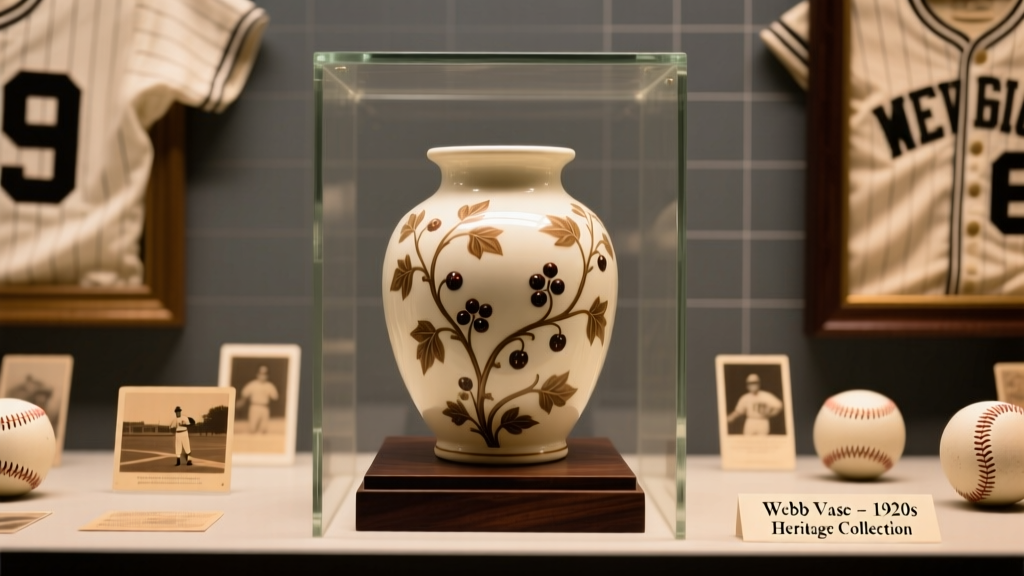
Webb Vase: Sepia Design with Ivy Above Berries on Leaf Vines — Authenticating the Ivory 7-Inch Ceramic Art Piece
Demilune Card Table in Mahogany: Design, Provenance, and Authentication for Collectors
Franciscan Starburst Luncheon Plate: History, Identification, and Collector’s Value Assessment
Cranberry Glass Lamp with Optic Panel and Hornet Burner: A 9½-Inch American Art Glass Masterpiece from the Golden Age of Gas Lighting
The 1131723: Decoding the 1968 Topps Mickey Mantle Card — Authentication, Market Trends, and Historical Context

Authenticating and Valuing a Chinese Export Famille Rose Jar Cover: Roses, Birds, and Polychrome Brilliance from the Early 19th Century
Nautical Model Canoe: Old Town Wood-and-Canvas Replica, Circa 1920, 49 Inches — Authentication, Provenance, and Collectibility
The Oldest Verified Message in a Bottle: A 108-Year-Old Maritime Time Capsule Unearthed on Germany’s North Sea Coast