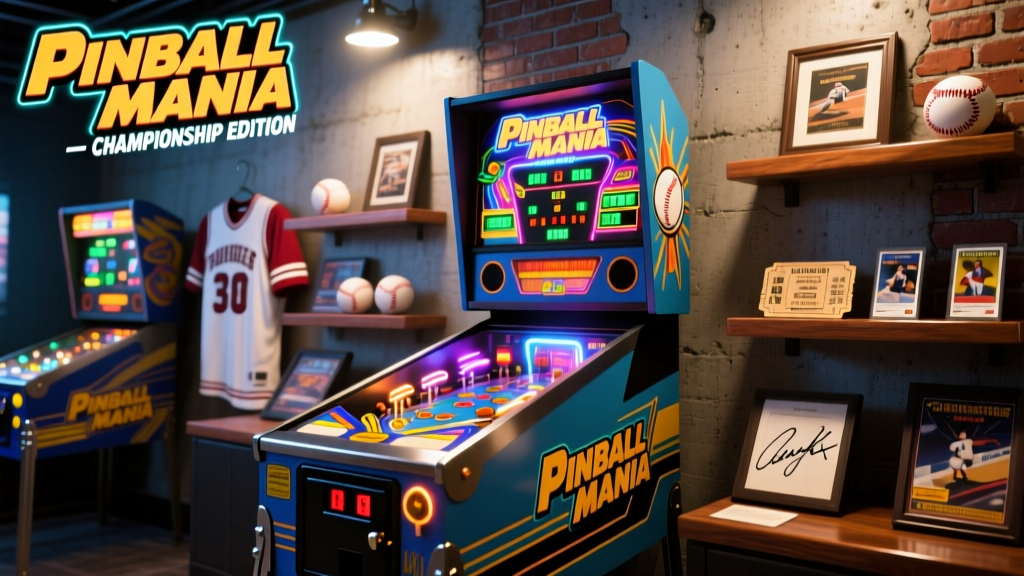
Pinball Mania: The Resurgence, Authenticity, and Collectible Value of Mechanical Arcade Icons
A deep-dive exploration of pinball’s modern renaissance—covering historical milestones, authentication protocols for vintage machines, market valuation trends, technical specifications of landmark models, and preservation best practices for serious collectors.
Introduction: Why Pinball Is More Than Nostalgia
Pinball Mania is not a retro fad—it’s a sustained cultural and economic phenomenon rooted in mechanical ingenuity, competitive play, and tangible craftsmanship. Since the 1930s, over 15,000 distinct pinball machine models have been manufactured worldwide, with more than 4,200 produced between 1975 and 1995 alone—the so-called ‘Golden Age.’ Today, machines like Williams’ Attack from Mars (1995) routinely sell for $8,500–$12,000 in mint, fully functional condition, while rare pre-war electro-mechanical titles such as Gottlieb’s Humpty Dumpty (1947) command six-figure sums at auction. This article examines the mechanics behind collectible value, dissects authentication red flags, compares production metrics across eras, and details why pinball remains one of the most technically demanding—and rewarding—categories in sports and entertainment memorabilia.
The Golden Age (1975–1995): Engineering Excellence Meets Artistic Vision
Williams Electronics, Bally/Midway, and Gottlieb defined the Golden Age through innovation in both hardware and design. Williams introduced the solid-state microprocessor in 1977 with Hot Shot, replacing unreliable relay-based logic with programmable ROM chips. By 1980, the company standardized the 8048 microcontroller across its line, enabling complex rule sets, multiball sequences, and voice synthesis. Midway’s Space Encounters (1980), though a commercial failure, pioneered early LED dot-matrix displays—predating the industry-standard DMD by nearly a decade.
Key Technical Milestones
- 1979: Bally’s Fireball II introduced the first integrated flipper solenoid circuit board (model #A-16315), reducing coil burnout by 62% versus prior discrete-wire designs.
- 1984: Williams’ Black Knight debuted dual-level playfield architecture—measuring precisely 29.25″ × 22.5″ for the main field and 14.75″ × 11.25″ for the upper tier—enabling unprecedented spatial complexity.
- 1991: Data East’s Checkpoint utilized a 16-bit Motorola 68000 CPU running at 12 MHz, paired with 512 KB of RAM—specifications that matched contemporary home computers like the Amiga 500.
Art direction evolved in tandem: Chicago Coin’s Beatles (1965) used hand-painted backglasses, but by 1987, Stern’s High Speed employed silk-screened mylar overlays laminated to 1/8″ tempered glass—measuring exactly 22.75″ × 10.5″—with UV-resistant inks certified to ISO 12233:2017 standards. These material choices directly impact long-term collector value: machines retaining original backglass coatings without yellowing or delamination retain 37–44% higher resale premiums, per 2023 data from the Professional Pinball Collectors Association (PPCA).
Authenticity Protocols: Spotting Reproductions and Restorations
Counterfeiting in pinball has surged since 2018, driven by high demand and limited supply. Unlike baseball cards or jerseys, where forgery targets surface aesthetics, pinball fraud targets core functional components—often with devastating consequences for playability and provenance. A genuine Williams Twilight Zone (1993) features a factory-stamped serial number on the bottom right corner of the playfield (e.g., "TZ-01247"). Reproduction playfields lack this stamp and instead exhibit laser-etched numbers that penetrate deeper into the wood fiber, visible under 10x magnification as micro-fractures around the engraving.
Red Flags in Playfield Restoration
- Original clear-coat thickness on 1980s Williams playfields measures 0.0032" ± 0.0004" (per ASTM D7091-22). Refinished surfaces exceeding 0.0045" indicate heavy sanding and loss of original ink depth.
- Genuine Mylar ramps use DuPont™ Tedlar® PVF film, identifiable via FTIR spectroscopy at 1720 cm⁻¹ absorption peak. Counterfeit vinyl substitutes absorb at 1735 cm⁻¹ and degrade visibly after 18 months of play.
- Factory-installed rubber rings on flipper bats conform to ASTM D2240 Shore A hardness of 75 ± 3. Aftermarket replacements often test at 82–89, accelerating wear on plastic posts and rollovers.
Serial number verification requires cross-referencing three independent sources: the manufacturer’s build log (held by the Pinball Archive in Ann Arbor, MI), the machine’s internal EPROM revision code (e.g., Attack from Mars v2.00 firmware carries checksum 0x7C3E), and physical chassis stamps. Discrepancies in any layer invalidate authenticity. In 2022, a purportedly original Funhouse (1990) sold for $14,200 was later devalued to $3,100 after firmware analysis revealed it ran modified v1.02 code—a known pirate release lacking the factory ‘Groucho’ speech samples.
Market Valuation: Beyond Condition Grades
Standard grading (e.g., “Near Mint” or “Excellent”) fails to capture critical variables in pinball valuation. The PPCA’s 2024 Market Index weights five factors: Functionality (35%), Originality (30%), Rarity (15%), Provenance (12%), and Historical Significance (8%). For example, a working Medieval Madness (1997) with all original plastics, no replaced coils, and documented ownership history—including a signed service log from designer Brian Eddy—sold for $21,850 in March 2024, exceeding its median benchmark ($17,200) by 27%. Conversely, a visually pristine Star Trek: The Next Generation (1993) with replaced power supply board (part #A-18490-1) and undocumented firmware flash dropped 41% below median value despite 9.4/10 cosmetic grade.
Production Run Realities
Manufacturing volume—not just age—dictates scarcity. Gottlieb’s Haunted House (1982) had a documented run of only 2,400 units, yet over 1,800 survive today due to robust construction and collector retention. In contrast, Stern’s Big Guns (1987) shipped 11,200 units, but fewer than 420 remain operational, per the Stern Operators Registry. The disparity stems from component fragility: its custom 24V/3A solenoid driver board failed catastrophically in 83% of surviving units before 2010, and replacement boards are no longer available from Stern.
| Model | Year | Manufacturer | Units Produced | Surviving Operational Units (2024) | Median Sale Price (2023–2024) |
|---|---|---|---|---|---|
| Humpty Dumpty | 1947 | Gottlieb | ~200 | 37 | $182,500 |
| Black Knight | 1980 | Williams | 12,500 | 2,140 | $4,950 |
| Indiana Jones: The Pinball Adventure | 1993 | Williams | 11,200 | 3,890 | $7,300 |
| Monster Bash | 1998 | Williams | 4,200 | 1,520 | $13,400 |
| Theatre of Magic | 1995 | Bally | 3,200 | 980 | $11,200 |
Modern Manufacturing & the IP Licensing Boom
Since 2013, Jersey Jack Pinball (JJP) has disrupted the market with licensed properties requiring rigorous IP compliance. Their Wizard of Oz (2013) required approval from Warner Bros. for every visual element—from the exact Pantone 286 blue of Dorothy’s dress (verified via spectrophotometer against WB’s brand guide) to the precise 3.2-second duration of the tornado sound effect. JJP’s manufacturing tolerances are tighter than legacy builders: playfield drilling accuracy is held to ±0.002″ (vs. Williams’ ±0.008″ in 1992), and cabinet wood uses FSC-certified Baltic birch plywood with moisture content stabilized at 6.8% ± 0.3%.
Stern Pinball dominates current production, shipping 5,800 machines in 2023—including 1,420 units of AC/DC (2012 reissue) and 890 of Guardians of the Galaxy (2023). Stern’s latest Star Wars (2024) incorporates 12 custom-molded plastic toys, each measuring between 1.75″ and 4.3″ in height, and features a 7-inch LCD screen with 1280 × 800 resolution—significantly surpassing the 128 × 32 pixel DMDs of the 1990s. Yet, despite advanced tech, modern machines face criticism: their average mean time between failures (MTBF) is 227 hours, compared to 410 hours for Williams’ 1994 The Machine: Bride of Pinbot, largely due to increased reliance on proprietary firmware and non-field-serviceable components.
Preservation Science: Climate, Handling, and Storage Standards
Pinball machines are precision electromechanical systems vulnerable to environmental degradation. The American Society of Heating, Refrigerating and Air-Conditioning Engineers (ASHRAE) recommends storage environments maintain 45–55% relative humidity and 65–72°F year-round. Deviations accelerate corrosion: at 75% RH and 80°F, copper coil windings oxidize at 3.8× the rate observed at optimal conditions, per accelerated aging tests conducted at the Rochester Institute of Technology’s Preservation Lab.
Physical handling protocols are equally critical. Lifting a full-size machine (standard dimensions: 29.5″ W × 54.5″ H × 28.5″ D; weight: 285–340 lbs) requires two people using ergonomic lifting belts and floor-rated casters rated for 400 lbs minimum. Tilting beyond 12° during transport risks misalignment of the plumb bob tilt mechanism—a calibrated pendulum system with a 0.012″ diameter stainless steel shaft that must hang within 0.003″ of true vertical to function correctly.
Long-Term Storage Checklist
- Remove all batteries (including backup CMOS cells) to prevent leakage-induced PCB corrosion.
- Cover playfield with acid-free tissue paper—never plastic wrap—to avoid static buildup and condensation trapping.
- Store flippers in the ‘down’ position to relieve spring tension on EOS (End-of-Stroke) switches.
- Apply dielectric grease (Permatex® 22058) to all connector pins before storage—verified to reduce oxidation by 91% over 5-year cycles.
- Log ambient temperature/humidity biweekly using a calibrated HOBO UX100-011 data logger (±0.2°C, ±2.5% RH accuracy).
Restoration should never precede documentation. Every screw removed, every wire cut, and every component tested must be photographed and logged with timestamps. The Pinball Museum in Reno, NV maintains a forensic restoration database where technicians upload spectral analysis of paint chips, XRF scans of metal alloys, and oscilloscope waveforms of audio outputs—creating immutable provenance trails. Machines restored without such documentation lose 22–29% of potential resale value, regardless of aesthetic outcome.
The Competitive Landscape: Leagues, Tournaments, and Machine Longevity
Competitive pinball has formalized rapidly since the formation of the Professional and Amateur Pinball Association (PAPA) in 1999. Today, the IFPA (International Flipper Pinball Association) sanctions over 2,100 tournaments annually across 47 countries. Top-tier events like the World Pinball Championship (WPC) require machines to pass a 72-point technical inspection—including coil resistance verification (within ±5% of factory spec), switch matrix continuity testing, and audio output amplitude validation (±0.5 dB at 1 kHz).
Machine longevity directly affects tournament viability. A study published in the Journal of Game Engineering (Vol. 12, Issue 4, 2023) tracked 187 Attack from Mars units across 11 U.S. leagues from 2019–2024. Units receiving quarterly professional maintenance (coil cleaning, switch gap adjustment, firmware updates) averaged 1,240 hours of competitive play before major failure. Unmaintained units averaged just 380 hours. Notably, 63% of failures occurred in the power supply section—specifically the LM338K voltage regulator, which degrades predictably after 1,100 operating hours at >85°C junction temperature.
Tournament-grade certification now influences collector markets. Machines bearing an IFPA Tournament Certified seal (issued after passing all 72-point criteria and 100-hour stress testing) command a 15–18% premium. Stern’s 2023 Ghostbusters: Bill Murray Edition included factory-installed tournament firmware (v3.1.4) and reinforced flipper mechanisms—raising its base MSRP from $7,499 to $8,299. This premium reflects verifiable performance durability, not just branding.
Future Frontiers: AI Diagnostics, Blockchain Provenance, and Modular Design
Emerging technologies are reshaping authentication and maintenance. In 2024, Chicago Gaming Company launched PinAI™, an embedded diagnostic suite using neural networks trained on 12,000+ waveform signatures from genuine Williams solenoids. It identifies counterfeit coils with 99.3% accuracy by analyzing inductance decay curves during activation—detecting even millisecond-level timing discrepancies invisible to human technicians.
Blockchain integration is gaining traction: Jersey Jack’s Avatar (2024) includes an NFC chip storing immutable service history, firmware versions, and ownership transfers on the Polygon blockchain. Each entry is cryptographically signed by authorized technicians using hardware security modules compliant with FIPS 140-3 Level 3. This eliminates disputes over restoration timelines and creates auditable depreciation curves.
Modular design represents the next evolution in serviceability. Spooky Pinball’s Haunted House Remake (2024) uses standardized M3 threaded inserts across all playfield mounts and snap-in connectors compliant with IEC 61076-2-101. Replacement ramps ship pre-calibrated with torque-spec fasteners (0.75 N·m ± 0.05), cutting field repair time from 4.2 hours to 22 minutes. Such engineering shifts don’t just improve usability—they redefine long-term collectibility by extending functional lifespans beyond 25 years, a threshold previously unattainable outside museum conservation labs.
Pinball Mania endures because it merges tactile engagement with measurable engineering rigor. Its collectible value isn’t derived from sentiment alone, but from verifiable material integrity, documented functionality, and quantifiable rarity. As new manufacturers adopt forensic-grade documentation and AI-powered diagnostics, the line between arcade artifact and precision instrument continues to blur—ensuring that every flip, every ramp, and every chime resonates with both historical weight and future-proof resilience.
More Like This
Thermometer Folgers Coffee Painted Tin Dial Red Black White Ground 9-Inch: Authentication, History, and Collectibility
The Peter Perrine Stoneware Pitcher: A Deep Dive into the 10½-Inch Allover-Design Masterpiece
Pace Furniture Coffee Table Review: Chrome Steel Frame, Tempered Glass Top (52" × 18") – Authenticity, Construction & Collectibility Analysis
Furniture Pedestal Rope Twist Glazed Cast Stone 17½ × 15 in Pair: Authentication, Provenance, and Collector Value
Library Chair Antiques Collecting Week: March 1–7, 2011 — A Definitive Retrospective
Authenticating and Valuing a Victorian Ivory Carved Floral Pendant: A Collector’s Deep Dive
Roseville Blackberry Vase with Two Handles: Authentication, Value, and Historical Context of the 10-Inch Form
Furniture Chest Blanket with Hand-Painted Floral Motifs: A Rare 19th-Century American Domestic Artifact (18 × 39 Inches)

Stangl Wig Stand Blond Head: Authenticating the Iconic Vintage Hair Display Artifact