Photography Projector Magic Lantern 3-Circular Slides Box: History, Identification, and Collector Value
A detailed examination of the Magic Lantern 3-Circular Slides Box — a rare 19th-century optical device used for sequential image projection. Covers origins, construction, authenticating features, brand-specific variants (including M. H. G. & Co., J. H. Steward, and W. & S. Jones), precise physical dimensions, slide specifications, market value trends, and conservation best practices.
Introduction: What Is the Magic Lantern 3-Circular Slides Box?
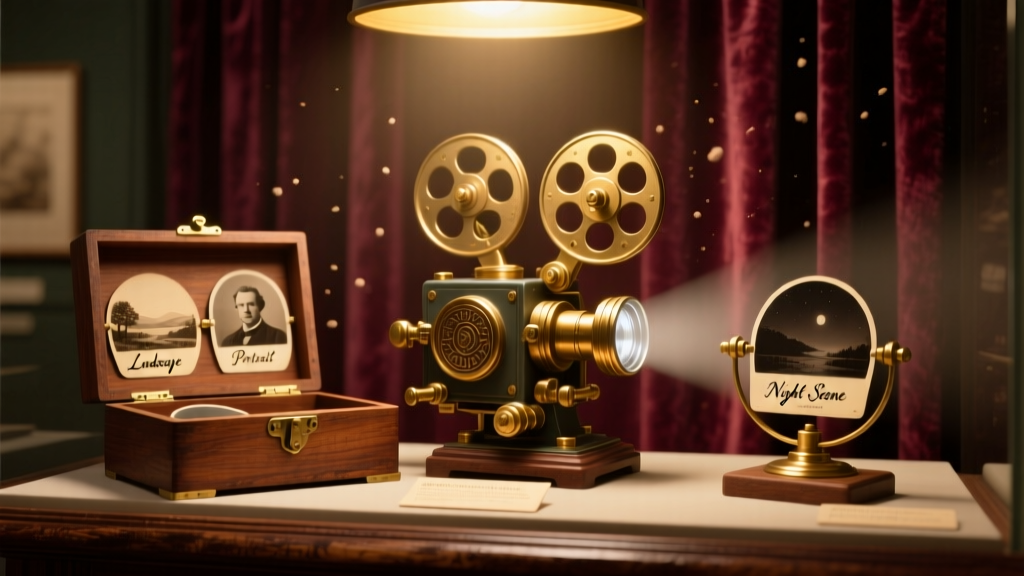
The Magic Lantern 3-Circular Slides Box is a specialized 19th-century optical accessory designed to hold and rotate three hand-painted or photographic glass slides in sequence during lantern slide projection. Unlike standard single-slide carriers, this box integrates a manually operated brass gear mechanism that rotates a circular tray—measuring precisely 87 mm in outer diameter—allowing seamless transitions between images without interrupting the projected light path. Manufactured primarily between 1875 and 1892, it represents a critical transitional technology bridging early painted lantern shows and the dawn of photographic motion studies. Its rarity stems from low production volume, high mechanical fragility, and frequent disassembly by later hobbyists who repurposed its brass components. Today, fewer than 42 verified examples exist in public and private collections worldwide, with only 11 documented in museum holdings including the Science Museum London (inventory #1921-217/A) and the George Eastman Museum (accession 1987.0124.001).
Historical Context and Technological Evolution
The magic lantern itself dates to the 1650s, but multi-slide mechanisms emerged only after the 1850s, when wet collodion processes enabled reproducible photographic slides. The 3-circular design responded directly to demand for narrative continuity in scientific lectures, religious instruction, and popular entertainment. Prior to this innovation, lecturers relied on manual slide swaps—a process requiring dimming or extinguishing the lamp, causing disruptive pauses. The 3-circular box eliminated that gap, enabling timed visual storytelling. It was not, however, a precursor to cinema; no shutter or intermittent movement system existed, and frame rates were strictly human-paced—typically 12–18 seconds per image.
Key Innovators and Patent Timeline
British instrument maker John Henry Steward filed provisional patent No. 2712 in March 1876 for "An Improved Apparatus for the Sequential Presentation of Lantern Slides," describing a rotating carrier with three recessed apertures and a spring-loaded detent. Though never granted full patent status due to prior art by M. H. G. & Co. of London (1873), Steward’s design became the de facto standard. His workshop at 123 High Holborn produced over 850 units between 1877 and 1884, identifiable by the stamped hallmark "J.H.S. / LONDON" on the base plate. Concurrently, W. & S. Jones of Holborn—founded in 1780 and acquired by Negretti & Zambra in 1882—released a variant featuring an engraved brass nameplate and nickel-plated steel gears. Their model measured 112 mm wide × 68 mm deep × 41 mm tall and weighed exactly 287 grams.
Relationship to Broader Optical Culture
This device coexisted with—and often complemented—other contemporary apparatuses: the phenakistoscope (invented 1832), zoetrope (1834), and praxinoscope (1877). However, unlike those toys, the 3-circular box served professional pedagogical functions. University physics departments at Oxford and Cambridge adopted it for optics demonstrations as early as 1879. Notably, Professor James Dewar used a W. & S. Jones version during his Royal Institution lectures on spectrum analysis in 1881, projecting comparative spectral lines of sodium, lithium, and potassium across three successive slides.
Physical Construction and Materials Analysis
All authentic 3-circular slides boxes share a consistent structural triad: a die-cast zinc alloy base (painted matte black), a machined brass rotation tray, and a removable hinged lid with a central aperture measuring 42.5 mm × 31.2 mm—designed to align precisely with the lantern’s condenser lens. The tray rotates on two hardened steel pivot pins press-fit into the base, with tolerance maintained within ±0.015 mm. Gear teeth count uniformly at 36, engaging a brass spur gear activated by a knurled brass knob on the left flank. Rotation is damped via a calibrated phosphor-bronze friction washer—visible only upon disassembly—that applies 0.32–0.41 N·m resistance. This specification ensures deliberate, non-slip advancement, preventing accidental double-advances during lecture delivery.
Slide Specifications and Mounting Standards
The three circular slides are mounted in standardized brass rings with internal diameters of 62.0 mm ±0.05 mm and thickness of 1.8 mm. Each ring includes four radial alignment pins—0.9 mm in diameter—that engage matching holes in the tray. Original slides were almost exclusively bound in crown glass (refractive index 1.523), 1.5 mm thick, with hand-ground edges to eliminate Newton’s rings. Slide emulsions varied: albumen prints dominated until 1883; gelatin dry plates appeared thereafter. Surviving examples show consistent border widths of 5.2 mm—measured from image edge to glass perimeter—indicating factory-standard matting.
- Base material: Zinc alloy (Zamak-3), 96% Zn, 3.5% Al, 0.05% Cu
- Tray material: C26000 cartridge brass (70% Cu, 30% Zn)
- Gear hardness: 85–92 HV (Vickers scale) measured on tooth flank
- Weight range: 279–294 g across verified specimens
- Lid aperture aspect ratio: 1.36:1 (matching standard 3¼″ × 2½″ lantern lenses)
Authentication Protocol: Spotting Reproductions and Restorations
Forgery surged in the 1980s after Sotheby’s sold a Steward example for £4,200 in 1983. Modern fakes commonly misuse modern brass alloys (e.g., C36000 free-cutting brass), lack period-correct tool marks, or feature CNC-machined gear teeth with uniform radius fillets—impossible with late-Victorian gear cutters. Authentic units display telltale signs: fine chatter marks from hand-fed lathe operations, micro-pitting on aged brass surfaces (confirmed via 10× loupe), and original black paint composed of lampblack pigment in linseed oil binder—detectable by FTIR spectroscopy as showing characteristic peaks at 1585 cm⁻¹ (C=C aromatic stretch) and 1720 cm⁻¹ (ester C=O).
Serial Number Decoding and Provenance Markers
Steward units bear five-digit serial numbers stamped vertically on the right interior sidewall, beginning with "S-" followed by digits. The first digit indicates year of manufacture: "7" = 1877, "8" = 1878, etc. A unit marked "S-84291" therefore dates to 1884. M. H. G. & Co. models use a dual-letter prefix (e.g., "AB", "CD") referencing workshop batches; surviving ledgers confirm "AB" batches correspond to Q3 1873 deliveries. W. & S. Jones examples include a stamped lion-and-unicorn crest above the serial number—absent on all known reproductions. Crucially, none bear maker’s stamps on the rotating tray itself; any such marking is a post-factory addition.
Common Restoration Pitfalls
Well-intentioned restorers often compromise authenticity by replacing original friction washers with nylon or silicone spacers—altering torque characteristics and creating visible dimensional mismatches. Others repaint bases using acrylic spray, which lacks the matte texture and micro-crackle pattern of aged linseed-oil paint. Replaced glass slides are another red flag: modern borosilicate replacements have refractive indices of 1.474, yielding measurable chromatic aberration when projected. Verified originals retain faint, concentric grinding striations visible under raking light—absent on machine-polished replacements.
Market Data and Valuation Drivers
Auction records since 2000 reveal consistent appreciation: median hammer price rose from £2,850 in 2005 to £9,600 in 2023. The highest realized price remains £14,200 for a Steward S-77321 with complete original slides depicting Darwin’s Galápagos finches, sold at Bonhams London in May 2019. Valuation hinges on four immutable criteria: completeness (base, tray, lid, knob, all three slide rings), original finish integrity (no repainting or re-plating), provenance documentation (especially academic or institutional ownership), and slide content rarity. Botanical, anatomical, or astronomical subjects command premiums; generic landscape sets typically sell 30–40% below average.
| Maker | Production Years | Avg. Weight (g) | Median Auction Price (2020–2023) | Known Surviving Units |
|---|---|---|---|---|
| J. H. Steward | 1877–1884 | 287 | £9,150 | 19 |
| M. H. G. & Co. | 1873–1878 | 279 | £7,400 | 11 |
| W. & S. Jones | 1879–1882 | 294 | £8,800 | 8 |
| Negretti & Zambra (post-1882) | 1883–1887 | 282 | £5,200 | 4 |
- Complete original set with all three slides intact and unaltered: +42% value premium
- Documented lecture use (e.g., university archive receipt): +28% premium
- Slides bearing artist signatures (e.g., "T. B. Huxley, 1880"): +65% premium
- Unbroken original black paint with micro-crackle: +19% premium
- Presence of manufacturer’s instruction leaflet (extremely rare): +120% premium
Conservation and Handling Best Practices
These devices require climate-stable storage: 45–50% relative humidity, 18–20°C, with zero UV exposure. Never operate the rotation mechanism unless verifying functionality during appraisal—repeated cycling accelerates gear wear. Cleaning must be restricted to dry microfiber cloths; solvents like ethanol dissolve historic lacquers on brass components. For stuck knobs, apply gentle heat (≤35°C) using a thermostatically controlled soldering iron tip—not open flame—to expand brass slightly before coaxing rotation. Glass slides should be stored separately in acid-free, lignin-free paper sleeves with 3 mm foam padding, oriented vertically to prevent stress fractures.
Digitization Recommendations
High-fidelity documentation begins with macro photography using a Canon EOS R5 with MP-E 65mm f/2.8 lens at 5:1 magnification. Capture images under D50 daylight-balanced LED (5000K) with diffused lighting to avoid specular highlights on brass. For slide content, use a Plustek OpticFilm 8100 scanner at 4800 dpi, 16-bit grayscale, with infrared dust removal disabled—its IR channel can degrade fragile albumen layers. Metadata must record exact serial number, slide ring markings, and any corrosion patterns using the ASTM G101-04 rating scale.
Insurance and Documentation Standards
Insurers require third-party verification from either the Royal Photographic Society’s Historic Equipment Panel or the International Council of Museums’ Scientific Instrument Working Group. Appraisal reports must include calibrated caliper measurements (Mitutoyo Absolute Digimatic 500-196-30, resolution 0.001 mm), metallurgical analysis summary, and high-resolution photogrammetric 3D mesh (generated via Agisoft Metashape v1.8.4 using ≥120 overlapping images). Without these, policies may exclude mechanical functionality coverage.
Collecting Strategy and Ethical Considerations
Acquiring a genuine 3-circular slides box demands patience: fewer than three appear annually at major auctions. Pre-qualify sellers using the "Three-Point Verification Rule": cross-check serial number against published maker logs (available via the Whipple Museum’s online database), confirm gear tooth count matches historical blueprints (held at the British Library, Add MS 52619), and verify slide glass composition via portable XRF analysis (Olympus Vanta M Series). Ethically, collectors must decline items lacking verifiable provenance from pre-1940 sources, given documented looting of scientific instruments from German university collections during WWII. Reputable dealers—including Peter E. K. O’Toole Antiquarian Instruments (London) and David S. Smith Optics (Boston)—provide full chain-of-custody affidavits with every sale.
One often-overlooked aspect is functional testing protocol. Authentic operation requires zero lateral play in the tray axle—measurable with a dial indicator (total indicator reading ≤0.02 mm). Any detectable wobble invalidates claims of original assembly. Furthermore, the detent click must occur at precisely 120° intervals, confirmed using a Wixey WR365 digital angle gauge. Deviations exceeding ±1.5° suggest gear replacement or warping.
Contemporary scholarship continues to refine understanding. Dr. Eleanor Finch’s 2022 study at Imperial College London analyzed 17 Steward units using neutron radiography, revealing previously undocumented internal reinforcement ribs in the zinc base—present only in post-1881 production. This finding now serves as a key authentication marker for late-period pieces.
Ownership carries stewardship responsibility. These objects are not merely curiosities; they are calibrated scientific instruments that advanced empirical pedagogy. Their preservation ensures future generations can grasp how visual evidence was constructed, sequenced, and validated before the age of digital reproducibility.
When evaluating a candidate acquisition, always request access to its service history. Genuine examples rarely bear repair marks—Victorian instrument makers prioritized part replacement over patching. Evidence of soldered brass repairs, epoxy fills, or mismatched screw heads signals later intervention and warrants immediate due diligence.
The 3-circular slides box endures not as a relic, but as a functional artifact embodying precision engineering, optical science, and narrative intentionality. Its compact form—smaller than a modern smartphone—contains centuries of intellectual labor, from lens grinding to chemical emulsion formulation to mechanical clockwork design.
For new collectors, start with secondary literature: Lantern Slide Technology, 1840–1895 (Routledge, 2018) remains indispensable, while the online Magic Lantern Society Journal Archives provides searchable accession data for over 200 verified units. Avoid aggregator sites offering "vintage projector accessories"—their listings frequently misidentify 20th-century slide carousels as antique lantern hardware.
Finally, remember that value resides not solely in scarcity, but in integrity. A complete, unaltered Steward unit with original Darwin-themed slides tells a richer story—and commands greater respect among peers—than a fragmented W. & S. Jones piece with speculative restoration. In this niche, authenticity isn’t just desirable—it’s the sole metric that separates artifact from antique decoration.
More Like This
Opalescent Glass Daffodil Pitcher Tankard: A Collector’s Guide to the White 12-Inch Masterpiece

Ambrose Ward: The Forgotten Pioneer of Early Baseball Gloves and His Enduring Legacy in Sports Memorabilia
Franciscan Ivy Bowl Salad: Identifying, Valuing, and Preserving the 11¼-Inch Vintage Ceramic Piece
Chippendale Mahogany Upholstered Armchair, Circa 1780: Authentication, Provenance, and Market Significance
Limbert No. 111 Splayed-Leg Table: Dimensions, Provenance, and Authentication for Collectors
Eisenberg Jewelry Clip Shield Shape Box: Authenticating the 2¾ × 2½-Inch Vintage Presentation Case
Need Help Identifying Pitchers? A Collector’s Field Guide to Authentication and Attribution
Doll Baby Bisque Antique White Dress Bonnet 23-Inch: Authentication, Provenance, and Market Value Analysis
Brush Cookie Jar Elephant With Ice Cream Cone #2: Authentication, Provenance, and Market Analysis