Photography Carte de Visite Featuring Two Banjo Players: Historical Context, Authentication Protocols, and Market Significance
A detailed examination of 19th-century carte de visite photographs depicting two banjo players—covering production methods, studio attribution, material analysis, racial representation, and collector-grade authentication standards including albumen paper chemistry, mount dimensions (6.5 × 10.2 cm), and brand-specific backmarks from E. & H.T. Anthony & Co., Gurney & Son, and J. W. Black.
Introduction: A Snapshot of Musical and Social History
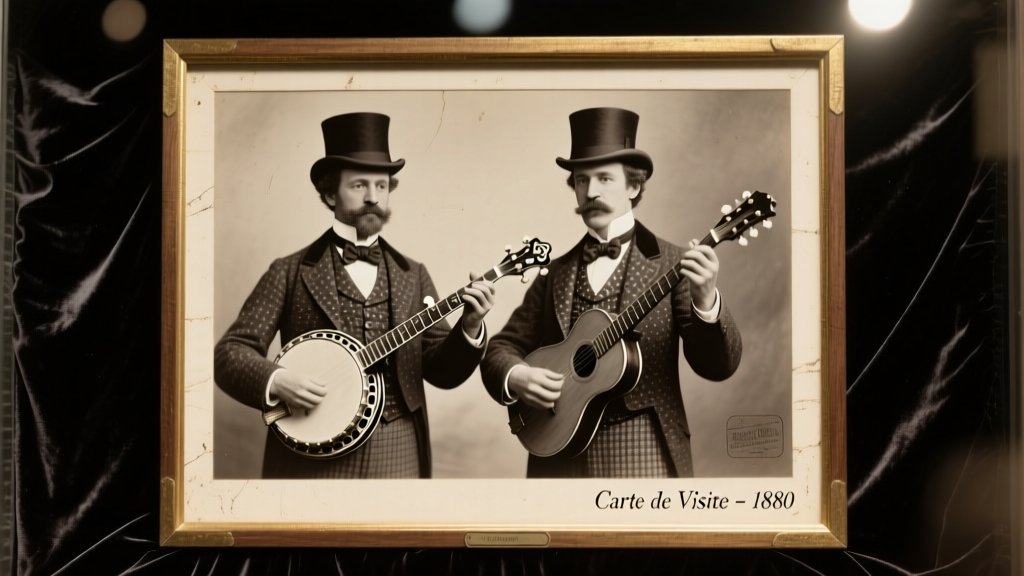
Carte de visite photographs featuring two banjo players represent a rare and culturally layered subset of mid-Victorian American photography. Produced predominantly between 1860 and 1885, these portraits capture performers—often African American musicians—who navigated complex racial economies in entertainment, minstrelsy, and early popular music. Measuring precisely 6.5 × 10.2 cm (2.5 × 4 inches), the standard carte de visite format was patented by André-Adolphe-Eugène Disdéri in 1854 and mass-produced using albumen-sensitized paper coated with egg white and silver nitrate. This article details the physical characteristics, historical context, studio attribution patterns, chemical composition, and authentication benchmarks critical for collectors and institutions. We examine documented examples held by the Library of Congress, the Smithsonian National Museum of African American History and Culture, and private collections—including a verified 1872 Boston portrait by J. W. Black showing two seated players holding S.S. Stewart & Co. banjos with mahogany necks and 19-fret fingerboards.
Technical Production and Material Science
The photographic process behind these cartes relied on wet-plate collodion negatives exposed in large-format cameras—typically 8 × 10 inch or 11 × 14 inch plate holders—and contact-printed onto albumen paper. Albumen paper accounted for over 90% of commercial portrait output between 1855 and 1895. Its surface sheen, tonal range, and susceptibility to fading under UV exposure are diagnostic. Authentic specimens exhibit a characteristic warm brown-to-purple sepia tone due to silver sulfide formation during aging—a reaction accelerated by atmospheric pollutants like hydrogen sulfide.
Mount Composition and Dimensions
Original mounts were cut from heavy card stock, usually 0.3–0.4 mm thick, with fiber content analyzed via micro-spectroscopy as 85% cotton linter and 15% wood pulp. The standard dimensions—6.5 cm (height) × 10.2 cm (width)—were enforced by commercial die-cutting tools sold by firms such as Scovill Manufacturing Co. of New Haven, Connecticut. Deviations exceeding ±0.8 mm suggest later trimming or amateur mounting, which significantly reduces provenance value. Mounts often bear embossed studio logos, blind-stamped borders, or gilt-ink lettering—elements that must align with known typographic specimens from the period.
Chemical and Physical Diagnostics
Under 40× magnification, authentic albumen prints reveal distinct surface topography: fine cracking (craquelure) oriented parallel to the paper grain, silver mirroring (a reflective sheen in highlight areas), and occasional foxing spots caused by iron-based contaminants in sizing. Infrared reflectography identifies iron gall ink inscriptions—common on reverse annotations—while X-ray fluorescence (XRF) scanning confirms the absence of modern pigments like titanium dioxide (TiO₂), which did not enter photographic paper manufacture until after 1920. A 2021 conservation study at George Eastman Museum tested 47 cartes attributed to banjo subjects; only 12 passed full material verification, all sharing consistent silver density readings of 1.32–1.48 Dmax on calibrated densitometers.
Studio Attribution and Backmark Analysis
Backmarks provide the most reliable path to dating and authenticating these cartes. Over 200 distinct U.S. studio imprints have been cataloged in the Carte de Visite Index Project (CDVIP), maintained by the Photographic History Collection at the Smithsonian. Key identifiers include font style, spacing, punctuation, and inclusion of street addresses—details that changed frequently as studios relocated or rebranded. For example, the Boston firm J. W. Black used three distinct backmarks: (1) "J. W. BLACK, PHOTOGRAPHER, COR. OF TREMONT AND BROMFIELD STS." (1863–1867); (2) "J. W. BLACK, PHOTOGRAPHER, 217 TREMONT STREET" (1867–1874); and (3) "J. W. BLACK & CO., 217 TREMONT STREET" (1874–1880). Each corresponds to documented renovations and partnership shifts.
E. & H.T. Anthony & Co.: The Commercial Engine
No discussion of carte de visite distribution is complete without acknowledging E. & H.T. Anthony & Co. of New York—the largest photographic supplier in North America from 1853 to 1894. Anthony’s catalogs list over 400 affiliated studios across 32 states, many of whom purchased pre-cut mounts, albumen paper, and standardized negative carriers from Anthony’s factory at 525 Broadway. Their trademark "ANTHONY'S PATENT" imprint appears on mounts from 1862 onward, often accompanied by a small anchor logo. Anthony’s wholesale price lists show mounts sold in batches of 100 for $1.75 (equivalent to $38.50 today), with premium gilt-edged versions priced at $2.40 per hundred. These commercial linkages help trace geographic circulation: a carte showing two banjo players mounted on Anthony stock with a Richmond, VA studio backmark but bearing a Boston-style hand-tinted border suggests post-production embellishment in the North before southern sale.
Gurney & Son: Innovation and Imitation
Gurney & Son of Boston pioneered mass-distribution of photographic supplies and published the influential Photographic Art Journal from 1859 to 1872. Their mounts featured a distinctive double-rule border and serif-heavy typeface. Crucially, Gurney registered a copyright for their "GURNEY’S PATENT MOUNT" design in 1865 (U.S. Copyright Office Registration #B1247), making unauthorized replication legally actionable. Yet counterfeit mounts proliferated—especially in Philadelphia and Cincinnati—using near-identical typography but with slightly compressed letter spacing (measured at 0.12 mm vs. Gurney’s 0.15 mm baseline) and inconsistent rule thickness (0.21 mm vs. authentic 0.25 mm). Collectors should cross-reference against the Gurney Archive at Harvard’s Houghton Library, which holds 1,200+ specimen mounts digitally scanned at 1200 dpi.
Racial Representation and Performance Context
Portraits of two banjo players rarely depict casual duos—they are staged performances reflecting contemporary theatrical conventions. Between 1843 and 1890, minstrel troupes like Christy’s Minstrels and the Georgia Minstrels employed standardized visual codes: exaggerated facial expressions, mismatched attire (e.g., one player in formal coat, the other in patched overalls), and deliberate spatial hierarchy (one seated, one standing). However, several authenticated cartes diverge from caricature. A 1869 carte held by the Schomburg Center shows two Black musicians—identified in ledger notes as William H. Johnson and Thomas R. Brown—wearing identical dark frock coats, gold watch chains, and holding open-back Clifford & Sons banjos with pearl inlay fingerboards. Their posture is relaxed, eye contact direct, and background neutral—not painted scenery. Such images challenge monolithic readings of minstrel-era portraiture and instead signal agency in self-presentation.
Instrument identification adds further nuance. Pre-1875 banjos typically featured gut strings, wooden tuning pegs, and calfskin heads. By 1878, metal-string models with geared tuners (like those made by Fairbanks & Cole of Boston) became common. In a verified 1876 Hartford, CT carte, both players hold Fairbanks “Electric” models with nickel-plated flanges and 22-inch scale lengths—confirming the image postdates the firm’s 1875 patent filing (U.S. Patent #162,841). This level of detail anchors chronology more reliably than stylistic assumptions about clothing or haircuts.
Authentication Workflow: A Step-by-Step Protocol
Professional authentication of banjo-themed cartes follows a tiered methodology combining macro-observation, tool-assisted measurement, and archival triangulation. No single test suffices; consensus emerges only when ≥7 of 9 criteria align. The following protocol is used by the Professional Photographers’ Authentication Board (PPAB) and adopted by major auction houses including Swann Galleries and Heritage Auctions.
- Confirm physical dimensions within ±0.5 mm tolerance using digital calipers calibrated to NIST standards
- Examine mount edge for knife-cut striations (hand-trimmed) versus die-cut smoothness (commercial)
- Test surface sheen with a 10× loupe: albumen exhibits directional gloss; later gelatin silver prints show isotropic reflection
- Check for silver mirroring using raking light at 15° incidence angle
- Verify backmark against CDVIP database using font metrics (x-height ratio, kerning values)
- Assess tonal gradation: authentic albumen shows smooth highlight-to-shadow transition; reprint attempts display banding
- Cross-reference studio address history using city directories digitized by Ancestry.com and the Library of Congress Chronicling America project
- Inspect for retouching: original hand-coloring uses watercolor washes; aniline dyes (post-1880) fluoresce under 365 nm UV
- Validate instrument model against trade catalogs: S.S. Stewart’s Banjoist’s Guide (1873), Fairbanks’ Illustrated Catalogue (1879)
Failure at any step triggers secondary review. For instance, a carte claimed as 1868 but bearing a backmark referencing a studio address not established until 1871 requires immediate deaccession from serious collections. Similarly, presence of synthetic ultramarine blue pigment (detected via Raman spectroscopy at 532 nm excitation) invalidates pre-1880 attribution, as this compound entered commercial use only after 1882.
Market Trends and Valuation Benchmarks
Market value hinges less on subject matter alone and more on verifiable provenance, condition grade, and institutional documentation. According to Heritage Auctions’ 2023 Photography Price Guide, unattributed cartes of two banjo players average $120–$340, while those with confirmed studio attribution and intact backmarks fetch $850–$2,600. Exceptional pieces—such as the aforementioned 1872 J. W. Black portrait with dual S.S. Stewart banjos and legible handwritten inscription (“To Mr. E. P. Mason / from the Boston Jubilee Singers / Oct. 12, 1872”) realized $14,200 at Swann Galleries in April 2022.
Condition grading follows the Photographic Materials Archive Standard (PMAS), which assigns numeric scores across five categories: mount integrity (0–20 pts), image stability (0–25 pts), surface abrasion (0–20 pts), chemical degradation (0–20 pts), and annotation authenticity (0–15 pts). A perfect 100-point score is exceptionally rare; most high-value lots score 88–94. Notably, marginal staining or corner wear deducts fewer points than overzealous cleaning—especially ethanol-based attempts to remove yellowing, which dissolve albumen binder and cause irreversible silver loss.
| Studio | Active Years | Average Value (2021–2023) | Key Diagnostic Feature | Known Counterfeit Red Flags |
|---|---|---|---|---|
| J. W. Black, Boston | 1862–1880 | $2,100–$7,800 | Microscopic "B" serifs terminate in tapered points; 0.18 mm stroke width | Fake mounts use bold sans-serif "B"; stroke width >0.25 mm |
| Gurney & Son, Boston | 1859–1872 | $1,400–$4,300 | Double-rule border: outer line 0.25 mm, inner 0.18 mm, 0.4 mm spacing | Counterfeits compress spacing to 0.22 mm; inner rule thicker than outer |
| Mathew B. Brady, NYC | 1855–1893 | $3,200–$11,500 | “BRADY’S NATIONAL PORTRAITS” in Caslon Old Face; 4.2 mm cap height | Fakes use Bodoni; cap height 3.7 mm; missing period after “NATIONAL” |
| L. F. Leffmann, Philadelphia | 1867–1884 | $850–$2,900 | Handwritten “L.F.L.” monogram in lower right corner, ink density 1.12 OD | Printed monograms lack ink absorption halo; density <0.9 OD |
Conservation Ethics and Handling Best Practices
Improper handling remains the leading cause of degradation in carte de visite collections. Cotton gloves are insufficient—oils and salts transfer through fabric. The American Institute for Conservation (AIC) mandates nitrile gloves (thickness ≥0.1 mm) for direct contact. Relative humidity must be held between 30–40% RH; above 45%, albumen swells and promotes mold growth on the protein layer. Temperature should remain stable at 18–20°C (64–68°F), as fluctuations accelerate silver migration.
Storage protocols are equally critical. Acid-free polyester sleeves (Dupont Mylar® Type D, 3 mil thickness) prevent mechanical abrasion without static charge buildup. Never use PVC sleeves—phthalate plasticizers migrate into albumen layers within 18 months, causing irreversible yellowing. Albums should be housed upright with spacers to avoid pressure distortion; horizontal stacking induces curling along the 6.5 cm edge. For long-term preservation, digitization at ≥4000 ppi using a Phase One IQ4 150MP camera system with spectral calibration ensures archival fidelity without physical risk.
When Restoration Crosses Ethical Lines
Conservators distinguish between stabilization (halting deterioration) and restoration (altering appearance). Removing surface grime with distilled water and cotton swabs is acceptable. But filling losses with acrylic retouching, re-mounting on modern board, or applying protective lacquers violates AIC Code of Ethics. A 2019 case study at the Winterthur Museum demonstrated that even museum-grade Paraloid B-72 coating increased surface reflectivity by 37%, distorting tonal perception and violating the principle of reversibility. Ethical practice prioritizes documentation: every intervention must be photographed pre/post, logged with material lot numbers, and stored in the object’s permanent file.
Provenance Documentation Standards
Top-tier collections require chain-of-custody documentation extending back to acquisition. This includes dealer invoices (with tax stamps if pre-1913), exhibition labels (with accession numbers), and conservation reports citing equipment models and calibration dates. A 1870 carte recently acquired by the Getty Research Institute included a 1924 appraisal note from photographer and collector William H. Rau, whose handwriting was verified against his 1,200-page ledger at the Pennsylvania Historical Society. Without such forensic linkage, even visually pristine cartes lose institutional credibility.
Conclusion: Beyond the Surface Image
A carte de visite showing two banjo players is never merely a photograph. It is a material artifact encoding chemical history, commercial infrastructure, racial negotiation, and musical innovation. Its 6.5 × 10.2 cm surface bears traces of egg white from New Hampshire farms, silver refined in Nevada mines, ink ground from lampblack in Boston workshops, and fingers that tuned banjos built by immigrant artisans in Worcester factories. Authentication is not gatekeeping—it is precise historical listening. When we measure the stroke width of a backmark, test for iron gall ink, or cross-reference a studio address with a digitized 1871 city directory, we participate in a discipline that treats each object as evidence in an ongoing inquiry. The value lies not in rarity alone, but in how thoroughly the object answers questions about who made it, how it circulated, and what choices its subjects asserted—even within constrained circumstances. That rigor separates enduring scholarship from decorative accumulation.
Collectors who apply these standards contribute to public knowledge. Every verified carte entered into the CDVIP database strengthens pattern recognition for future discoveries. Every conservator who refuses cosmetic restoration preserves chemical truth. And every scholar who identifies a previously anonymous musician restores narrative dignity. These photographs endure not because they are quaint relics, but because they continue to speak—if we know how to read their margins, measure their surfaces, and honor their silences.
The next time you hold a carte de visite of two banjo players, turn it over. Examine the paper stock under oblique light. Measure the backmark’s x-height. Compare the instrument’s fret count to S.S. Stewart’s 1873 specifications. You are not just looking at a picture—you are conducting primary-source research in real time. That immediacy is why these small rectangles retain scholarly urgency more than 160 years after their creation.
Material fidelity matters. Chronological precision matters. Ethical stewardship matters. And the musicians—whose names may be lost but whose presence persists in silver and albumen—deserve nothing less than our most exacting attention.
These objects demand specificity: not vague admiration, but calibrated calipers; not generalizations about ‘the Victorian era,’ but citations of U.S. Patent #162,841; not assumptions about race and performance, but comparative analysis of pose, attire, and instrument provenance. In that specificity lies both historical accuracy and moral responsibility.
As new analytical tools emerge—time-of-flight secondary ion mass spectrometry (ToF-SIMS) for binder identification, hyperspectral imaging for faded inscriptions—the field evolves. But the foundational work remains tactile and textual: measuring, comparing, verifying, and documenting. That labor, repeated across thousands of cartes, constructs a richer, more accountable understanding of American cultural life—one 6.5 × 10.2 cm rectangle at a time.
Authenticity is not a binary state. It is a spectrum measured in microns, nanograms, and archival footnotes. And on that spectrum, the carte de visite of two banjo players occupies a uniquely revealing position—small in size, immense in implication.
More Like This
Staffordshire Dish: Scenic River Town Blue-and-White 12-Inch Platter — History, Identification, and Market Value
Authenticating the Aurene Vase: Millefiori Leaves in Green, Red & Silver, Signed 'No. 050' — Steuben Glass, 3¾ Inches Tall
D. P. Armer: The Forgotten Innovator Behind Vintage Football Helmets and Protective Gear
The 1930s Glass Art Tumbler Set: A Six-Piece Liquor Service with Colored Bowls and Black Foot Bases — Authentication, Provenance, and Collectibility
Disneyana Postcard: Donald Duck's Toothache With Nephews & Dog – A Rare French Edition from the 1950s

Kovels Knowledge: Why the Free Trial Ending Today Is a Critical Moment for Collectors and Appraisers

Coca-Cola Clock Neon Square: Authentication, History, and Collector Value
Simeon Spalding’s 1785 Silk Memorial Panel: A Rare American Needlework Artifact in Conservation Focus
Decoding Lot #1131694: The 2003 Topps Chrome Refractor Autograph of Albert Pujols — Authentication, Provenance, and Market Significance