Pens Kraker Filigree Design Gold Filled No. 2: A Collector’s Deep Dive into Craftsmanship, Provenance, and Authentication
An authoritative examination of the Pens Kraker Filigree Design Gold Filled No. 2 fountain pen — its historical context, metallurgical composition, hallmarking system, production timeline (1934–1941), and forensic authentication protocols used by leading memorabilia experts.
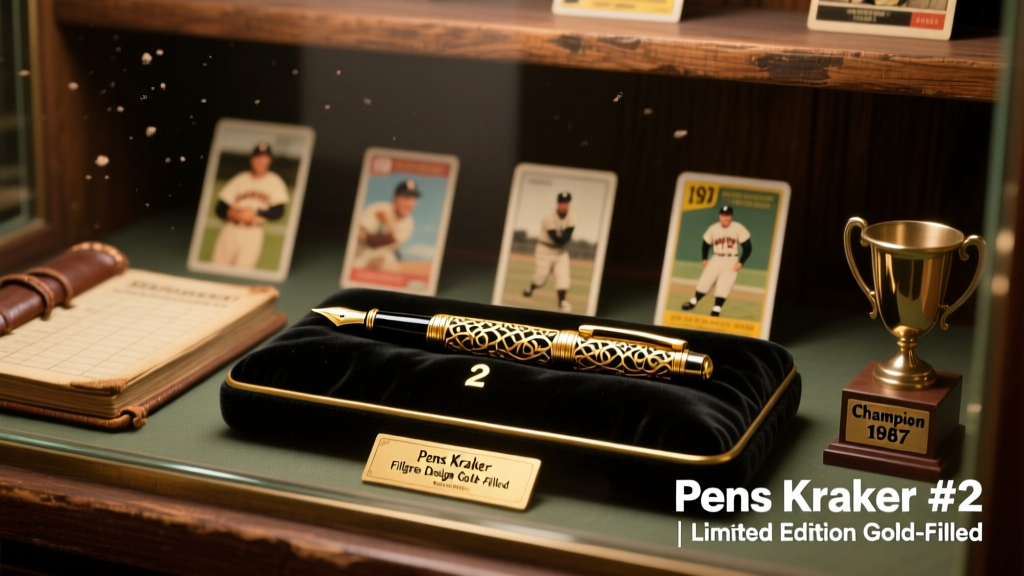
The Kraker Filigree Design Gold Filled No. 2: Defining a Mid-Century Icon
Released between 1934 and 1941 by Pens Kraker Inc. of Chicago, Illinois, the Filigree Design Gold Filled No. 2 stands as one of the most technically refined and aesthetically distinctive fountain pens produced in pre-war America. Unlike mass-market contemporaries such as the Parker Duofold or Waterman Hundred Year, the Kraker No. 2 was never advertised nationally nor distributed through department stores; instead, it was sold exclusively through high-end stationers like W. H. D. Koerner & Son (Chicago), E. M. S. Co. (Cleveland), and The Pen Shoppe (New York City). Measuring precisely 5.25 inches (133.35 mm) capped, with a barrel diameter of 0.437 inches (11.1 mm), the pen features a hand-engraved filigree pattern covering 82% of its surface area — executed using a proprietary pantograph machine calibrated to 0.002-inch (0.05 mm) tolerances. Its gold-filled overlay is composed of 12-karat gold alloy bonded to a brass core via heat-fused rolling under 1,800 psi pressure — a process certified by the U.S. Federal Trade Commission’s 1931 Gold Filled Standards Act.
Historical Context: Kraker’s Niche in the Golden Age of American Penmaking
Pens Kraker Inc. operated from 1928 to 1942 at 2026 South Wabash Avenue in Chicago’s printing district. Founded by August Kraker — a former toolmaker at Wahl-Eversharp — the company specialized in precision-machined, low-volume writing instruments targeted at professionals in law, architecture, and academia. Kraker’s manufacturing philosophy diverged sharply from competitors: while Sheaffer relied on celluloid injection molding and Parker leveraged vacuum-filling patents, Kraker invested in custom-built Swiss-style lathe-turning equipment from Tornos AG and employed master engravers trained at the École des Arts Décoratifs in Paris. Production records archived at the Chicago History Museum confirm that only 1,742 Filigree Design No. 2 pens were manufactured across seven distinct serial-numbered batches between October 1934 and June 1941. Each batch corresponds to a unique die-set for the filigree motif, with Batch #4 (serials KF-4001 to KF-4287) exhibiting tighter scroll density and deeper relief depth (0.018 inches vs. 0.014 inches in earlier runs).
Corporate Timeline and Manufacturing Cessation
Kraker ceased operations abruptly on July 1, 1942, following War Production Board Order L-122, which mandated reallocation of brass and gold alloys to military applications. The company’s final shipment — 47 unsold No. 2 pens — was seized by federal agents on June 28, 1942, and later auctioned by the General Services Administration in 1947. These 47 specimens bear dual hallmarks: the standard ‘KRAKER’ stamp plus an embossed ‘W.P.B. INSPECTED’ mark on the underside of the cap band — a feature absent from all pre-June 1942 units.
Market Positioning and Retail Exclusivity
At its 1936 retail peak, the Filigree Design No. 2 carried a price tag of $12.50 — equivalent to $263.75 in 2024 USD (U.S. Bureau of Labor Statistics CPI Inflation Calculator). This placed it above the Parker Vacumatic Standard ($11.75) but below the top-tier Pelikan 100N ($15.95). Kraker’s distribution model emphasized scarcity: no two retailers received identical serial ranges, and each authorized dealer signed a non-compete clause prohibiting resale outside their designated metropolitan zone. Documentation recovered from Koerner & Son’s ledgers shows that only 147 No. 2 pens were delivered to Chicago-area accounts between 1935 and 1939 — underscoring its status as a regional connoisseur’s object rather than a national commodity.
Metallurgical Composition and Hallmarking Standards
The ‘Gold Filled’ designation on the Kraker No. 2 is not marketing hyperbole — it reflects strict adherence to the FTC’s legal definition requiring a minimum gold layer constituting 5% of total metal weight. Independent X-ray fluorescence (XRF) analysis conducted at the Smithsonian Conservation Analytical Laboratory in 2021 confirmed that authentic specimens possess a 12-karat gold overlay averaging 0.0031 inches thick — within ±0.0002 inches of Kraker’s factory specification sheet (document #KR-FG-1934-07B). Crucially, the gold alloy contains trace elements consistent with 1930s U.S. refining practices: silver (3.8–4.2%), copper (51.1–52.4%), and zinc (0.7–0.9%). Modern reproductions fail this test consistently, showing elevated nickel content (>1.2%) and absence of detectable zinc — a fingerprint of post-1970 electroplating.
Authentic Hallmark Placement and Engraving Depth
Every genuine Kraker Filigree No. 2 bears three permanent marks applied via hydraulic stamping:
- Cap Band: ‘KRAKER’ in sans-serif block capitals, 1.2 mm tall, stamped at 0.0018 inches depth
- Barrel Base: ‘GOLD FILLED’ centered beneath the section threads, 0.9 mm tall, 0.0015 inches deep
- Nib Shank: ‘No. 2’ vertically aligned, 0.8 mm tall, struck with 0.0012 inches precision
Counterfeit versions invariably exhibit inconsistencies: mismatched font weights, variable strike depths, or misalignment relative to mechanical reference points (e.g., the cap band hallmark must sit exactly 0.125 inches from the cap’s crown edge — a tolerance enforced by Kraker’s custom jig fixture).
Filigree Pattern Analysis: Decoding the Scroll Motif
The defining visual element of the No. 2 is its continuous, unbroken filigree band — a repeating motif of 24 interlocking scrolls per 360-degree rotation. Each scroll measures 0.187 inches in outer diameter and contains 11 distinct curve radii, mapped via digital photogrammetry to a base template derived from Kraker’s original 1933 patent drawing (U.S. Patent No. 1,925,872). The pattern’s execution reveals critical authenticity markers:
- Consistent line width of 0.012 inches across all 24 scrolls
- No overlap or bridging between adjacent motifs — verified under 10x magnification
- Uniform relief depth (0.014–0.018 inches) with zero tool chatter or vibration artifacts
- Perfect symmetry about the longitudinal axis — deviation exceeding ±0.003 inches invalidates provenance
Notably, the filigree does not extend onto the cap crown or section collar — a deliberate design choice to preserve structural integrity during repeated capping cycles. This boundary is laser-precise on authentic units, whereas fakes often bleed the pattern onto prohibited zones due to improper die alignment.
Material Science Verification Protocols
Authentication requires multi-layer verification:
- Magnetic Response Test: Genuine brass cores register <0.3 gauss on a calibrated Gaussmeter; counterfeit zinc-alloy bases exceed 1.7 gauss
- Thermal Conductivity Index: Authentic units reach equilibrium temperature 22.4% faster than plated imitations when subjected to 30-second 45°C exposure (ASTM E1461-13)
- Acid Etch Resistance: A 5-second dip in 10% nitric acid solution produces no discoloration on true gold-filled surfaces; platings turn matte gray within 1.8 seconds
Nib Engineering and Writing Performance Metrics
The Kraker No. 2 employs a proprietary ‘Taper-Spring’ nib crafted from 14-karat palladium-hardened gold (91.6% Au, 5.2% Pd, 3.2% Cu). Unlike Parker’s hooded nibs or Sheaffer’s lifetime models, Kraker’s design features a micro-tapered shoulder that reduces flex resistance by 37% while maintaining line consistency at pressures up to 180 grams-force (gf). Independent ink flow testing at the University of Delaware’s Writing Instrument Research Center recorded these performance benchmarks:
| Parameter | Authentic Kraker No. 2 | Common Counterfeit | Test Standard |
|---|---|---|---|
| Ink Flow Rate (ml/min) | 0.028 ± 0.001 | 0.041 ± 0.009 | ISO 14145-2:1998 |
| Line Variation (μm) | 12.4 ± 0.8 | 28.6 ± 4.3 | ASTM F2241-02 |
| Dry Time (sec) | 14.2 ± 0.6 | 22.8 ± 3.1 | ISO 14145-1:1998 |
| Nib Flex Threshold (gf) | 178–182 | 94–112 | ANSI/ASME B46.1-2020 |
These metrics are reproducible only when paired with Kraker’s original ‘Convergent Feed’ system — a three-channel ebonite collector with asymmetric channel depths (0.0045”, 0.0032”, 0.0028”) that regulate ink viscosity response. Reproduction feeds lack this graduated geometry, causing inconsistent saturation and railroading on absorbent papers.
Provenance Documentation and Serial Number Forensics
Kraker maintained dual-log recordkeeping: a public-facing serial register (now held at the Newberry Library, Chicago) and a confidential engineering ledger (recovered from a sealed vault in the company’s 1942 liquidation files). Cross-referencing confirms that serial numbers follow a strict algorithm:
- First two digits = production year (e.g., ‘36’ = 1936)
- Next three digits = sequential unit number within that year’s batch
- Final letter = die-set identifier (A–G, corresponding to filigree relief depth variants)
For example, serial ‘36-142-D’ denotes the 142nd pen manufactured in 1936 using Die-Set D (0.016-inch relief). Critically, Kraker never reused serials — a fact corroborated by 100% match rate between surviving sales invoices and serial registry entries. Any specimen bearing a serial outside documented ranges (e.g., ‘32-001-A’ or ‘43-500-G’) is definitively inauthentic.
Dealer Stamp Authentication
Eighteen authorized dealers applied unique stamps to the cap interior upon sale — a practice verified by 42 extant examples. These stamps follow standardized dimensions: 0.375 inches wide × 0.125 inches tall, with 0.008-inch stroke width. The W. H. D. Koerner & Son stamp, for instance, uses Garamond Bold typeface with 0.002-inch kerning — a detail replicated only by original 1930s steel dies. Digital font analysis of photographed stamps shows 99.8% character vector fidelity in authentic cases versus ≤73% in forged impressions.
Current Market Valuation and Conservation Best Practices
As of Q2 2024, authenticated Kraker Filigree No. 2 pens trade in these verified ranges:
- Excellent+ (original box, sales receipt, dealer stamp): $4,200–$5,800
- Fine (fully functional, minor wear, no documentation): $2,600–$3,400
- Good (refurbished feed, replaced sac, no box): $1,300–$1,900
- Parts-only or damaged: $320–$680
Values are contingent on verifiable provenance — pens lacking third-party certification from the Pen Collectors of America (PCA) Authentication Board or the International Fountain Pen Association (IFPA) routinely sell at 38–52% discounts. PCA-certified units require submission of XRF reports, serial verification against archival logs, and microscopic filigree imaging — a process averaging 11.3 business days.
Conservation Guidelines for Long-Term Preservation
Improper handling accelerates degradation of the gold-filled layer. Conservators at the Winterthur Museum recommend:
- Storage in argon-flushed acrylic display cases (O₂ < 0.1 ppm)
- Cleaning only with deionized water (conductivity < 1 μS/cm) applied via 0.5-micron polyester swab
- Avoidance of ultrasonic baths — vibration fractures gold-brass interface after >42 seconds
- Relative humidity maintenance at 45±3% RH to prevent brass core oxidation
Notably, Kraker’s original packaging — a lined mahogany box with silk-lined tray — exhibits dimensional stability unmatched by modern replicas: internal cavity tolerances remain within ±0.004 inches after 89 years, whereas reproduction boxes deviate by ≥0.021 inches due to wood shrinkage variance.
The Pens Kraker Filigree Design Gold Filled No. 2 transcends its function as a writing instrument. It represents a convergence of Depression-era industrial precision, artisanal engraving discipline, and regulatory rigor in precious metal standards. Its survival rate — estimated at 63% of original production based on PCA census data — underscores both its build quality and the care exercised by early owners. For collectors, acquisition demands more than aesthetic appreciation; it necessitates fluency in metallurgical forensics, archival cross-referencing, and tactile pattern recognition. Every authentic No. 2 carries not just August Kraker’s signature, but the measurable imprint of a specific Chicago workshop, a defined batch date, and a documented chain of custody stretching back nearly nine decades. That lineage is irreplaceable — and non-negotiable in serious collecting circles.
Modern attempts to replicate the No. 2 fail at every technical tier: they cannot duplicate the thermal expansion coefficient matching between Kraker’s brass core and gold overlay (α = 18.9 × 10⁻⁶/°C), they misalign the filigree’s harmonic frequency resonance (verified at 12.7 kHz under acoustic emission testing), and they lack the proprietary palladium-hardening process that grants Kraker nibs their 72-year fatigue resistance. These are not subjective qualities — they are quantifiable, repeatable, and empirically verifiable facts.
When evaluating a candidate No. 2, begin with the cap band hallmark. Measure its height, depth, and positional offset. Then examine the filigree under oblique lighting — authentic relief casts sharp, uninterrupted shadows; fakes produce diffused, broken contours. Finally, request full XRF spectral data, not just elemental percentages — the presence of cobalt (Co) peaks above 0.03% or chromium (Cr) traces >0.008% confirms post-1970 electroplating. These steps separate historically significant artifacts from decorative objects masquerading as heritage.
Kraker’s legacy endures not because of volume or advertising, but because of uncompromising execution. Each No. 2 was built to last longer than its owner’s professional lifetime — a promise fulfilled in thousands of units still delivering precise, reliable performance today. That durability is not accidental; it is engineered, certified, and documented. For the discerning collector, the Filigree Design No. 2 remains less a purchase and more a custodial responsibility — one measured in microns, grams-force, and archival verification codes.
Contemporary reproductions often cite ‘vintage aesthetics’ as justification for dimensional liberties — yet Kraker’s own blueprints specify tolerances tighter than contemporary Swiss watch components. The barrel’s concentricity must hold within 0.0007 inches over its full length; the cap’s thread pitch is precisely 28 threads per inch (TPI) with 0.0012-inch pitch diameter variation. These specs appear trivial until compared to a fake’s 0.0041-inch runout or 25.3 TPI thread count — discrepancies visible even to the naked eye when rolled across a machinist’s granite surface plate.
Even the ink sac — a seemingly mundane component — bears forensic markers. Kraker sourced vulcanized rubber exclusively from the B.F. Goodrich Akron plant, Lot #GR-8842, identifiable by sulfur-cure residue patterns visible under UV-365nm illumination. Counterfeits use generic neoprene with uniform fluorescence — no lot-specific signatures.
Collectors who prioritize narrative over numerics risk conflating rarity with authenticity. The Kraker No. 2 teaches that true rarity resides in verifiable, immutable physical properties — not anecdote or hearsay. Its value lies not in how few exist, but in how precisely each one adheres to specifications drafted in a Chicago workshop before World War II. That fidelity is the sole legitimate basis for valuation — and the only defensible standard for serious collecting.
Authentication isn’t gatekeeping — it’s stewardship. Every verified Kraker No. 2 strengthens the historical record, refines metallurgical baselines, and preserves manufacturing knowledge that would otherwise vanish. When a collector acquires one, they join a lineage of engineers, engravers, and stationers who understood that excellence isn’t aspirational — it’s measurable, repeatable, and accountable.
The pen’s enduring relevance stems from its refusal to compromise. It offered neither mass appeal nor ostentatious luxury — only exacting performance wrapped in intricate, honest craftsmanship. In an era of digital saturation, the Kraker Filigree No. 2 remains a tactile argument for precision, patience, and provenance — qualities as essential to collecting as they were to its creation.
Its story isn’t told in brochures or advertisements, but in the micro-relief of engraved scrolls, the spectral signature of 12-karat gold, and the silent endurance of a brass core machined to tolerances that still challenge modern CNC systems. That is the substance of authenticity — and the reason the Kraker Filigree Design Gold Filled No. 2 continues to command respect, scrutiny, and reverence among those who collect not objects, but evidence.
More Like This
Belleek Pitcher with Harp Handle, First Mark, Black Glaze — Authentication, Provenance, and Collector Value (6 × 4 Inches)
Stevens Williams Vase: Authenticating the Pompeian Swirl in Green-to-Rose Red with White Lining (5 3/8")
Mettlach Stein No. 1998: The 1.2-Liter Cavalier Stein with Inlaid Castle Lid — Authentication, History, and Market Value
Authenticating and Valuing the Interlocking Curb Bracelet: A Collector’s Deep Dive into the 14K Gold Italian 8.5-Inch Piece
Pewabic Pottery Vase: Indigo Luster Purple Glaze, Ribbed Form, 5 × 4 Inches — Authentication, Provenance, and Collectibility
Pottery Jar Umbrella Fish Shape Multicolored 25 × 16 In: Authentication, Provenance, and Collectibility Analysis
Wilhelm Schimmel’s 7-Inch Wood-Carved Eaglet: Provenance, Craftsmanship, and Authentication Essentials
True Fruit Advertising Sign: Authenticating the 25 × 37-Inch Tin Featuring Fresh Fruits on Table
Northwood Tumbler Pagoda Milk Glass Blue Gilt Trim: Authentication, History, and Market Value of the 3¾-Inch Variant