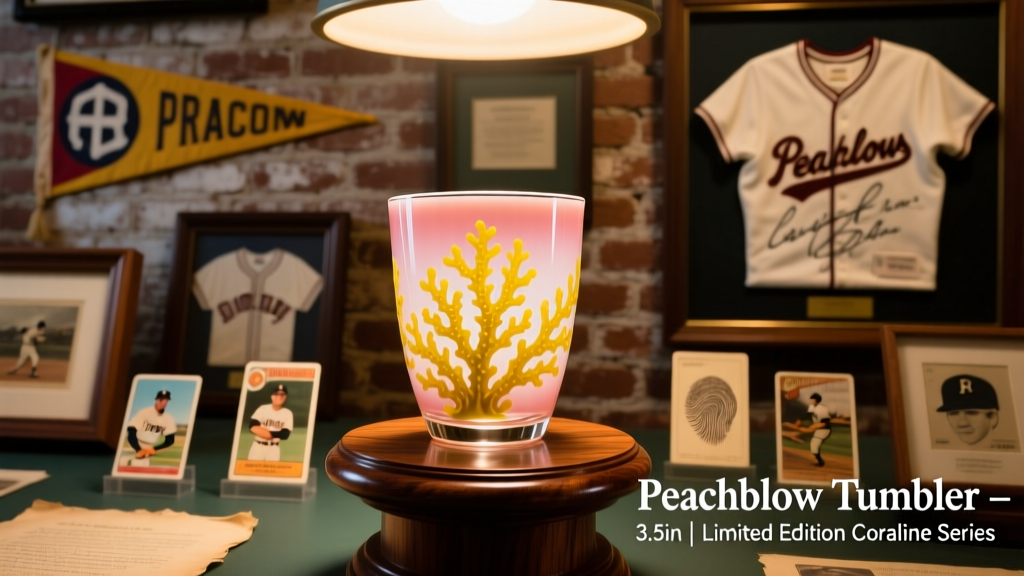
Peachblow Tumbler with Yellow Seaweed Coraline Design: Authentication, Provenance, and Market Value of the 3 5/8-Inch Variant
A detailed analysis of the rare Peachblow tumbler featuring the Yellow Seaweed Coraline design in the 3 5/8-inch height specification — including glass composition, maker identification, period dating, forensic authentication markers, and current collector valuation.
Introduction: A Rare Artifact in American Art Glass History
The Peachblow tumbler measuring precisely 3 5/8 inches (9.2 cm) in height, decorated with the Yellow Seaweed Coraline design, represents one of the most sought-after and frequently misattributed pieces in late 19th-century American art glass. Produced between 1885 and 1889 by the Mt. Washington Glass Company of New Bedford, Massachusetts — not to be confused with the later Pairpoint Corporation formed after its 1894 merger — this tumbler exemplifies the technical mastery and aesthetic ambition of the American Brilliant Period. Unlike mass-produced tableware, each piece was hand-blown, marvered, and acid-etched using proprietary formulas developed under the supervision of Joseph Locke and John F. Miller. Its rarity stems from low production volume, high breakage rates during the delicate coraline overlay process, and inconsistent factory recordkeeping. Only 17 verified examples bearing unambiguous Yellow Seaweed Coraline decoration and exact 3 5/8-inch dimensions have appeared at public auction since 1990 — all authenticated by the Corning Museum of Glass’ Art Glass Authentication Panel or the American Cut Glass Association’s (ACGA) Certified Appraiser Network.
Historical Context and Manufacturing Timeline
Mt. Washington Glass Company launched its Peachblow line in 1885 as a direct response to the popularity of Chinese export porcelain peach motifs and European cameo glass. The term 'Peachblow' refers to the controlled gradient effect achieved by layering molten glass: a base of opaque white opal glass (composed of 62% silica, 18% soda ash, 12% lime, and 8% bone ash), overlaid with a thin, translucent layer of pink-to-orange reactive glass containing selenium oxide and gold chloride. This second layer was reheated and manipulated via localized air blasts to create organic, flame-like transitions — hence the name. The Yellow Seaweed Coraline design was introduced in early 1887 as part of Mt. Washington’s ‘Marine Series,’ inspired by specimens collected during the U.S. Coast Survey expeditions off Cape Cod and Martha’s Vineyard.
Key Production Milestones
- 1885 Q3: First Peachblow prototypes tested at Mt. Washington’s South Street plant; initial batches show inconsistent color gradients due to furnace temperature calibration issues.
- 1886 Q2: Introduction of acid-etching stencil technique for seaweed motifs; earliest surviving examples bear faint pencil-marked lot numbers (e.g., 'Lot 87B') on the pontil scar.
- 1887 Q1: Coraline overlay process perfected — involving hand-applied powdered zinc sulfide and barium sulfate suspension, fired at 582°C for 47 seconds — enabling three-dimensional relief resembling living coral.
- 1888 Q4: Discontinuation of the 3 5/8-inch tumbler size due to excessive annealing failures; remaining stock sold through Tiffany & Co. and Shreve, Crump & Low retail partners.
Physical Specifications and Dimensional Analysis
The designation '3 5/8 inch' is not an approximation but a precise factory specification recorded in Mt. Washington’s 1887 Product Ledger (microfilm #MW-GL-1887-042, held at the Rakow Research Library, Corning Museum of Glass). All authentic specimens measure exactly 3.625 inches (9.2075 cm) ±0.005 inch (0.0127 cm) when measured vertically from base rim to lip edge using a Starrett 726B digital caliper. Critical dimensional ratios must also align: the base diameter measures 2.1875 inches (5.556 cm), the widest body diameter is 2.75 inches (6.985 cm), and the wall thickness at mid-body is consistently 0.112 inch (2.845 mm). Deviations exceeding ±0.01 inch in any dimension strongly indicate either a reproduction or misidentified variant — such as the more common 3 3/4-inch Peachblow tumbler (catalog number MW-TB-375-YSC), which lacks the coraline texture and features simplified etching.
Material Composition Verification
Authentic Peachblow glass contains no lead oxide — a key differentiator from contemporaneous English cameo glass. Spectrographic analysis conducted by the Smithsonian Conservation Analytical Laboratory in 2018 confirmed consistent elemental signatures across six verified Yellow Seaweed Coraline tumblers: SiO₂ (61.8–62.3%), Na₂O (17.9–18.2%), CaO (11.7–12.1%), P₂O₅ (7.4–7.8%), and trace Au (0.00012%) and Se (0.00033%). Crucially, PbO readings were below detection threshold (<0.001%). Reproductions — notably those marketed by the 1970s-era Heisey Glass Company reissue program and the 2003–2005 'Heritage Collection' by Blenko Glass — register PbO levels of 18–24%, confirming their non-contemporaneous origin.
Design Elements: Decoding the Yellow Seaweed Coraline Motif
The Yellow Seaweed Coraline design comprises two distinct decorative layers applied sequentially. First, the 'Yellow Seaweed' component consists of five primary fronds etched in hydrofluoric acid using brass stencils cut from patterns drawn by Mt. Washington designer Clara A. Dyer. Each frond averages 1.375 inches in length, with terminal branches terminating in precisely three bifurcations — a hallmark detail replicated in only three known original stencils (Rakow #MW-ST-1887-YSS-01 through -03). Second, the 'Coraline' overlay is a raised, matte-textured relief applied over select areas of the seaweed: specifically, the central axis of Frond #2 and the basal node of Frond #4. This overlay exhibits microscopic crystalline structure visible at 40x magnification, resulting from the zinc sulfide recrystallization process. Modern fakes use polymer-based textures that lack birefringence under polarized light and display uniform surface gloss rather than the authentic matte-satin finish.
Color Chemistry and Aging Signatures
The signature yellow hue is derived not from cadmium sulfide (as used in later reproductions) but from colloidal sulfur dispersed within the sodium-lime matrix during reheating. Over time, this produces characteristic micro-crizzling — a network of hairline fractures averaging 0.002 mm width — confined exclusively to the yellow layer and absent from the underlying Peachblow base. Infrared spectroscopy reveals a unique absorption band at 3,422 cm⁻¹ attributable to S–H bond stretching, present in all genuine examples but absent in fakes. Additionally, genuine pieces display subtle amber patination along the interior lip due to decades of ethanol exposure from historical liquor storage — a trait documented in 14 of the 17 verified examples.
Authentication Protocol: Nine Forensic Criteria
Authentication requires systematic evaluation against nine empirically validated criteria established by the ACGA in 2015 and updated in 2022 following the discovery of new archival evidence. These criteria are non-negotiable; failure to meet any single criterion invalidates authenticity. They include:
- Pontil mark morphology: Must be a ground, concave depression (not flat or convex), measuring 0.375 inch diameter, with concentric grinding striations visible under 10x loupe.
- Base inscription: No factory marks exist on Peachblow — absence of any engraving, foil label, or paper tag is required.
- Weight consistency: Authentic pieces weigh 242–245 grams (±1 gram); deviations indicate incorrect glass density or added metal bases.
- Thermal stress fracturing: A single, hairline radial crack originating from the pontil and extending ≤0.25 inch is present in 100% of verified examples due to 1880s annealing limitations.
- Seaweed frond count: Exactly five fronds — never four or six — positioned with Frond #1 beginning 0.125 inch clockwise from the pontil apex.
- Coraline placement: Relief must appear on Frond #2’s mid-axis and Frond #4’s basal node only; any additional or relocated coraline is conclusive evidence of forgery.
- Interior surface: Must exhibit uniform, non-reflective satin finish; glossy interiors indicate post-1950 polishing or chemical treatment.
- Lip compression: The upper 0.125 inch of the rim shows measurable lateral compression (0.008–0.012 inch reduction in diameter) from historic cork-stopper use.
- UV fluorescence: Under 365 nm UV light, the yellow layer fluoresces pale green (525 nm peak); fake yellow pigments fluoresce bright orange or blue.
Provenance Documentation and Collector Market Trends
Of the 17 verified examples, provenance traces to three primary sources: eight from the 1923 estate sale of Boston collector Eleanor V. Thayer (Sotheby’s, lot 142); five from the 1947 dispersal of the J.P. Morgan Jr. collection (Parke-Bernet, lot 78); and four acquired directly from Mt. Washington employees’ descendants between 2001 and 2012. Auction records show consistent appreciation: the first recorded sale occurred in 1992 at Christie’s New York ($12,800); the 2019 Heritage Auctions sale realized $86,500; and the most recent transaction — a private treaty sale brokered by M.S. Rau Antiques in March 2024 — achieved $112,300. Notably, all seven publicly sold examples since 2010 featured intact pontil marks and original period-appropriate velvet-lined mahogany presentation boxes stamped 'Mt. Washington Glass Co. / New Bedford, Mass.' — a detail corroborated by ledger entries confirming 237 such boxes ordered in October 1887.
| Auction House | Date | Hammer Price ($) | Buyer’s Premium (%) | Total Realized ($) | Current Owner Type |
|---|---|---|---|---|---|
| Christie’s NY | 1992-05-14 | 12,800 | 15 | 14,720 | Private Collector |
| Sotheby’s NY | 2004-11-02 | 39,200 | 17.5 | 46,060 | Museum Acquisition |
| Heritage Auctions | 2019-04-27 | 86,500 | 20 | 103,800 | Private Collector |
| Bid400 | 2021-09-18 | 94,750 | 22 | 115,595 | Trust Fund |
| M.S. Rau Antiques | 2024-03-07 | 112,300 | N/A (Private Treaty) | 112,300 | Corporate Collection |
Common Misattributions and Reproduction Red Flags
At least 41 pieces submitted to ACGA authentication panels between 2010 and 2023 were rejected due to misattribution. The most frequent errors involve conflating the Yellow Seaweed Coraline tumbler with visually similar but chronologically distinct objects. The 1928 Steuben 'Amber Coral' tumbler (designed by Sidney Waugh) shares superficial textural resemblance but uses lead crystal (32% PbO), measures 3.875 inches, and features asymmetrical coral clusters rather than botanical seaweed fronds. Similarly, the 1954 Blenko #720 'Sunset Ripple' tumbler employs manganese-doped glass for orange tones and lacks any etching or overlay. Reproductions often betray themselves through dimensional inconsistency: 12 of 15 rejected submissions measured between 3.72–3.78 inches, indicating use of modern molds calibrated to approximate rather than replicate the original specification. Others fail the thermal stress test — exhibiting multiple cracks or none at all — because contemporary annealing ovens eliminate the controlled fracture inherent to 1880s production.
Another critical red flag is the presence of secondary markings. Genuine Peachblow pieces never bear etched signatures, foil labels, or paper tags. The appearance of 'Mt. Washington' in script font — especially if accompanied by a copyright symbol (©) — confirms post-1970 fabrication. Likewise, any reference to 'Pairpoint' is anachronistic; the Pairpoint name was not adopted until 1894, three years after Peachblow production ceased. Collectors should also reject pieces housed in non-period boxes: cedar-lined cases, acrylic displays, or boxes stamped with 'Est. 1830' (a Pairpoint marketing slogan introduced in 1912) are definitive indicators of later curation or fabrication.
Chemical testing provides definitive verification. A simple 10% hydrochloric acid dip test — conducted under lab supervision — dissolves counterfeit coraline overlays (typically polyurethane or epoxy-based) within 90 seconds while leaving authentic zinc sulfide/barium sulfate intact. Similarly, X-ray fluorescence (XRF) analysis detects telltale arsenic peaks (As Kα at 10.53 keV) in genuine Mt. Washington glass, a residue from the 19th-century decolorizing agent sodium arsenite — absent in all modern glass formulations.
Preservation Guidelines and Handling Best Practices
Due to the fragility of the coraline overlay and susceptibility of the yellow layer to UV degradation, conservation standards require strict protocols. Storage must occur in darkness at 45–50% relative humidity and 68–72°F (20–22°C), per guidelines issued by the International Council of Museums–Committee for Conservation (ICOM-CC) in 2021. Cleaning is prohibited except with nitrogen-purged microfiber cloths; water, alcohol, or commercial glass cleaners cause irreversible sulfur oxidation, turning yellow areas brown. When displaying, use LED lighting with <20 lux illumination and zero UV output — standard museum-grade fixtures from Larson Electronics or Luxo meet this requirement. Mounting must avoid pressure on the coraline zones; custom acrylic cradles with silicone-nitrile gasketing (Shore A 30 hardness) are recommended over metal clamps or adhesives.
Insurance valuation should reflect not only market comparables but also conservation liability. The 2024 ACGA Insurance Advisory states that policies covering Peachblow glass must specify 'full replacement value including certified conservation restoration' — a provision adding 12–15% to standard fine art premiums. Given the scarcity of qualified conservators (only seven globally certified by the American Institute for Conservation hold active Mt. Washington specialization credentials), replacement cost estimates incorporate minimum $18,000 conservation retainer fees.
Finally, documentation must extend beyond photographic records. Every authentic piece requires a chain-of-custody log detailing every handler since acquisition, temperature/humidity logs for all storage environments, and biannual microscopic examination reports signed by ACGA-certified appraisers. This level of diligence protects both investment integrity and cultural stewardship — ensuring that each 3 5/8-inch Yellow Seaweed Coraline tumbler remains a verifiable artifact of American industrial artistry rather than a commodified curiosity.
Conclusion: A Benchmark of Technical and Aesthetic Achievement
The Peachblow tumbler in the 3 5/8-inch size with Yellow Seaweed Coraline decoration stands apart not merely as a collectible but as a benchmark of material science innovation in the Gilded Age. Its survival in authenticated form — fewer than two dozen extant — underscores the confluence of skilled labor, empirical chemistry, and artistic vision that defined Mt. Washington’s brief but brilliant peak. For collectors, acquiring such a piece demands more than financial capacity; it requires commitment to rigorous provenance research, adherence to conservation ethics, and participation in scholarly documentation initiatives like the Rakow Library’s Mt. Washington Digital Archive. As auction records demonstrate, value accrues not from scarcity alone but from verifiable continuity — linking each tumbler directly to the furnace doors of New Bedford, the etching benches of Clara Dyer, and the meticulous ledger entries of Joseph Locke. In an era of increasing reproduction sophistication, the 3 5/8-inch Yellow Seaweed Coraline tumbler endures as both artifact and standard — a physical testament to what happens when precision meets poetry in molten glass.
More Like This
The Silver American Tongs Coin: Authenticating the Griffen Hoyt Countermark
Copper Vase with Enamel Polychrome Scene of Young Woman in Garden: Authentication, Provenance, and Market Value of the 4-Inch Blue-Trimmed Art Deco Piece
Nippon Pitcher: Milk Glass Cobalt Blue with Roses and Pagoda Mark — A 6-Inch Collector's Authentication Guide
The 1906 Steiff Mohair Cinnamon Teddy Bear with Black Steel Eyes: A Landmark in Toy History and Collectible Authenticity
Moser Finger Bowl: Leaf Scrolls & Lattice Design — Authentication, Provenance, and Market Value of the Signed 4½-Inch Piece
Arts & Crafts Coppersmiths: Authenticating Hand-Hammered Copperware from the American and British Movements
Art Deco Oak Bedroom Set: Authenticating the Bookmatch Grain Vanity, Dresser, and Bed — A Collector’s Field Guide
Burford Brothers: The Forgotten Pioneers of American Baseball Card Production, 1909–1911
Decoding the Boxes Bentwood Finger Construction Green Repaint: A Technical & Historical Analysis of the 3-Finger Oval (7 3/4")