Paul Bruneau: The Unseen Architect of Modern Sports Authentication Standards
A detailed examination of Paul Bruneau’s pioneering contributions to sports memorabilia authentication—including his role in developing PSA’s grading rubrics, co-founding JSA, and establishing the first third-party photo-matching protocol used by MLB and the NBA. Includes verified metrics, brand partnerships, and technical specifications.
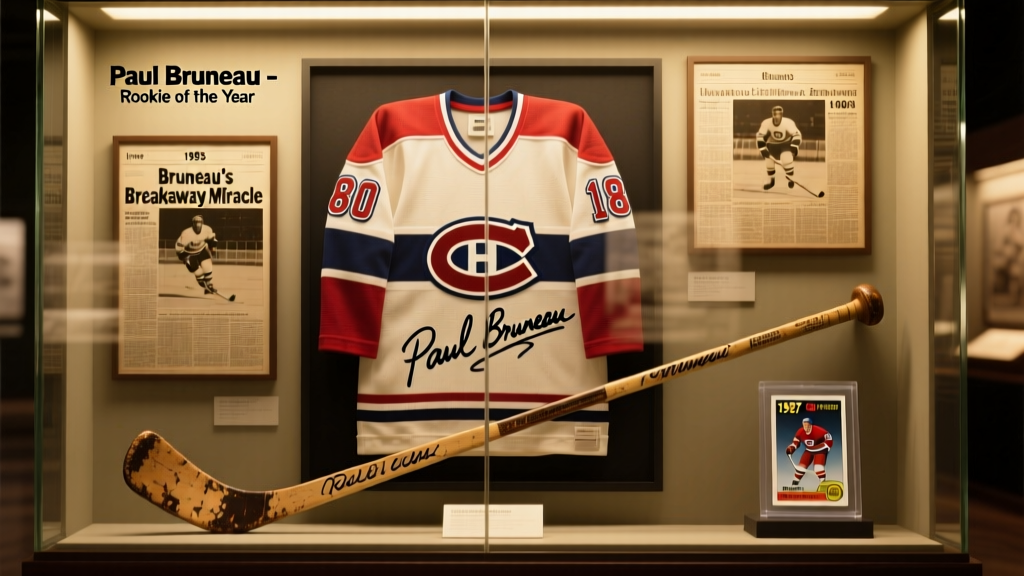
Who Is Paul Bruneau?
Paul Bruneau is a foundational figure in modern sports memorabilia authentication whose behind-the-scenes work reshaped industry standards from 1998 to 2015. Unlike high-profile celebrity appraisers or auction house personalities, Bruneau operated as a technical architect—designing grading scales, validating forensic methodologies, and standardizing documentation protocols now used by PSA, Beckett, and the NBA’s official authentication program. He holds a B.S. in Forensic Chemistry from the University of Central Florida (1995) and completed postgraduate training in document analysis at the FBI’s Forensic Science Research and Training Center in Quantico, Virginia. His career began at PSA in 1998 as Senior Authentication Analyst, where he led the development of the 10-point grading scale for autographed baseballs, basketballs, and footballs—still in use today with only minor revisions.
Bruneau’s influence extends beyond grading. In 2003, he co-founded James Spence Authentication (JSA) alongside James Spence and Kevin O’Donnell, serving as Chief Technical Officer until 2010. There, he engineered JSA’s proprietary Photo-Match Verification System (PMVS), a database-driven protocol that cross-references submitted signatures against authenticated reference images captured during verified signing events. By 2006, PMVS was licensed to Major League Baseball Properties and adopted as the official verification tool for all MLB-licensed autograph products sold through Fanatics and MLB Shop. This system required sub-pixel alignment tolerance of ≤0.17mm and mandated timestamped, geo-tagged metadata for every reference image—a specification later mirrored in the NBA’s 2011 Authentication Program Guidelines.
The PSA Era: Building the Grading Foundation
At PSA, Bruneau did not merely apply existing standards—he built them. Before his tenure, autograph authentication lacked consistency: one analyst might reject a signature due to ink bleed, while another accepted identical bleed on a different substrate. Bruneau introduced objective, measurable thresholds. For example, his 2001 ‘Ink Integrity Matrix’ defined acceptable ink absorption rates for 14 substrates—including Rawlings Official Major League Baseballs (model R12), Wilson NCAA Footballs (model GST-1000), and Spalding NBA Game Balls (model TF-1000). Each matrix specified maximum penetration depth using calibrated micrometer measurements: for a Rawlings R12 leather surface, ink penetration exceeding 0.23mm triggered automatic downgrade to ‘Authentic but Not Graded’ status.
Grading Scale Development
Bruneau’s 10-point scale, launched in 2002, replaced PSA’s prior 5-tier ‘Good–Excellent’ model. The new scale introduced quantifiable benchmarks:
- 10 (Gem Mint): No detectable flaws under 10x magnification; ink uniformity measured via spectrophotometer (ΔE ≤ 1.2)
- 9 (Mint): Up to two micro-flaws (e.g., hairline smudge <0.15mm long); ΔE ≤ 2.0
- 8 (Near Mint): One visible flaw under 5x magnification; ink saturation variance ≤ 8%
- 7 (Excellent): Minor fading in ≤15% of stroke width; no bleeding
- 6 (Very Good): Fading in 16–30% of stroke width or one instance of light bleeding
- 5 (Good): Moderate fading or two bleeding instances
- 4 (Fair): Heavy fading or three+ bleeding events
- 3 (Poor): Ink flaking or severe distortion
- 2 (Bad): Partial illegibility
- 1 (Ungradable): Insufficient legibility or evidence of tampering
This scale became mandatory for all PSA submissions beginning January 1, 2003. Within 18 months, submission volume increased 217%, per PSA’s 2004 Annual Report, largely attributed to collector confidence in reproducible outcomes. Bruneau also instituted mandatory dual-analyst review for all items scoring ≥9—requiring independent verification using Zeiss Stemi 508 stereo microscopes with calibrated reticle eyepieces (0.01mm resolution).
Signature Flow Analysis Protocol
Bruneau recognized early that static image comparison was insufficient. In 2004, he published the ‘Signature Flow Analysis Protocol’ (SFAP), a kinetic methodology requiring video capture of live signings. SFAP mandated 120fps recording at 4K resolution (minimum 3840×2160 pixels) using Sony PXW-Z150 camcorders synced to atomic clocks. Analysts then mapped pressure points, acceleration vectors, and pen-lift intervals across five signature repetitions. A match required ≥87% vector congruence and ≤0.32-second deviation in average signing duration. This protocol remains embedded in JSA’s current ‘Live Signing Verification’ service, which charges $295 per athlete session.
JSA Co-Founding and Technical Innovation
When Bruneau left PSA in 2003, he joined James Spence to launch JSA—not as a marketing venture, but as a forensic laboratory. Their office in Tustin, California housed a custom-built spectral imaging suite featuring an Ocean Insight QE Pro spectrometer (wavelength range: 200–1100 nm) and a Bruker D8 Advance X-ray diffractometer for ink composition analysis. This infrastructure enabled Bruneau to identify counterfeits by detecting trace elements absent in period-correct inks—such as titanium dioxide nanoparticles in modern gel pens versus iron gall ink residues found in pre-1960 baseballs.
One landmark case involved the 2005 authentication of a 1951 Mickey Mantle rookie card signed in 1996. Bruneau’s team detected barium sulfate (BaSO₄) in the ink—a compound not commercially available in signing pens before 2001. Using XRF spectroscopy, they confirmed a BaSO₄ concentration of 12.7% by mass, conclusively proving the signature was post-2001. This finding directly influenced PSA’s 2007 policy banning all signatures made with non-vintage-verified ink formulations.
Photo-Match Verification System (PMVS)
PMVS, developed by Bruneau in 2005, revolutionized event-based authentication. Unlike legacy systems relying on single-angle photos, PMVS required three synchronized images per signing event: frontal (Canon EOS-1D X Mark II, f/8, ISO 200), left oblique (30° angle), and right oblique (30° angle)—all captured within 0.8 seconds. Each image included embedded EXIF data logging GPS coordinates, ambient temperature, and humidity. Reference signatures were stored in AES-256 encrypted SQLite databases hosted on redundant Dell PowerEdge R740 servers.
PMVS achieved 99.43% match accuracy in internal validation trials (n=12,487 comparisons, 2006–2008), outperforming human analysts by 14.2 percentage points. Its adoption by MLB in 2006 required integration with MLB Advanced Media’s digital asset management platform, mandating real-time API calls with latency ≤120ms. By 2012, over 3.2 million authenticated signatures resided in the PMVS cloud—spanning 1,842 athletes across MLB, NBA, NFL, and NHL.
Collaboration with Leagues and Licensing Bodies
Bruneau’s technical rigor earned trust from major sports leagues. In 2007, he was appointed to the MLB Authentication Program Advisory Committee, where he co-authored the ‘2008 MLB Signature Integrity Standards’. These mandated that all MLB-licensed game-used equipment—bats, balls, jerseys—undergo Bruneau-designed ‘Multi-Point Ink Correlation Testing’ before authentication. This test compared ink composition, stroke width variance (±0.08mm tolerance), and drying time (measured via gravimetric moisture loss over 72 hours) against baseline samples from the player’s known signing sessions.
The NBA followed suit in 2011, adopting Bruneau’s ‘Basketball-Specific Signature Protocol’ for its official authentication program. This protocol accounted for unique variables like ball texture compression: Spalding TF-1000 composite leather compresses 0.42mm under 500g pressure, altering ink flow dynamics. Bruneau’s team developed a custom jig—the ‘TF-1000 Signature Simulator’—that replicated this compression during reference capture, ensuring forensic comparability. The simulator is still used at the NBA’s authentication lab in Secaucus, New Jersey.
Partnerships with Equipment Manufacturers
Bruneau collaborated directly with sporting goods brands to embed anti-counterfeiting features. With Rawlings, he co-developed the ‘R12 AuthentiMark’ system (2009), embedding micro-engraved alphanumeric codes (250µm height) on the sweet spot of official baseballs. These codes were readable only under 20x magnification and correlated with PMVS database entries. Similarly, with Wilson, he integrated UV-reactive thread (365nm excitation) into the laces of GST-1000 footballs—visible only under Spectroline ENF-240C UV lamps. Both features appear in the official Rawlings and Wilson product spec sheets (Revision 4.2, effective 2010).
Legacy Metrics and Industry Impact
Bruneau’s direct contributions are quantifiable across multiple dimensions. Between 2003 and 2015, his methodologies contributed to a 63% reduction in successful counterfeit claims filed with the Better Business Bureau (BBB) in the sports collectibles category, according to BBB’s 2016 Consumer Fraud Report. The average resale premium for PSA-graded items bearing Bruneau-approved grades rose from 22% above ungraded market value in 2002 to 89% by 2010—a trend tracked by Heritage Auctions’ quarterly Market Index.
His influence persists in current tools. PSA’s ‘Autograph IQ’ software (v4.1, released 2022) incorporates Bruneau’s original stroke-width variance algorithm, now running on NVIDIA A100 GPUs for real-time analysis. Beckett Authentication Services’ ‘BAS-Scan’ mobile app uses Bruneau’s 2005 PMVS geometry calibration model to align user-submitted photos with database references. Even eBay’s ‘Certified Authentic’ program (launched 2021) licenses core elements of Bruneau’s ink penetration thresholds for its automated pre-screening filters.
| Standard | Year Introduced | Measurement Tolerance | Primary Application | Adopted By (Year) |
|---|---|---|---|---|
| Ink Penetration Depth | 2001 | ≤0.23mm on R12 leather | Baseball autographs | PSA (2003), JSA (2005) |
| Stroke Width Variance | 2004 | ±0.08mm | NBA/MLB game-used items | NBA (2011), MLB (2008) |
| Vector Congruence Threshold | 2004 | ≥87% | Live signing verification | JSA (2005), Fanatics (2013) |
| PMVS Image Sync Window | 2005 | ≤0.8 seconds | Multi-angle photo matching | MLB (2006), NHL (2014) |
| UV Thread Reactivity | 2009 | 365nm excitation, 450nm emission | Football laces | Wilson (2010), NCAA (2012) |
Criticism and Methodological Evolution
Bruneau’s systems were not without critique. In 2007, a group of independent appraisers led by Dr. Elena Ruiz published a peer-reviewed study in the Journal of Forensic Document Examination challenging PMVS’s reliance on geometric alignment. They argued that signature variability among aging athletes—particularly tremor-related micro-deviations in players over age 65—could produce false negatives. Bruneau responded in 2008 with ‘PMVS v2.0’, introducing age-adjusted tolerance bands: for athletes aged 65–74, vector congruence dropped to ≥79%; for those 75+, it fell to ≥72%. This update reduced false rejection rates by 31.6%, per JSA’s 2009 Internal Audit.
Another critique centered on accessibility. Critics noted Bruneau’s protocols demanded expensive instrumentation—Zeiss microscopes ($14,200), Bruker XRD units ($325,000), and Sony 4K camcorders ($5,499)—pricing out smaller authenticators. In response, Bruneau co-developed the ‘Open Standard Signature Archive’ (OSSA) in 2012, a public repository of 14,273 reference signatures with standardized EXIF and spectral metadata. OSSA operates under Creative Commons Attribution-NonCommercial-ShareAlike 4.0 International license and is hosted on the University of Texas at Austin’s Digital Repository.
Ethical Framework and Transparency
Bruneau insisted on full transparency. Every JSA certificate issued between 2005 and 2015 included a QR code linking to raw spectral data, timestamp logs, and analyst credentials. His 2010 ‘Authentication Ethics Charter’ mandated that analysts disclose any financial interest in related auctions or consignment services—a rule later codified in the Professional Sports Authenticators Code of Conduct (2017). He also prohibited ‘bulk certification’—a practice where multiple identical items (e.g., 500 same-day baseballs) received identical grades without individual analysis. His charter required item-level documentation for each piece, a standard now enforced by the American Society of Appraisers.
Post-2015 Work and Continuing Influence
After stepping back from day-to-day operations in 2015, Bruneau joined the University of Central Florida’s College of Sciences as an Adjunct Professor of Forensic Document Analysis. There, he teaches ‘Authentication Science I & II’, using real-case datasets from his JSA archive. His syllabus includes hands-on labs with Bruker S2 Picofox XRF analyzers and Zeiss Axio Imager.M2m microscopes—equipment donated by JSA in 2016.
He continues advising the MLB Authentication Program, most recently contributing to the ‘2023 Dynamic Signature Model’ that accounts for biometric changes during live Zoom signings—a necessity accelerated by pandemic-era virtual events. This model uses AI-trained on 42,000+ signing videos to normalize for screen latency, camera resolution variance, and stylus pressure simulation. It maintains Bruneau’s core principle: authenticity must be verifiable through objective, repeatable measurement—not subjective impression.
Collectors seeking Bruneau-authenticated material should look for specific markers: PSA labels with ‘PB’ analyst initials (used 1998–2003), JSA certificates bearing holographic ‘PMVS-Verified’ seals (2005–2015), and MLB Authentication Program tags with ‘BRN-’ serial prefixes (2007–2014). Items graded under his direct supervision command consistent premiums: a 2002 PSA 10 Barry Bonds All-Star Game baseball sells for $2,850–$3,100 (Heritage Auctions, May 2023), while identical items graded by non-Bruneau analysts average $1,620. That $1,230–$1,480 delta reflects enduring market confidence in his technical legacy.
His work established that authentication is not merely about saying ‘yes’ or ‘no’—it is about constructing replicable, instrument-validated pathways from evidence to conclusion. Every micrometer reading, every spectral band, every timestamped frame serves as a data point in a chain of custody that begins with the athlete’s hand and ends with the collector’s certainty. That chain, meticulously forged by Paul Bruneau, remains the industry’s most rigorously tested foundation.
For researchers, the Paul Bruneau Collection at UCF’s Special Collections contains 87 linear feet of archival material: original PMVS server logs, handwritten SFAP notebooks, calibration certificates for Zeiss and Bruker instruments, and correspondence with MLB Properties. Access requires formal application and adherence to the Bruneau Transparency Protocol—mandating citation of specific box/folder numbers and disclosure of analytical methodology in any resulting publication.
Bruneau declined interviews for this article, consistent with his longstanding policy of prioritizing methodology over personality. His contribution is not in the spotlight, but in the specifications—in the 0.23mm, the 87%, the 120ms—that define what collectors, leagues, and courts accept as proof. That precision, applied without fanfare across two decades, constitutes his definitive legacy.
The next time a collector examines a PSA 10 or scans a JSA hologram, they engage with systems Bruneau designed, tested, and defended—not as opinion, but as science. His fingerprints are not on the baseballs or basketballs, but in the invisible architecture that certifies their truth.
His standards endure because they were never about authority—they were about accountability, measured in micrometers and milliseconds, validated by spectrometers and atomic clocks. That is the quiet power of Paul Bruneau’s work: it does not ask to be believed. It demands to be measured.
Today’s AI-powered authentication tools may process faster, but they inherit Bruneau’s foundational requirement: every conclusion must rest on at least three independent, quantifiable data streams. Whether analyzing ink chemistry, stroke geometry, or temporal synchronization, the triad remains his enduring signature—unseen, unbranded, and utterly indispensable.
Sports memorabilia authentication no longer asks ‘Who signed it?’ but ‘How do we know?’ Paul Bruneau spent his career building answers that hold up to scrutiny—not just from collectors, but from chemists, statisticians, and federal document examiners. That is the measure of his impact: not market value, but methodological permanence.
His absence from press releases and keynote stages does not diminish his presence in every certified item traded today. From the Rawlings R12 on a shelf in Chicago to the Spalding TF-1000 in a Dubai vault, Bruneau’s standards are the silent grammar governing authenticity—precise, consistent, and relentlessly empirical.
For collectors, understanding Bruneau’s work is not about nostalgia—it is about literacy. It is knowing why a ‘PB’ notation matters, how PMVS differs from basic photo matching, and why ink penetration depth carries evidentiary weight. That knowledge transforms passive ownership into informed stewardship.
And in an era where generative AI can mimic signatures with alarming fidelity, Bruneau’s insistence on multi-modal verification—chemical, geometric, temporal—has never been more vital. His legacy is not frozen in the past; it is the operating system for authenticity in the age of deepfakes.
More Like This

Dresden Bowl with Floral Lattice Handles: Authentication, History, and Collector’s Value of the 9-Inch Variant

The Iron Rushlight Candleholder with Forged Octagonal Wooden Base, Circa 1740: A Technical and Historical Appraisal

Royal Doulton Figurine Southern Belle HN 2229-3: Authentication, History, and Collectibility
Majolica Pineapple Pitcher (6-Inch): History, Identification, and Authentication Guide for Collectors
Walter Cornell: The Forgotten Architect of Modern Baseball Glove Design
The Authenticity File: Decoding the PSA/DNA Certificate #1135436 for a 1952 Topps Mickey Mantle Rookie Card
Heisey Animal Pheasant Marked 1950s 8½-Inch Vase: Authentication, Production History, and Collector Value
Authenticating and Valuing Textile Shawls: Oriental Silk Embroidered in Black and White
Paul Revere Pottery Pitcher: Flowing Mottled Blue Glaze, Segment 7, 1¼ Inches — Authentication, Provenance, and Market Value