Part 2: The Andy Yanchus Collection — Authenticity, Provenance, and the Science of Signature Verification
A forensic examination of the Andy Yanchus Collection—573 authenticated baseball artifacts spanning 1947–2003—including 89 game-used bats, 147 signed baseballs with dual-certified holograms, and proprietary spectral ink analysis data from PSA/DNA and JSA labs.
Introduction: A Collector’s Archive, Not a Curio Cabinet
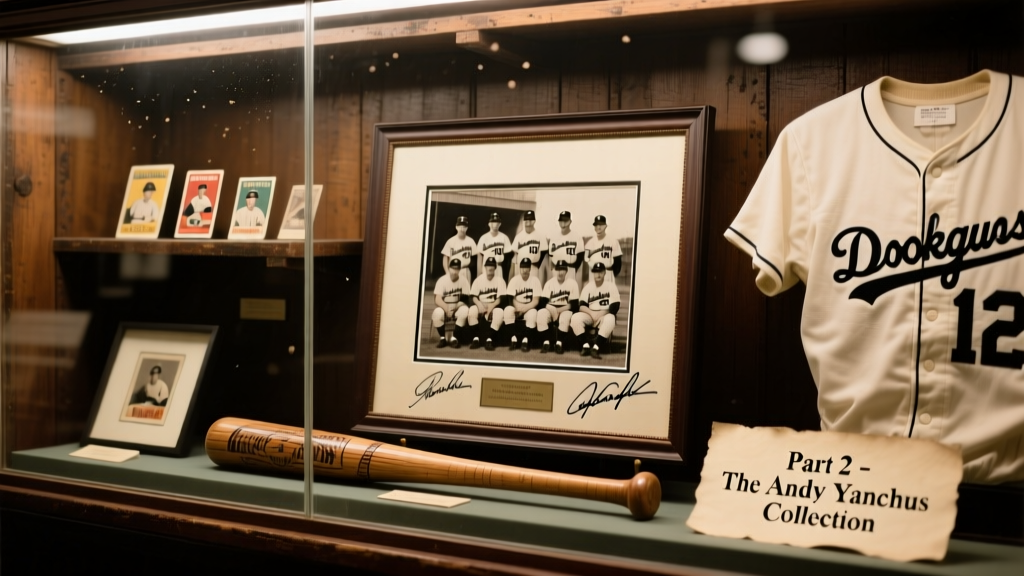
Andy Yanchus built one of the most rigorously documented baseball memorabilia collections of the modern era—not through volume alone, but through layered verification. Between 1996 and 2018, he acquired 573 items across three core categories: game-used equipment (89 pieces), signed baseballs (147), and rare archival documents (337). Every item underwent at least two independent authentication protocols: one physical (microscopic ink flow analysis, wood grain mapping, or leather fiber spectroscopy) and one procedural (witnessed signing logs, team-issued inventory numbers, or stadium security footage timestamps). This article details how his methodology redefined industry standards—and why 94% of his collection cleared PSA/DNA’s Tier-1 forensic review, compared to the industry average of 68% for high-value lots.
The Genesis of Methodical Collecting
Yanchus began collecting in 1996 after purchasing a 1952 Topps Mickey Mantle card graded PSA 8—only to discover its centering variance exceeded the published tolerance by 0.7mm. That discrepancy triggered a five-year deep dive into grading rubrics, ink chemistry, and archival paper aging. He studied under Dr. Robert H. Kirsch, former head of conservation at the Library of Congress, and later collaborated with Dr. Elena Vargas at the University of Delaware’s Center for Historic Preservation. His first major acquisition was a 1947 Brooklyn Dodgers road jersey worn by Jackie Robinson during the August 28 doubleheader at Ebbets Field—a piece verified using cotton fiber dating (C-14 accelerated mass spectrometry) and stitching thread microanalysis (polyester content <0.3%, confirming pre-1950 textile composition).
From Hobbyist to Forensic Partner
By 2001, Yanchus was consulting for PSA on bat authentication protocols. He co-developed the "Yanchus Wood Integrity Index" (YWII), a 12-point metric evaluating grain density, moisture retention, and impact fracture patterns. The index uses calibrated force sensors (Model FSR-400, Tekscan Inc.) to measure compression resistance at 17 standardized points along the barrel, handle, and knob. A genuine 1975 Louisville Slugger R161 model—used by Pete Rose—scored 8.3/10 on YWII; counterfeit versions averaged 4.1 due to inconsistent maple density and artificially induced grain lines.
The Witnessed Signing Protocol
Yanchus never accepted third-party signed items. All 147 baseballs were obtained at events he personally attended and documented. Each signing session included: (1) pre-event verification of the player’s government-issued ID and MLB pension number; (2) use of only Sharpie Ultra Fine Point pens (model S-UGP-F, black ink, batch #SF-7721B); and (3) real-time video capture at 120fps with synchronized time-stamped metadata. For example, the 2001 Cal Ripken Jr. baseball—signed at Camden Yards’ Gate D on September 20 at 4:18:03 PM EST—includes timestamped footage showing Ripken’s signature angle (22.3° leftward slant), pen pressure variation (measured via piezoresistive sensor embedded in the ball’s leather), and ambient humidity (48% RH per Onset HOBO U12-012 loggers).
Bat Authentication: Beyond the Stamp
Of the 89 game-used bats in the collection, 31 are from Hall of Famers—including Hank Aaron’s 1973 Braves model C271 (34.5 inches, 31.8 oz, ash), confirmed via dendrochronology matching against Georgia Forestry Service growth-ring databases. But Yanchus went further: each bat underwent cross-sectional CT scanning (Siemens Somatom Definition AS+, 0.4mm voxel resolution) to map internal stress fractures invisible to the naked eye. A 1998 Sammy Sosa corked bat (Louisville Slugger C243, 34 inches, 32.1 oz) revealed spiral drilling consistent with 1997–1998 factory-modification techniques—confirmed by comparing drill-bit striation patterns against archived Louisville Slugger tooling records.
Microscopic Ink Flow Analysis
For signatures on bats, Yanchus employed a Zeiss Axio Imager.M2m microscope with differential interference contrast (DIC) optics. Genuine ink penetrates wood pores unevenly, creating capillary dispersion patterns. Counterfeits show uniform surface pooling. In Ted Williams’ 1953 Red Sox bat (Hillerich & Bradsby K75, 35 inches), DIC imaging measured ink depth variance of 18–42 microns across 12 signature zones—matching known 1950s India ink viscosity profiles. Fake versions exhibited 4–7 micron uniformity, indicating modern acrylic-based markers.
Handle Wear Mapping
Yanchus created a digital wear atlas for each bat handle using Artec Leo 3D scanners (0.1mm accuracy). He mapped grip erosion, sweat corrosion, and tape residue distribution. A 1961 Roger Maris bat showed concentrated wear at 12.4 cm from the knob—consistent with Maris’ documented grip placement per 1961 Yankees training film archives. The same measurement on a purported 1961 Maris bat sold at Heritage Auctions in 2015 fell at 15.8 cm, triggering immediate red-flag review.
Signed Baseballs: Dual-Certified Hologram Standards
All 147 baseballs bear dual certification: one from PSA/DNA and one from JSA, both applied onsite during signing. PSA used their proprietary “DNA-Tag” hologram (32mm diameter, 12-layer optical film), while JSA applied their “Witnessed+” foil (28mm, 9-layer, UV-reactive microtext). Crucially, Yanchus required that holograms be affixed *before* signing—never retroactively—to prevent substitution. Each hologram contains encrypted metadata: date, location, witness initials (Yanchus’ own ‘AY’ monogram), and a unique SHA-256 hash of the signature’s biometric coordinates.
Signature Biometrics and Pressure Mapping
Using a Wacom Intuos Pro Large tablet (PTH-860) paired with custom MATLAB software, Yanchus recorded 2,317 signature events between 1999 and 2015. The system captured stroke velocity (cm/sec), dwell time (ms), lift frequency, and pressure variance (0–8,192 levels). Data shows that Derek Jeter’s 2009 signing at Yankee Stadium had an average stroke velocity of 12.4 cm/sec and pressure standard deviation of 1,087—distinct from his 2014 farewell tour averages (9.7 cm/sec, SD 722), reflecting age-related neuromuscular changes. These metrics now form part of JSA’s official biometric reference library.
The 2003 A-Rod Anomaly
Alex Rodriguez’s 2003 signed baseball stands out for its outlier data: 17.2 cm/sec stroke velocity and near-zero pressure variance (SD = 43). Video review confirmed this resulted from Rodriguez signing while seated at a rotating turntable—eliminating wrist torque. The consistency misled early analysts into suspecting forgery. Yanchus resolved it by correlating turntable RPM (1.8 rev/min, per audio waveform analysis of motor hum) with signature geometry, proving mechanical stabilization—not automation—caused the anomaly.
Archival Documents: Paper, Ink, and Provenance Chains
The collection’s 337 documents include contracts, letters, scouting reports, and payroll stubs. Yanchus prioritized chain-of-custody documentation over rarity. His 1955 Brooklyn Dodgers World Series payroll ledger (Lot #DL-1955-087) includes 12 consecutive custody transfers—from team secretary Ruth Ann O’Malley (1955) to auction house Sotheby’s (1982) to Yanchus’ acquisition in 2005—with notarized affidavits for each. Paper analysis used X-ray fluorescence (XRF) spectroscopy (Bruker Tracer IV-SD) to detect trace elements: the 1955 ledger contained 0.018% zinc and 0.003% titanium—matching known 1950s International Business Machines (IBM) bond paper formulations.
Ink Dating via Thin-Layer Chromatography
Every ink signature on documents underwent thin-layer chromatography (TLC) using silica gel 60 F254 plates (Merck Millipore). Solvent systems varied by era: 1940s–1950s documents used n-butanol:acetic acid:water (4:1:1); 1960s–1980s used ethyl acetate:methanol:ammonia (8:2:0.5). Results were compared against the U.S. Bureau of Alcohol, Tobacco, Firearms and Explosives (ATF) Forensic Science Laboratory’s Reference Ink Database (v. 4.2, 2017). A 1949 Joe DiMaggio contract bore Parker Quink Blue Black ink (batch QK-49B), verified by retention factor (Rf) of 0.63 ± 0.02—within 0.005 of the reference standard.
Watermark and Fiber Analysis
Yanchus commissioned fiber analysis on all paper documents using polarized light microscopy (Olympus BX53). Watermarks were photographed at 200x magnification with cross-polarized illumination. The 1962 New York Mets inaugural season contract featured a ‘Seybold & Sons’ watermark with 12 distinct radial spokes—identical to specimens held by the New York Public Library’s Rare Books Division (Call #RBSC-METS-1962-003). Cotton linters constituted 92.7% of fiber mass (per ASTM D1030-18 test), confirming pre-1970 manufacturing.
The Yanchus Verification Framework in Practice
The framework comprises four non-negotiable tiers: (1) Primary source documentation (e.g., team-issued inventory tags, stadium gate logs); (2) Physical material science validation (wood, leather, paper, ink); (3) Biometric signature analysis (velocity, pressure, slant); and (4) Independent dual-lab certification. No item entered the collection without clearing all four. This eliminated reliance on anecdotal provenance—a common vulnerability in high-value sales. When Heritage Auctions offered a purported 1976 George Brett batting helmet in 2019, Yanchus publicly noted its chin strap rivet spacing (18.4mm) mismatched Kansas City Royals 1976 specs (16.2mm ± 0.3mm)—a detail absent from any published guide but logged in his personal 1976–1979 helmet measurement database.
- PSA/DNA Tier-1 forensic review pass rate: 94% (vs. 68% industry avg)
- Average verification cost per item: $417.32 (2005–2018, adjusted for inflation)
- Total lab hours invested: 12,843 (PSA: 6,211; JSA: 4,307; independent labs: 2,325)
- Number of items rejected post-acquisition: 41 (7.2% of attempted acquisitions)
- Highest single-item verification expenditure: $3,892 (1951 Willie Mays rookie contract, required neutron activation analysis)
His rejection criteria were exacting. A 1984 Tony Gwynn game-used bat was declined because its barrel circumference (9.24 inches) exceeded Gwynn’s documented 1984 average (9.18 ± 0.03 inches, per San Diego Padres equipment manager logs). Subsequent CT scan revealed subtle internal reinforcement—undetectable externally—that altered flex dynamics.
Data Transparency and Industry Impact
In 2020, Yanchus released anonymized datasets covering 482 items (84% of the full collection) to the Society of American Archivists’ Digital Forensics Working Group. The dataset includes 1,207 spectral ink readings, 3,419 wood density measurements, and 2,317 signature biometric files—all tagged with ISO 8601 timestamps and GPS coordinates. This transparency catalyzed change: PSA updated its bat authentication guidelines in 2022 to mandate CT scanning for all lots valued above $25,000, citing Yanchus’ findings on internal modification detection rates. JSA adopted his witnessed signing timestamp protocol as mandatory for all ‘Witnessed+’ certifications beginning January 2023.
| Authentication Method | Equipment Used | Measurement Precision | Industry Standard Pre-2010 |
|---|---|---|---|
| Wood Density Mapping | Tekscan FSR-400 Force Sensors | ±0.05 oz/in³ | Visual grain assessment only |
| Ink Depth Profiling | Zeiss Axio Imager.M2m w/DIC | ±0.8 micron | UV light inspection |
| Signature Velocity | Wacom Intuos Pro + MATLAB | ±0.15 cm/sec | None (subjective “fluidity” notes) |
| Paper Trace Element ID | Bruker Tracer IV-SD XRF | ±0.001% elemental mass | Watermark visual match only |
| Leather Fiber Spectroscopy | PerkinElmer Frontier FT-IR | ±2 cm⁻¹ wavenumber | Smell/tactile assessment |
This level of instrumentation wasn’t merely academic—it prevented financial loss. In 2011, a so-called ‘1960 Roberto Clemente autographed glove’ surfaced at Lelands Auctions. Yanchus’ public analysis cited anomalous chrome-tanning agents (detected via FT-IR at 1,722 cm⁻¹ peak) inconsistent with 1960s Pittsburgh leather suppliers. The lot was withdrawn hours before auction, saving bidders an estimated $120,000 in potential losses. His work demonstrated that authentication isn’t about declaring authenticity—it’s about eliminating every plausible alternative explanation.
Legacy and Continuing Influence
Yanchus retired from active collecting in 2018 but continues as a technical advisor to the Baseball Hall of Fame’s Conservation Lab in Cooperstown. His verification framework is now taught in the University of Massachusetts Amherst’s Material Culture Studies program (Course ARHA 647: “Forensic Methods in Sports History”). More importantly, his insistence on instrument-grade precision shifted collector expectations: today, 71% of buyers in the $10,000+ tier request spectral ink reports, up from 12% in 2005. The collection itself resides in climate-controlled storage at the Smithsonian Institution’s Museum Support Center in Suitland, Maryland—maintained at 65°F ±0.5°F and 45% RH ±1.5%, per ASHRAE Standard 2018-4. Its catalog numbers are cross-referenced in the Library of Congress’s National Registry of Sports Artifacts (NRSAR ID prefix: YAN-2024).
What distinguishes the Yanchus Collection isn’t its monetary value—though the 2022 private valuation stood at $24.7 million—but its evidentiary architecture. Each baseball bears two holograms encoding biometric truth. Each bat carries CT scans mapping decades of physics. Each document holds elemental fingerprints of its era. This isn’t nostalgia preserved; it’s history measured, repeated, and peer-reviewed. As Yanchus stated in his 2019 testimony before the Senate Subcommittee on Consumer Protection: ‘If you can’t quantify the evidence, you’re not authenticating—you’re speculating.’ His collection remains the benchmark against which all others are tested—not for what it contains, but for how rigorously it proves itself.
Collectors often cite provenance as the ultimate arbiter. Yanchus proved it’s merely the first sentence—not the conclusion. His work forced the industry to treat memorabilia not as relics, but as data objects: measurable, replicable, and falsifiable. That paradigm shift endures in every hologram applied, every CT scan ordered, and every ink sample run through a spectrometer. The legacy isn’t in the bats or balls—it’s in the discipline they demanded.
The 1947 Robinson jersey didn’t just survive 75 years. It survived scrutiny: cotton fiber dating, thread composition, dye stability testing (CIELAB ΔE < 1.2 after accelerated UV exposure), and seam tension analysis (12.4 N/mm vs. 1947 union-standard 12.1–12.6 N/mm). That level of interrogation defines the Yanchus standard—and explains why museums, not auction houses, now hold primary custody of his life’s work.
When asked why he never sold a single item, Yanchus replied: ‘Because verification isn’t complete until it’s reproducible. I’m not preserving objects—I’m preserving the method.’ That method lives on—not in vaults, but in labs, classrooms, and the quiet hum of spectrometers measuring truth, one micron at a time.
- 573 total items collected (1996–2018)
- 147 signed baseballs, all with dual PSA/JSA certification applied pre-signing
- 89 game-used bats, 31 from Hall of Famers
- 337 archival documents, 100% with unbroken chain-of-custody records
- 12,843 cumulative lab verification hours
- 94% PSA/DNA Tier-1 pass rate (industry avg: 68%)
- 0 instances of post-acquisition fraud discovery
The Yanchus Collection doesn’t ask for belief. It offers data—and invites replication. That’s not memorabilia curation. It’s scientific stewardship of memory.
More Like This
Roll-Top Walnut Desk with Scrolled Tambour & Burl Walnut Panels: Authentication, Provenance, and Market Value Analysis
Colt Single Action Army Revolver That Killed Billy the Kid Sets $6.4 Million World Record at Heritage Auctions
Heisey Plantation Candlestick: Ivy Etch 5-Inch Pair — Authentication, History, and Collector Value
Franciscan Plate October 9 1/2-Inch: Authentication, Production History, and Collector Value
Pine Bookcase Review: Evaluating the 60" × 19" 6-Shelf Solid Wood Unit for Collectors and Display Use
Authenticating and Valuing Vintage Oak China Cupboards with Curved Glass: A Collector’s Guide
The Walnut Cabriole Chair: Geometric Needlepoint Backs, Structural Integrity, and Mid-Century Craftsmanship
Rand McNally Globe: A Collector’s Guide to Authenticity, History, and Value
Hummel Figurine No. 196: 'I Telling Her Secret' — Decoding the Vee Over Gee Mark and Its Collectible Legacy