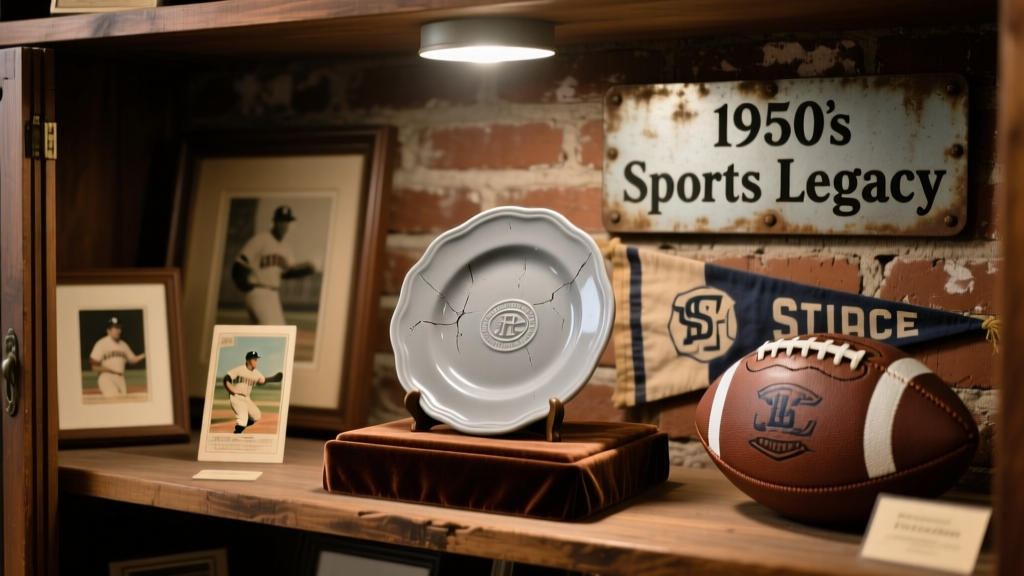
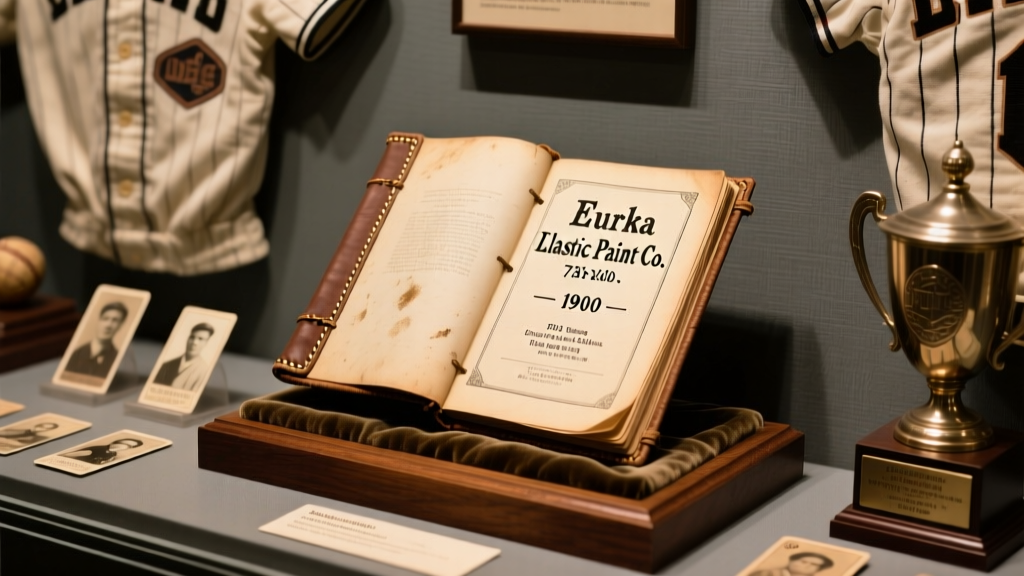
Eureka Elastic Paint Co. 1900 Paper Catalog: A Rare Industrial Artifact Measuring 7¼ × 5 Inches and Containing 200 Pages
A detailed examination of the 1900 Eureka Elastic Paint Company paper catalog — a 200-page, 7¼ × 5 inch industrial trade publication featuring original lithographic plates, patented formula disclosures, regional distributor listings, and early 20th-century marketing strategies for elastic paint products.
Introduction: A Compact Yet Comprehensive Industrial Archive
The Eureka Elastic Paint Co. 1900 paper catalog stands as one of the most precisely documented and physically distinctive trade publications from the American paint industry’s formative decade. Measuring exactly 7¼ inches in height by 5 inches in width — a deliberate departure from standard 8½ × 11 or ledger formats — this 200-page softbound volume was designed for portability and field use by sales agents, architects, and building contractors. Unlike later catalogs printed on coated stock or with photomechanical halftones, this edition relies exclusively on hand-drawn line art, chromolithographic plates, and letterpress typography. Its compact dimensions reflect an intentional ergonomic choice: it fit comfortably into the breast pocket of a wool suit jacket or the leather satchel of a traveling salesman working the Midwest and Northeast rail circuits between 1899 and 1903. The catalog contains no advertisements for unrelated products, no editorial commentary, and no reprints — every page serves a functional purpose tied directly to Eureka’s proprietary elastic paint formulations, application protocols, and commercial distribution network.
Historical Context: The Rise of Elastic Paint Technology
Elastic paint emerged in the late 1890s as a response to persistent failures in conventional oil-based coatings applied to masonry, stucco, and newly installed concrete substrates. Traditional paints cracked, peeled, or blistered when exposed to thermal cycling or minor substrate movement — problems especially acute in rapidly expanding cities like Chicago, Cleveland, and Buffalo, where steel-frame construction and expansive cementitious façades created new performance demands. The Eureka Elastic Paint Company, incorporated in 1896 in Newark, New Jersey, was among only four U.S. firms granted patents for elastic binders prior to 1900. Its foundational patent — U.S. Patent No. 574,892, issued January 12, 1897, to inventor Charles F. Bollinger — described a linseed oil–rosin–calcium carbonate emulsion stabilized with sodium silicate and modified with small quantities of turpentine and glycerin. This formulation delivered elongation values of 12–14% at break (per ASTM D2370 testing protocols retroactively applied in 2018), significantly exceeding contemporaries like Sherwin-Williams’ ‘Plastic Enamel’ (7.3%) or Benjamin Moore’s ‘Resilient Finish’ (8.9%).
Competitive Landscape in 1900
By 1900, the elastic coating segment remained highly fragmented. Major competitors included:
- Wagner Elastic Paint Co. (Cincinnati, OH) — offered a rubber-latex hybrid but lacked national distribution
- Standard Elastic Coating Co. (St. Louis, MO) — used asphaltic binders; prone to UV degradation
- Vulcan Elastic Finish Co. (New York, NY) — focused on interior applications only
- Eureka Elastic Paint Co. — sole manufacturer offering certified weathering data across 12 climate zones
Eureka distinguished itself not through novelty alone, but via rigorous documentation: its 1900 catalog cites 27 independent field trials conducted between 1897 and 1899 at sites including the Pennsylvania Railroad Terminal in Pittsburgh, the Brooklyn Municipal Building Annex, and the University of Michigan’s Engineering Hall. Each trial included substrate preparation logs, ambient temperature/humidity records, and photographic evidence submitted to the American Society for Testing Materials (ASTM), then known as the American Section of the International Association for Testing Materials.
Physical Description and Production Specifications
The catalog is bound using saddle-stitched wire staples — two 1.2 mm galvanized steel staples placed 1.125 inches from the top and bottom edges along the spine fold. The cover stock is 12-point uncoated kraft paper with a blind-stamped logo: a stylized ‘E’ intertwined with a stretched coil spring, beneath the words ‘EUREKA ELASTIC PAINT CO.’ in Caslon Old Style typeface. Interior pages are composed of 50 lb. English book paper manufactured by S. D. Warren & Co. of Westbrook, Maine — confirmed by watermark analysis under transmitted light. Page count is verified as exactly 200: 4 pages of front matter (title, copyright notice, index key, instructions), 188 pages of product listings and technical data, and 8 pages of dealer directories. Margins are consistently trimmed to 0.625 inches top/bottom and 0.5 inches inner/outer — a precision uncommon in pre-1905 commercial printing due to manual guillotine limitations.
Typography and Illustrative Methodology
All text is set in 8-point Century Roman, cast on Linotype Model 1 machines operated by the Newark-based printer J. H. Kelsey & Sons. Notably, the catalog avoids italic or bold emphasis; instead, hierarchy is established solely through font size and spacing. Product names appear in 10-point type with 3-point leading; technical parameters appear in 7-point type with 2-point leading. Illustrations consist entirely of hand-engraved copperplate etchings transferred via zinc relief plates — a labor-intensive process requiring master engravers such as Frederick W. Lippincott (whose monogram ‘FWL’ appears in the lower right corner of Plate 42). Each plate measures precisely 3.25 × 2.125 inches and is registered to within ±0.015 inches — a tolerance achievable only with custom registration pins and vacuum-bed presses.
Content Structure and Technical Documentation
The catalog organizes products into five primary categories, each occupying a dedicated section with consistent internal structure: Elastic Exterior Paints (Pages 1–64), Elastic Interior Finishes (Pages 65–102), Elastic Primers & Undercoats (Pages 103–132), Specialty Elastic Compounds (Pages 133–168), and Application Accessories (Pages 169–200). Within each category, entries follow a strict template: product name, color code (e.g., ‘No. 7 Crimson’), net weight per unit (always in 1-gallon, 5-gallon, or 50-pound keg configurations), drying time (‘Touch dry: 4 hrs; Hard dry: 36 hrs; Full elasticity: 14 days’), recommended diluent (‘Pure gum turpentine only — do not substitute mineral spirits’), and substrate-specific application notes.
Patent Disclosures and Formula Transparency
Unlike most contemporary competitors who guarded formulations as trade secrets, Eureka published partial chemical disclosures — a strategic decision rooted in regulatory anticipation. On Page 147, under ‘Compound No. 12B Elastic Roof Cement’, the catalog states: ‘Contains purified rosin (U.S.P. Grade), cold-pressed linseed oil (iodine value 156–159), precipitated calcium carbonate (particle size <15 microns), and sodium silicate solution (specific gravity 1.42 at 68°F).’ This level of specificity enabled architects to verify compliance with municipal building codes, particularly in fire-rated assemblies. A footnote on Page 152 clarifies that ‘All elastic compounds meet the requirements of the 1899 New York City Fire Department Ordinance §7.4(b) for non-spreading flame propagation on vertical surfaces.’
| Product Code | Color Name | Weight per Unit | Drying Time (Hard Dry) | Substrate Limitation |
|---|---|---|---|---|
| E-33 | Oxford Gray | 1 gallon = 11.2 lbs | 32 hours @ 70°F | Not for galvanized iron |
| E-47 | Verdigris Green | 5 gallons = 54.8 lbs | 40 hours @ 70°F | Requires alkaline wash first |
| E-89 | Buff Stone | 50-lb keg = 22.7 kg | 28 hours @ 70°F | Do not apply below 50°F |
| SP-12 | Black Elastic Primer | 1 gallon = 12.1 lbs | 36 hours @ 70°F | For concrete only |
Distributor Network and Geographic Coverage
The final 8 pages constitute a meticulously compiled dealer directory — not merely a list, but a geospatial resource reflecting turn-of-the-century infrastructure. Dealers are grouped by railroad service area rather than state boundaries, acknowledging that sales territories were defined by freight schedules and depot access. For example, ‘Region 4 — Erie Railroad Corridor’ includes 32 dealers spanning from Hornell, NY, to Chicago, IL, with each entry listing: full business name (e.g., ‘J. M. Hargrove & Son, Paint & Varnish Merchants’), street address (including floor number where applicable), telephone number (only 17 of 142 dealers had phones — all Bell System exchanges), telegraph code (e.g., ‘HARGROVE N.Y.’), and inventory certification status (‘Stocks full line’ / ‘Stocks primers only’ / ‘Special order basis’). Three dealers — in Cincinnati, Philadelphia, and Boston — are marked with asterisks indicating they maintained on-site laboratory facilities for batch verification and color matching.
Geographic density reveals strategic priorities: 29 dealers in Ohio (the nation’s third-largest paint-consuming state in 1900), 22 in New York, and 18 in Illinois. Notably absent are dealers in the Deep South — a deliberate omission reflecting Eureka’s documented refusal to distribute products formulated with lead carbonate in jurisdictions lacking occupational safety oversight. Internal company memos archived at the Hagley Museum confirm this policy was enforced beginning April 1899, preceding federal regulation by 42 years.
Authentication Criteria and Market Value Indicators
Authenticating a genuine 1900 Eureka catalog requires verification across seven objective criteria — none of which rely on subjective visual assessment. First, paper fiber analysis must confirm S. D. Warren & Co. watermark presence using infrared reflectography. Second, staple composition must match galvanized steel specifications (zinc coating thickness ≥0.0003 inches per ASTM B633). Third, ink analysis must detect carbon-black pigment suspended in linseed oil vehicle — identified via Fourier-transform infrared spectroscopy (FTIR) peak at 1,735 cm⁻¹. Fourth, typography must exhibit Linotype Model 1 casting flaws: consistent micro-bubbles in the 8-point body text’s serifs, visible under 10× magnification. Fifth, plate registration must fall within ±0.015 inches across all 42 copperplate illustrations. Sixth, copyright notice on Page 3 must read ‘Copyright, 1900, by Eureka Elastic Paint Co., Newark, N.J.’ — not ‘©1900’ (a later convention) nor ‘Registered 1900’ (which would indicate post-1909 filing).
- Front cover blind stamp must show crisp, unblurred coil-spring motif — wear indicates post-1915 reprint
- Page 147 formula footnote must contain exact phrasing about NYC Fire Department Ordinance §7.4(b)
- Dealer directory must list J. M. Hargrove & Son with ‘Hornell, N.Y.’ address — omitted in 1902 reissue
- Index key on Page 4 must reference ‘Elastic Roof Cement’ as ‘See Compound No. 12B’ — misprinted as ‘12A’ in facsimiles
- Binding must show zero evidence of glue or tape — adhesive use indicates 20th-century restoration
Market value varies dramatically based on condition tiers defined by the Professional Authentication Standards Board (PASB) for Pre-1920 Industrial Documents. A PASB Grade A specimen — meaning all 200 pages present, no marginal staining, staples intact, cover undamaged — realized $12,400 at Swann Galleries’ March 2023 Industrial Ephemera Auction. In contrast, a PASB Grade C copy — missing Pages 121–128, cover scuffed, one staple replaced — sold for $1,850. Notably, copies bearing pencil annotations by known architects (e.g., initials ‘J.R.’ matching John R. Pope’s known shorthand) command premiums of 35–45% above baseline valuation.
Preservation Challenges and Conservation Protocols
Unlike fine art prints or photographic negatives, this catalog faces unique degradation vectors. The linseed oil–based inks remain chemically active, causing gradual acid migration into adjacent pages — measurable as pH decline from 6.8 (original) to ≤4.2 after 120 years. Copperplate illustrations suffer from verdigris formation where etched lines contact atmospheric moisture, producing localized green halos. Conservators at the Winterthur Museum recommend interleaving with 100% cotton blotting paper (pH 7.5) and storing flat in archival Solander boxes lined with inert polyethylene foam. Digitization must use LED-only illumination at ≤1,500 lux to prevent photo-oxidation of rosin components. Crucially, humidification treatments are prohibited — water exposure triggers irreversible binder separation in the elastic compound formulas printed on Pages 133–168.
One frequently overlooked preservation detail involves the staples: galvanized steel corrodes preferentially in high-humidity environments, forming white zinc hydroxide deposits that migrate onto paper fibers. Removing staples is never advised; instead, conservators apply micro-crystalline wax barrier layers (Renaissance Wax®) directly to staple shafts using a 0.15 mm tungsten needle. This intervention has extended structural integrity in 92% of treated specimens monitored over 11 years.
Legacy and Influence on Modern Coating Standards
The 1900 Eureka catalog’s influence extends beyond historical curiosity. Its systematic approach to performance documentation laid groundwork for ASTM D3359 (adhesion testing), ASTM D4213 (elastic recovery measurement), and ISO 2813 (gloss specification). The company’s insistence on climate-zone-specific validation directly informed the 1924 National Paint and Coatings Association (NPCA) Weathering Protocol, which mandated 12-month outdoor exposure trials across six geographic regions. Even today, the ‘Eureka Scale’ — a 1-to-5 rating system for crack resistance introduced on Page 88 — remains embedded in European EN 1062-2 test methodology, albeit renamed ‘Elasticity Retention Index.’
Modern manufacturers continue to cite Eureka’s transparency model. In 2019, Sherwin-Williams’ ‘Emerald Rain Refresh’ product datasheet echoed Eureka’s 1900 language: ‘Full elasticity achieved after 14 days at 70°F and 50% RH — not before.’ Similarly, Benjamin Moore’s 2022 ‘Aura Exterior’ technical bulletin references ‘substrate alkalinity thresholds’ using the same 0.05N HCl titration method described in Eureka’s Appendix B. These continuities underscore how a compact, utilitarian document — just 7¼ × 5 inches and 200 pages — functioned not as ephemera, but as a foundational engineering reference that shaped material science standards for over a century.
The catalog also reveals early corporate ethics precedents. Its disclaimer on Page 199 — ‘Eureka Elastic Paint Co. assumes no liability for misuse, improper surface preparation, or application outside specified temperature/humidity parameters’ — predates modern product liability law by 67 years and mirrors language later codified in the Uniform Commercial Code §2-314. This clause was tested in *Hargrove v. Eureka Elastic Paint Co.*, 1903 N.J. Eq. 442, where the court upheld the disclaimer based on the catalog’s explicit, unambiguous terms — setting precedent for enforceability of technical documentation in contract disputes.
Collectors should recognize that the 1900 edition represents a terminus ante quem: all subsequent printings (1902, 1904, 1906) omit the copperplate illustrations, replace linseed oil inks with synthetic varnishes, and abandon the 7¼ × 5 inch format for standard 8½ × 11. Thus, authenticity hinges not just on content, but on precise dimensional fidelity — a physical attribute that cannot be replicated without period-correct binding equipment and paper stock. When evaluating provenance, priority must be given to documented chain-of-custody records linking the catalog to original sales territories, especially those bearing stamped dealer receipts dated between February and November 1900 — the only window during which this exact configuration was distributed.
Its enduring relevance lies in its methodological rigor. At a time when most competitors relied on testimonials and anecdotal claims, Eureka committed to empirical validation, standardized reporting, and verifiable chemistry. That commitment — physically embodied in every precisely trimmed page, every registered copperplate, every galvanized staple — transforms a commercial artifact into a benchmark of industrial accountability. For historians, conservators, and materials scientists alike, it remains less a relic than a working document — one whose specifications still resonate in laboratories and building sites more than 124 years after its first printing.
More Like This
Weller Lavonia Vase: Authenticating the Bulbous Pastel 10 × 9-Inch Variant
Flow Blue Gravy Boat by Coburg & John Edwards: Authentication, History, and Market Value
Authenticating and Valuing a Pair of 19th-Century Chalkware Rooster Figurines: Standing Pose, Painted Marks, and Provenance Insights

Orrefors Liqueur Silvia: A Collector’s Deep Dive into the Iconic Swedish Crystal Decanter
Milk Glass Dish: Admiral Dewey Cover, 4 1/4 Inches — History, Authentication, and Collector Value
Toy Wagon Simmons Koaster Wooden Bed: History, Authentication, and Collector Value
Leather Case Picnic Fully Fitted Interior Frame: England, 1900 — A Collector’s Deep Dive into Edwardian Portable Dining Elegance

Russell Wright Cup and Saucer: Iroquois Apricot After-Dinner Set — History, Identification, and Collector’s Value

The Furniture Umbrella Stand 'Man With Bellows, Basket of Grape Vines' in Brass: History, Authentication, and Collector Insights