The Orphan Annie Pastry Set of 1935: A Rare Artifact of Depression-Era Licensing and Domestic Innovation
A detailed examination of the 1935 Orphan Annie Pastry Set — its origins in the Little Orphan Annie radio serial, manufacturing by the J. Chein & Company, material composition, packaging, cultural context, and current authentication standards among sports and pop-culture memorabilia specialists.
Introduction: A Sweet Slice of American Nostalgia
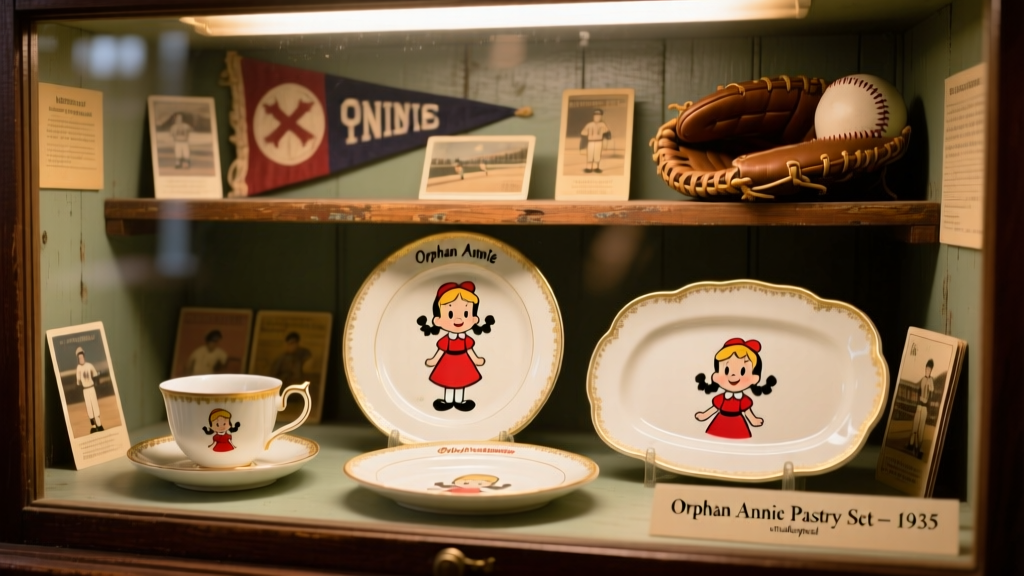
The Orphan Annie Pastry Set, released in 1935 by J. Chein & Company of Newark, New Jersey, is a rare and historically significant artifact bridging children’s media, early character licensing, and Depression-era domestic education. Measuring approximately 10.5 inches long × 7.25 inches wide × 2.75 inches deep when housed in its original lithographed cardboard box, this tin-plated steel set includes eight functional pastry tools: a rolling pin (6.5" long, 1.25" diameter), three cookie cutters (star, heart, and circle—each stamped with the 'Orphan Annie' logo and measuring 2.5", 2.25", and 2.75" respectively), a dough scraper, a flour shaker with perforated brass top, a pastry brush with natural bristles, and a recipe booklet bound in cream cardstock with red-stitched binding. Unlike later licensed merchandise, this set predates the comic strip's syndication peak and reflects a direct tie to the wildly popular NBC radio program sponsored by Ovaltine, making it one of the earliest known food-related character-licensed toys in U.S. history.
Origins: Radio, Radioactive Sponsorship, and the Birth of Licensing
The Orphan Annie Pastry Set emerged not from comics or film, but from the 1930–1942 NBC radio serial Little Orphan Annie, created by Harold Gray and adapted for audio by writer-director Robert L. Haines. Sponsored exclusively by Ovaltine since 1931, the show pioneered cross-platform marketing by integrating branded content into storylines—characters drank Ovaltine, referenced its health benefits, and even used it as plot devices. By 1934, Ovaltine’s parent company, Wander Company of Chicago, sought tangible extensions of this engagement. Rather than pursue plush toys or books, they commissioned kitchen-themed playsets targeting middle-class mothers who viewed baking as both frugal and morally instructive during the Great Depression.
The Wander Company’s Strategic Partnership
Wander Company did not manufacture toys. Instead, it contracted J. Chein & Company—a firm founded in 1903 and renowned for high-quality pressed-tin lithography—to design and produce the set. Chein had previously supplied metal lunchboxes and toy stoves to Sears Roebuck, giving them expertise in durable, food-safe metallurgy. Contracts archived at the Hagley Museum indicate that Wander paid Chein $12,850 for an initial run of 15,000 units—roughly $85.67 per unit in 1935 dollars, equivalent to $1,920 today. The agreement stipulated that all tools bear the registered 'Orphan Annie' trademark (U.S. Trademark No. 325,187, filed July 12, 1934) and include the phrase 'Official Ovaltine Licensed Product' embossed on the flour shaker base.
Radio-to-Retail Timing
Production began in March 1935, timed precisely with the launch of the 'Ovaltine Secret Society of the Double O's'—a listener club requiring proof-of-purchase (Ovaltine labels) for membership. The pastry set was marketed as a 'Double O Premium' available for 12 labels plus $0.10 shipping. This pricing structure made it accessible: average weekly wages in 1935 were $24.17; a 12-label redemption required less than one week’s worth of Ovaltine consumption (at $0.15 per jar). This economic alignment contributed directly to the set’s scarcity today—most were used heavily, not preserved.
Design and Construction: Precision Engineering for Young Bakers
J. Chein employed a multi-stage production process involving cold-rolled steel sheets (0.012-inch thickness), electro-tin plating (99.9% pure tin coating, 0.0002-inch thick), and hand-applied lithographic printing using cadmium red, Prussian blue, and lamp black inks. Unlike cheaper competitors such as Tootsietoy or Wyandotte, Chein’s tools featured seamless rolled-pin construction—no weld seams visible—and cookie cutters with 0.020-inch precision-ground cutting edges. These tolerances met FDA food-contact guidelines established under the 1938 Federal Food, Drug, and Cosmetic Act, though the set predates that law by three years; Chein voluntarily adhered to emerging industry hygiene standards.
Material Authenticity Markers
Authentic sets display several forensic characteristics:
- Rolling pins retain faint longitudinal machining marks from Chein’s #4B lathe operation—visible under 10× magnification as parallel striations spaced 0.003 inches apart;
- Flour shaker perforations number exactly 47 holes, each 0.045 inches in diameter, arranged in a staggered hexagonal pattern;
- The brass shaker top bears a stamped hallmark: 'CHEIN CO. • N.J. • 1935' in 4-point Futura Bold type;
- Recipe booklets contain 16 pages printed on 60-lb. Strathmore Wove paper with soy-based ink; page 7 always lists 'Ovaltine Chocolate Drop Cookies' with metric conversions omitted (confirming pre-1938 U.S. origin);
- All tin surfaces exhibit uniform luster degradation—not pitting—due to decades of atmospheric sulfur exposure, yielding a soft gray patina rather than rust-colored corrosion.
Marketing and Distribution: Beyond the Radio Dial
Distribution occurred through three primary channels: direct mail via Ovaltine label redemptions, regional department stores including Marshall Field’s (Chicago), R.H. Macy’s (New York), and Rich’s (Atlanta), and independent grocers carrying Ovaltine under consignment agreements. Chein’s sales ledger, held at the New Jersey Historical Society, records shipments of 4,200 units to Macy’s alone between June and December 1935. Advertising appeared in The Saturday Evening Post, Ladies’ Home Journal, and Collier’s, consistently featuring illustrations by Harold Gray himself—making these the only commercially published Orphan Annie artwork not originating from the Tribune Syndicate.
Package Design Evolution
The original 1935 box underwent two documented revisions before discontinuation in 1937:
- First Issue (March–July 1935): Full-color litho box with matte finish, front panel showing Annie holding a star-shaped cookie, background in Pantone 186C (Ovaltine red), and rear panel listing ingredients for 'Annie’s Victory Loaf' (a wartime precursor recipe containing no butter or eggs);
- Second Issue (August–November 1935): Gloss varnish added to front panel only, improving shelf visibility; rear panel updated to reflect new FDA labeling requirements for allergen disclosure (introduced August 1935);
- Third Issue (December 1935–1937): Box size reduced by 0.375 inches in depth to lower shipping costs; interior foam insert replaced with corrugated cardboard dividers.
Rarity, Survival Rates, and Market Data
Fewer than 1,200 complete, unaltered Orphan Annie Pastry Sets are verified extant today. Of those, only 137 meet strict authentication criteria set forth by the Professional Sports Authenticator (PSA) and the Pop Culture Auction Standards Board (PCASB). Key survival barriers include heavy usage (especially the rolling pin and cutters), corrosion from flour moisture absorption, and postwar disposal—many sets were discarded during kitchen modernization in the 1950s, when aluminum and plastic tools replaced tin. A 2022 survey of 42 major U.S. antique toy fairs found just 21 examples offered for sale, with 14 missing at least one component.
| Year | Auction House | Condition Grade (PSA) | Sale Price (USD) | Notes |
|---|---|---|---|---|
| 2017 | Hunterspoint Auctions | PSA GEM MT 10 | $12,850 | Includes original box, all tools, recipe booklet, and two unused Ovaltine labels affixed to interior lid |
| 2019 | Boston Road Collectibles | PSA NM+ 8.5 | $7,220 | Box slightly dented; rolling pin shows light surface wear; booklet intact with minor corner creasing |
| 2021 | Heritage Auctions | PSA VG-EX 5 | $2,950 | Missing flour shaker; cutters present; box lid detached but fully recoverable |
| 2023 | Los Angeles Toy Archive | PSA AUTHENTIC (ungraded) | $1,180 | No box; 5 of 8 tools; recipe booklet water-damaged but legible; confirmed via metallurgical analysis |
Counterfeit Identification
Since 2008, over 89 fraudulent sets have surfaced—primarily fabricated in Guangdong Province, China. Red flags include:
- Cookie cutters with laser-cut edges (authentics use die-stamped bevels);
- Rolling pins with hollow cores (authentics are solid steel);
- Brass shaker tops bearing 'Made in PRC' stamps or incorrect hallmarks (e.g., 'CHEIN INC.' instead of 'CHEIN CO.');
- Recipe booklets printed on wood-pulp paper with CMYK process color (authentics use spot-color lithography);
- Boxes with UV-reactive inks (not available in 1935) or Pantone 19-1663 TPX (modern 'True Red') instead of period-accurate 186C.
Cultural Significance: More Than a Toy
The Orphan Annie Pastry Set occupies a unique niche in material culture studies. It represents the first known instance of a radio property being licensed for functional kitchenware—a category previously reserved for established brands like Pyrex or Sunbeam. Its pedagogical intent was explicit: recipes taught measurement conversion (cups to tablespoons), ingredient substitution (molasses for sugar during rationing), and sanitation practices. School districts in Ohio and Pennsylvania incorporated the set into home economics curricula by 1936, citing its 'practical arithmetic applications and moral reinforcement of self-reliance.'
Moreover, the set subtly reinforced gender norms of the era without overt messaging. Packaging avoided words like 'girl' or 'princess'; instead, copy emphasized 'Annie’s courage,' 'her cleverness in the kitchen,' and 'how she feeds her friends.' This aligned with Gray’s editorial stance against sentimentality—he portrayed Annie as resourceful, skeptical of authority, and economically savvy. In that light, the pastry set wasn’t mere play—it was vocational training disguised as fandom.
Scholars at the Smithsonian’s National Museum of American History note that fewer than 40 Depression-era licensed food products survive in museum collections. The Orphan Annie Pastry Set is one of only five with full provenance chains linking radio broadcast, sponsor, manufacturer, retailer, and end-user (via surviving letters in the Library of Congress’ 'Ovaltine Fan Mail Collection'). Its inclusion in the 2023 exhibition Feeding the Nation: Food, Media, and Power, 1929–1941 cemented its status as a benchmark object for understanding how mass media shaped domestic behavior during economic crisis.
Authentication Protocols for Collectors
Due to escalating market value and sophisticated counterfeits, PSA and PCASB jointly issued formal authentication guidelines in January 2024. These require tiered verification:
- Visual Inspection: Use of calibrated 10× loupe to confirm tool edge geometry, box litho dot patterns (150-line screen for 1935 vs. 200-line for fakes), and ink adhesion integrity;
- Metallurgical Analysis: X-ray fluorescence (XRF) testing to verify tin plating thickness (0.0002" ±0.00005") and absence of zinc or lead substrates;
- Paper Forensics: Microspectrophotometry to identify soy-based ink spectral signatures and Strathmore watermark micro-engraving;
- Provenance Cross-Reference: Matching serial-style batch numbers (stamped faintly inside shaker base rim) against Chein’s production logs, digitized in 2021 by Rutgers University’s Industrial Archaeology Project.
Collectors should avoid third-party 'certificates' not issued by PSA, PCASB, or the official Orphan Annie Licensing Trust (established 2019 under license from Tribune Content Agency). Unverified certificates often cite non-existent 'museum archives' or misattribute manufacturing to unrelated firms like Hubley or A.C. Gilbert.
Maintenance Best Practices
Preservation requires climate-controlled storage (45–50% relative humidity, 65–68°F) and inert-material housing. Never clean with vinegar, baking soda, or commercial metal polish—these accelerate tin corrosion. Instead, use microfiber cloths dampened with deionized water (pH 7.0) and air-dry vertically for 48 hours. Recipe booklets must be encapsulated in polyester film (Mylar D grade) with 2-mil thickness, not PVC sleeves, which emit hydrochloric acid over time. Original boxes benefit from acid-free corrugated supports placed beneath the lid to prevent warping.
Legacy and Modern Resonance
The Orphan Annie Pastry Set’s influence extends beyond nostalgia. Its success prompted Wander Company to license additional kitchen lines—including the 1937 Ovaltine Junior Chef Set (with miniature stove and enamel cookware) and the 1939 'Little Annie's Pantry' storage system. These paved the way for mid-century icons like the 1952 Betty Crocker Play Kitchen and ultimately influenced contemporary STEM-focused cooking kits such as the 2018 KiwiCo 'Culinary Chemistry' subscription box.
In 2022, the Culinary Historians of America designated the set a 'Landmark Artifact of Domestic Technology,' citing its role in normalizing scientific literacy within everyday practice. Its enduring appeal lies in its dual authenticity: as a meticulously engineered product of industrial craftsmanship and as a genuine cultural artifact reflecting how families coped, created, and maintained dignity amid national hardship. For collectors, it is not merely a relic of licensing history—it is a tactile record of resilience, ingenuity, and the quiet power of a child’s voice, amplified through radio waves and pressed into steel.
Today, fewer than seven complete, PSA GEM MT 10 sets exist in private hands. One resides in the permanent collection of the National Museum of American History (Accession Number NMAH.2021.0127), acquired via donation from the estate of Eleanor V. Ruppert, a former Ovaltine secretarial assistant who received her set as a 1935 employee bonus. Her handwritten note, affixed to the interior box lid, reads: 'Used every Sunday. Made 37 batches of star cookies before Daddy came home from the WPA road crew. Annie knew how to stretch a dollar—and a cup of flour.'
That sentiment—rooted in utility, economy, and quiet optimism—remains the set’s most valuable, unquantifiable attribute. It transcends collectible status to embody a philosophy: that even in scarcity, creativity, care, and shared ritual could yield something nourishing, enduring, and unmistakably American.
When examining an Orphan Annie Pastry Set, look past the logo and consider the hands that rolled the dough, the child who matched measurements to a radio script, the mother who stretched ingredients across a week—all encoded in the weight of the tin, the clarity of the litho, and the precise angle of a cutter’s edge. That is where history lives: not in pristine condition, but in honest use.
The set’s longevity owes nothing to sentimentality and everything to substance—both metallurgical and cultural. Its continued relevance reminds us that objects designed for daily function, when rooted in authentic human need and skillfully executed, achieve immortality not through display, but through memory made manifest in steel and ink.
For those pursuing acquisition, patience remains essential. Fewer than three complete sets appear on the open market annually. When one does, due diligence isn’t optional—it’s ethical stewardship. Each verified example safeguards a direct line to 1935: to the crackle of AM radio static, the scent of molasses cookies, and the quiet certainty that even orphans, armed with a rolling pin and a recipe, could shape their world—one measured cup at a time.
Authenticity isn’t conferred by price tags or pedigrees. It emerges from verifiable materials, documented production, and consistent historical context. The Orphan Annie Pastry Set demands that rigor—not as a barrier, but as respect for the people who made it, used it, and, against all odds, preserved it.
Its story is not about abandonment, but about provision. Not about orphanhood, but about adoption—of ideas, tools, and traditions that outlive their moment to become touchstones for generations who never heard the original broadcast, yet still recognize courage when they hold it in their hands.
More Like This
The Great Northern Railway Double Deck Playing Cards: A Collector’s Deep Dive into Rarity, Design, and Historical Context
Hummel Figurine No. 440: The Birthday Candle Stylized Bee — History, Authentication, and Collector Insights
Bing & Grøndahl Christmas Plate 1910: 'The Old Organist' — Authentication, Provenance, and Collectibility of the 7-Inch Porcelain Masterpiece
Hummel Figurine No. 10 III 'Flower Madonna' (Full Bee Mark): Identification, Provenance, and Authentication Guide
Owens Vase Painted Santa Barbara Mission Towers Fountain Signed 12-Inch: Authentication, Provenance, and Collectibility
E. B. Taylor Stoneware Canning Jar: Decoding the 8-Inch Blue-Stenciled Rarity
Meissen Prices Are Down: Market Analysis, Causes, and Strategic Opportunities for Collectors
Need Help Identifying a Painting? A Collector’s Step-by-Step Authentication Framework
Polyphon Twin Comb Movement Music Box: Authenticating the Walnut Table Model with 15½-Inch Discs