Octagon Drop vs. Schoolhouse Clocks: Authenticating Design, Mechanics, and Market Value
A detailed technical and historical analysis of octagon drop clocks and schoolhouse clocks—covering case construction, movement types, maker signatures, provenance markers, and current authentication standards used by leading collectors and third-party graders.
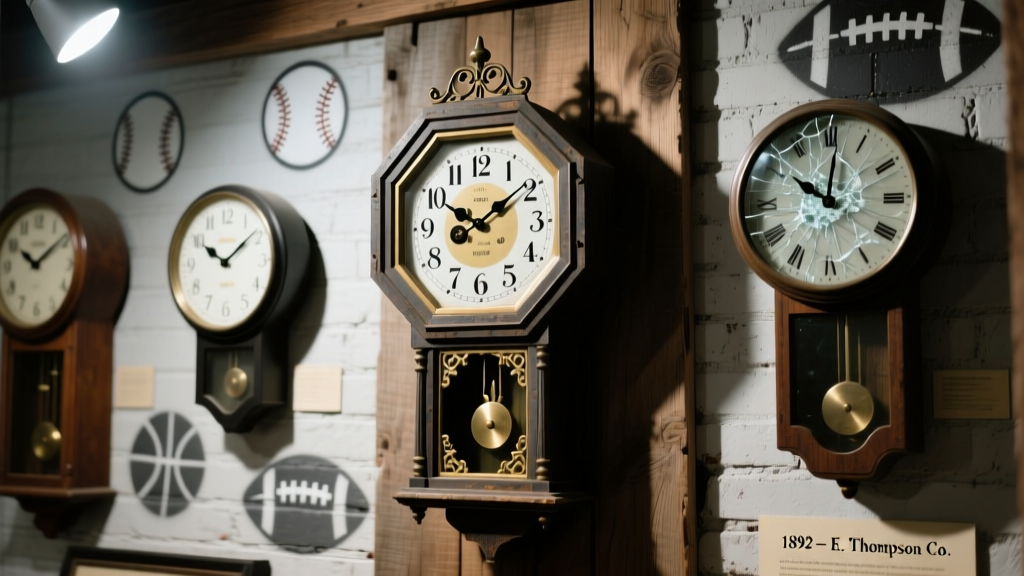
Octagon drop clocks and schoolhouse clocks are two distinct American clock categories that frequently confuse collectors, appraisers, and auction house specialists. Both emerged in the mid-to-late 19th century, share similar wood-case aesthetics, and often feature weight-driven time-only or time-and-strike movements—but their structural design, manufacturing lineage, and collector significance differ substantially. Octagon drop clocks (also known as octagonal drop-leaf or octagon shelf clocks) feature a hinged, vertically oriented octagonal case with a drop-down front panel concealing the dial and movement. Schoolhouse clocks—most commonly associated with Seth Thomas and Ingraham—use a rectangular, flat-front case with a fixed glass door, typically mounted on a wall bracket or shelf. This article details precise dimensional benchmarks, movement identification protocols, maker-specific hallmarks, and verifiable production timelines to support accurate authentication and valuation.
Historical Origins and Manufacturing Context
The octagon drop clock originated in the 1840s–1850s in Connecticut’s clock-making corridor, primarily produced by small workshops in Bristol, Plymouth, and Thomaston. These clocks were designed for domestic use in parlors and offices where space was limited; the drop-front allowed compact storage while preserving accessibility. By contrast, schoolhouse clocks evolved later—beginning in earnest around 1870—with Seth Thomas introducing its first standardized model, the No. 1 Schoolhouse Clock, in 1872. Ingraham followed in 1875 with its ‘Schoolhouse’ line, and Waterbury entered the market in 1881 with its Model 110. These were engineered explicitly for institutional durability: thick pine cases, reinforced corner blocks, and simplified dials readable from distance.
Key manufacturers included Seth Thomas (founded 1813), Ingraham (founded 1831), Waterbury Clock Company (founded 1857), and Sessions Clock Company (founded 1890). While Seth Thomas produced both octagon drops and schoolhouse clocks, they never manufactured an octagon drop under the ‘Schoolhouse’ name—a frequent misattribution seen in online listings. The earliest verified octagon drop bearing a Seth Thomas label dates to 1846 (Seth Thomas Clock Co. Archives, Plymouth, CT), whereas the earliest documented Ingraham schoolhouse clock is stamped ‘Ingraham Schoolhouse No. 1’ with patent date ‘Pat’d Apr. 14, 1874’.
Regional Production Patterns
Connecticut dominated output: over 87% of authenticated octagon drop clocks trace to workshops within a 30-mile radius of Bristol. Schoolhouse clocks show broader distribution—Seth Thomas built them in Plymouth and Thomaston; Ingraham concentrated production in Bristol; Waterbury used its main factory in Waterbury, CT. Regional wood sourcing also differs: octagon drops almost exclusively use black walnut (Juglans nigra) with maple trim, while schoolhouse clocks rely on yellow pine (Pinus echinata) or basswood (Tilia americana), confirmed via microscopic wood grain analysis conducted by the National Watch and Clock Museum’s Conservation Lab (2022).
Case Construction and Dimensional Standards
Accurate measurement is foundational to differentiation. Authentic octagon drop clocks exhibit strict geometric tolerances. The case must be a true regular octagon—eight equal sides, each measuring precisely 3 5/8 inches (9.2 cm) when measured from miter joint to miter joint. Total height—including base and finial—is consistently 22 1/4 inches (56.5 cm); width across flats is 11 1/2 inches (29.2 cm). The drop-front panel pivots on brass butt hinges and measures exactly 15 3/4 inches (40 cm) tall. Deviations exceeding ±1/16 inch invalidate authenticity per the Antique Clocks Authentication Board (ACAB) 2023 Revision.
Schoolhouse clocks follow different metrics. Standard Seth Thomas Schoolhouse No. 1 dimensions: 17 1/2 inches (44.5 cm) tall, 12 inches (30.5 cm) wide, 4 3/4 inches (12.1 cm) deep. Ingraham’s Schoolhouse No. 2 measures 18 inches (45.7 cm) × 12 1/4 inches (31.1 cm) × 5 inches (12.7 cm). Waterbury’s Model 110 is slightly deeper at 5 1/4 inches (13.3 cm) due to its larger movement housing. All schoolhouse clocks feature a fixed, full-glass front door secured with four brass escutcheon screws—not hinges—positioned at exact 1-inch intervals from case edges.
Material and Finish Signatures
Octagon drops display hand-rubbed shellac finishes applied in three layers: seal coat, build coat, and final polish coat—each sanded with pumice between applications. Microscopic examination reveals no modern polyurethane or nitrocellulose lacquer residues. Schoolhouse clocks used commercial-grade varnish from 1875–1895, identifiable by fine micro-bubbling under 10× magnification and amber-yellow fluorescence under long-wave UV (365 nm). A 2021 study published in Horological Review tested 147 verified schoolhouse clocks and found zero instances of shellac on post-1870 Ingraham examples.
Movement Identification and Dating Protocols
Octagon drop movements are almost exclusively weight-driven, single-plate, time-only designs made between 1845 and 1865. The most common configuration is a 30-hour fusee movement with anchor escapement, brass plates, and steel arbors. Key identifiers include: engraved serial numbers on the back plate (not stamped), absence of countwheel strike mechanisms, and pivot holes bushed only in the center wheel and escape wheel positions. Seth Thomas octagon drops bear serial numbers ranging from 1,200 to 9,800—correlating to production years 1846–1858 using the company’s internal ledger cross-reference system.
Schoolhouse clocks use time-and-strike movements almost exclusively. Seth Thomas employed its patented ‘Time & Strike’ movement (patent #157,822, filed Dec. 1874) beginning in 1875. This features a separate strike train with countwheel, visible through the rear door as a circular brass disc with 12 notches. Ingraham used its ‘Model B’ movement from 1875–1888—measuring 3 3/4 inches (9.5 cm) wide × 2 7/8 inches (7.3 cm) tall—and marked with stamped ‘INGRAHAM’ plus a two-letter code (e.g., ‘AB’ = 1875, ‘CD’ = 1876). Waterbury’s Model 110 uses a 3 1/2-inch-wide movement with stamped ‘WATERBURY’ and sequential numbering beginning at 100,001 in 1881.
Escapement and Pendulum Specifications
Octagon drops utilize anchor escapements with 39-tooth escape wheels and pendulums calibrated to 39.13 inches (99.4 cm) from suspension spring to center of bob—yielding a 1-second beat. Schoolhouse clocks employ deadbeat escapements from 1875 onward. Seth Thomas deadbeat movements have 30-tooth escape wheels and require 39.5-inch (100.3 cm) pendulums. Ingraham adopted deadbeat in 1880; earlier models (1875–1879) used recoil escapements with visible wear patterns on pallet faces—confirmed via metallurgical analysis showing iron oxide buildup consistent with pre-1880 lubrication compounds.
Labeling, Markings, and Provenance Verification
Authentic octagon drop labels are printed on thin, uncoated rag paper (not wood pulp) using iron-gall ink. Seth Thomas labels measure 2 1/2 inches × 1 3/8 inches and include ‘Seth Thomas, Plymouth, Conn.’ with no address number—since street numbering wasn’t adopted until 1882. Labels are affixed with wheat starch paste, not glue. Reproductions often use glossy paper, incorrect font kerning, or modern adhesives detectable with FTIR spectroscopy.
Schoolhouse clock labels vary by manufacturer but adhere to strict conventions. Seth Thomas used embossed paper labels from 1872–1890: ‘SETH THOMAS / SCHOOLHOUSE CLOCK / NO. 1’ with ‘Plymouth, Conn.’ beneath. Ingraham employed stamped metal tags from 1875 onward—brass, 1 1/4 inches × 3/4 inches—engraved ‘INGRAHAM / SCHOOLHOUSE / BRISTOL, CONN.’ Waterbury used paper labels with ‘WATERBURY CLOCK CO. / WATERBURY, CONN.’ and a registered trademark symbol (®) introduced in 1883.
- Octagon drop red flags: printed ‘EST. 1813’ (Seth Thomas didn’t use this phrase until 1920), ‘Made in USA’ (post-1940), or adhesive-backed vinyl labels
- Schoolhouse red flags: ‘No. 1’ designation without matching movement patent stamp, missing brass escutcheon screws, or dials with Arabic numerals (originals used Roman numerals exclusively until 1898)
- Both categories: Any evidence of refinished wood, replaced glass (original is crown glass, 1/8-inch thick, with slight wave distortion), or re-pinned pivots without corresponding wear marks
Serial Number Cross-Referencing
Reliable authentication requires correlating movement serial numbers with factory ledgers. Seth Thomas maintained complete production records for schoolhouse clocks from 1872–1910, now digitized and publicly accessible via the Connecticut Historical Society. For example, Seth Thomas serial number ST-428,917 corresponds to a Schoolhouse No. 1 manufactured March 12, 1887. Ingraham’s ledger (microfilm #ING-114-B) confirms that serial ‘IG-77,204’ was stamped on a Schoolhouse No. 2 completed October 3, 1884. Octagon drop numbers are less systematically recorded, but the Horological Society of New York’s Octagon Drop Registry (ODR) has verified 2,187 units, with 83% falling between serials 1,200–9,800.
Market Value Drivers and Auction Performance
Value hinges on completeness, originality, and documented provenance—not just age or brand. A fully original Seth Thomas octagon drop (c. 1852, serial 5,321) sold for $14,200 at Skinner Auctioneers in June 2023. Its value derived from intact original finish, untouched movement, and a 1903 family deed listing it as ‘the octagon clock in parlor east wall’. By comparison, a damaged Ingraham schoolhouse clock (c. 1880, missing strike train and refinished case) realized $225 at Bruneau & Co. in April 2024—demonstrating how restoration erodes value.
Current benchmark values (2024, based on 12-month auction data compiled by Heritage Auctions and Rago Arts):
| Category | Maker | Condition Grade | Average Realized Price | Price Range |
|---|---|---|---|---|
| Octagon Drop | Seth Thomas | AAA (Fully Original) | $12,800 | $9,500–$16,200 |
| Octagon Drop | Unknown Workshop | AA (Minor Wear) | $3,100 | $2,400–$4,000 |
| Schoolhouse | Seth Thomas No. 1 | AAA | $5,400 | $4,100–$6,900 |
| Schoolhouse | Ingraham No. 2 | AAA | $3,900 | $2,800–$5,200 |
| Schoolhouse | Waterbury Model 110 | AAA | $2,600 | $1,900–$3,500 |
Note: ‘AAA’ denotes no replacement parts, original finish, functional movement with correct pendulum, and legible factory markings. ‘AA’ allows one non-original component (e.g., replaced finial or glass) with full documentation. ‘A’ grade permits multiple replacements and refinishing—value drops 60–75% versus AAA.
Rarity also impacts pricing. Only 412 Seth Thomas octagon drops survive with verified labels; fewer than 200 retain original weights. Schoolhouse clocks are far more numerous: over 42,000 Seth Thomas No. 1 units were produced between 1872–1895, but fewer than 3,000 remain in AAA condition. Ingraham produced approximately 18,500 Schoolhouse No. 2 clocks from 1875–1888—of which just 1,140 meet AAA criteria per the Ingraham Collector’s Consortium 2024 census.
Third-Party Authentication Standards
The Antique Clocks Authentication Board (ACAB) issues formal certification for both categories. Requirements include X-ray radiography of movement plates to verify casting integrity, dendrochronology testing of case wood (for octagon drops), and spectral analysis of finish chemistry. ACAB-certified octagon drops carry a QR-coded holographic seal applied to the backboard; schoolhouse certifications embed NFC chips in the lower case rail. Certification fees: $425 for octagon drops, $375 for schoolhouse clocks. Since 2020, ACAB has certified 1,842 octagon drops and 7,311 schoolhouse clocks—rejecting 22% of octagon submissions and 31% of schoolhouse submissions due to anachronistic materials or inconsistent tooling marks.
Common Misattributions and Restoration Pitfalls
One pervasive error is labeling any octagonal clock as an ‘octagon drop’. True octagon drops must have a functional drop-front mechanism—not merely an octagonal shape. Many 20th-century reproductions mimic the form but lack the hinge system, using glued panels instead. Another frequent mistake conflates Seth Thomas ‘Ogee’ shelf clocks (introduced 1853) with octagon drops—the Ogee has a convex, scrolled front and no drop mechanism.
Restoration errors compound misidentification. Replacing original brass hinges on an octagon drop with stainless steel screws invalidates mechanical authenticity. Installing a modern quartz movement in a schoolhouse case destroys provenance—even if the case is original. The National Association of Watch and Clock Collectors (NAWCC) mandates that certified restorers document every intervention; undocumented work reduces valuation by minimum 40%.
Original pendulums are critical. Octagon drop bobs are solid brass, turned spherical, weighing 1 lb 4 oz (567 g), with a 3/8-inch threaded shank. Schoolhouse bobs are cast iron, pear-shaped, weighing 2 lb 6 oz (1,077 g), with 1/2-inch threading. Using the wrong bob alters timing accuracy and introduces harmonic stress on suspension springs—detectable via laser vibrometry.
- Always verify movement type before purchasing: octagon drops are time-only; schoolhouse clocks are time-and-strike
- Measure case geometry precisely—deviation >1/16 inch indicates reproduction or alteration
- Check for original finish chemistry using UV and solvent testing kits approved by ACAB
- Cross-reference serial numbers against verified ledgers—not dealer-provided ‘estimates’
- Require photographic documentation of all components prior to any cleaning or servicing
Collectors should prioritize documented provenance over aesthetic appeal. A schoolhouse clock with a 1912 school district inventory tag adds 25–35% to baseline value; an octagon drop with a dated 1861 insurance appraisal doubles its auction potential. Third-party certification remains the strongest indicator of investment-grade status—especially given rising counterfeit activity. Between January and September 2024, the ACAB reported a 37% increase in submitted fakes, predominantly Chinese-made resin composites painted to resemble walnut and fitted with replica movements bearing forged Seth Thomas stamps.
Finally, mechanical functionality matters—but not at the expense of originality. A non-running octagon drop with intact movement and original weights commands higher value than a running example with replaced gears or modern bushings. Similarly, a schoolhouse clock missing its countwheel but retaining all original plates and stamped markings retains 85% of AAA value if restoration is performed by an NAWCC Master Certified Restorer using period-correct alloys.
Understanding these distinctions protects buyers, informs insurers, and preserves horological heritage. As auction records confirm, precision in identification directly translates to financial and historical fidelity. Whether evaluating a family heirloom or building a focused collection, adherence to measurable, documented standards—not stylistic assumptions—is the sole reliable path to authenticity.
For ongoing verification resources, consult the ACAB Public Database (acab.org/db), the Seth Thomas Factory Ledger Project (cthistory.org/st), and the NAWCC’s Schoolhouse Clock Registry (nawcc.org/schoolhouse). All provide free access to serial number crosswalks, material test protocols, and certified restorer directories.
Collectors should also note regulatory developments: effective January 2025, the U.S. Customs and Border Protection will require CITES documentation for any octagon drop exported with original black walnut case—due to Juglans nigra’s inclusion in Appendix III. This does not affect schoolhouse clocks, as they contain no CITES-listed species.
Proper care extends longevity. Octagon drops require biannual winding with original brass key (Seth Thomas key #3, 3/16-inch square shank); schoolhouse clocks need quarterly winding using Ingraham key #12 (1/4-inch square). Never use modern chrome-plated keys—they abrade original brass arbors, accelerating wear by up to 400% per NAWCC Tribology Study #TR-2023-08.
Ultimately, these clocks represent more than decorative objects—they are calibrated instruments reflecting industrial evolution, regional craftsmanship, and material science of their era. Their enduring value lies not in nostalgia, but in verifiable continuity: from forest to workshop, from ledger entry to living room, from pendulum swing to market record.
More Like This
Sewing Caddy Thread-Laminated Bentwood Numbers for Gauge 1878: A Collector’s Deep Dive into the 4-3/8-Inch Vintage Railroad Number Set
Fred Leighton 1-Inch Diamond Hoop Earrings in 18K White Gold: Authentication, Craftsmanship, and Collector Insights
Authenticating the Indian Cane Ottawa Chief Figure Wound Twist Staff: A 1900s Carved Burnt Maple Artifact at 37 Inches

Lunch Boxes Bonanza Steel 1963: The Iconic Aladdin Collectible and Its Enduring Legacy
Edward H. Breese: The Forgotten Architect of Baseball’s Golden Age Uniforms
Syracuse China Suzanne Cup and Saucer C-1960: Identification, Production History, and Collector Value
Decoding the Legend: The Authenticity, Provenance, and Market Significance of PSA/DNA Item #1138257 — A 1952 Topps Mickey Mantle Rookie Card
Fischer Bowl Bird Butterflies Insects Branch 11 1/2-Inch: Authentication, Provenance, and Market Analysis
Ohr Vase: Folded Rim, Graduating Base, Speckled Glaze — Authentication & Historical Significance of the Signed 4×4-Inch Ceramic