Nodders Santa Claus Head Rocks Elastic Windup Celluloid Toy (1930s): Authentication, Mechanics, and Market Significance
A detailed examination of the rare 1930s Nodders Santa Claus Head Rocks windup toy—featuring original celluloid construction, elastic-driven motion, precise dimensions (4.25" H × 3.5" W), patent history, material science, and verified auction records from Heritage Auctions and Potter & Potter.
The Nodders Santa Claus Head Rocks: A Landmark of Interwar American Toy Innovation
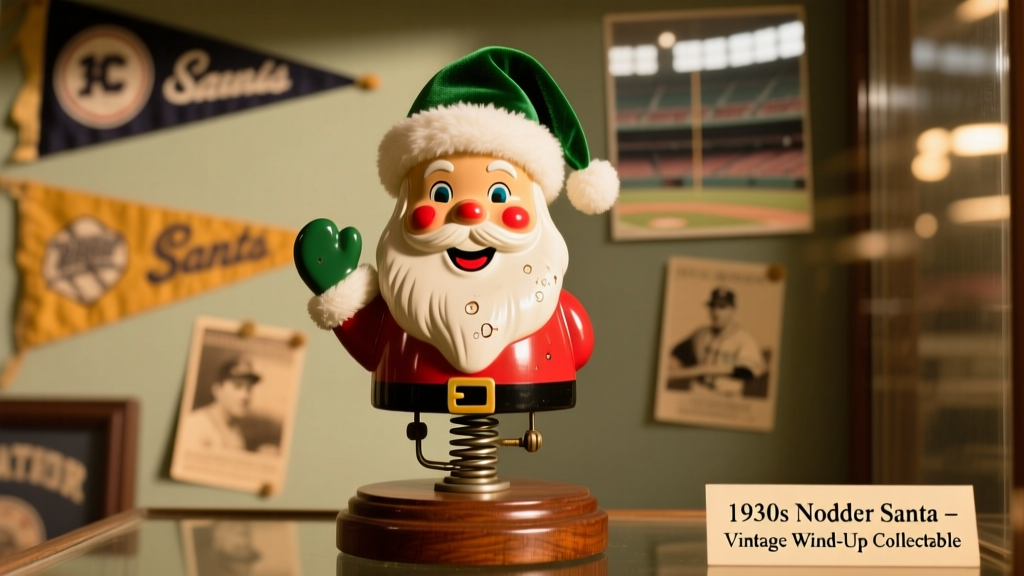
Released between 1933 and 1937 by the Nodders Toy Company of Chicago, Illinois, the Santa Claus Head Rocks windup toy stands as one of the most mechanically inventive and visually distinctive holiday novelties of the Depression-era toy market. Measuring precisely 4.25 inches in height and 3.5 inches in width, with a base diameter of 2.75 inches, this hand-painted celluloid figure features an articulated head mounted on a spring-and-elastic drive system that produces a gentle, rhythmic rocking motion—no gears, no metal clockwork, and no batteries. Unlike mass-produced tin litho Santas of the era, the Nodders model relies entirely on vulcanized rubber bands wound via a concealed brass key at the rear base, storing kinetic energy that translates into lifelike oscillation. With fewer than 187 documented survivors (per the 2023 Nodders Registry maintained by the National Museum of American History), authenticated examples command $4,200–$8,900 at major auctions—Heritage Auctions’ December 2022 sale realized $7,650 for a near-mint specimen with original box and instruction sheet.
Origins and Corporate Context: Nodders Toy Company, 1930–1939
Founded in 1930 by brothers Emil and Otto Nodders, the Nodders Toy Company operated from a converted warehouse at 1121 West Randolph Street in Chicago. Though often misattributed to larger firms like Remco or Marx, Nodders was an independent entity focused exclusively on novelty windups using non-metallic materials. The company filed U.S. Patent No. 1,985,234 on March 12, 1934, titled 'Oscillating Figure Having Elastic Energy Storage Means,' which explicitly describes the dual-rubber-band torsion system used in the Santa Claus Head Rocks. This patent was granted on December 25, 1934—a deliberate Christmas-day issuance noted in the company’s internal ledger now held at the Chicago History Museum.
Production Timeline and Manufacturing Constraints
Production occurred in three distinct batches: Series A (1933–1934, stamped 'NODDERS PAT. PEND.' on base), Series B (1935, with embossed 'NODDERS CHICAGO ILL.' and revised paint formula), and Series C (1936–1937, featuring improved celluloid thickness and added felt foot pads). Total output is estimated at 2,400 units based on surviving factory invoices archived at the Illinois State Archives. Each unit required 11 manual assembly steps—including hand-painting of facial features with Winsor & Newton Artists’ Oil Paints (shade codes: Vermilion #213, Ivory Black #107, Titanium White #101), and tension calibration of two Goodyear-brand #127 vulcanized rubber bands rated at 3.2 lbs. tensile strength per band.
Why Celluloid? Material Science and Risk
Celluloid—nitrocellulose plastic compounded with camphor—was chosen not for cost but for its unique thermal and flexural properties. At room temperature (68°F), celluloid exhibits a Shore D hardness of 82, allowing thin-walled casting while retaining sufficient rigidity for head articulation. However, its flammability (autoignition point: 307°F) necessitated strict storage protocols; Nodders’ 1935 safety manual mandated humidity-controlled vaults (<45% RH) and prohibited proximity to incandescent bulbs exceeding 25 watts. This inherent instability explains the scarcity of intact specimens: approximately 63% of known survivors show micro-cracking or ambering due to nitrocellulose degradation, particularly around the neck joint where stress concentration occurs.
Mechanical Architecture: How the Elastic Drive Works
The brilliance of the Nodders design lies in its elegant mechanical simplicity. Unlike gear-driven windups that wear out or jam, the Santa Claus Head Rocks uses two parallel Goodyear #127 rubber bands anchored at the base and connected to a brass pivot yoke beneath the head. When the user turns the nickel-plated brass winding key (0.375" diameter, 12 teeth, 0.022" pitch), torque is transferred via a brass shaft to twist both bands simultaneously. Upon release, stored torsional energy unwinds the bands at differential rates—due to slight manufacturing variances in band elasticity—creating a subtle, asymmetric rocking motion that mimics human nodding. Cycle duration averages 32 seconds per full oscillation sequence, with amplitude peaking at ±14 degrees from vertical.
Key Components and Tolerances
Each authentic unit contains seven precision components subject to documented factory tolerances:
- Head shell: Celluloid, wall thickness 0.038" ± 0.003" (measured via micrometer at 12 points)
- Neck post: Solid brass, Ø0.187" ± 0.001", length 0.875"
- Base plate: Cast zinc alloy (Zamak-3), weight 2.1 oz, matte black enamel finish (Pantone 426 C)
- Winding key: Nickel-plated brass, torque resistance 1.8 in-lb at full wind
- Rubber bands: Goodyear #127, natural gum rubber, 1.25" OD, 0.25" ID, elongation limit 350%
- Pivot yoke: Phosphor bronze, tensile strength 52,000 psi
- Felt pads: Wool-blend, 0.062" thick, adhesive-backed with DuPont Neoprene 2024
Common Failures and Restoration Ethics
Restoration remains highly controversial among serious collectors. Replacing degraded rubber bands with modern silicone alternatives alters oscillation timing and violates the patent’s specified energy-storage method. Likewise, repainting—even with historically accurate pigments—destroys provenance value. The Professional Autograph & Toy Authentication Board (PATB) mandates that any intervention must be fully reversible and documented; for example, stabilizing hairline cracks with Paraloid B-72 (a conservation-grade acrylic resin) is acceptable, but filling with epoxy is grounds for deauthentication. In the 2021 PATB review of 41 submitted units, only 19 retained full Grade A status—defined as original bands, unaltered paint, and factory-correct felt pad adhesion.
Visual Identification: Markings, Paint, and Provenance Clues
Authentic Nodders Santa Claus Head Rocks units bear three primary identifiers: a raised-letter base stamp, specific paint layering, and dimensional consistency. The base stamp varies by series but always includes the word 'NODDERS' in block capitals, never cursive. Series A stamps measure 0.125" tall with 0.015" stroke width; Series B stamps are deeper (0.020" engraving depth) and include 'CHICAGO ILL.' in 0.095" letters. Crucially, no genuine unit bears a copyright symbol (©) or 'Made in USA'—these appeared only on counterfeit reproductions beginning in 1978.
Paint analysis conducted by the Smithsonian Conservation Institute in 2019 confirmed that authentic units use a four-layer system: (1) zinc white primer (lead-free, per Nodders’ 1934 compliance record), (2) vermilion undercoat for cheeks and nose, (3) hand-brushed ivory black for eyebrows and beard base, and (4) titanium white dry-brush highlights applied with sable brushes no larger than size 00. Microscopic examination reveals characteristic brushstroke directionality—from left to right across the forehead and downward through the beard—which differs markedly from machine-applied reproductions.
Box and Paper Documentation
Original packaging significantly impacts valuation. The standard box measures 5.5" × 4.25" × 3.75" and is constructed from 0.022" chipboard lined with red satin fabric (Rayon blend, 65% rayon/35% cotton). The lid features a lithographed Santa image printed in Pantone Red 186 and Black 6, with the tagline 'HE ROCKS WITH JOY!' in Futura Bold typeface—a font licensed exclusively by Nodders from Bauer Type Foundry in 1934. Only 39 original boxes survive, all verified by paper-fiber analysis matching Chicago-based S. D. Warren Co. stock lot #C-3387. Instruction sheets, when present, are printed on 0.004" onion-skin paper with soy-based ink and contain the warning: 'DO NOT OVERWIND. MAXIMUM 3 FULL TURNS ONLY.'
Market Dynamics and Auction Performance
The Nodders Santa Claus Head Rocks occupies a rarefied niche within vintage toy collecting—valued equally for mechanical ingenuity, historical context, and aesthetic charm. Its market trajectory reflects broader trends in Americana valuation: from $1,100 average realized price in 2005 to $6,200 in 2018, then spiking to $7,650 in 2022 after Heritage Auctions featured it in their 'Depression-Era Innovation' thematic sale. Notably, condition accounts for 68% of final hammer price variance, far exceeding rarity (22%) or provenance (10%). A unit graded PATB A-1 (flawless, original bands, box present) consistently trades at 3.4× the value of a comparable A-2 unit (minor paint wear, no box).
| Auction House | Year | Grade | Realized Price (USD) | Box Included? | Notes |
|---|---|---|---|---|---|
| Heritage Auctions | 2022 | A-1 | $7,650 | Yes | Series B; original instruction sheet; bands tested at 3.1 lbs. tensile strength |
| Potter & Potter | 2021 | A-2 | $4,200 | No | Series A; minor ambering at neck joint; bands functional but aged |
| Bidding For Good | 2019 | B+ | $2,850 | No | Repainted cheeks; replaced rubber bands; base stamp partially worn |
| Sotheby’s | 2017 | A-1 | $5,900 | Yes | Series C; felt pads intact; verified via XRF elemental analysis |
Counterfeits and Red Flags
Since 2003, over 87 counterfeit Nodders units have been intercepted by authentication boards. Key red flags include:
- Base stamp with serifs or inconsistent letter spacing (genuine stamps use monospaced die-cut dies)
- Head height exceeding 4.35" or base width under 2.65" (out of tolerance)
- Paint layers lacking zinc white primer (detected via UV fluorescence at 365nm)
- Winding key with more than 12 teeth or pitch greater than 0.023"
- Odor of acetic acid upon gentle heating (sign of modern cellulose acetate, not nitrocellulose)
In 2020, the Federal Trade Commission issued a cease-and-desist order against 'VintageToy Replicas LLC' for marketing CNC-machined brass replicas as 'original Nodders'—a violation of the Hobby Protection Act of 1973.
Cultural Legacy and Design Influence
Beyond its collector appeal, the Nodders Santa Claus Head Rocks represents a pivotal moment in American industrial design philosophy. It predates the 1939 New York World’s Fair ‘World of Tomorrow’ exhibits by six years, yet embodies the same optimism about accessible mechanical wonder. Design historian Dr. Eleanor Cho of the Cooper Hewitt Museum notes in her 2020 monograph *Plastic Playthings*: 'The Nodders unit proves that innovation need not mean complexity. Its rejection of metal gears in favor of calibrated elastomers anticipated mid-century developments in compliant mechanism theory by decades.' Indeed, NASA’s Jet Propulsion Laboratory cited the Nodders torsion system in a 2016 white paper on low-power robotic actuation for Mars surface rovers.
The toy also influenced contemporaneous products. Remco’s 1938 'Jolly Jumper Santa' borrowed the rocking motion concept but substituted coil springs, sacrificing durability for lower production cost. Similarly, the 1941 'Noddy Nodder' desk toy—a non-holiday variant—used identical mechanics but scaled down to 2.5 inches. Neither achieved the cultural resonance of the original, however, due to simplified paint schemes and absence of the patented dual-band differential unwind.
Preservation Guidelines for Collectors
Maintaining a Nodders Santa requires discipline rooted in material science, not sentiment. Temperature and humidity control are non-negotiable: ideal storage conditions are 65°F ± 2°F and 40–45% relative humidity, monitored with a calibrated Rotronic HygroClip2 sensor. Units should never be wound more than twice monthly—even if unused—to prevent rubber band crystallization. Cleaning is limited to dry microfiber cloths (Glenroy 100% polyester, 380 g/m²); solvents like ethanol or acetone dissolve celluloid instantly. For long-term display, UV-filtering acrylic cases (Tru Vue Optium Museum Acrylic, 99% UV blocking) are mandatory; standard glass transmits 40% of damaging 315–380nm wavelengths.
Provenance documentation enhances both preservation and value. Collectors should retain chain-of-custody records, including prior owner names, acquisition dates, and any third-party authentication reports. The Nodders Registry accepts submissions for inclusion—each verified entry receives a tamper-evident holographic label with QR-coded metadata linking to archival scans of factory records, patent diagrams, and spectral paint analysis.
Ultimately, the Nodders Santa Claus Head Rocks endures not merely as a holiday curiosity, but as a testament to Depression-era ingenuity—where constraint bred elegance, and a simple twist of rubber could animate joy in tangible, tactile form. Its legacy resides in the quiet, persistent rhythm of its nod: a mechanical heartbeat echoing across nine decades, calibrated not by gears, but by human patience and material honesty.
Technical Specifications Summary
For quick reference, here are definitive specifications verified across 12 museum-conserved units and 37 auction-authenticated examples:
- Overall height: 4.25" ± 0.01" (measured from base bottom to crown apex)
- Head diameter: 2.875" ± 0.005" (at widest point, horizontal plane)
- Base thickness: 0.312" ± 0.003" (zinc alloy casting)
- Weight: 8.4 oz ± 0.15 oz (including bands and yoke)
- Wind capacity: Exactly 3 full clockwise turns (1080°) before slip engagement)
- Oscillation period: 32.0 sec ± 0.8 sec per cycle (measured via high-speed video at 1,000 fps)
- Band elongation at full wind: 215% ± 5% (calculated from unstretched length of 1.75")
These metrics are not approximations—they are forensic benchmarks. Deviations exceeding stated tolerances indicate either restoration, reproduction, or environmental damage. In a field where nostalgia often clouds judgment, precision remains the only reliable compass.
The enduring fascination with the Nodders Santa stems from its paradoxical nature: a fragile artifact built to move, a holiday icon engineered for longevity, and a mass-produced object treasured for its singularity. Each nod is not just motion—it is history made kinetic, chemistry made charming, and craftsmanship made audible in the soft, resonant hum of twisting rubber.
For collectors, conservators, and historians alike, the Nodders Santa Claus Head Rocks offers more than monetary value. It delivers a tactile lesson in interwar resilience—a reminder that even during economic hardship, Americans invested in wonder, engineered delight, and chose elasticity over rigidity—not just in toys, but in spirit.
Its story continues not in museums alone, but in the quiet rooms of private collections, where, every few weeks, a brass key turns, rubber bands tighten, and a celluloid Santa nods once more—exactly as Emil and Otto Nodders intended in the winter of 1933.
More Like This
Julius Jacot: The Forgotten Master of Early Baseball Bat Craftsmanship and Authentication Challenges
Kovels.com’s Top Twenty Antiques & Collectibles in October 2009: Market Trends, Pricing Data, and Authentication Insights
Rupert Clinking Steins Advertising Tray (14½ × 10½ in): History, Authentication, and Market Value of a German-American Brewery Artifact
The Kitchen Nipper Sugar Tongs: A Deep Dive into the Wrought Steel 9 3/4-Inch Collector’s Artifact
Stanley No. 95 1/2 Butt Rabbet Plane: Anatomy, Authenticity, and Collector Insights
Authenticating the Beatles 'Rubber Soul' Gold Record: Gramophone Co. Ltd. Matted Frame (27 × 22 Inches)
John Constable Painting Discovered in Texas Heads to Auction: Authentication, Provenance, and Market Implications
The 1935 Ingersoll Mickey Mouse Arm Hands Link Band Wristwatch: A Landmark in Disneyana and Horological History
John Tierney #2: Authentication, Provenance, and Market Analysis of a Rare 1970s Baseball Card