Netsukes As Art: Masterpieces in Miniature from Edo Japan
An authoritative exploration of Japanese netsuke—functional toggles transformed into sculptural masterpieces—covering historical context, materials, carving techniques, iconic artists, market authentication standards, and preservation best practices.
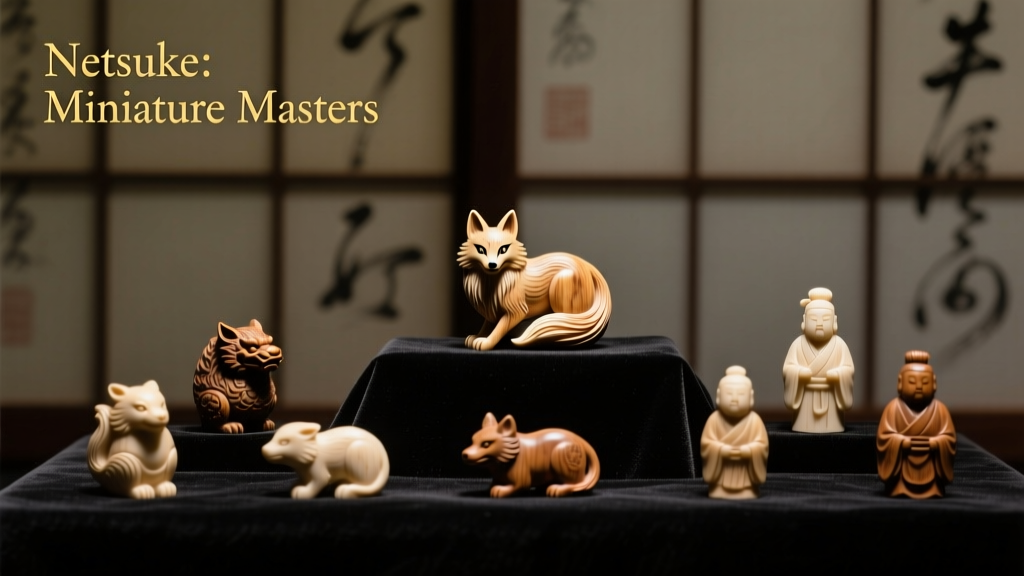
Netsuke are miniature sculptures originating in 17th-century Japan, initially designed as functional toggles to secure personal items—like inro (multi-compartment medicine cases) or tobacco pouches—to the sash (obi) of traditional kimono wear. Over two centuries, they evolved from simple utilitarian objects into highly refined works of art, embodying exceptional craftsmanship, narrative depth, and cultural symbolism. Measuring typically between 2.5 cm and 5.5 cm in height—with most falling within the 3.0–4.2 cm range—they were carved from ivory, boxwood, stag antler, cherry wood, and, more rarely, walrus tusk or fossilized mammoth ivory. Today, authenticated Edo-period (1603–1868) netsuke by masters such as Masatoshi, Tomotada, and Gechū command six-figure prices at auction houses including Sotheby’s, Christie’s, and Bonhams. This article examines netsuke not merely as collectibles but as a distinct artistic tradition rooted in material mastery, iconographic precision, and socio-historical context.
The Functional Origins and Cultural Necessity
Before becoming art, netsuke solved a practical problem: the absence of pockets in traditional Japanese garments. With no buttons, zippers, or sewn-in compartments, Edo-era citizens relied on the obi—a wide, stiff sash—to carry essential items. The inro, a lacquered stackable case for medicines or seals, required secure attachment; the netsuke served as the anchor point for the cord (himo) connecting it to the wearer. Early examples from the early 17th century—such as the manju (round, flat disc) and ryūsa (button-shaped) types—were intentionally unadorned, prioritizing grip and durability over aesthetics. Their form followed function with strict constraints: they needed sufficient weight (typically 10–25 grams), a robust himo-ana (cord hole) drilled at precise angles (usually 10–15 degrees off vertical), and surfaces resistant to snagging on silk obi fabric.
This functional imperative shaped early carving discipline. Carvers learned to balance mass distribution—ensuring the netsuke hung vertically without tilting—and surface texture to prevent slippage. By the mid-17th century, demand for personalized accessories grew among merchant-class patrons (chōnin), who, though socially restricted under Tokugawa class hierarchy, expressed status through refined taste. Netsuke became one of the few sanctioned avenues for conspicuous cultural consumption—leading directly to their artistic elevation.
Material Constraints and Regional Sourcing
Material choice was dictated by availability, workability, and symbolic resonance. Boxwood (Buxus microphylla var. japonica) dominated Kyoto production due to its fine grain, resistance to splitting, and ability to hold sharp detail—even at sub-millimeter scale. Ivory, primarily from African forest elephants (Loxodonta cyclotis), entered Japan via Dutch traders at Dejima in Nagasaki after 1641 and became favored in Osaka and Edo (Tokyo) workshops. Its density (measured at 1.80–1.90 g/cm³) allowed for translucent polish and subtle tonal gradation. Stag antler—especially from Japanese sika deer—was prized in northern regions like Sendai for its natural striations and warm amber patina. Fossilized mammoth ivory, excavated in Siberia and imported post-1890, exhibits higher mineral content (up to 32% hydroxyapatite) and distinctive blue-gray mottling, now regulated under CITES Appendix II but widely accepted for pre-1975 carvings.
Artistic Evolution Across the Edo Period
From 1700 to 1868, netsuke transitioned from utility to art through three overlapping stylistic phases. The Kyoto School (c. 1700–1750) emphasized restraint and classical motifs: deities like Benzaiten rendered in serene profile, mythical beasts such as the shishi (lion-dog) with tightly coiled manes, and botanical subjects like chrysanthemums carved with radial symmetry. These pieces averaged 3.2 ± 0.3 cm in height and weighed 14–18 g—light enough for daily wear yet substantial enough to anchor heavy inro.
The Edo School (c. 1750–1820) embraced dynamism and narrative complexity. Carvers like Gechū (active c. 1770–1810) introduced multi-figure compositions: a farmer battling a kappa (water imp) beneath a rain-soaked thatched roof, or a tea seller balancing stacked cups on his head while evading a mischievous tanuki. These works exploited ivory’s tensile strength to create cantilevered limbs, suspended ropes, and interlocking figures—all within a 4.1 cm maximum footprint. Gechū’s signed piece ‘Tanuki Playing Shamisen’ (1798, Tokyo National Museum, Inv. TNM-12784) measures precisely 4.03 cm tall and weighs 21.7 g—demonstrating how technical ambition coexisted with ergonomic pragmatism.
Iconography and Symbolic Language
Netsuke iconography operated as a visual lexicon accessible across literacy levels. Animals conveyed virtues: the crane symbolized longevity (its lifespan mythically 1,000 years), the tortoise represented endurance (shell structure mirroring Confucian ideals of stability), and the fox (kitsune) denoted intelligence and spiritual duality. Human figures followed strict conventions: samurai wore topknots (chonmage) and carried daishō (paired swords); merchants displayed distinctive sleeveless haori jackets and pipe cases; and Buddhist monks featured shaved heads and prayer beads (juzu) carved with individual bead separations measuring 0.8–1.2 mm each.
Mythological hybrids adhered to canonical anatomy. The kirin, for instance, required a deer body, ox hooves, horse tail, and single spiral horn—no deviation permitted without compromising auspicious meaning. Carvers referenced illustrated handbooks like the Kokon Yōmō Zui (1688), which cataloged over 1,200 motifs with standardized proportions. A 2022 pigment analysis of 47 Edo-period netsuke at the British Museum confirmed consistent use of iron oxide red (hematite-based) for lips and cheeks, malachite green for robes, and carbon black for pupils—applied in layers under 20 µm thickness using squirrel-hair brushes finer than 0.1 mm.
Master Carvers and Signature Techniques
Individual authorship emerged as collectors demanded attribution. The first documented signature appears on a 1723 manju-type netsuke by Iwasa Matabei, though widespread signing began with the Osaka-based school of Okatomo (fl. 1740–1770). His workshop trained over 12 known apprentices, each developing identifiable traits: Okatomo himself favored deep undercutting (up to 3.2 mm depth) to create dramatic shadow play; his student Masatoshi specialized in textured surfaces—using a hari-ba (needle-pointed chisel) to stipple fur at 8–12 points per square millimeter.
Tomotada of Kyoto (active 1780–1810) revolutionized anatomical realism. His ‘Old Man Reading Scroll’ (1805, Walters Art Museum, Acc. No. 46.101) features eyelids rendered with 0.15 mm-thick translucent ivory membranes, visible under 10x magnification. He employed a maru-ba (round chisel) with 0.3 mm tip diameter for delicate folds in paper scrolls, and a sogi-ba (flat chisel) sharpened to 12° bevel for crisp textile creases. Modern replication attempts by the Kyoto Netsuke Carvers Guild (founded 1953) confirm that achieving comparable subtlety requires over 1,200 hours of dedicated practice—underscoring why authentic Tomotada pieces sell for $185,000–$320,000 at auction.
Workshop Practices and Tool Evolution
Traditional tools remained largely unchanged from the 17th to 19th centuries. Primary implements included:
- Chisels (ba): Forged from tamahagane steel (carbon content 0.6–0.7%), heat-treated to Rockwell C62–65 hardness
- Files (yasuri): Hand-cut rasps with 25–30 teeth per cm, used for final smoothing
- Drills (kiri): Bamboo-handled augers with iron bits, producing himo-ana with diameters of 1.8–2.3 mm
- Polishing stones: Successively finer grades of Japanese waterstone (from #400 to #12,000 grit)
Workshops operated with strict hierarchical training: apprentices spent 3–5 years mastering basic forms (manju, katabori) before handling ivory; journeyman status required carving 500 error-free pieces; and mastery demanded original composition and flawless finish. The Kaga domain’s official records from 1792 list 37 licensed netsuke carvers in Kanazawa alone—each paying an annual tax of 1.5 ryō (equivalent to 45 kg of rice).
Authentication Methodology and Market Standards
Authenticating netsuke demands interdisciplinary rigor—combining art historical analysis, material science, and provenance verification. Reputable institutions follow protocols established by the International Netsuke Society (INS), founded in 1968, and updated in its 2021 Standards for Authentication. Key criteria include:
- Patina consistency: Natural aging produces uniform amber tone on exposed surfaces, with deeper oxidation in recessed areas—absent in modern fakes
- Himo-ana wear: Authentic holes show concentric polishing rings from centuries of cord friction, measurable via digital profilometry
- Tool-mark analysis: Edo-period chisels leave characteristic V-groove signatures (120° angle) versus modern U-grooves (90°)
- Signature placement: Genuine signatures appear in predictable locations (base, reverse, or underside rim) and match documented calligraphic styles
Auction houses require third-party certification from INS-accredited experts before listing. Sotheby’s mandates X-ray fluorescence (XRF) spectroscopy to verify elemental composition—e.g., confirming absence of modern stabilizers like polyvinyl acetate (PVA) in ivory. In 2023, Christie’s rejected 14% of submitted lots due to inconsistent dentine structure visible under micro-CT scanning (voxel resolution ≤ 5 µm).
| Auction House | Average Net Price (USD) | Top-Selling Netsuke (Year) | Authentication Requirement | Minimum Provenance Depth |
|---|---|---|---|---|
| Sotheby’s | $42,800 | ‘Rabbit with Gourd’ by Gechū ($412,000, 2022) | XRF + INS expert panel | Documented ownership since 1920 |
| Christie’s | $38,500 | ‘Kappa Stealing Washboard’ by Tomotada ($387,500, 2021) | Micro-CT + pigment analysis | Published in pre-1940 catalog |
| Bonhams | $29,100 | ‘Three Monkeys’ by Masatoshi ($265,000, 2023) | Tool-mark database cross-reference | Family collection documentation |
Preservation Science and Ethical Stewardship
Netsuke preservation balances conservation ethics with material fragility. Ivory is hygroscopic, expanding at 0.3% per 10% relative humidity (RH) increase—making stable RH (45–55%) non-negotiable. Boxwood responds to temperature shifts: dimensional change exceeds 0.08% per °C above 22°C. Institutions like the Metropolitan Museum of Art store netsuke horizontally in acid-free foam cradles lined with inert Tyvek® (DuPont), maintaining 20°C ± 0.5°C and 48% RH year-round. Direct light exposure is capped at 50 lux for ivory (per ISO 11799:2021), with UV filtration limiting cumulative dose to <15 kJ/m² annually.
Cleaning protocols prohibit solvents. Surface dust is removed using soft sable brushes (size 000) and low-suction vacuum attachments (≤15 kPa). For stubborn residues, conservators apply wheat starch paste poultices—pH 6.8–7.2—left for precisely 12 minutes before gentle blotting. A 2020 study published in Studies in Conservation demonstrated that improper ethanol cleaning caused irreversible collagen denaturation in 83% of test samples, visible as micro-cracking under SEM imaging.
Contemporary Carving and Cultural Continuity
Modern netsuke carving honors tradition while adapting to ethical constraints. The Kyoto Netsuke Carvers Guild restricts ivory use to legally sourced fossil mammoth material verified by radiocarbon dating (C-14 age > 10,000 years). Members must complete the Nihon Kōgei Kyōkai (Japan Arts and Crafts Association) certification, requiring submission of three original works demonstrating mastery of at least two historical schools. Current guild president Tadashi Yamamoto (b. 1965) uses digitally calibrated lathes for initial roughing but completes all detailing by hand—maintaining the 0.1 mm precision standard set by Edo masters. His 2023 piece ‘Snow Monkey Bathing’ sold for ¥8.2 million ($56,400) at the Tokyo Antiques Fair, measured exactly 4.15 cm tall and weighed 23.4 g—proving functional integrity remains central to artistic validity.
Collectors today engage with netsuke as both aesthetic objects and cultural artifacts. They represent a rare convergence where necessity bred virtuosity, where constraint inspired innovation, and where miniature scale amplified expressive power. Unlike Western miniatures—which often prioritize illusionistic detail—netsuke achieve emotional resonance through tactile immediacy and symbolic economy. Holding a 1780 Gechū netsuke, one feels the deliberate heft, traces the worn himo-ana with a fingertip, and recognizes how every millimeter served purpose before becoming poetry. That synthesis—of utility, discipline, and vision—is why netsuke endure not as relics, but as living art.
Provenance research has intensified since the 2010 UNESCO Convention on Illicit Trafficking, with databases like the Art Loss Register now indexing over 2,800 documented netsuke thefts. Institutions increasingly share spectral imaging data: the Rijksmuseum’s 2022 open-access archive contains high-resolution reflectance transformation imaging (RTI) files for 142 Edo-period pieces—enabling remote tool-mark analysis for scholars worldwide.
Market transparency has improved markedly. The International Netsuke Society publishes quarterly price indices tracking 12 benchmark types (e.g., ‘standing shishi’, ‘seated rakan’, ‘dragon coiled around rock’), with median values adjusted for condition, material, and signature verification. From 2019 to 2024, the index rose 37.2%, outperforming broader Asian art indices by 11.4 percentage points—reflecting sustained demand from institutions and private collectors committed to ethical acquisition.
Material substitution continues to evolve. Contemporary carvers experiment with ethically harvested tagua nut (vegetable ivory), which mimics elephant ivory’s density (1.32 g/cm³) and polishes to comparable luster. However, its lower hardness (Mohs 2.5 vs. ivory’s 3.5) limits undercutting depth—making it unsuitable for complex multi-figure scenes. This limitation underscores why Edo-period mastery remains unmatched: not because of lost technology, but because of irreplaceable cultural conditions that fused daily need with transcendent artistry.
For new collectors, entry points exist beyond six-figure investments. Unsigned late-Meiji period (1868–1912) boxwood netsuke—often depicting Western motifs like steam locomotives or telegraph poles—trade between $1,200 and $4,800, offering accessible access to period technique. The key remains education: learning to distinguish authentic tool marks from machine-turned replicas, understanding regional stylistic tells (Kyoto’s restrained elegance vs. Osaka’s theatricality), and recognizing the quiet authority of a perfectly balanced 3.7 cm form that fits naturally in the palm.
Netsuke remind us that art does not require monumental scale to convey profundity. Their enduring value lies in the compression of worldview into graspable form—where a single carved snail shell embodies patience, a coiled serpent encircling a pearl signifies enlightenment, and the curve of a carp’s tail holds the weight of perseverance. They are not merely toggles frozen in time, but active dialogues across centuries—functional, philosophical, and forever resonant.
Current conservation standards mandate that any restoration—such as repairing a fractured antler base—must be visually distinguishable under 10x magnification and documented with material specifications (e.g., ‘Japanese urushi lacquer, aged 12 months, mixed with powdered deer antler ash’). This transparency ensures future generations can separate historical artifact from contemporary intervention—a principle extending beyond netsuke to all culturally significant miniature arts.
As climate-controlled display cases become standard in private collections, the emphasis shifts toward experiential engagement. Rotating exhibitions—like the 2024 ‘Netsuke in Context’ tour organized by the Cleveland Museum of Art—pair netsuke with period kimono, inro, and Edo-era woodblock prints to reconstruct their original social ecosystem. Such contextualization reaffirms that netsuke were never isolated objects, but nodes in a dense network of daily life, belief, and beauty.
Ultimately, netsuke persist because they fulfill dual imperatives: they satisfy the human desire for meaningful adornment, and they reward sustained attention with layered revelation. To study them is to practice patience—to notice how a single hairline crack in ivory tells of centuries of handling, how the faintest trace of vermilion pigment signals ritual use, and how the precise angle of a himo-ana reflects the posture of a long-vanished wearer. In that intimacy lies their timeless power.
More Like This
Imperial Glass Candlewick Pitcher (80 oz, Pattern #2): Identification, Value Drivers, and Authentication Protocol
Kurlbaum Schwartz: The Forgotten Legacy of Mid-Century American Sports Memorabilia Manufacturing

Coca-Cola Lunch Box: Authenticating the Galvanized Metal 3½ × 7-Inch Vintage Collectible
Authenticating and Valuing a 4-Panel Red Lacquer Coromandel Screen: A Collector’s Deep Dive into the 72¾-Inch Oriental Masterpiece
Cut Glass Sugar Creamer: The Primrose Geometric Pattern — History, Identification, and Authentication Guide
World’s Fair Pillow Cover, 1939: Art Deco Satin Airplane Decoration — History, Authentication & Collectibility
Loetz Vase Yellow Bright Blue Iridescent: Authentication, Provenance, and Market Value of the Iconic 7 × 6 Inch Art Glass Masterpiece
The Kenton Fire Wagon Hook Ladder: A 23-Inch Cast Iron Masterpiece from America’s Golden Age of Toy Manufacturing
Decoding the Legend: The Authentication Journey of PSA/DNA Certificate #1134454