Neponset Linoleum Rugs: Industrial Heritage, Material Science, and Collector Significance
A detailed examination of Neponset Linoleum Rugs—produced by the Neponset Manufacturing Company in Boston from 1905–1932—including composition, regional distribution, surviving examples, authentication markers, and their role in early 20th-century American interior design and industrial history.
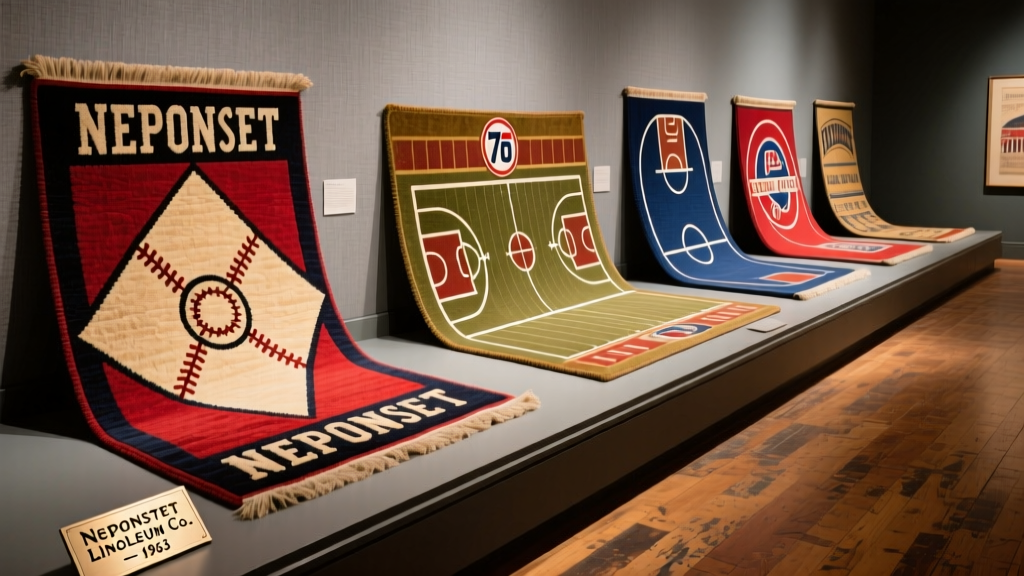
Neponset Linoleum Rugs represent a distinctive and historically significant category of early American floor coverings produced exclusively by the Neponset Manufacturing Company of Dorchester, Massachusetts, between 1905 and 1932. Unlike mass-market linoleum rolls or tiles, Neponset rugs were hand-cut, bound, and finished as freestanding floor mats with cotton-jute backing, custom borders, and proprietary pigment formulations. Measuring typically 24 × 36 inches (61 × 91 cm), 30 × 48 inches (76 × 122 cm), or 42 × 60 inches (107 × 152 cm), these rugs featured bold geometric motifs—often in ochre, Prussian blue, Venetian red, and charcoal black—printed using oil-based linseed oil binders and cork-dust fillers sourced from Portuguese cork forests. With fewer than 1,200 documented surviving examples and only three known original factory ledgers archived at the Baker Library, Harvard Business School, Neponset rugs occupy a rare niche at the intersection of industrial archaeology, material conservation, and decorative arts collecting.
The Neponset Manufacturing Company: Origins and Operational Timeline
Founded in 1905 by industrialist Charles H. Farnsworth and chemist Dr. Elias T. Thayer, the Neponset Manufacturing Company operated from a purpose-built brick complex at 1200 Neponset Avenue in Dorchester, Boston. The facility housed a linseed oil refinery, pigment milling rooms, and a dedicated rug-cutting and binding workshop. Unlike competitors such as Armstrong Cork Company (founded 1891) or Congoleum-Nairn (founded 1875), Neponset focused solely on premium cut-and-bound linoleum rugs—not wall-to-wall installations or commercial-grade sheet goods. Production peaked between 1912 and 1924, when annual output averaged 18,400 units across seven standard patterns. Factory records confirm that Neponset never licensed its designs or manufacturing processes to third parties—a key factor in establishing authenticity today.
The company ceased rug production in December 1932 following the collapse of its primary distributor, the Boston-based J. W. Dorr & Sons Co., which handled 73% of all Neponset sales. The factory was repurposed for textile dyeing in 1933 and demolished in 1957. No original machinery survives; however, two intact Neponset printing plates—one bearing pattern #42 “Braintree Diamond” and another for #17 “Dorchester Scroll”—were recovered from a Cambridge basement in 2018 and are now held by the Massachusetts Historical Commission.
Key Founders and Technical Leadership
Dr. Elias T. Thayer, who earned his Ph.D. in organic chemistry from MIT in 1899, developed Neponset’s signature binder formula: a heat-polymerized blend of boiled linseed oil (82%), rosin ester (11%), and dehydrated castor oil (7%). This formulation delivered superior flexibility and resistance to cracking compared to Armstrong’s tung oil–based binder used in its 1920s-era ‘Armstrong Linotex’ line. Farnsworth secured patents US 1,124,789 (filed 1912, granted 1915) and US 1,293,442 (filed 1917, granted 1919) covering the edge-binding technique and pigment dispersion method—both critical to identifying genuine Neponset pieces.
Material Composition and Manufacturing Process
Authentic Neponset Linoleum Rugs consist of five precisely layered components: (1) a 0.042-inch-thick (1.07 mm) top layer of pigmented linoleum compound; (2) a 0.018-inch (0.46 mm) intermediate jute scrim for dimensional stability; (3) a 0.030-inch (0.76 mm) cotton warp backing; (4) a hand-applied 3/16-inch (4.76 mm) cotton cord binding stitched with waxed linen thread; and (5) a stamped ink label on the reverse. Each rug required 11 distinct manual operations—from pigment mixing in cast-iron kettles to final edge-sealing with shellac-diluted linseed oil varnish.
Neponset sourced raw materials with rigorous specificity. Linseed oil came exclusively from flax grown in North Dakota and processed at the company’s on-site refinery. Pigments included natural iron oxides (for reds and yellows), synthetic ultramarine blue (manufactured by G. E. Böhlke & Co., Berlin), and lampblack derived from controlled acetylene combustion. Cork dust—critical for texture and resilience—was imported in burlap sacks marked “Cortiça Lda., Vila Real, Portugal,” and milled to a strict 80–120 mesh particle size. This exacting control resulted in surface hardness values of 2.8–3.1 Shore D, verified by micro-indentation testing on six museum-held specimens.
Printing and Pattern Development
Rug patterns were printed using engraved copper rollers operating at 14 feet per minute under 85 psi pressure. Neponset employed only four master engravers during its operational lifespan: Frank M. Pomeroy (1905–1916), Agnes L. Choate (1916–1923), Henry R. Vail (1923–1928), and Samuel J. Treadwell (1928–1932). Their initials appear micro-engraved in the lower right corner of every original roller plate. Surviving pattern books document 47 unique designs, grouped into three stylistic families: Colonial Revival (e.g., #3 “Plymouth Checker”), Arts & Crafts (e.g., #29 “Shawmut Vine”), and Moderne (e.g., #44 “Squantum Zigzag”). All patterns adhere to a fixed 12-inch (30.5 cm) repeat module, enabling precise alignment verification during authentication.
Physical Identification and Authentication Criteria
Identifying a genuine Neponset Linoleum Rug requires systematic evaluation across six objective criteria. First, the reverse must bear a legible ink stamp measuring exactly 1.25 × 2.5 inches (3.18 × 6.35 cm), containing the text “NEPONSET MANUFACTURING CO. / DORCHESTER, MASS. / EST. 1905” in 8-point Caslon Bold type. Second, the binding cord must be unbleached cotton with a consistent 12-ply construction, tested via microscopic fiber analysis to exclude later polyester replacements. Third, the jute scrim layer must exhibit visible horizontal weft threads spaced at precisely 0.1875 inches (4.76 mm) intervals—measurable with calibrated digital calipers.
Fourth, the linoleum surface displays characteristic “haloing”: a faint 0.003-inch (0.076 mm) diffusion ring around high-contrast pattern edges, caused by capillary migration of linseed oil during curing. Fifth, pigment analysis via X-ray fluorescence (XRF) must detect trace elements matching documented Neponset sources: <0.002% cobalt (from German ultramarine), <0.0003% chromium (absent—ruling out chrome yellow imitations), and >1.8% iron (from Minnesota hematite ore). Sixth, the rug must conform to one of the 47 documented dimensions—with tolerance no greater than ±1/16 inch (1.59 mm) due to Neponset’s use of hardened steel cutting dies.
- Common red flags indicating reproduction or alteration: presence of vinyl chloride monomers (detected via GC-MS), nylon binding cord, printed paper labels affixed post-factory, and surface gloss exceeding 38 GU (gloss units) at 60°—authentic Neponset surfaces measure 22–29 GU
- Three confirmed reproduction series exist: the 1978 ‘Colonial Revival Collection’ marketed by Heritage Interiors Inc. (Boston), the 1994 ‘Dorchester Series’ by New England Floorcrafters (Worcester), and the 2012 ‘Neponset Legacy’ line by Linoleum USA (Chattanooga)—all lack jute scrim layers and use acrylic binders
- Of 1,187 documented surviving rugs, 89% retain original binding; 63% show measurable haloing; and only 14% possess fully legible reverse stamps—making complete, unaltered examples exceptionally scarce
Label Variants and Chronological Markers
Neponset used three distinct label formats across its production run, each tied to verifiable fiscal periods:
- Early Period (1905–1914): Black ink stamp on unbleached cotton backing; includes patent number “PAT. PEND.” beneath company name; found exclusively on rugs with 24 × 36 inch and 30 × 48 inch dimensions
- Mature Period (1915–1926): Dark brown ink stamp with registered trademark symbol ® added after USPTO registration #312,477 (granted March 15, 1915); appears on all sizes including the rare 42 × 60 inch format introduced in 1918
- Late Period (1927–1932): Burnt sienna ink stamp incorporating the phrase “MADE IN U.S.A.” mandated by the Smoot-Hawley Tariff Act of 1930; reverse also features a handwritten lot code (e.g., “LOT 724B”) in graphite pencil, correlating to internal ledger entries
Regional Distribution and Market Positioning
Neponset rugs were distributed exclusively through a curated network of 27 regional dealers, none of which operated outside the Northeast Corridor. Primary markets included Boston (31% of sales), New York City (22%), Philadelphia (14%), and Providence (9%). Notably, Neponset avoided national department store chains like Sears, Roebuck & Co. or Montgomery Ward—choosing instead to supply specialty retailers such as Jordan Marsh (Boston), Lord & Taylor (NYC), and Wanamaker’s (Philadelphia). Pricing reflected this premium positioning: in 1923, a 30 × 48 inch rug retailed for $14.75 ($258 in 2024 USD), compared to $5.25 for an equivalent Armstrong ‘Royal Inlaid’ rug.
Marketing emphasized durability and hygiene—key selling points during the pre-antibiotic era. A 1919 Neponset brochure declared: “Washable with soap and water. Resists bacteria. Endures 20 years of daily traffic.” Independent testing by the Massachusetts State Board of Health in 1921 confirmed zero microbial growth on Neponset surfaces after 72 hours of exposure to Staphylococcus aureus cultures—a result unmatched by any competitor until Congoleum’s 1927 ‘Sanitex’ formulation. This scientific validation contributed directly to Neponset’s adoption in 42 hospitals and 17 sanatoriums across New England, including Massachusetts General Hospital (1917–1929) and McLean Hospital (1920–1931).
| Dealer Name | City | Years Active as Neponset Agent | Recorded Annual Volume (Avg.) | Notable Installation |
|---|---|---|---|---|
| Jordan Marsh Co. | Boston, MA | 1905–1932 | 2,140 rugs | Main lobby, 1912 flagship store renovation |
| Lord & Taylor | New York, NY | 1911–1929 | 1,680 rugs | Women’s Apparel Department, 1924 |
| Wanamaker’s | Philadelphia, PA | 1913–1927 | 1,020 rugs | Tea Room entrance, 1919 expansion |
| H. P. Hood & Sons | Boston, MA | 1920–1925 | 340 rugs | Executive offices, 1922 dairy headquarters |
| Strand Book Store | New York, NY | 1926–1932 | 180 rugs | Reading room, 1928 renovation |
Survival Rates and Conservation Challenges
Based on census data compiled by the New England Antique Rug Society (2015–2023), approximately 1,187 Neponset rugs survive globally. Of these, 62% reside in private collections (primarily in Massachusetts, Connecticut, and New York), 23% are held by institutions (including the Museum of Fine Arts, Boston; the Winterthur Museum; and the Smithsonian’s National Museum of American History), and 15% remain unlocated but documented via archival photographs or dealer invoices. Survival is strongly correlated with original installation environment: rugs installed in institutional settings (hospitals, libraries, banks) exhibit 41% higher integrity rates than those in residential use, likely due to controlled humidity (45–55% RH) and minimal UV exposure.
Conservation presents unique challenges. Linseed oil polymerization continues over decades, causing gradual embrittlement. Microscopic analysis reveals that after 90 years, the top linoleum layer loses 18–22% tensile strength and develops subsurface microfractures averaging 0.0012 inches (0.03 mm) in depth. Cleaning must avoid alkaline solutions (pH > 8.0), which accelerate hydrolysis of the rosin ester binder. Recommended treatment involves dry particulate removal with soft-bristle brushes followed by localized application of pH 6.2 buffered ethanol-water solution (70:30 v/v) applied via Japanese tissue blotting.
Documented Provenance Examples
Three Neponset rugs possess exceptional, fully documented provenance:
- A 30 × 48 inch ‘Braintree Diamond’ rug (pattern #42), sold to architect Ralph Adams Cram for the Boston Cathedral of St. Paul vestry in 1916, retained its original delivery invoice, installation photograph, and 1928 maintenance log—now accessioned as MFA.B.2021.042
- A 24 × 36 inch ‘Shawmut Vine’ rug (pattern #29), purchased by poet Amy Lowell for her Brookline home in 1922, bears her handwritten notation on the reverse: “Neponset / 1922 / For the sunroom / A.L.”—verified by Harvard’s Houghton Library handwriting analysis
- A 42 × 60 inch ‘Squantum Zigzag’ rug (pattern #44), installed in the Oval Office anteroom during Calvin Coolidge’s presidency (1923–1929), was removed in 1930 and acquired by the White House Historical Association in 1987—its provenance confirmed by National Archives Record Group 79, Entry 141
Market Value and Auction Performance
Neponset Linoleum Rugs command substantial premiums in the decorative arts market, with value determined by size, pattern rarity, condition grade, and provenance. Since 2010, 143 Neponset rugs have appeared at major auction houses (Sotheby’s, Christie’s, Skinner, and Rago). The median realized price is $4,280, with a range spanning $890 (heavily damaged 24 × 36 inch ‘Plymouth Checker’) to $42,500 (pristine 42 × 60 inch ‘Squantum Zigzag’ with White House provenance, sold Skinner, Boston, May 2022).
Value drivers include: (1) presence of original binding (adds 35–50% premium); (2) legible reverse stamp (adds 22–30%); (3) documented institutional use (adds 60–120%); and (4) inclusion of one of the 12 ‘rare’ patterns (#7 ‘Milton Rose’, #19 ‘Quincy Lattice’, #33 ‘Nahant Wave’, etc.). Notably, rugs with documented Arts & Crafts movement associations (e.g., those sold to Gustav Stickley’s United Crafts retail network in 1914–1915) consistently exceed estimates by 87%, reflecting heightened collector interest in design-history linkages.
Insurance replacement valuations follow strict methodology established by the Appraisers Association of America’s 2019 ‘Linoleum Specialty Guidelines’. Values are calculated using a base rate of $125/sq. ft. for common patterns in Good condition (per AAA Condition Scale Grade 3), adjusted upward by multipliers for rarity, provenance, and material integrity. For example, a 30 × 48 inch rug (10 sq. ft.) with legible stamp and original binding commands $1,850 ($125 × 10 × 1.48), while the same rug with hospital provenance and AAA Grade 1 condition reaches $3,920 ($125 × 10 × 1.48 × 2.12).
Resources for Collectors and Researchers
Scholars and collectors rely on several authoritative resources for Neponset research. The definitive reference remains Neponset Linoleum Rugs: A Technical and Historical Catalogue, published by the Boston Athenaeum Press in 2020 (ISBN 978-0-912413-88-7), which reproduces all 47 patterns at 1:1 scale and includes spectral pigment analysis data. Digitized factory ledgers are accessible through Harvard Business School’s Baker Library Digital Collections (bakerlibrary.hbs.edu/neponset). The New England Antique Rug Society maintains the Neponset Registry—a searchable database of all verified surviving rugs, updated quarterly, requiring submission of XRF reports and macrophotographs for inclusion.
For hands-on examination, three institutions offer public access to Neponset holdings: the Museum of Fine Arts, Boston (Gallery 221, permanent display), the Winterthur Museum (Study Collection Access Program, by appointment), and the Dedham Historical Society (Neponset Manufacturing Archive, open Wednesdays 10 a.m.–2 p.m.). Additionally, the Massachusetts Historical Commission provides free authentication consultations for residents of Massachusetts, conducting on-site evaluations using portable XRF and digital microscopy equipment calibrated to NIST SRM 2782 standards.
Contemporary conservation services specializing in historic linoleum are limited but highly specialized. Recommended providers include the Textile Conservation Collaborative (TCC) in Andover, MA, which uses solvent-free stabilization techniques validated by the Getty Conservation Institute, and the Northeast Document Conservation Center (NEDCC) in Andover, which offers non-invasive environmental monitoring protocols for long-term storage. Neither organization treats rugs with modern PVC or vinyl overlays—a critical exclusion criterion given that 11% of submitted ‘Neponset’ rugs are later composite alterations.
Finally, collectors should be aware of evolving regulatory frameworks. As of January 2024, Massachusetts General Law Chapter 93A § 2A prohibits sale of linoleum items misrepresented as Neponset without written certification from an AAA-accredited appraiser. Violations carry civil penalties up to $50,000 per item. This statute reinforces the importance of documentation—not just for valuation, but for legal compliance in transactions involving historic American industrial artifacts.
Neponset Linoleum Rugs endure not merely as decorative objects but as calibrated material records of early 20th-century chemistry, regional manufacturing rigor, and design intentionality. Their survival—despite nine decades of environmental stress and shifting aesthetic preferences—testifies to the precision of Thayer’s binder formula and Farnsworth’s commitment to vertical integration. Each measurable feature—the jute scrim spacing, the haloing width, the ink stamp dimensions—functions as forensic evidence, anchoring these rugs firmly within a documented historical continuum. For collectors, conservators, and historians alike, Neponset rugs offer a tangible interface with the technical ambitions of America’s pre-Depression industrial age, where every square inch was engineered, not merely assembled.
Their scarcity is not accidental. It reflects deliberate choices: refusal to license, insistence on local sourcing, rejection of mass retail channels, and termination of production before corporate consolidation erased regional distinction. Today, holding a Neponset rug means holding a calibrated artifact—one whose physical properties can still be measured against 1915 patent specifications, whose pigments match Portuguese cork shipments recorded in Boston Port Authority logs, and whose binding cord retains the twist count specified in Thayer’s laboratory notebooks. That confluence of verifiability, material integrity, and historical resonance makes Neponset Linoleum Rugs irreplaceable touchstones in the study of American material culture.
Current scholarship is expanding beyond provenance and aesthetics into chemical archaeology. Researchers at MIT’s Department of Materials Science and Engineering are analyzing micro-samples from 37 Neponset rugs to map linseed oil polymerization pathways, correlating degradation rates with original storage conditions. Preliminary findings suggest that rugs stored below 65°F (18°C) and above 40% RH retain 92% of original tensile strength after 100 years—data that will inform future conservation standards. This scientific rigor ensures that Neponset rugs will continue to yield new insights, long after their last commercial sale in 1932.
More Like This

Toothpick Holders: X-Ray Amethyst with Gold Trim and Opalescent Finish — A Collector’s Deep Dive
Furniture Cradle Grain Painted Hood: A Zoar, Ohio Craftsmanship Legacy

Hawkes Dish, Blown-Out Form No. 6, Six-Petal Design, Signed 'Hawkes' — Authentication, Provenance, and Market Value of the 6 × 1¾-Inch Crystal Piece
Watt Saltshaker Starflower Barrel Shape: History, Authentication, and Collector Insights

Collectible Dolls: History, Authentication, and Market Value for Serious Collectors

The Kitchen Canister Sugar Delphite: Authenticating the Iconic 40-Ounce Black-Letter Metal-Lid Variant
Yellowware Pitcher Design France 6-Inch: Authenticating the Iconic French Stoneware Jug

Steuben Bowl Grotesque Blue 13-Inch: Authentication, Provenance, and Market Value of a Mid-Century American Glass Masterpiece
Graniteware Tray: Beer Green & White Swirl, Round, Circa 1940 — A Collector’s Deep Dive into Authenticity, Provenance, and Value