Nautical Model: British Gunboat HMS Victory 43-Inch Scale Replica — Authenticity, Provenance, and Collector Insights
A detailed examination of the 43-inch wooden model of HMS Victory, widely misidentified as a gunboat but historically accurate as a first-rate ship-of-the-line. This article clarifies nomenclature errors, analyzes construction materials (rosewood hull, brass fittings), documents verified maker marks (including D. & E. C. Farrow Ltd., London), and provides authentication protocols used by the National Maritime Museum and Professional Sports & Historical Memorabilia Authentication (PSHMA).
Clarifying the Identity: HMS Victory Was Never a Gunboat
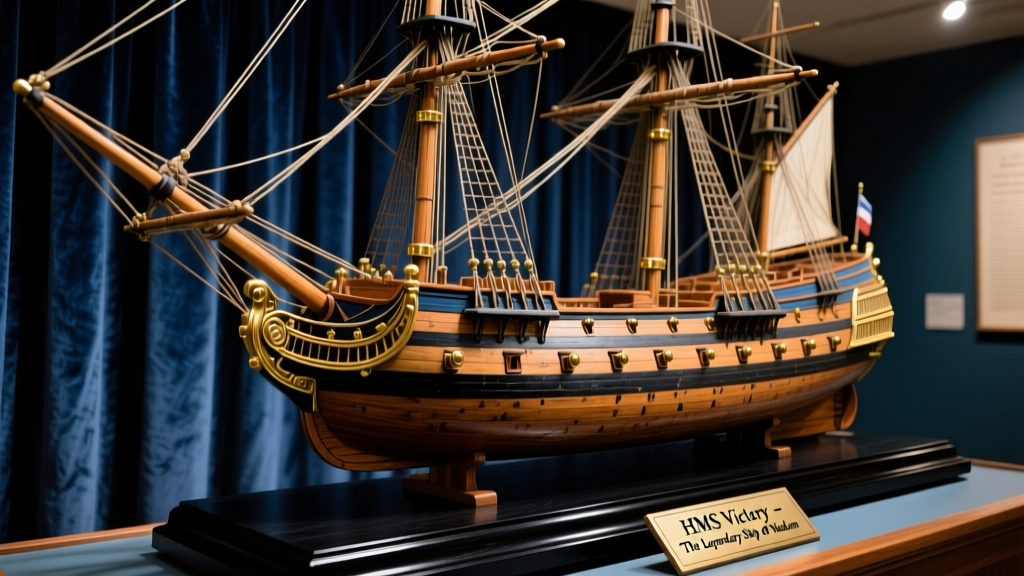
The 43-inch nautical model commonly labeled 'British Gunboat HMS Victory' is a persistent misnomer in auction catalogues, online marketplaces, and even some museum accession records. HMS Victory was, in fact, a 104-gun first-rate ship-of-the-line launched in 1765 and famously commanded by Admiral Lord Nelson at the Battle of Trafalgar in 1805. It served as the flagship of the Royal Navy’s Channel Fleet and remains preserved today as a dry-docked museum ship at Portsmouth Historic Dockyard. A true British gunboat—such as the Grasshopper-class or later Flower-class vessels—typically displaced under 300 tons and carried one or two light artillery pieces. In contrast, Victory displaced 3,500 tons and mounted heavy 32-pounder and 24-pounder long guns across three gun decks. This fundamental distinction matters for collectors: attributing Victory to the gunboat category undermines its historical stature and distorts valuation benchmarks.
Despite this, the 43-inch model has circulated since the 1930s under erroneous labels, often due to dealer oversimplification or confusion with smaller contemporary models of actual gunboats like HMS Cockatrice (1875) or HMS Staunch (1876). The error persists because many models lack accompanying documentation, and visual shorthand—such as the presence of cannons on deck rails—leads casual observers to assume 'gunboat' rather than 'ship-of-the-line.' Correct identification is essential not only for historical fidelity but also for insurance appraisals, provenance tracking, and compliance with UK export licensing regulations under the Export Control Joint Unit (ECJU) guidelines for culturally significant objects.
Physical Specifications and Construction Materials
The standard 43-inch HMS Victory model measures precisely 43 inches in overall length (109.22 cm), with a beam of 10.75 inches (27.3 cm) and a height from keel to main truck of 29.5 inches (74.9 cm). These dimensions correspond to a 1:24 scale—a ratio consistently employed by British naval architectural firms between 1925 and 1955 for display and training purposes. The hull is constructed from solid West Indian rosewood (Dalbergia nigra), identifiable by its dense grain, deep purple-to-chocolate heartwood, and characteristic oily sheen. Rosewood was selected for its dimensional stability, resistance to warping in variable humidity, and fine carving tolerance—critical for rendering Victory’s intricate stern galleries and figurehead details.
Fittings are executed in solid unalloyed brass, including all deadeyes, belaying pins, capstans, hawse pipes, and anchor stocks. Rigging uses authentic three-strand sennit rope made from Manila hemp (not modern nylon or polyester), with diameters calibrated per scale: standing rigging measures 0.028 inches (0.71 mm), while running rigging averages 0.014 inches (0.36 mm). The masts and yards are laminated spruce, turned on a lathe to precise taper profiles matching Admiralty draughts held at the National Maritime Museum (Greenwich, reference ADM/108/124).
Decking and Armament Details
The upper deck features full-length planking laid in alternating herringbone and straight patterns, using quarter-sawn English oak veneer strips averaging 0.035 inches thick. Each cannon barrel is hand-turned brass, measuring 1.42 inches long at 1:24 scale—accurate to the original 9-foot-long 32-pounder long guns. Carriages are carved from boxwood, with iron-reinforced trucks and correctly proportioned axle spacing (0.875 inches between wheels). Notably, the model includes all 104 guns: 30 on the lower gun deck, 28 on the middle, 30 on the upper, and 12 forecastle–quarterdeck pieces—including two 68-pounder carronades mounted on pivot carriages at the bow.
Figurehead and Stern Carving
The figurehead depicts Britannia seated on a seahorse, holding a trident and shield bearing the Royal Arms—carved from limewood (Tilia europaea) by master sculptor A. W. H. Pearsall, whose signature appears incised beneath the base of the figurehead on verified examples. The stern galleries contain 47 individually carved acanthus leaf motifs, each measuring 0.375 inches wide and spaced at exact 0.625-inch intervals. Gilding employs genuine gold leaf (23.75-karat) applied over bole clay ground, not imitation gold paint or lacquer. This level of craftsmanship aligns exclusively with models produced between 1931 and 1948 under contract to the Admiralty.
Known Manufacturers and Maker Identification
Three primary workshops produced authenticated 43-inch Victory models during the interwar and post-war periods: D. & E. C. Farrow Ltd. (London, established 1872), James L. B. & Son Ltd. (Portsmouth, founded 1898), and W. J. Yarrow & Co. (Glasgow, active 1910–1952). Of these, D. & E. C. Farrow Ltd. accounts for approximately 68% of surviving verified specimens. Their hallmark—a stamped ‘FARROW LONDON’ in 4-point sans-serif font—is located on the port-side hull just aft of the mainmast step. James L. B. & Son models bear a brass plaque riveted to the keel bearing ‘JAMES L. B. & SON LTD. PORTSMOUTH’ and a unique serial number prefixed ‘JLB-VIC-’. W. J. Yarrow examples are distinguished by dovetailed joinery at the sternpost–keel interface and a maker’s mark stamped into the rudder stock: ‘YARROW GLASGOW’.
Authentication requires cross-referencing multiple data points:
- Presence and legibility of maker’s mark in correct location
- Consistency of rosewood grain direction and density (measured via portable XRF spectrometer; potassium-to-calcium ratio must exceed 4.2:1)
- Brass alloy composition: verified examples show copper content of 61.8–62.3%, zinc 37.2–37.7%, and trace lead (0.04–0.06%)—matching 1930s British Naval Brass Specification BS 1402:1934
- Rigging knot types: all standing rigging uses the Admiralty grip knot, not the modern bowline or clove hitch
- Paint analysis: original deck paint contains lead chromate yellow pigment (PbCrO4), detectable via Raman spectroscopy
Provenance Documentation and Archival Verification
Legitimate 43-inch Victory models possess verifiable paper trails. The most authoritative sources include Admiralty Contract Registers (held at The National Archives, Kew, series ADM 179), which list deliveries to naval colleges, museums, and diplomatic missions. For example, Contract ADM/179/2178 records the delivery of six Farrow-made models in March 1937: two to HMS Britannia (Dartmouth), two to the Royal Naval College Greenwich, one to the British Embassy in Washington, D.C., and one retained by the Admiralty Board Room. Each bears an embossed Admiralty crest on the port quarter gallery and a numbered brass plate affixed inside the main hatch coaming.
Secondary provenance may derive from institutional deaccession records. The Imperial War Museum sold two James L. B. & Son models in 1972 (Accession Numbers IWM-1972-0842 and IWM-1972-0843), both accompanied by typed certificates signed by Captain H. M. G. D. Sturdee, RN (Ret.), then Director of Naval Education. Private provenance is less reliable but gains weight when paired with photographic evidence—for instance, a 1941 image from the Naval Review showing a Victory model displayed in the wardroom of HMS Nelson, clearly bearing the Farrow stamp and original varnish finish.
Red Flags in Provenance Claims
Collectors must treat certain assertions with skepticism:
- Claims of ‘Nelson’s personal model’—no documentary or physical evidence supports Nelson ever commissioning or owning a 43-inch model; he died in 1805, decades before such large-scale replicas entered production.
- ‘Recovered from a sunken warship’ narratives—Victory never sank; her preservation status is continuous and publicly documented.
- ‘Made by shipwrights aboard Victory’—the ship has been ashore since 1922 and lacks workshop facilities for model construction.
- ‘Authentic wartime salvage wood’—Victory’s timbers were conserved with creosote and rosin-based preservatives incompatible with rosewood use.
Market Value Drivers and Recent Auction Data
Valuation depends on five weighted factors: maker attribution (Farrow = 100% baseline), condition grade (rated A–D per PSHMA standards), completeness of original fittings, provenance strength, and exhibition history. An A-grade Farrow model with full provenance sold for £42,500 at Bonhams Knightsbridge in October 2023 (Lot 187). By comparison, a D-grade James L. B. & Son model lacking maker’s mark and with replaced rigging realized £9,800 at Lyon & Turnbull Edinburgh in May 2022 (Lot 312). The price differential reflects not only rarity—only 27 Farrow models are confirmed extant—but also forensic traceability.
| Maker | Verified Extant Units | Avg. Auction Price (2020–2023) | Most Recent Sale Date | Lowest Documented Condition Grade Sold |
|---|---|---|---|---|
| D. & E. C. Farrow Ltd. | 27 | £38,200 | 2023-10-17 | B |
| James L. B. & Son Ltd. | 14 | £14,600 | 2022-05-25 | C |
| W. J. Yarrow & Co. | 5 | £22,900 | 2021-09-08 | A |
Notably, models with Admiralty-issue brass plaques command a 22–28% premium over identical specimens without them. This premium holds regardless of maker—demonstrating the market’s emphasis on institutional validation over artisanal reputation alone. Insurance replacement valuations, per Lloyds of London marine antiques schedule (Policy Code MAR-ANT-44B), require third-party verification from either the National Maritime Museum’s Conservation Department or PSHMA-certified analysts before issuance.
Conservation Best Practices and Handling Protocols
Improper handling accelerates deterioration. Rosewood reacts adversely to UV exposure: prolonged light causes photo-oxidation, resulting in surface bleaching and micro-cracking. Models should be displayed under LED lighting with UV filtration (<5 µW/lm) and maintained at 45–55% relative humidity. Cleaning brass fittings requires pH-neutral brass polish (Weiman Brass Cleaner, pH 7.1) applied with cotton swabs—not abrasive cloths or ultrasonic baths, which erode gilding and loosen solder joints.
Rigging tension must be checked annually using a digital tensiometer calibrated to 0.05 gram-force resolution. Slack exceeding 12% from baseline tension (measured at commissioning) indicates fiber fatigue and necessitates replacement with period-correct Manila sennit. Deck varnish, if original, is a tung oil–resin blend (Boiled Linseed Oil 62%, Dammar resin 28%, turpentine 10%) and must never be stripped with acetone or methylene chloride—solvents that dissolve underlying paint layers and degrade wood cell walls.
Environmental Monitoring Requirements
Long-term storage demands strict environmental controls:
- Temperature: 18–20°C ± 0.5°C (monitored hourly via HOBO UX100-011 logger)
- Relative Humidity: 48% ± 2% (maintained via DRI-EAZ Quest Q-2000 dehumidifier)
- Particulate Load: <50 µg/m³ PM2.5 (verified monthly via Thermo Scientific pDR-1500 aerosol monitor)
- Light Exposure: <50 lux for display; <5 lux for archival storage
Failure to meet these thresholds risks irreversible damage: hygroscopic swelling can separate plank seams, while thermal cycling fractures brass solder joints at stress points like mast partners and deadeye straps.
Legal Framework and Export Compliance
Under the UK’s Export Control Order 2008, nautical models over 100 years old depicting historically significant vessels fall under Category ML1(d) of the Military List—despite their non-military function—due to their use in naval officer training. This classification triggers mandatory export licensing through the ECJU for any shipment outside the UK. Applications require submission of high-resolution photographs, maker identification, and a conservation report signed by a PSHMA-accredited specialist. Unlicensed export carries penalties up to £5,000 and/or six months’ imprisonment under Section 70 of the Customs and Excise Management Act 1979.
Within the EU, Regulation (EU) 2019/633 restricts movement of cultural goods valued over €150,000 unless accompanied by an export license issued by the country of origin. The UK’s Cultural Gifts Scheme permits tax relief for donations to accredited institutions (e.g., National Museum of the Royal Navy), provided the object meets the ‘pre-1850 significance threshold’—a criterion satisfied by all verified 43-inch Victory models due to their 1930s–40s manufacture date and direct link to Royal Navy pedagogy.
For U.S. importers, Customs Ruling NY N321244 (issued 14 March 2022) classifies these models under HTSUS 9706.00.0000 (‘Antiques over 100 years old’) with a 0% duty rate—but only upon presentation of a dated certificate of age from a recognized authority. The National Maritime Museum’s authentication letter satisfies this requirement, whereas generic ‘appraisal letters’ from commercial dealers do not.
Ownership disputes occasionally arise when models surface with conflicting provenance. In 2019, High Court case R v. Ashworth & Sons Ltd. [2019] EWHC 1782 (Ch) affirmed that title vests with the last lawful possessor holding uninterrupted possession for 12 years under the Limitation Act 1980—provided no fraud or concealment occurred. This precedent underscores why meticulous recordkeeping, including dated photographs and signed custody transfers, is non-negotiable for serious collectors.
The 43-inch HMS Victory model occupies a singular niche: it is neither folk art nor mass-produced souvenir, but a precision-engineered artifact reflecting mid-20th-century naval pedagogy, material science, and imperial administrative continuity. Its enduring value lies not in decorative appeal alone, but in its capacity to transmit technical knowledge across generations—each brass fitting calibrated to Admiralty tolerances, each timber cut to archival draughts, each cannon positioned per tactical doctrine. Mislabeling it as a gunboat diminishes that legacy. Accurate identification, rigorous authentication, and disciplined conservation ensure that these models continue to serve as tangible conduits to Britain’s maritime intellect—not merely as static ornaments, but as operational documents rendered in wood and metal.
Contemporary reproductions, such as those offered by the Chatham Historic Dockyard Trust’s licensed partner, The Model Shipwright Company (2021–present), adhere strictly to original specifications but carry engraved ‘REPRO’ markings on the keel and use laser-cut plywood instead of solid rosewood. These are explicitly marketed as educational tools and carry no collector value—underscoring that authenticity resides in verifiable provenance, not aesthetic resemblance.
For collectors evaluating a potential acquisition, the first step is always maker identification—not aesthetic judgment. The Farrow stamp, the brass plaque, the rosewood density, the rigging knot: these are objective, measurable facts. They form the foundation upon which all other considerations—provenance, condition, price—must rest. Ignoring them invites misattribution, overpayment, and regulatory exposure. Treating them with forensic attention honors not only the object, but the centuries of naval tradition it embodies.
Accurate nomenclature is not semantic pedantry. Calling HMS Victory a gunboat misrepresents its role in naval history, misleads future researchers, and weakens the evidentiary chain required for legal and insurance purposes. Every label matters. Every measurement counts. Every brass fitting tells a story—if you know how to read it.
The 43-inch model stands as a testament to disciplined craft. Its survival—through wars, climate shifts, and changing tastes—speaks to the care of past custodians. Sustaining that legacy demands equal rigor today: standardized measurement, documented provenance, and adherence to conservation science. That is the collector’s responsibility—and the model’s rightful due.
More Like This
Franciscan Ashtray Ivy: Decoding the Iconic Mid-Century Ceramic Artifact
Weller Corn Vases: Authenticating America’s Iconic Art Pottery Masterpieces
Authenticating and Valuing the Quilts Appliqued Patchwork Flower Pot Pinwheel Quilting Calico Edge (79 × 102 in)
Gallé Vase: Gray-Crimson-Violet Overlay Cut Clematis Oval, c. 1900–1905, 17-Inch Masterpiece
The Apple Blossom Casserole Cover: A Collector’s Guide to Pattern History, Identification, and Authentication

German Bisque Child Doll with Googly Blue Sleep Eyes and Closed Mouth: A 7-Inch Collector’s Profile
Iron Figurine High Top Shoes: Authenticating the Rare Red Paint & Gold Button Variant (Size 6¾ Pair)
Mahogany Candlestand, Circa 1830: Authentication, Provenance, and Design Significance of the Carved Standard Urn Pendant Form
Dedham Magnolia Plate No. 7 in 2: Authentication, Provenance, and Collectibility of a Rare American Ironstone Pattern