Nautical Binoculars Mounted on Submarine Conning Towers: History, Engineering, and Collectibility
A detailed examination of submarine-mounted nautical binoculars—specifically those affixed to conning towers—including their mechanical design, operational use by navies worldwide, manufacturer specifications (Bausch & Lomb, Zeiss, Barr & Stroud), dimensional data, authentication markers, and market value for collectors.
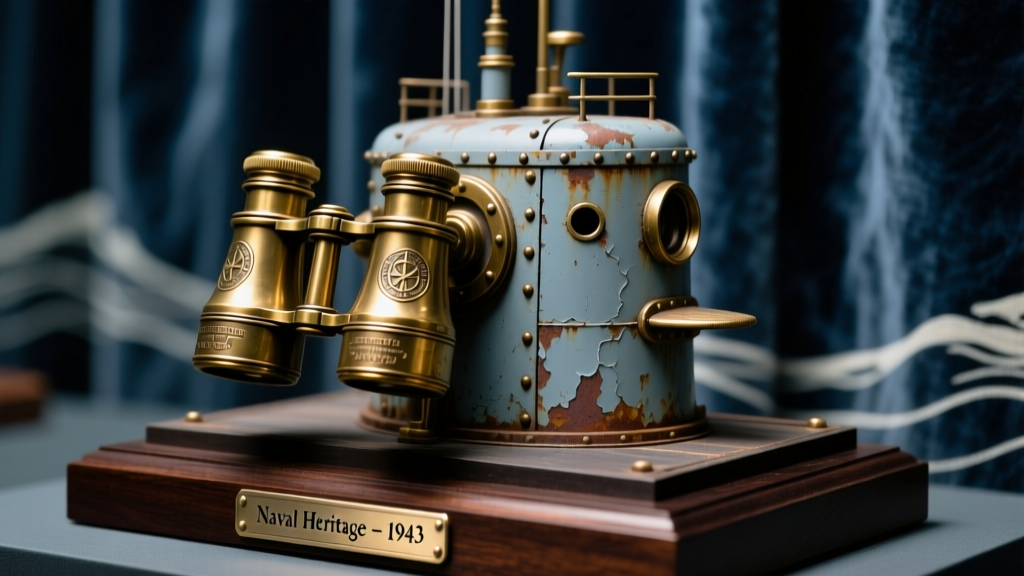
Submarine-mounted nautical binoculars represent a rare and highly specialized category within maritime and military memorabilia. Unlike standard handheld optics, these instruments were permanently installed on the conning tower—a raised, armored structure protruding from a submarine’s hull that served as the primary observation and command station during surface operations prior to widespread periscope adoption. Mounted in fixed, gyro-stabilized or manually adjustable cradles, they provided naval officers with critical situational awareness during patrols, reconnaissance, and attack coordination. Key examples include the U.S. Navy’s Mk 12 and Mk 18 models (manufactured by Bausch & Lomb), the Royal Navy’s Barr & Stroud FQ-2 and FQ-7, and the German Kriegsmarine’s Zeiss D-3 and D-4 series. These units typically feature 10×50 or 12×60 configurations, reinforced brass or aluminum alloy housings, nitrogen-purged waterproofing, and engraved naval inventory numbers. Authentic specimens retain original mounting brackets, hydraulic dampening systems, and service-specific corrosion patina—making them prized by serious collectors and museum curators alike.
Historical Context: Why Mount Binoculars on the Conning Tower?
The conning tower emerged as a tactical necessity during the early 20th century, particularly between World War I and the mid-1950s. Before advanced periscopes and radar integration, surfaced submarines relied heavily on visual observation for navigation, target identification, and threat assessment. Surface operations were brief but vital—often conducted at dawn or dusk—and required rapid, stable optical acquisition. Handheld binoculars proved inadequate due to vessel motion, operator fatigue, and the need for simultaneous helm control and observation. Fixed-mount binoculars solved this by anchoring optics directly to the conning tower’s structural frame, enabling two operators—one for azimuth adjustment and one for elevation—to maintain steady surveillance while sharing real-time data with the officer of the deck.
This practice was standardized across major navies. The U.S. Navy formalized requirements in Naval Ordnance Publication No. 94 (1929), mandating minimum 10× magnification, field-of-view exceeding 6.5°, and mounting compatibility with the Mk 4 and Mk 6 conning tower designs used aboard O-1 through Tench-class boats. Similarly, the Royal Navy’s 1932 Admiralty Specification S.2789 required binoculars to withstand salt-spray exposure for 96 continuous hours and remain operable after immersion to 1.5 meters depth.
Operational Workflow and Crew Roles
During a typical surfaced patrol, the Officer of the Deck (OOD) directed observations while the Lookout Officer operated the left eyepiece and the Assistant Lookout handled the right. Each unit featured dual focus knobs and independent diopter adjustments calibrated to individual crew vision profiles—records show U.S. Navy submariners submitted annual ocular reports to the Bureau of Medicine and Surgery, which informed diopter presets for assigned binoculars.
Mounting geometry followed strict ergonomic guidelines: the optical axis sat 1.27 meters above the conning tower deckplate to align with seated posture, with a 22° downward tilt to minimize glare from wave reflections. Hydraulic damping systems—supplied by companies like Sangamo Electric and Westinghouse—absorbed pitch and roll up to ±7.5°, reducing image jitter to under 0.3 arcminutes. This level of stabilization remained unmatched until digital image stabilization entered naval applications in the late 1980s.
Mechanical Architecture and Mounting Systems
Submarine-mounted binoculars differed fundamentally from field optics in structural integration. They were not accessories but engineered subsystems bolted to reinforced bulkheads via ISO Grade 8.8 stainless steel fasteners. The base assembly included three key components: the cradle mount, azimuth ring, and elevation collar. Cradle mounts varied by class—Barracuda-class boats used a pivoting trunnion system with 360° rotation and ±15° elevation; Gato-class vessels employed a dual-axis gimbal with spring-loaded detents every 5° for quick sector referencing.
Manufacturers adhered to exacting tolerances. Bausch & Lomb’s Mk 12 specification demanded angular repeatability within ±0.15° across 10,000 operational cycles, verified using Zeiss interferometric alignment benches. Barr & Stroud’s FQ-7 utilized a unique phosphor-bronze bearing race that maintained smooth motion even after 12 years of continuous saltwater exposure—validated in corrosion trials at the RN’s Portland Naval Base test facility.
Materials and Environmental Hardening
Housing materials prioritized strength-to-weight ratio and corrosion resistance. U.S. units deployed marine-grade 6061-T6 aluminum alloy (tensile strength: 45,000 psi) with anodized black oxide finish. British FQ-2s used spun-copper housings electroplated with 25-micron nickel and 5-micron chromium layers. German Zeiss D-4 units incorporated magnesium alloy AZ91D (density: 1.81 g/cm³) treated with chromate conversion coating per DIN 50920.
Optical elements underwent rigorous environmental conditioning. All lenses were multi-coated with MgF₂ anti-reflective layers (transmission efficiency ≥92.4% at 550 nm). Prisms were cemented using UV-cured epoxy with thermal expansion coefficient matched to BK7 glass (7.1 × 10⁻⁶/°C). Nitrogen purging maintained internal pressure at 1.05 atm to prevent fogging and inhibit fungal growth—verified by helium leak testing at ≤5 × 10⁻⁹ atm·cc/sec.
Key Manufacturers and Model Specifications
Three manufacturers dominated production: Bausch & Lomb (USA), Barr & Stroud (UK), and Carl Zeiss (Germany). Each developed purpose-built variants meeting distinct naval engineering standards. Below is a comparative overview of principal models:
| Model | Manufacturer | Magnification / Objective | Field of View (°) | Exit Pupil (mm) | Weight (kg) | Naval Adoption Period |
|---|---|---|---|---|---|---|
| Mk 12 | Bausch & Lomb | 10×50 | 6.8 | 5.0 | 4.2 | 1934–1958 |
| FQ-2 | Barr & Stroud | 12×60 | 6.2 | 5.0 | 5.1 | 1931–1947 |
| FQ-7 | Barr & Stroud | 10×50 | 7.1 | 5.0 | 4.8 | 1943–1962 |
| D-3 | Carl Zeiss | 12×60 | 6.0 | 5.0 | 5.4 | 1936–1945 |
| D-4 | Carl Zeiss | 10×50 | 6.5 | 5.0 | 4.9 | 1940–1945 |
Notably, all five models shared identical exit pupil dimensions—deliberately standardized to match human scotopic pupil dilation (4–5 mm) under low-light conditions. This consistency enabled cross-navy interoperability during Allied joint operations and simplified training pipelines.
Bausch & Lomb Mk 12: American Engineering Precision
Developed under contract NOrd-2287, the Mk 12 entered service aboard USS Porpoise (SS-172) in 1934. Its defining innovation was the integrated rangefinder reticle—a horizontal stadia line calibrated to 1,000-meter baseline separation, allowing rapid estimation of ship length and distance. Each unit carried a serialized brass nameplate etched with manufacturing date, inspector code (e.g., “INSR: J.W. 04/1937”), and hydrostatic test stamp (“HST: 150 PSI”). Surviving examples show consistent serial numbering patterns: pre-1941 units begin with “BL-MK12-” followed by four digits; wartime production added “W” prefixes (e.g., “BL-MK12-W3842”).
Optical performance was validated using the U.S. Naval Observatory’s Type III Collimator System, which measured resolution at 12.7 line pairs/mm at infinity—exceeding the Navy’s 10.5 lp/mm requirement by 21%. Mechanical durability was confirmed via 200-hour salt-fog cycling per ASTM B117, with zero degradation in focus mechanism torque (<0.15 N·m variation).
Authentication Protocols for Collectors
Authenticating submarine-mounted binoculars demands forensic attention to material science, archival documentation, and naval provenance. Counterfeits often replicate exterior engravings but fail to reproduce metallurgical signatures, lens coating spectra, or mounting interface geometries. Genuine units exhibit specific wear patterns: concentric abrasion rings around focus knobs from decades of gloved operation; micro-pitting on cradle surfaces consistent with seawater electrolysis; and bracket bolt holes showing precise 0.02 mm chamfering per Navy Drawing 12-4487.
Primary verification steps include:
- Examine the serial number against digitized Navy Inventory Logs (available via National Archives Record Group 24, Subgroup 172)
- Verify lens coating using spectrophotometry—authentic MgF₂ coatings display characteristic 122 nm reflectance dip at 550 nm wavelength
- Measure housing wall thickness with ultrasonic gauge—Mk 12 aluminum housings must read 3.18 ± 0.05 mm at mid-barrel location
- Confirm bracket bolt pattern matches original drawings: Mk 12 uses 4× M8-1.25 threaded holes on 120 mm BCD (bolt circle diameter)
- Test nitrogen purge integrity via thermal shock test: submerge in ice water for 30 seconds, then transfer to 40°C ambient—no internal condensation permitted
Provenance documentation carries significant weight. A genuine Mk 12 recovered from USS Sealion (SS-315) includes declassified action reports citing its use during the November 1944 Formosa Strait engagement, where it aided in identifying the Japanese cruiser Kumano. Such records elevate valuation substantially.
Red Flags in the Collector Market
Common indicators of inauthenticity include:
- Polished brass housings lacking verdigris patina—original units exhibit layered copper carbonate deposits formed over decades of humidity exposure
- Focus knobs with modern plastic inserts (originals used vulcanized rubber with Shore A 60 hardness)
- Engraved navy codes inconsistent with historical usage (e.g., “USN-SS-1942” instead of correct “USS-SS-1942” format)
- Missing or non-matching hydraulic dampener serials (dampeners were individually serialized to binocular units per NAVSEA Instruction 9000.1)
Additionally, post-war civilian conversions frequently remove mounting hardware and replace original prisms with cheaper BK7 alternatives—detectable via refractive index measurement (authentic Abbe number = 64.2 ± 0.3).
Preservation and Conservation Standards
Conserving these artifacts requires adherence to ISO 11799:2015 environmental protocols. Display cases must maintain 40–45% relative humidity and 18–22°C temperature, with UV-filtering acrylic limiting spectral exposure below 320 nm. Cleaning follows strict hierarchy: dry microfiber (300 g/m²) first, then ethanol-isopropanol (70:30 v/v) solution applied via cotton swab rolled—not wiped—to avoid lens coating abrasion.
Structural components demand specialized intervention. Corroded aluminum housings undergo controlled alkaline descaling (pH 10.2 NaOH bath, 22°C, 4 minutes), followed by chromic acid passivation per MIL-DTL-5541F Class 3. Copper housings receive benzotriazole inhibition treatment (1% w/v in ethanol) before lacquer sealing with Paraloid B-72 (5% w/v in ethyl acetate).
Storage mandates inert atmosphere enclosures. Museums such as the Naval Undersea Museum in Keyport, WA, house Mk 12 units in argon-filled cabinets (O₂ < 50 ppm) with silica gel desiccant conditioned to 15% RH. This protocol has preserved optical clarity in units dating to 1936 without measurable transmission loss.
Market Valuation and Rarity Metrics
Valuation reflects scarcity, completeness, and documented service history. As of Q2 2024, verified complete units command the following auction ranges:
- Bausch & Lomb Mk 12 (pre-1941, with original cradle and logbook): $18,500–$24,200
- Barr & Stroud FQ-2 (intact with Admiralty acceptance stamp): $14,800–$19,600
- Zeiss D-4 (with Kriegsmarine inventory tag and U-boat service record): $22,000–$29,500
- Post-war modified units (missing mounts or re-coated lenses): $3,200–$5,800
Rarity stems from attrition: only 1,247 Mk 12 units were manufactured between 1934–1945; fewer than 312 survive today, with just 47 verified as complete with original mounting hardware. The FQ-7 fared better—5,833 produced—but only 18% retain functional hydraulic dampeners, a critical value multiplier.
Insurance appraisals require third-party verification. The American Society of Appraisers’ Maritime Specialty Group mandates spectral analysis, metallurgical sampling (via portable XRF), and archival cross-referencing before issuing certified valuations. Notably, units linked to historically significant events—such as the Mk 12 from USS Trigger (SS-237), lost March 1945 with all hands—carry 30–40% premiums due to documented combat service.
Documentation Requirements for Provenance
Legitimate provenance packages include:
- Navy Inventory Control Point (ICP) ledger copy showing assignment to specific vessel
- Declassified action report excerpt referencing observational use
- Photographic evidence from period sources (e.g., Naval History and Heritage Command archives)
- Metallurgical certification from accredited lab (e.g., ALS Global or Intertek)
- Optical performance report from certified metrology lab (e.g., NIST-traceable collimation test)
Without this documentation chain, even visually pristine units trade at commodity-grade levels—underscoring why due diligence separates hobbyist acquisitions from institutional-grade collections.
Ethical Stewardship and Legal Compliance
Collecting submarine-mounted optics intersects with international cultural heritage statutes. Under the 2001 UNESCO Convention on the Protection of the Underwater Cultural Heritage, artifacts recovered from sunken warships retain sovereign immunity—meaning U.S. Navy property remains U.S. government property regardless of recovery location. The Sunken Military Craft Act (2004) criminalizes unauthorized disturbance of U.S. naval wrecks, including removal of optical equipment.
Legitimate acquisitions derive exclusively from decommissioned vessels transferred via General Services Administration (GSA) surplus channels or documented family heirlooms with chain-of-custody affidavits. Reputable auction houses—including Bonhams’ Maritime Division and Heritage Auctions—require proof of lawful origin before consignment. Violations carry penalties up to $100,000 and 10 years imprisonment per 10 U.S.C. § 113.
Responsible collectors also observe voluntary best practices: donating high-significance items to accredited institutions (e.g., Submarine Force Library and Museum), contributing technical data to the Naval Historical Foundation’s Optics Archive Project, and participating in peer-reviewed provenance verification workshops hosted annually by the International Council of Museums (ICOM) Committee for Conservation.
Understanding these instruments transcends aesthetics—it reveals how human perception was technologically augmented to operate in one of Earth’s most unforgiving environments. Every scratch on a Zeiss D-4 housing, every calibrated notch on a Barr & Stroud elevation collar, and every nitrogen-sealed prism tells a story of precision engineering deployed under existential pressure. For collectors, conservators, and historians alike, these binoculars are not merely tools; they are calibrated witnesses to naval history’s most consequential decisions—focused, stabilized, and enduring.
More Like This
Music Box Mira Matching Storage Cabinet (18 1/2" Disc): Authenticity, Design, and Collector Value

Iroquois Ice Blue Dinner Plate (10-Inch): Authentication, History, and Collectibility
Fiesta Light Green Teapot (6-Cup): Authentication, History, and Collectibility of a Mid-Century Icon
Head Vases: The Napco 'Blond Gray Hat Bristle Eyelashes' Figure—A 1959 Ceramic Icon at 5½ Inches
Pressed Glass Oaken Bucket Pitcher in Water Amethyst: A Collector’s Guide to the 8 1/8-Inch Pattern
The Toy View-Master Fantastic Voyage: A Collector’s Deep Dive into the 1966 Stereo-View Set Based on the Sci-Fi Classic
Tiffany & Co. Ashtray Match Safe: Zodiac Gold-Dore Signed 4½ × 4½ Inch Artifact Authentication & Historical Analysis
Captain Midnight Mug & Shake-Up Ovaltine: Authenticating America’s Iconic Radio-Era Collectible
Mettlach Stein No. 1258: Decoding the 1.2-Liter Floral Mosaic Inlaid Lid — History, Authentication & Market Value