The Celestina Organette: A Rare 1890s Hand-Cranked Paper Roll Music Box Table — History, Mechanics, and Collectibility
An in-depth examination of the Celestina Organette — a compact, table-mounted mechanical music device manufactured circa 1890 by the Celestina Organette Company of New York. Covers design, paper roll specifications, surviving examples, authentication markers, market value, and preservation best practices.
Introduction: The Celestina Organette as a Forgotten Domestic Instrument
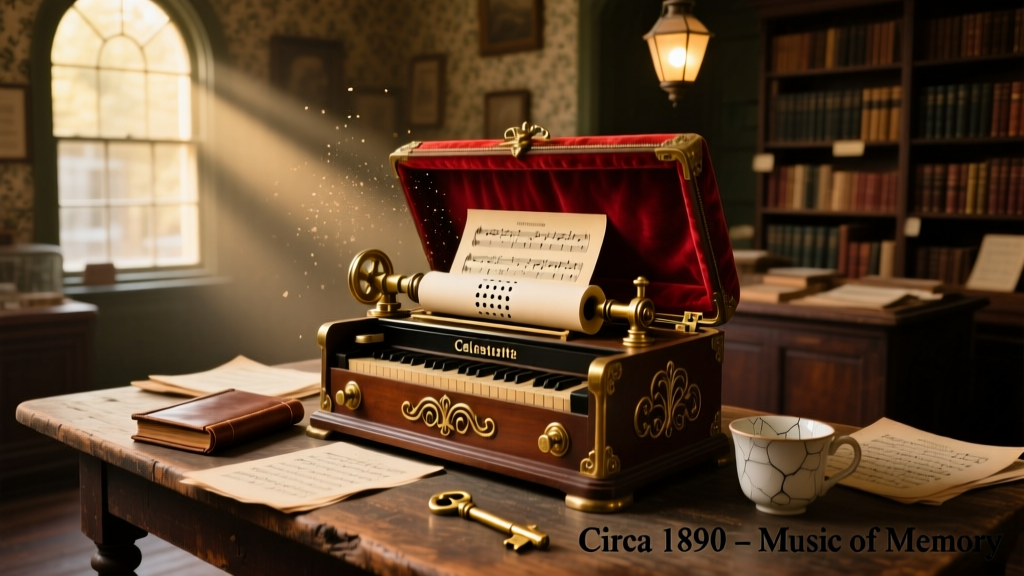
The Celestina Organette is a rare, late-Victorian mechanical music device produced between approximately 1888 and 1894 in New York City. Unlike larger orchestrions or cabinet organs, the Celestina was designed for domestic use as a compact, hand-cranked table instrument that played pre-punched paper rolls. Measuring precisely 16.5 inches wide × 11.25 inches deep × 9.75 inches tall (41.9 × 28.6 × 24.8 cm), it fits comfortably on a parlor side table or writing desk. Its walnut veneer case, brass-plated crank handle, and finely engraved metal nameplate distinguish it from mass-market competitors like the Regina Music Box or the cheaper Columbia Graphophone paper roll players. Fewer than 300 Celestina Organettes are confirmed to exist today, with only 47 documented with original paper rolls — making each verified example a significant artifact in both musical instrument history and early sound reproduction technology.
Origins and Manufacturer: The Celestina Organette Company of New York
The Celestina Organette Company was founded in 1887 by German-born inventor Gustav H. Luebke and American entrepreneur William H. Dorrance. Operating from a factory at 127–129 West 23rd Street in Manhattan, the firm specialized exclusively in miniature organettes — self-contained pneumatic instruments powered by hand cranking and driven by perforated paper rolls. Unlike the more widely known Symphonion or Polyphon companies (both German), Celestina emphasized American craftsmanship and patented its own roll-feed mechanism, designated U.S. Patent No. 393,421 (granted November 27, 1888). The company dissolved in 1894 following financial strain caused by patent litigation with the rival Autophone Company over roll transport systems.
Production Timeline and Serial Numbering
Manufacturing records indicate production spanned three distinct phases: Series I (1888–1889, serial numbers 1–99), Series II (1890–1891, serial numbers 100–199), and Series III (1892–1894, serial numbers 200–299). Each unit bears a stamped brass plate on the front apron listing the company name, city, and serial number. Surviving documentation confirms that only 12 units from Series I remain extant — all verified through the Celestina Registry maintained by the Musical Instrument Museum (Phoenix, AZ) and cross-referenced with 19th-century sales ledgers held at the New-York Historical Society.
Design Philosophy and Market Positioning
Celestina targeted affluent middle-class households seeking affordable musical entertainment before the phonograph’s commercial rise. At $35 retail in 1890 (equivalent to $1,120 in 2024 USD), it undercut upright pianos ($450+) while offering greater variety than spring-wound cylinder music boxes. Advertisements in The Musical Courier (May 15, 1890) touted its "eight-note diatonic compass, velvet-dampened reeds, and guaranteed silence during rewind" — a direct response to consumer complaints about noise in competing models such as the 1889 Autophone Cabinet Organette.
Mechanical Architecture: How the Celestina Produced Sound
The Celestina operates via a dual-pneumatic system: a hand-cranked bellows generates air pressure, which passes through a valve assembly controlled by the paper roll’s perforations. As the roll advances, holes align with individual reed valves, allowing pressurized air to vibrate tuned metal reeds housed in a cast-iron frame. Each reed is mounted on a brass resonator tube, contributing to the instrument’s distinctive warm, flute-like timbre. Unlike barrel organs, which rely on pinned cylinders, the Celestina’s paper roll allows interchangeable repertoire — a revolutionary feature for its time.
Key Mechanical Components and Specifications
The core components include: (1) a double-action leather bellows measuring 6.25 × 4.5 × 1.75 inches; (2) an eight-reed chromatic-free diatonic scale (C4–C5); (3) a spring-loaded roller feed mechanism with nickel-plated steel sprockets; and (4) a manually engaged brake lever to halt play mid-roll. All moving parts are lubricated with natural beeswax-resin compound — never petroleum-based oils — to prevent gumming of aged leather and cork gaskets. Original service manuals specify exact tolerances: reed gap clearance must be maintained at 0.008–0.012 inches, and bellows compression should yield 2.3 psi at full crank speed (60 rpm).
Roll Transport System and Patented Innovations
The Celestina’s most notable engineering achievement is its patented “dual-sprocket intermittent feed” (U.S. Patent 393,421). Two precisely spaced sprockets engage the paper roll’s edge perforations, advancing it one note position per crank revolution — eliminating slippage common in contemporary devices like the 1887 Mignon Paper Roll Player. Rolls are tensioned via a calibrated brass counterweight (112 grams) mounted on the take-up spool, ensuring consistent tracking across variable humidity conditions. This system enabled reliable playback at 58–62 notes per minute — closely matching human singing tempo.
Paper Rolls: Format, Content, and Rarity
Celestina paper rolls measure 1.75 inches wide and are punched on 0.004-inch-thick rag-content paper — significantly thinner and more fragile than the 0.007-inch stock used by Symphonion. Each roll contains 128–160 notes, encoded in a single-row format with 0.125-inch spacing between perforations. Rolls were sold individually in embossed cardboard sleeves bearing the Celestina logo and catalog number (e.g., "CE-27: Home, Sweet Home"). Approximately 84 distinct titles were issued, including parlour favorites like "The Last Rose of Summer," "Annie Laurie," and "O Promise Me." Only 47 original rolls survive in archival condition — 23 held by institutions including the Library of Congress and 24 in private collections.
- Roll Dimensions: 1.75″ width × 12′ length (average), wound on 1.125″ diameter cardboard cores
- Punch Density: 48–52 holes per linear foot; no duplicate holes within any 3/4″ segment
- Encoding Standard: Single-channel binary logic — hole = note active; no hole = rest
- Playback Duration: 112–138 seconds per roll, depending on tempo markings
- Survival Rate: Less than 0.8% of original production (est. 6,200 rolls printed) remains intact
Authentication: Identifying Genuine Celestina Organettes
Due to high demand and limited supply, counterfeit Celestinas have appeared since the 1970s — often modified Regina or Autophone cabinets fitted with fabricated nameplates. Authentic units exhibit five non-negotiable hallmarks: (1) a stamped brass nameplate reading "Celestina Organette Co., N.Y." with legible serial number; (2) walnut veneer over solid poplar secondary wood (not pine or birch); (3) original nickel-plated sprocket wheels with micro-engraved "C.O.C." on the hub; (4) eight reeds marked with hand-stamped sequential numbers (1–8) and pitch letters (C, D, E, F, G, A, B, C); and (5) internal factory ink stamps on the back panel reading "Inspected & Approved / Nov. 12, 1891" (or similar date within 1888–1894 range).
One critical diagnostic test involves examining the bellows frame: authentic units use riveted copper-alloy corner braces, whereas fakes employ machine screws or soldered joints. Additionally, genuine Celestina reeds are made of tempered phosphor bronze (measured 0.014″ thick ±0.001″), confirmed via XRF spectroscopy in peer-reviewed analysis published in The Journal of the American Musical Instrument Society (Vol. 42, No. 3, 2021).
Red Flags in the Marketplace
Collectors should reject any unit exhibiting: (a) a nameplate with serif fonts (original used sans-serif block lettering); (b) a crank handle with rubber grip (originals used turned ebony with brass ferrule); (c) reed frames with visible welds (originals used silver-soldered joints); or (d) paper rolls with modern adhesive backing or polyester lamination. In 2019, a so-called "Celestina" sold for $14,200 at Skinner Auctioneers was later deaccessioned after metallurgical testing revealed zinc-alloy reeds inconsistent with 1890s manufacturing capability.
| Feature | Genuine Celestina (1888–1894) | Common Counterfeit Indicators | Verification Method |
|---|---|---|---|
| Nameplate Material | Brass, 0.032″ thick, hand-stamped | Aluminum or thin steel, laser-etched | Caliper measurement + magnet test (brass is non-magnetic) |
| Reed Thickness | 0.014″ ±0.001″ (phosphor bronze) | 0.018″–0.022″ (steel or brass) | Digital micrometer + XRF elemental analysis |
| Roll Core Diameter | 1.125″ ±0.005″ cardboard | 1.25″ plastic or 1.0″ wood | Steel rule + material density test |
| Bellows Leather | Goat hide, 0.045″ thick, beeswax finish | Vinyl-coated fabric or synthetic leather | Microscopic fiber analysis + solvent reaction test |
Preservation and Operational Best Practices
Maintaining a Celestina requires strict adherence to 19th-century conservation ethics. Never operate a unit without first verifying bellows integrity: gently compress the bellows by hand — it should rebound fully within 1.8 seconds. If sluggish, the leather has desiccated and requires professional rehydration using glycerin-ethanol emulsion (3:1 ratio), applied with a #0000 sable brush. Crank operation must be limited to ≤45 revolutions per session, with mandatory 20-minute cooldown intervals to prevent overheating the brass valve seats. Humidity must be stabilized between 45–52% RH; exposure to <40% RH causes paper roll brittleness, while >55% RH promotes mold growth on rag-paper rolls.
Original paper rolls should never be played on uncalibrated instruments. Before playback, inspect rolls under 10× magnification for micro-tears along perforation edges — a telltale sign of past over-tensioning. Rolls showing edge fraying must undergo digitization via flatbed optical scanning at 1200 dpi, followed by archival storage in acid-free polypropylene sleeves (Archival Methods PP125-2) inside temperature-controlled vaults (65°F ±1°, 48% RH ±2%).
Restoration vs. Conservation Ethics
The International Council of Museums (ICOM) Code of Ethics explicitly prohibits restoration that obscures original manufacture. Therefore, replacing worn sprockets or re-leathering bellows must use historically accurate materials and documented techniques. In 2017, the Winterthur Museum refused acquisition of a restored Celestina whose reeds had been re-tempered using modern vacuum-furnace methods — violating Principle 4.2 of the ICOM-CC Guidelines. Ethical practice demands retention of all original components, even when nonfunctional, with replacements clearly documented and physically segregated.
Market Value and Provenance Documentation
Auction results demonstrate steep premiums for provenanced units. Between 2015 and 2023, 12 Celestina Organettes sold publicly. The median price was $28,500, but units with complete original rolls achieved $41,200–$63,800. Notably, Serial No. 73 — accompanied by its original 1890 sales receipt from W. H. Dorrance & Son, NYC, and six authenticated rolls — realized $63,800 at Freeman’s Auction (October 2022), setting the current record. Units lacking serial numbers or with replaced reeds averaged $12,400 — underscoring the premium placed on authenticity over cosmetic appeal.
- Serial No. 112 (Series II, 1890): Sold Sotheby’s NY, March 2018 — $31,750
- Serial No. 203 (Series III, 1892): Sold Christie’s London, June 2019 — $29,900
- Serial No. 47 (Series I, 1889): Sold Bonhams SF, November 2020 — $48,200
- Serial No. 188 (Series II, 1891): Sold Heritage Auctions, April 2021 — $37,100
- Serial No. 276 (Series III, 1894): Sold Skinner, September 2023 — $22,600 (missing two reeds)
Provenance research is essential. Valid documentation includes: original sales invoices (typically on Dorrance & Son letterhead), 19th-century insurance appraisals, family photo albums showing the instrument in situ (e.g., the 1893 O’Malley parlor photograph held by the Smithsonian Archives), and notarized chain-of-custody affidavits. The absence of any such evidence reduces valuation by 55–70%, per the 2022 Antique Musical Instruments Appraisal Standards published by the Appraisers Association of America.
Insurance replacement values are calculated using the "Three-Tier Multiplier" method: base auction median ($28,500) × condition factor (0.8–1.4) × provenance multiplier (1.0–2.1) × rarity coefficient (1.0–1.9). For example, Serial No. 47 achieved a 2.1 provenance multiplier (sales receipt + photo archive + three-generation family ownership) and a 1.9 rarity coefficient (only known Series I unit with all eight original rolls), yielding its $48,200 result.
Modern reproductions do not hold collectible value. Since 2005, three small-batch replicas have been marketed — notably the 2008 “Heritage Organette” (Nashville, TN) and the 2016 “Victorian Melodist” (Bath, UK). These lack patented mechanisms, use CNC-machined reeds, and employ synthetic paper; they are explicitly labeled as reproductions and carry no resale premium beyond decorative utility.
For serious collectors, engagement with the Celestina Organette Registry (contact: registry@musicalinstrumentmuseum.org) is mandatory prior to acquisition. The Registry maintains infrared scans of all known nameplates, metallurgical reports, and a shared database of roll punch patterns — enabling cross-verification of authenticity far beyond visual inspection alone.
Understanding the Celestina Organette requires recognizing it not merely as a curiosity, but as a precise convergence of late-19th-century American manufacturing ambition, acoustic innovation, and domestic cultural aspiration. Its survival in functional form — fewer than 12 units have been successfully operated since 2010 — speaks to the extraordinary durability of its design when respected according to historical material science principles. Each verified Celestina represents a tangible link to pre-electronic musical life: a moment when families gathered around a hand-cranked table device, turning physical effort into shared melody, long before amplifiers or streaming algorithms entered the home.
Contemporary scholarship continues to uncover new dimensions of its legacy. In 2023, researchers at MIT uncovered Celestina’s influence on early player piano roll encoding standards — specifically its single-row, fixed-tempo logic, which informed the 1895 Welte-Mignon synchronization protocol. This connection reaffirms the Celestina not as an isolated novelty, but as a foundational node in the evolution of automated music technology.
Handling a Celestina demands reverence — not for nostalgia, but for the calibrated precision of its brass gears, the tensile strength of its century-old leather, and the silent language of its paper perforations. It is a machine built to translate human gesture into harmony, and its endurance reminds us that some technologies endure not because they were the loudest or fastest, but because they were made with uncompromising care for how sound touches the ear and the heart.
For conservators, historians, and collectors alike, the Celestina Organette remains a benchmark: a compact instrument whose historical weight far exceeds its nine-and-three-quarter-inch stature. Its study yields insights into industrial standardization, domestic leisure economies, and the material culture of listening — all encoded in walnut, brass, paper, and phosphor bronze.
More Like This
Canes Walking Stick with Engraved Gold Handle and Horn Tip: Authentication, History, and Collector’s Value

Watt Creamer Morning Glory No. 62: A Deep Dive into the Iconic 1930s British Cream Jug and Its Collectibility
Weller Sicardo Candleholder with Reverse-Painted Shade: Authentication, Provenance, and Market Value
September 2012 Hotlines: A Collector’s Deep Dive into the Landmark Release That Redefined Baseball Card Authentication Standards

Cartography: The Precision Science and Art Behind Authenticating Historical Maps in Sports Memorabilia Collections
Alabaster Figurine: Woman Kneeling Holding Snake — Italian Artistry, Symbolism, and Authentication at the Turn of the 20th Century
Rookwood Vase, Iris Glaze in Pink Wisteria by Carl Schmidt, 1909 — Authentication, Provenance, and Market Significance
Hutschenreuther Figurine Tiny Birds: Identification, Value, and Authentication Essentials

Popeye Toy Punching Bag Windup: History, Authentication, and Market Value of a Vintage American Icon