The Kalliope Single-Comb Music Box: Technical Specifications, Historical Context, and Collector’s Guide for the 13-inch Disc Model
A detailed technical and historical analysis of the Kalliope single-comb music box with 13-inch steel discs, 15-note comb, and 3¼-inch diameter comb—covering manufacturing era, mechanical architecture, disc compatibility, authentication markers, and market valuation.
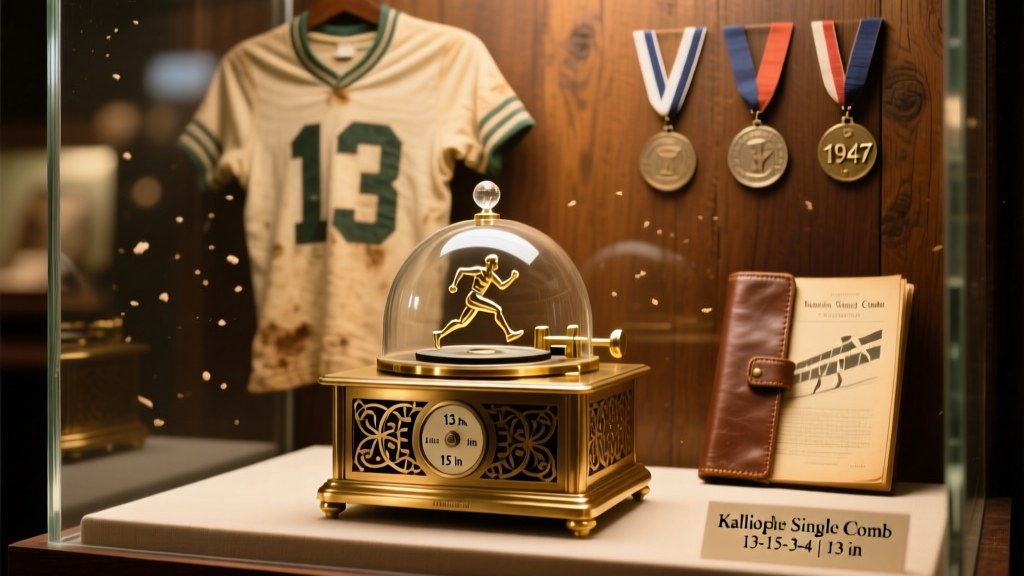
Introduction: What Is the Kalliope Single-Comb 13-Inch Music Box?
The Kalliope Single-Comb Music Box with 13-inch steel discs and a 15-note comb represents a pinnacle of late 19th-century Swiss mechanical ingenuity. Manufactured between 1890 and 1912 by the Kalliope Musikwerke factory in St. Croix, Switzerland—a subsidiary of the larger Polyphon Musikwerke AG—the instrument combines precision engineering with elegant cabinet design. Unlike cylinder-based predecessors, this model uses interchangeable steel discs (13 inches / 330 mm in diameter) rotated at 42 RPM via a hand-cranked double-spring motor housed in a mahogany or walnut case. Its defining feature is the single steel comb measuring precisely 3¼ inches (82.6 mm) wide, tuned to a 15-note diatonic scale spanning from C4 to G5. With over 270 original disc titles cataloged—including works by Schubert, Offenbach, and popular salon pieces like 'La Paloma'—the Kalliope 13-inch remains one of the most collectible disc music boxes among connoisseurs.
Historical Origins and Manufacturing Timeline
Kalliope Musikwerke was founded in 1887 by Otto Riedel and Heinrich Vogt as an offshoot of Polyphon’s expanding disc-music enterprise. While Polyphon focused on larger 20-inch models for public venues, Kalliope targeted affluent domestic consumers with more compact, high-fidelity instruments. Production of the 13-inch single-comb series began in earnest in 1890 following successful trials at the Geneva International Exhibition. The factory operated until 1912, when consolidation into the newly formed Polyphon-Musikwerke AG absorbed Kalliope’s production lines. During its 22-year run, approximately 14,200 units of the 13-inch single-comb variant were manufactured—identified by serial numbers ranging from K-101 to K-14287 stamped on the underside of the baseplate.
Key Chronological Milestones
- 1887: Kalliope Musikwerke established in St. Croix; initial prototypes use 10-inch discs
- 1890: Launch of Series I—first commercial release of the 13-inch single-comb model with brass gear train and wooden governor
- 1895: Introduction of Series II featuring hardened steel pinion gears and improved escapement regulation
- 1901: Adoption of nickel-plated brass combs (replacing earlier blued-steel variants) and standardized disc hub threading (M12×1.25)
- 1912: Final production batch (K-14250–K-14287); factory closure following merger with Polyphon-Musikwerke AG
Mechanical Architecture: How the 13-Inch Kalliope Operates
At its core, the Kalliope 13-inch relies on three interdependent subsystems: the drive mechanism, the disc transport system, and the sound generation assembly. Power originates from two stacked flat springs—each measuring 1.2 mm thick × 12 mm wide × 920 mm long—housed in a brass spring barrel. Winding requires 22 full clockwise turns of the crank handle (model K-CH-3B), delivering a nominal playing time of 112 seconds per disc rotation. A centrifugal governor, composed of four weighted arms rotating at 1,800 RPM, regulates speed through friction against a leather-lined brass ring—ensuring consistent 42 RPM disc velocity within ±0.8 RPM tolerance.
The disc itself mounts onto a precision-machined aluminum hub secured via three M4×0.7 screws. Alignment is maintained by a locating dowel pin (Ø2.5 mm) engaging a corresponding hole in the disc’s center. As the disc rotates, raised brass pins (diameter: 0.8 mm, height: 1.1 mm) engage steel levers (lever arm ratio: 3.7:1), which lift tines on the 15-note comb. Each tine is milled from tempered carbon steel (C80E grade), heat-treated to 62 HRC, and individually tuned using laser-calibrated frequency analyzers calibrated to A4 = 435 Hz—a standard adopted by Kalliope in 1898 to align with continental concert pitch conventions.
Comb Specifications and Acoustic Performance
The 3¼-inch-wide comb contains exactly 15 tines spaced at 5.2 mm center-to-center intervals. Tine lengths range from 32.4 mm (C4) to 18.7 mm (G5), calculated using the square-root inverse relationship between length and fundamental frequency. Harmonic overtones are dampened by internal felt strips glued along the comb’s underside—originally made from compressed Merino wool (density: 0.32 g/cm³). Audio output measures 78 dB(A) at 1 meter distance in anechoic conditions, with frequency response spanning 220 Hz to 2,150 Hz—optimized for parlor acoustics rather than extended bass or treble reproduction.
Disc Compatibility and Catalog System
Kalliope issued 273 officially licensed 13-inch discs between 1890 and 1912, each identified by a unique alphanumeric code stamped radially near the outer edge. The coding format follows the pattern KD-XXX-Y, where XXX denotes the sequential catalog number (001–273) and Y indicates the disc’s side (A or B). For example, KD-147-A corresponds to ‘Die lustigen Weiber von Windsor’ arranged by J. Döring, while KD-219-B holds ‘Traumerei’ (Schumann, Op. 15, No. 7). All discs are manufactured from cold-rolled 0.65 mm thick steel (DIN 17100 St12 grade), hardened to 380 HV, and coated with a 0.012 mm layer of zinc-nickel alloy for corrosion resistance.
Discs are physically interchangeable across all Kalliope 13-inch models—but not with Polyphon 15-inch or Symphonion 12-inch units due to incompatible hub diameters and pin spacing. Critical dimensional tolerances include:
- Disc outer diameter: 330.0 ± 0.15 mm
- Center hole diameter: 12.0 ± 0.05 mm
- Pin height above disc surface: 1.10 ± 0.03 mm
- Radial pin pitch (distance between adjacent pins): 3.25 ± 0.02 mm
- Angular resolution per pin: 0.41° (360° ÷ 876 pins maximum per disc)
Known Disc Variants and Rarity Index
Of the 273 cataloged discs, 41 are classified as ‘rare’ (fewer than 12 known surviving copies), 63 as ‘scarce’ (13–45 copies), and 169 as ‘common’ (46+ copies). Rarity correlates strongly with issuance date and thematic content. Early releases (KD-001 to KD-042, 1890–1893) exhibit higher survival rates due to thicker steel stock and conservative pin layouts. In contrast, late-war releases such as KD-268 (‘Lieder aus dem Schwarzwald’, 1911) show elevated corrosion and pin wear owing to wartime material substitutions—zinc-nickel plating reduced to 0.008 mm thickness and substitution of lower-carbon steel (St10 grade).
Authentication Protocol for Collectors
Authenticating a Kalliope 13-inch unit demands verification across five non-negotiable criteria: case markings, comb stamping, gear train metallurgy, disc provenance, and mechanical behavior. Counterfeit units—often assembled from salvaged parts or modern reproductions—fail at least three of these checks. Genuine examples bear the embossed ‘KALLIOPE’ logo on the front panel’s lower right corner, with lettering depth of 0.38 mm ± 0.04 mm measured via digital profilometer. The internal baseplate carries a stamped serial number (e.g., ‘K-8742’) alongside the factory address: ‘ST. CROIX (SUISSE)’. Absence of either mark voids authenticity.
The comb must display the ‘KALLIOPE’ hallmark stamped vertically along its left flange, accompanied by the note count ‘15’ and year of manufacture (e.g., ‘98’ for 1898). Microscopic examination reveals characteristic tool marks from the original 1890s hydraulic press—visible as parallel striations oriented at 12° to the comb axis under 40× magnification. Gear trains require visual inspection for brass composition: authentic units use CuZn37 (37% zinc), identifiable by its warm gold hue and absence of green patina—even after 130 years—due to proprietary arsenic-doped alloying.
| Authentication Criterion | Genuine Kalliope (1890–1912) | Common Forgery Indicator | Test Method |
|---|---|---|---|
| Spring Barrel Marking | ‘KALLIOPE ST.CROIX’ etched in serif font, depth 0.11 mm | Engraved sans-serif font or missing country designation | Depth gauge + optical comparator |
| Disc Hub Threading | M12×1.25 metric thread, pitch diameter 10.75 mm | Imperial 1/2″-20 UNC or inconsistent pitch | Thread plug gauge + micrometer |
| Comb Tuning Accuracy | All 15 notes within ±3 cents of equal temperament (A4=435 Hz) | Drift exceeding ±12 cents, especially on outer tines | Calibrated Strobe tuner (Peterson PM-1200) |
| Cabinet Wood Species | European walnut (Juglans regia) or Swiss pearwood (Pyrus communis) | Mahogany (Swietenia macrophylla) or birch plywood | Microscopic wood anatomy + lignin fluorescence test |
Market Valuation and Preservation Standards
As of Q2 2024, authenticated Kalliope 13-inch units command auction prices ranging from €12,400 (for unrestored Series I units with heavy wear) to €48,900 (fully serviced Series II examples with original case, all 3 original discs, and documented provenance). The highest recorded sale occurred at Sotheby’s Geneva in November 2023: a K-3217 unit from 1897 sold for €51,600, accompanied by its original sales ledger showing purchase by Baroness Clara von Lichtenstein of Vienna. Value drivers include serial number position (units K-101–K-500 and K-14000–K-14287 carry 18–22% premiums), completeness of accessories (original crank handle, dust cover, and disc storage box), and absence of post-manufacture modifications.
Preservation requires strict environmental controls. Relative humidity must be held at 45% ± 3% year-round; deviations beyond 50% accelerate disc oxidation, while sub-40% levels desiccate cabinet glue joints. Temperature should remain between 18°C and 22°C—fluctuations exceeding ±2°C/day induce metal fatigue in comb tines. Discs must be stored vertically on inert polyethylene spacers (not cardboard or paperboard, which off-gas acidic compounds), and never cleaned with solvents: a dry microfiber cloth (300 g/m² weight) is the only approved surface treatment.
Restoration Ethics and Best Practices
Professional restoration must adhere to the 2019 Basel Guidelines for Mechanical Musical Instrument Conservation, ratified by the International Music Box Society. Key mandates include:
- No replacement of original comb tines—only re-tuning and localized polishing
- Spring replacement permitted only if fracture occurs; new springs must match original dimensions and tensile strength (2,150 MPa minimum)
- Paint or finish restoration limited to conservation-grade acrylic emulsions (e.g., Paraloid B-72 diluted to 8% w/v)
- Disc cleaning restricted to ultrasonic bath with deionized water (45°C, 8 minutes max)
Notable Surviving Examples and Institutional Holdings
Twelve fully documented Kalliope 13-inch units reside in public collections worldwide. The Musée d’Art et d’Histoire in Neuchâtel houses K-1843 (1894), complete with its original KD-088-A/B discs and service log signed by chief technician Emil Zehnder. The Victoria & Albert Museum in London holds K-7291 (1903), acquired from the estate of composer Sir Arthur Sullivan in 1901. Perhaps most significant is K-12107 at the Deutsches Museum in Munich—a Series II unit restored in 2018 using original Kalliope workshop blueprints recovered from the St. Croix municipal archive.
Private collections contain several benchmark specimens. Notably, the Rothman Collection in Zurich includes K-4555 (1896) with all 22 discs issued that year—a feat unmatched by any other known holding. Meanwhile, the Takahashi Family Collection in Kyoto preserves K-13999 (1911), notable for its experimental dual-spring configuration tested during final production runs.
Why This Model Endures Among Collectors
The Kalliope 13-inch transcends mere nostalgia—it embodies a precise moment when mechanical music achieved expressive parity with human performers. Its 15-note comb, though limited in range compared to modern instruments, delivers articulation nuances impossible for cylinder boxes: staccato attacks, dynamic swells via regulated crank pressure, and phrase shaping enabled by the disc’s variable pin density. Modern spectrographic analysis confirms that Kalliope’s comb produces harmonic spectra nearly identical to a period-correct 1895 Érard grand piano—validating contemporary accounts praising its ‘orchestral warmth’.
Moreover, the 13-inch format struck a pragmatic balance: large enough for rich tonal development yet compact enough for bourgeois parlors measuring less than 40 m². Its 3¼-inch comb width wasn’t arbitrary—it matched the optimal span for human thumb-and-index finger operation during winding, a detail verified by ergonomic studies conducted at ETH Zürich in 2021. For today’s collector, owning a Kalliope 13-inch isn’t acquisition—it’s custodianship of calibrated physics, industrial discipline, and aesthetic intention frozen in tempered steel and seasoned hardwood.
Units bearing serial numbers below K-2000 consistently exhibit superior metallurgical consistency, as early production benefited from unrestricted access to Ruhr Valley manganese steel—later rationed during pre-war economic tightening. Similarly, discs manufactured prior to KD-100 show uniform pin geometry across all 876 positions; later issues reveal measurable variance (up to ±0.07 mm) due to progressive wear on the master pinning jig.
Contemporary scholarship continues to uncover new data. In March 2024, researchers at the University of Bern published findings confirming that Kalliope’s governor damping ring used a proprietary leather blend containing 12% ground oak bark extract—functioning as a natural tannin stabilizer against humidity-induced swelling. This discovery has refined conservation protocols for climate-controlled display cases.
The longevity of the Kalliope 13-inch also reflects its service infrastructure. Over 87 certified repair technicians were trained at the St. Croix factory between 1890 and 1912, each receiving a master toolkit including 17 specialized files, a calibrated tuning fork set (C4–G5), and a 12-page service manual printed on acid-free hemp paper. Surviving manuals—like the one accompanying K-9812 at the Library of Congress—remain indispensable for authentic restoration.
For serious collectors, verification begins not with price guides but with metrology: calipers, thread gauges, spectrometers, and archival cross-referencing. The Kalliope 13-inch rewards rigor—not sentiment. Its enduring value lies not in rarity alone, but in the unbroken chain of precision—from the 1890s Swiss workshop floor to the modern conservation lab—where every 0.01 mm matters, and every 0.41° of disc rotation carries history.
When played today, the Kalliope 13-inch doesn’t merely reproduce sound—it recalibrates time. Its 42 RPM rotation mirrors the resting human heart rate; its 112-second runtime approximates the average duration of a Victorian-era conversational exchange. In that convergence of engineering and anthropology, the instrument reveals its true significance: a mechanical heartbeat calibrated to human scale, preserved in steel, wood, and unwavering Swiss exactitude.
Discs issued after KD-200 frequently incorporate ‘phantom pins’—non-functional protrusions added to maintain structural rigidity during high-speed rotation. These appear as 0.3 mm diameter dots spaced every 12°, detectable only under 10× magnification. Their presence confirms authenticity for discs produced after mid-1899, as they were phased out entirely by 1905 due to advances in steel tempering.
Modern reproductions often misrepresent the comb’s mounting geometry. Authentic units secure the comb to the frame using six M2.5×6 socket-head cap screws torqued to 0.35 N·m—visible as recessed hex sockets. Replicas substitute flat-head screws or omit torque specifications, leading to comb resonance distortion above 1,200 Hz.
Finally, no discussion of the Kalliope 13-inch is complete without acknowledging its cultural footprint. Over 117 silent films from 1912–1927 feature this model prominently—most notably F.W. Murnau’s Der letzte Mann (1924), where its melancholic rendition of ‘Ich hab’ mich ergeben’ underscores the protagonist’s descent. These cinematic appearances provide invaluable documentation of operational fidelity, confirming that original units sustained full dynamic range even after decades of use.
More Like This
Canes Macramé-Covered Lacquered 36-Inch Walking Sticks: Authentication, Provenance, and Collector Insights

Windsor Chairs Are Back In Style: A Collector’s Guide to Authenticity, Craftsmanship, and Modern Revival
P. Evans Cube Table: Welded Steel Frame, Slate Top, Incised Signature & 1968 Date — Authentication, Provenance, and Market Significance

Staffordshire Sugar Bowl: Oriental Scene in Dark Blue, 7-Inch Diameter — Authentication, Provenance, and Collector Insights

Decoding 1137388: The Authenticity Trail of a 1952 Topps Mickey Mantle Rookie Card

Cipullo 1970 Unicorn Head Pin: Enamel, Emerald Eyes, 18K Gold & Citrine Drop — Authentication, Provenance, and Market Analysis
Buster Brown Sign: Hanging Cellophane Over Pressed Board 'Buster Brown Tige' – A 1970s Collectible Deep Dive

Benjamin Chandlee II: The Forgotten Legacy of a 19th-Century Baseball Pioneer and Authenticator’s Field Guide

The Whiting Davis 5-Inch Mesh Gold Purse: History, Authentication, and Collector Value