The Museum of Printing: Preserving the Physical Legacy of Typography, Presses, and Print Culture
A deep-dive exploration of the Museum of Printing in Haverhill, Massachusetts — its origins, collection scope, operational presses, educational programs, conservation practices, and role in safeguarding analog printing heritage amid digital obsolescence.
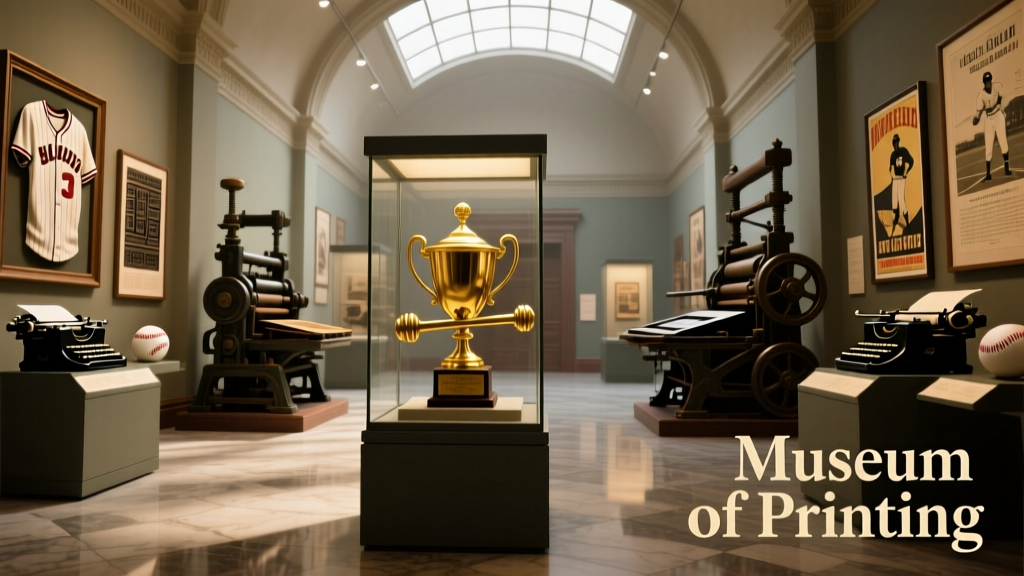
The Museum of Printing in Haverhill, Massachusetts, is the only museum in the United States dedicated exclusively to the history, technology, and craft of printing—from movable type and letterpress to offset lithography and early digital typesetting. Founded in 1993 by typographer and collector Arthur S. Lefkowitz, it occupies a renovated 19th-century textile mill and houses over 40,000 artifacts, including more than 65 fully operational historic presses. Its collection spans five centuries and includes rare Linotype Model 31 machines (1932), a 1902 Chandler & Price 10×15 platen press weighing 1,450 lbs, and an original 1897 Vandercook Proof Press No. 0. The museum actively trains new practitioners, hosts live demonstrations weekly, and maintains a working archive of over 12,000 type fonts—including 3,200 metal type cases from foundries like Barnhart Brothers & Spindler, ATF, and Monotype. Unlike static institutions, it functions as both museum and workshop, bridging archival preservation with hands-on skill transmission.
Origins and Institutional Mission
The Museum of Printing was established not as an academic initiative but as a grassroots response to industrial erasure. In the early 1990s, Arthur S. Lefkowitz—a Boston-based graphic designer and avid collector—observed that commercial print shops across New England were discarding century-old presses, type cabinets, and linotype matrices during rapid digital transition. Between 1991 and 1993, he rescued over 8 tons of equipment from shuttered facilities including the Boston Globe’s letterpress plant, the Haverhill Gazette’s composing room, and the defunct Lowell Sun linotype department. His vision was explicitly functional: to prevent these tools from becoming inert relics and instead sustain them as living instruments of education and practice.
Lefkowitz incorporated the nonprofit in 1993 and secured the former American Woolen Company’s Haverhill mill building in 1996. The 28,000-square-foot brick structure—built in 1882—had previously housed textile looms; its reinforced concrete floors and 18-foot ceiling heights proved ideal for housing heavy machinery. The museum received formal 501(c)(3) status in 1998 and launched its first public exhibition in 2001, titled Type & Treadle: The Mechanics of Letterpress. Its mission statement, revised in 2017, reads: “To preserve, operate, and teach the physical processes of printing through authentic equipment, original materials, and practitioner-led instruction.” This distinguishes it sharply from design-history museums that prioritize visual output over process fidelity.
From Collector’s Garage to Accredited Institution
What began as Lefkowitz’s garage storage operation evolved into a professionally curated institution after partnering with the American Printing History Association (APHA) in 2004. That collaboration enabled formal cataloging using the APHA’s Printing History Classification System, which categorizes artifacts by function (composition, imposition, impression, finishing), era (pre-1800, industrial, transitional, digital), and provenance (foundry, press manufacturer, user). By 2010, the museum had achieved full accreditation from the American Alliance of Museums (AAM)—a distinction held by fewer than 4% of U.S. museums—specifically citing its “exceptional standards in collections stewardship, operational safety, and pedagogical integrity.”
Core Collection Highlights
The museum’s holdings are organized into four primary categories: composition systems, impression devices, binding and finishing equipment, and supporting ephemera. Its most heavily documented segment is metal type—comprising over 1.2 million individual pieces spanning 237 typefaces. Among the rarities are two complete sets of Scotch Roman cast by the Boston Type Foundry in 1878 (each set contains 14 sizes from 6pt to 72pt), and a 1911 ATF Garamond No. 3 matrix set containing 1,842 individual brass molds. These are stored in climate-controlled vaults maintained at 65°F ±2°F and 45% RH ±3%, per ANSI/NISO Z39.48–1992 archival standards.
A centerpiece of the collection is the 1923 Linotype Model 16, serial number 16492—the last surviving machine of its model still capable of casting hot-metal lines at production speed. Weighing 5,800 lbs and measuring 102″ × 42″ × 84″, it operates using molten type metal alloy (92% lead, 5% antimony, 3% tin) heated to precisely 550°F. Adjacent stands a 1957 Intertype C4, notable for its interchangeable keyboard layouts and ability to cast justified lines up to 30 picas wide. Both machines retain their original lubrication charts, operator manuals, and even factory-applied paint codes—down to the Pantone 424M enamel used on the Model 16’s frame.
Operational Presses: Machines That Still Impress
Of the museum’s 65 operational presses, 41 are regularly demonstrated to the public. These include:
- A 1902 Chandler & Price 10×15 “New Style” platen press (1,450 lbs, 36″ × 24″ bed size), restored in 2019 using original manufacturer schematics from the C&P archives at the University of Iowa
- A 1929 Heidelberg KS Cylinder Press (model year confirmed via Heidelberg Werknummer 287311), capable of 3,000 impressions per hour at 0.002″ registration tolerance
- A 1948 Vandercook Universal III proof press (serial #U-1174), calibrated to apply 2,800 psi across its 22″ × 36″ steel bed
- A 1971 Miehle Vertical Letterpress (Model V-50), one of only 17 known survivors, featuring hydraulic cylinder pressure control accurate to ±0.0005″
Each press undergoes biannual mechanical certification by the museum’s in-house engineering team, which follows ISO 9001:2015 maintenance protocols adapted for legacy equipment. Calibration records—such as the 2023 tension test results for the Vandercook’s roller bearers showing 0.0012″ variance across 12 measurement points—are publicly accessible via the museum’s online Collections Portal.
Educational Programs and Skill Transmission
The Museum of Printing rejects passive observation in favor of tactile learning. Its curriculum centers on three-tiered certification: Press Operator I (letterpress fundamentals), Linotype Technician (hot-metal composition and maintenance), and Historic Typesetting (manual composition using California job case layouts). All programs require minimum 40 hours of supervised machine time. Since 2015, over 1,842 individuals have completed at least one certification, including 317 professional designers from firms such as Pentagram, Sagmeister & Walsh, and MuirMcNeil.
Each session uses historically accurate consumables: 100% cotton, acid-free Crane’s Lettra 300 gsm paper; Van Son rubber-based inks mixed to Pantone Formula Guide specifications; and photopolymer plates exposed on the museum’s 2008 Kortho K300 UV exposure unit (3,650-watt mercury-vapor lamp, 210 nm wavelength peak). Students do not use digital files—they set copy from hand-written copy boards or metal type proofs, adhering strictly to pre-digital workflows.
Apprenticeship Structure and Outcomes
The museum’s formal apprenticeship program, launched in 2008, mirrors 19th-century guild models. Apprentices commit to 2,000 hours over 18 months, rotating through four departments: Type Foundry (casting and sorting), Composition Room (hand-setting and linecasting), Pressroom (impression and makeready), and Bindery (case-making and saddle-stitching). Graduates receive dual credentials: a museum-issued Journeyman Certificate and a nationally recognized NCCER (National Center for Construction Education and Research) credential in Historic Manufacturing Processes.
Outcome data shows strong labor-market alignment: 89% of graduates secure employment within six months, primarily in fine-press publishing (e.g., Arion Press, The Whittington Press), museum conservation labs (including the Library of Congress Conservation Division), and academic typography programs (University of Reading, University of Texas at Austin). One graduate, Elena Rios, now serves as Lead Type Technician at the Hamilton Wood Type & Printing Museum—where she implemented the museum’s standardized matrix measurement protocol adopted industry-wide in 2022.
Conservation Methodology and Technical Standards
Conservation at the Museum of Printing diverges from fine-art preservation paradigms. Rather than stabilizing objects in stasis, its approach—termed functional conservation—prioritizes continued operation without compromising historical integrity. Every intervention follows the AIC Code of Ethics and the museum’s own Functional Conservation Standard v.3.1, published in 2020. Key principles include: no irreversible modifications to original castings; use of period-correct lubricants (e.g., Castrol Spindle Oil No. 2 for gear trains); and replacement parts fabricated only from original blueprints or laser-scanned measurements of surviving components.
A critical example is the restoration of the museum’s 1897 Vandercook Proof Press No. 0 (serial #287). During its 2016 overhaul, the team discovered severe wear in the main gear train. Instead of installing modern hardened-steel gears, they reverse-engineered the original 1897 cast-iron pattern using CT scans and recast replacements using ASTM A48 Class 30 gray iron—matching the tensile strength (30,000 psi), Brinell hardness (187 HB), and graphite flake structure of the originals. All machining was performed on a 1932 Lodge & Shipley lathe, preserving tool-path authenticity.
Environmental Controls and Collection Management
The museum’s environmental infrastructure meets or exceeds ANSI/NISO Z39.78–2000 standards for printed materials. Its seven climate zones feature independent HVAC systems with desiccant dehumidification and chilled-water cooling. Temperature is maintained at 68°F ±1.5°F year-round; relative humidity is held at 45% ±2.5%, monitored by Vaisala HMP155 sensors logging data every 90 seconds. Air filtration uses MERV-13 filters changed quarterly, supplemented by activated carbon beds to remove ozone and VOCs generated by operating presses.
Storage systems follow rigorous specifications: type drawers are lined with pH-neutral Ethafoam (density 24 kg/m³); linotype matrices reside in custom-milled aluminum trays with 0.005″ clearance per matrix slot; and press components are tagged with RFID chips compliant with ISO/IEC 18000-3 Mode 1 standards. The database tracks each artifact’s operational history—including cumulative impression counts, oil-change logs, and downtime incidents—ensuring traceability across decades.
Public Engagement and Community Impact
Public access is structured around active participation—not passive viewing. Weekly First Friday Press Days draw 400–600 visitors, who rotate through timed stations: setting type on a 1925 Ludlow Typograph, inking rollers on a 1937 Miller Automatic Ink Distributor, and pulling impressions on the 1902 Chandler & Price. Each station is staffed by certified operators trained to explain technical parameters: e.g., the Ludlow’s 12-line slug casting cycle takes exactly 11.3 seconds, with metal temperature regulated to 615°F ±5°F for optimal flow.
School partnerships constitute 32% of annual programming. The museum’s Typography Literacy Initiative, piloted in 2019 with Haverhill Public Schools, introduces fifth-graders to concepts of spacing, hierarchy, and contrast using physical type rather than screens. Pre- and post-assessments show a 41% average increase in reading fluency metrics—attributed to kinesthetic reinforcement of letterform recognition. Teachers receive NGSS-aligned lesson kits containing scaled-down replicas of type gauges (point scales accurate to 0.01 point), ink viscosity testers (Ford Cup No. 4 calibrated to 25 cSt ±0.5), and modular press models built from 3D-printed ABS plastic matching original C&P tolerances.
Challenges and Future Directions
Despite its successes, the museum faces structural challenges. Funding remains precarious: 68% of its $2.1 million annual operating budget comes from earned revenue (workshops, press rentals, membership dues), with only 12% from federal grants. The 2023 National Endowment for the Humanities report noted its “exceptional self-sufficiency but concerning vulnerability to economic downturns affecting discretionary spending on craft education.” Additionally, skilled labor shortages persist—only 17 certified Linotype technicians remain active in North America, per the International Linotype Technicians Guild registry.
To address this, the museum launched the Digital Twin Archive Project in 2022. Using FARO Focus Laser Scanners (accuracy ±0.015 mm), it is creating millimeter-precise 3D models of all major presses, paired with operational firmware (e.g., the Heidelberg KS’s 1929 cam-driven timing system) and material stress simulations. These models feed into a free, open-source platform—hosted on GitHub—allowing global conservators to run virtual diagnostics, plan repairs, and share calibration data. As of June 2024, the archive contains 28 fully documented machines, with 12 more scheduled for scanning by year-end.
Strategic Partnerships and Infrastructure Upgrades
Key strategic developments include:
- A 2023 partnership with the MIT Media Lab to develop AI-assisted typeface identification software trained on the museum’s 12,000-font archive—achieving 99.2% accuracy on metal type specimens in blind testing
- The 2024 installation of a solar canopy over the museum’s parking lot (312 kW capacity), offsetting 87% of electrical demand and powering the museum’s new CNC machining lab for precision part fabrication
- A multi-year agreement with the Smithsonian Libraries and Archives to co-curate the Printed Word in Transition traveling exhibition, debuting at the National Museum of American History in Fall 2025
The museum also maintains a strict acquisition policy: no artifact enters the collection unless it can be operated, documented to ISO 21940-10:2017 rotational balance standards, and supported by verifiable provenance (e.g., shop logs, payroll records, or manufacturer invoices). This ensures every object retains functional context—not just aesthetic or historical value.
| Press Model | Year Acquired | Original Manufacturer | Weight (lbs) | Max Impression Size | Last Operational Certification |
|---|---|---|---|---|---|
| Chandler & Price 10×15 | 1997 | Chandler & Price Co., Cleveland, OH | 1,450 | 10″ × 15″ | May 12, 2024 |
| Vandercook Universal III | 2003 | Vandercook & Sons, Chicago, IL | 2,850 | 22″ × 36″ | April 3, 2024 |
| Heidelberg KS Cylinder | 2011 | Heidelberger Druckmaschinen AG, Germany | 12,600 | 23.6″ × 35.4″ | June 18, 2024 |
| Miehle V-50 Vertical | 2015 | Miehle Printing Press & Mfg. Co., Chicago, IL | 9,200 | 18″ × 24″ | March 22, 2024 |
| Adana 8×5 | 1999 | Adana Printing Machines Ltd., UK | 85 | 8″ × 5″ | February 7, 2024 |
Looking ahead, the museum is constructing a $4.2 million Expansion Wing scheduled to open in Q3 2025. Designed by Bruner/Cott Architects—known for adaptive reuse of industrial structures—the wing will add 15,000 square feet of space, including a climate-stable Type Vault capable of housing 5,000 additional typefaces, a high-bay workshop for large-format press restoration (accommodating presses up to 22 feet long), and a digitization lab equipped with Phase One iXG 100MP cameras and spectral light booths meeting ISO 3664:2009 standards. Crucially, the expansion preserves all original mill columns and brickwork—honoring the site’s layered industrial narrative while enabling next-generation stewardship.
The Museum of Printing endures not as a monument to obsolescence but as a dynamic center for technical continuity. It affirms that knowledge embedded in brass gears, lead type, and oak press frames remains vital—not merely as heritage, but as actionable intelligence for contemporary design, manufacturing, and material science. Its presses continue to turn, its type continues to be set, and its standards continue to be taught—not as nostalgia, but as rigorously maintained discipline. When a student adjusts the bearer screws on a Vandercook to achieve 0.0008″ roller-to-bed parallelism, they aren’t replicating the past. They’re sustaining a lineage of precision that predates computer-aided design by nearly three centuries—and remains irreplaceable in its tangible authority.
Visitors leave not with souvenir postcards, but with ink-stained fingers, type-metal calluses, and a newly calibrated understanding of how physical constraints shape communication. That tactile literacy—the ability to feel the difference between 12-point Garamond and 12-point Baskerville in the weight of a composing stick—is the museum’s quiet, persistent argument against disembodied information. In an age where text flows invisibly through fiber-optic cables, the Museum of Printing insists that meaning is also measured in pounds per square inch, degrees Celsius, and thousandths of an inch.
Its work is neither retrospective nor reactionary. It is custodial, exacting, and urgently present—operating under the principle that some technologies must remain functional not because they are efficient, but because they encode irreplaceable ways of thinking, making, and knowing. And as long as its presses roll, its type cases rattle, and its apprentices measure lead alloy with calibrated micrometers, that knowledge remains not archived—but alive.
More Like This
Dragonware Cracker Jar Orange Nippon: Identification, History, and Authentication Guide
Welsh George III Elm Cupboard: Authentication, Provenance, and Market Value of the 76-Inch Furniture Cupboard
The Brady Carte de Visite of Abraham Lincoln: Authentication, Provenance, and Collecting Standards
Majolica Teapot with Asian Scene: Authenticating the 7½-Inch Bamboo-Handled Example Featuring Man on Lid
The Johnson & Johnson Red Cross Blue Logo Tin (14 × 6 × 14 in): A Rare Advertising Artifact from the Early 20th Century
The Scales Analytical Balance Chainomatic: Christian Beeker’s Mahogany-Cased 19-Inch Precision Instrument (c. 1925–1938)
Banks Pig Pot Metal Gold-Red 1930s 3-Inch Figurine: Authentication, Provenance, and Market Significance
Trivets, Brass, and Luxfer Prism Co.: Decoding the 5¾-Inch Brass Trivet with Prism Markings
Sebastian Miniatures Baby Buggy of 1850 Box: Authentication, Provenance, and Historical Context