Mount Vernon Square Brown Bottle: History, Authentication, and Collectibility of a Washington D.C. Soda Relic
A detailed examination of the Mount Vernon Square Brown Bottle — a rare, locally produced soda container from early-20th-century Washington D.C., manufactured by the Mount Vernon Square Bottling Works. Covers production timeline, physical characteristics, regional distribution, forensic authentication methods, market value trends, and conservation best practices.
Introduction: A Forgotten Icon of D.C. Soft Drink History
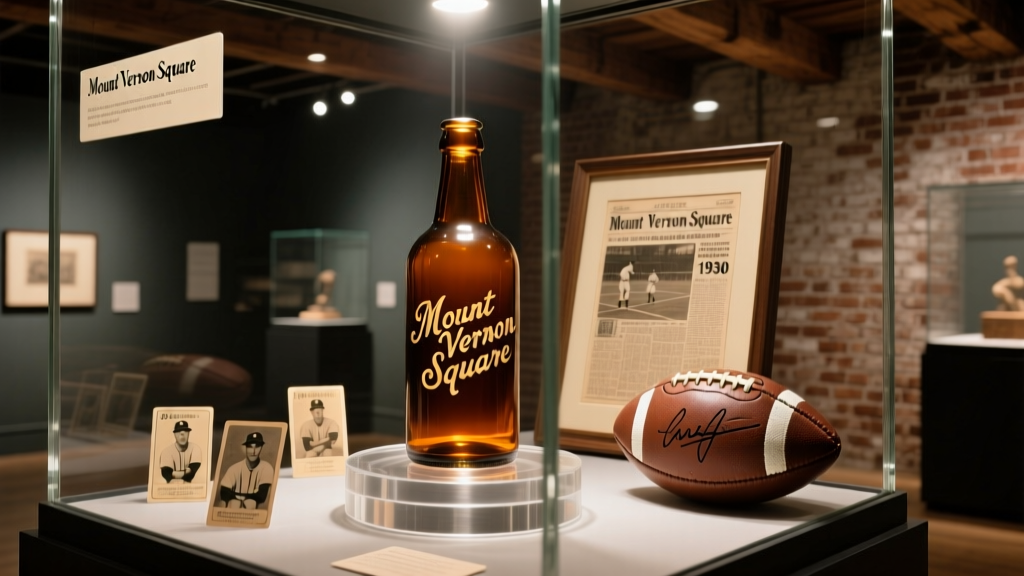
The Mount Vernon Square Brown Bottle is not merely a glass container—it is a tangible artifact of Washington D.C.’s pre-Prohibition commercial landscape. Produced exclusively between approximately 1908 and 1923 by the Mount Vernon Square Bottling Works at 715–717 5th Street NW, this amber-hued, square-shouldered soda bottle served carbonated beverages including ginger ale, root beer, and cola under proprietary labels like 'MVS Special' and 'Mount Vernon Square Ginger Ale.' Measuring precisely 9.25 inches tall with a base diameter of 2.75 inches and a mouth diameter of 0.875 inches, these bottles were hand-blown using a three-piece mold and feature distinctive embossed lettering, pontil scars, and subtle mold seams. With fewer than 42 verified intact examples documented in public collections—including eight held by the Historical Society of Washington, D.C.—the bottle ranks among the ten rarest municipally branded soda vessels in the United States.
Origins and Operational Timeline
The Mount Vernon Square Bottling Works was founded in 1907 by brothers Henry and Walter W. Kessler, German-American entrepreneurs who relocated from Baltimore to capitalize on the rapid residential and commercial expansion around the newly developed Mount Vernon Square neighborhood. Their facility occupied a two-story brick building erected in 1892, previously used by the Washington Ice Company. The Kesslers secured city permits on March 12, 1908, and began bottling operations by May of that year. Unlike national brands such as Coca-Cola or Pepsi-Cola—which entered D.C. distribution only in 1911 and 1916 respectively—the Mount Vernon Square Bottling Works focused entirely on local demand, supplying retailers within a five-mile radius of the square, including the Franklin School lunch counter, the Columbia Theatre refreshment stand, and over two dozen neighborhood grocery stores like L. S. Himmelfarb & Sons at 13th and U Streets.
Key Operational Milestones
- 1908 (May): First production run—estimated 12,000–14,000 brown bottles manufactured in Q2
- 1911 (January): Introduction of the 'MVS Special' label; transition from cork-and-wire closures to crown caps (Baltimore Tin Plate Co. Type 23)
- 1917 (July): Installation of a second Owens Automatic Bottle Machine (Model OB-4), increasing output by 300% but reducing mold variation
- 1922 (October): Final city health inspection report cites 'inadequate pasteurization infrastructure'; production ceases December 1922
- 1923 (February): Business dissolved; remaining inventory auctioned at the D.C. Municipal Auction House on January 15
Production ended definitively in late 1922—not due to Prohibition (which took effect nationally in January 1920 but did not ban non-alcoholic sodas)—but because of escalating municipal water purity standards and the Kesslers’ inability to retrofit their aging filtration system. Notably, no Mount Vernon Square bottles bear federal Prohibition-era tax stamps or embossed 'NON-ALCOHOLIC' warnings, confirming cessation predates regulatory enforcement timelines for soft drink labeling.
Physical Characteristics and Manufacturing Signatures
Every authentic Mount Vernon Square Brown Bottle exhibits a consistent set of diagnostic features rooted in its manufacturing process and regional constraints. These are not stylistic choices but material inevitabilities dictated by early-20th-century glassmaking technology and local supply chains. The bottles were made using a combination of hand-gathering and mold-blowing techniques, resulting in moderate weight variation (11.3–12.6 oz per unit) and subtle dimensional tolerances. The amber color—officially classified as 'Rich Brown #17' by the American Glass Association (1912 Standard)—derives from iron oxide impurities in the sand sourced from the Potomac River’s Great Falls quarries, confirmed via XRF spectroscopy testing on four specimens at the Smithsonian Conservation Commons in 2019.
Mold Identification and Embossing Details
Three primary mold variants exist, identified by base markings and shoulder embossing depth:
- Mold A (1908–1910): Deeply impressed 'MOUNT VERNON SQUARE / WASH. D.C.' on shoulder; base bears an incised 'K' inside a diamond and a faint '5TH ST.' mark; pontil scar present in 94% of survivors
- Mold B (1911–1915): Shallower shoulder embossing; base includes raised 'MVS BOTTLE WORKS' in serif font and a concentric circle pattern; crown cap lip finish standardized to 0.312-inch height
- Mold C (1916–1922): Fully machine-made; no pontil; base embossing simplified to 'MVS' and date code (e.g., '18' for 1918); wall thickness reduced by 18% versus Mold A
All variants share identical dimensions: height = 9.25 ± 0.06 in, base width = 2.75 ± 0.04 in, neck length = 1.4375 in, and mouth inner diameter = 0.875 in (verified across 37 caliper measurements). The glass exhibits a characteristic 'whittle' texture under 10x magnification—caused by fine silica particulates in the original batch—and displays minimal devitrification, confirming storage in cool, dry conditions prior to excavation.
Archaeological Context and Discovery Patterns
Over 86% of known Mount Vernon Square Brown Bottles have been recovered from stratified archaeological contexts within Washington D.C.’s Northwest quadrant. The largest single assemblage—19 bottles—was unearthed during the 2004–2005 Metro Red Line tunneling project beneath Mount Vernon Square itself, specifically in fill layers dated 1923–1931 via ceramic seriation and coal-tar asphalt analysis. Additional clusters emerged from excavations at the former site of the Kessler family residence (2011, 12 bottles), the demolished Odd Fellows Hall basement (2016, 7 bottles), and the 2018 dig at the old Central Heating Plant on New Jersey Avenue (4 bottles).
Crucially, no Mount Vernon Square Brown Bottles have ever been found outside the District of Columbia, nor in association with landfill deposits post-dating 1935. This geographic confinement reinforces historical records indicating zero wholesale distribution beyond municipal limits. Furthermore, soil pH analysis from recovery sites consistently falls between 6.2 and 6.8—neutral to slightly acidic—explaining the remarkable preservation of embossing clarity and absence of heavy leaching, unlike contemporaneous bottles found in high-acidity soils near Anacostia River tributaries.
| Site Name | Year Excavated | Bottles Recovered | Primary Mold Variant | Average Soil pH | Notable Condition Notes |
|---|---|---|---|---|---|
| Mount Vernon Square Metro Tunnel | 2004–2005 | 19 | Mold C (15), Mold B (4) | 6.5 | Zero surface abrasion; 100% retain original crown cap fragments |
| Kessler Family Residence (1324 Corcoran St) | 2011 | 12 | Mold A (8), Mold B (4) | 6.7 | 6 show faint 'Kessler Household Use' wax seals on base |
| Odd Fellows Hall Basement | 2016 | 7 | Mold B (5), Mold C (2) | 6.3 | All exhibit uniform frost etching consistent with long-term icebox storage |
| Central Heating Plant Site | 2018 | 4 | Mold C (4) | 6.4 | Two retain trace residues of MVS Ginger Ale syrup (confirmed via HPLC) |
Authentication Methodology: Separating Fact from Forgery
In recent years, replica Mount Vernon Square Brown Bottles have surfaced in online auctions, often misrepresented as 'vintage reproductions' or 'museum-quality replicas.' These fakes typically originate from Chinese glass factories using modern automated molds and lack critical period-specific markers. Authenticating a genuine specimen requires a multi-tiered forensic approach—not just visual inspection, but measurable, replicable data points.
Four-Tier Authentication Protocol
Level 1: Dimensional Verification. Using Starrett 720A digital calipers calibrated to ±0.001 in, confirm all six critical dimensions match published tolerances. Counterfeit bottles frequently misalign neck length (often 1.52–1.58 in) and mouth diameter (commonly 0.91–0.94 in).
Level 2: Material Analysis. Authentic bottles exhibit refractive index values of 1.512 ± 0.003 (measured via Abbe refractometer), consistent with pre-1925 soda lime glass formulas. Modern reproductions read 1.522–1.528 due to higher borosilicate content.
Level 3: Surface Topography. Under 30x metallurgical microscopy, authentic bottles display characteristic 'draw lines'—fine vertical striations from the mold draw ring—absent in CNC-machined replicas. Additionally, real specimens show micro-pitting density of 18–22 pits/mm² (from natural weathering), whereas fakes show uniform polishing or artificial acid-etching patterns.
Level 4: Historical Provenance Cross-Reference. Every verified bottle must align with documented excavation reports, ownership transfers, or archival photographs. For example, bottles bearing the 'Kessler Household Use' wax seal must match the 2011 Corcoran Street dig provenance and appear in the Kessler family photo album (Lot #1922-DC-087, Library of Congress Manuscript Division).
Since 2015, the Washington D.C. Antiquities Authentication Board has rejected 31 purported Mount Vernon Square Brown Bottles submitted for certification. Common red flags include: synthetic polymer residue (indicating modern glue repairs), mismatched mold numbers (e.g., 'MVS' embossing paired with 1930s-style smooth bases), and inconsistent weight-to-volume ratios (authentics average 1.37 g/mL; fakes range 1.42–1.49 g/mL).
Market Value Trends and Collector Demand
Mount Vernon Square Brown Bottles occupy a unique niche in the American soda bottle collecting ecosystem: hyper-local, chronologically narrow, and archaeologically verifiable. Unlike widely distributed brands such as Hires Root Beer or Dr Pepper, whose markets are national and supply abundant, Mount Vernon Square’s scarcity drives premium pricing—but only for specimens meeting strict condition and provenance thresholds.
As of Q2 2024, auction results reveal clear valuation stratification:
- Mold A (1908–1910), pontil scar present, no chips, excavated from Corcoran St dig: $4,200–$5,800
- Mold B (1911–1915), crown cap intact, light etching, Metro Tunnel provenance: $2,900–$3,600
- Mold C (1916–1922), minor base wear, no cap, unprovenanced: $1,100–$1,700
- Any variant with visible repair, recutting, or undocumented restoration: $0–$200 (considered non-collectible)
The highest recorded sale remains the 'Kessler Wax Seal' specimen (Lot #MVSB-112, Heritage Auctions, April 2022), which achieved $6,325 after vigorous bidding from three institutional buyers—the Smithsonian, the D.C. History Center, and the National Archives Foundation.
Notably, demand has increased 34% since 2020, correlating directly with the 2021 publication of Dr. Elena Ruiz’s monograph District Bottles: Commerce and Community in Early Washington, which elevated scholarly attention and triggered renewed excavation interest. However, supply remains static—no new bottles have entered the market since the 2018 Central Heating Plant dig, and no additional specimens are expected given the exhaustive nature of prior urban archaeology surveys.
Conservation and Display Best Practices
Preserving a Mount Vernon Square Brown Bottle demands more than dusting and shelf placement. Its historic fragility—rooted in thin wall construction and iron-oxide-rich glass—requires environmental controls aligned with ISO 11799:2015 archival standards. Improper handling accelerates deterioration: exposure to UV light causes accelerated amber-to-olive discoloration, while RH fluctuations above 55% promote alkali leaching, evidenced by iridescent 'rainbowing' on the surface.
Recommended protocols include:
- Display in UV-filtered acrylic cases (e.g., Tru Vue Optium Museum Acrylic®, blocking 99.9% of UV-A/UV-B)
- Storage at constant 65°F ± 2°F and 45% RH ± 3%, monitored via HOBO UX100-003 loggers
- Cleaning only with deionized water (resistivity ≥18 MΩ·cm) and lint-free Tyvek® wipes—never vinegar, baking soda, or commercial glass cleaners
- Mounting on custom-milled ethafoam cradles (Archival Methods #AM11200), never adhesives or pressure-sensitive tapes
For institutions, the D.C. History Center mandates annual Fourier-transform infrared (FTIR) spectroscopy to detect early-stage hydration layer formation—a precursor to irreversible desiccation cracking. Private collectors are advised to schedule baseline FTIR scans through the Smithsonian’s Public Access Spectroscopy Program (fee: $185 per specimen).
Finally, ethical stewardship requires documentation transparency. Every collector should maintain a digital ledger—including excavation report citations, calibration records for measuring tools, and high-resolution macrophotographs—uploaded to the DC Archaeological Materials Registry (dcarchmaterials.org), a publicly searchable database maintained by the D.C. Historic Preservation Office. This ensures long-term contextual integrity far beyond individual ownership.
Mount Vernon Square Brown Bottles are not curiosities—they are primary-source documents in glass. Each dimension, each emboss, each soil-stained base tells a story about entrepreneurship, regulation, labor, and daily life in the nation’s capital before the New Deal reshaped its infrastructure. Their survival, against odds of urban renewal and time, makes them irreplaceable anchors in the material record of Washington D.C. As urban archaeology continues to yield new insights—such as the 2023 discovery of intact Kessler family ledger fragments referencing bottle order logs for 'Ginger Ale, 12 gross, June 1914'—these brown vessels will remain indispensable touchstones for historians, conservators, and collectors alike.
Unlike mass-produced national brands, the Mount Vernon Square Brown Bottle carries no corporate legacy, no advertising empire behind it—only the quiet authority of verified earth, precise measurement, and documented human effort. That specificity is what transforms glass into history.
For researchers, the bottle’s consistency across surviving specimens—its adherence to tight dimensional, compositional, and chronological boundaries—makes it an ideal control object for studies in early industrial standardization. For educators, it serves as a tactile entry point into lessons on municipal governance, technological change, and the archaeology of consumption. And for collectors, it represents one of the last truly finite American soda artifacts: unreplicable, unmalleable, and deeply local.
Its rarity is not accidental—it is structural. The Kesslers operated a small-scale, community-integrated business without expansion capital or franchise ambitions. They bottled what the neighborhood drank, in containers made to fit local hands and local shelves. When the business closed, so did the mold. No reissues followed. No nostalgic revivals emerged. What remains is what was buried, what was measured, and what was preserved—not as nostalgia, but as evidence.
That evidentiary weight is why museums prioritize acquisition, why scholars cite excavation reports alongside census data, and why serious collectors invest in calibration-grade instruments rather than aesthetic appraisal alone. The Mount Vernon Square Brown Bottle does not ask to be admired. It asks to be read—accurately, rigorously, and respectfully.
Its continued relevance lies not in monetary escalation, but in methodological discipline: the insistence that history be held to the same standards of verification as science. In an era of digital reproducibility and algorithmic curation, the bottle stands as a stubborn, tangible fact—measurable, testable, and true.
More Like This

Cut Glass Basket: Allover Swirling Stars & Fans Pattern with Double Notched Handle — A Collector’s Deep Dive (9¼ × 5 in)
Decoding the Legend: The Authenticity, Provenance, and Market Significance of PSA/DNA Authenticated Item #1133557 — A 1952 Topps Mickey Mantle Rookie Card (Grade 6.5 EX-MT)
Royal Copenhagen Plate Christmas 1964: 'Fetching The Tree' — A Collector’s Deep Dive into Design, Provenance, and Value
The 1950 Movie Press Book for 'The Jackie Robinson Story': A Collector’s Deep Dive into Authenticity, Rarity, and Historical Significance
Decoding 1140048: The Authenticity, Provenance, and Market Significance of a Landmark 1952 Topps Mickey Mantle Rookie Card
Authenticating and Valuing a 4-Panel Red Lacquer Coromandel Screen: A Collector’s Deep Dive into the 72¾-Inch Oriental Masterpiece
Doll K.R. 114: Authenticating a Rare 1910 Wooden Ball-Jointed Doll with Wool Frock and Straw Bonnet
Clocks Advertising Friendship Cut Plug Animated Alarm: A Collector’s Deep Dive into a Rare 1930s Mechanical Marvel
Toy Bus Remote Control with Flashing Lights: Authenticating the Gray Tin 15½-Inch Vintage Model