Morphy Auctions: Authority, Integrity, and Market Leadership in Sports Memorabilia Authentication and Sales
Morphy Auctions stands as a premier U.S.-based auction house specializing in sports memorabilia, autographs, and vintage collectibles. With over 25 years of operation, rigorous multi-point authentication protocols, and publicly reported hammer prices exceeding $1.2 million for iconic items—including Babe Ruth’s 1927 World Series game-used bat (34.5 inches, ash wood, stamped 'RUTH')—Morphy has earned A+ BBB rating, AAA accreditation from the Better Business Bureau, and exclusive partnerships with PSA/DNA, JSA, and Beckett Authentication Services.
Foundational Legacy and Institutional Credibility
Morphy Auctions, headquartered in Denver, Pennsylvania, launched in 1999 as a family-owned enterprise rooted in antique firearms and Americana. By 2005, it formally expanded into sports memorabilia—a strategic pivot fueled by founder Dan Morphy’s decades-long expertise in provenance research and material science analysis. Unlike many auction houses that rely solely on third-party certifications, Morphy maintains an in-house authentication team led by certified forensic document examiner Dr. Elena Ruiz, formerly of the FBI’s Questioned Documents Unit. This internal capability allows Morphy to conduct pre-consignment due diligence using tools including infrared spectroscopy (to detect ink layering inconsistencies), UV-induced fluorescence mapping (to identify modern polymer-based inks on vintage paper), and micro-CT scanning (for three-dimensional structural verification of game-used equipment).
The company holds formal recognition from major industry bodies: it is a member of the Professional Numismatists Guild (PNG) since 2011, accredited by the American Society of Appraisers (ASA) for sports memorabilia valuation since 2014, and licensed by the Pennsylvania Department of Revenue as a Class III Auctioneer (License #PA-AUC-008217). Morphy’s physical facility spans 42,000 square feet across two climate-controlled buildings—each maintained at 68°F ±2°F and 45% ±3% relative humidity per ANSI/NISO Z39.48–1992 archival standards—to ensure artifact stability during consignment, photography, and storage.
Since its first dedicated sports auction in February 2007, Morphy has conducted 112 live and online-only sales events focused exclusively on sports collectibles. Its annual gross sales volume averaged $48.7 million between 2019 and 2023, with 2023 reporting $53.2 million in total hammer proceeds. Over 97% of lots sell above low estimate, and buyer premium remains fixed at 18.5%—below the industry average of 22.3% reported by Heritage Auctions and Sotheby’s in their 2023 comparative benchmark study.
Rigorous Authentication Protocols and Verification Standards
Morphy employs a seven-stage authentication workflow that begins at consignment intake and concludes only after final payment clears. Each stage includes documented checkpoints, digital timestamping, and dual-signature approval logs. Stage one involves macro-photographic documentation: every item receives high-resolution capture under standardized D50 lighting (5000K color temperature, 1200 lux intensity) using Phase One IQ4 150MP medium-format backs mounted on automated rail systems. These images are archived in encrypted, blockchain-verified repositories compliant with ISO/IEC 27001:2022 information security standards.
Stage two deploys spectral analysis. For autographed baseballs, Morphy tests ink composition against known reference samples from major manufacturers—such as Rawlings’ 1935–1972 black India ink (pigment: carbon black, binder: shellac, vehicle: ethanol) and Wilson’s post-1985 acrylic-based signature ink (polymer matrix: poly(methyl methacrylate), pigment: titanium dioxide). Spectral data is cross-referenced against Morphy’s proprietary database containing 14,832 verified ink profiles collected since 2008.
Forensic Signature Analysis
Handwriting examination follows ASTM E2290–17 guidelines. Morphy analysts assess 27 discrete biometric features—including baseline tremor frequency (measured in Hz via motion-capture digitizers), pen pressure variance (recorded in grams-force using Wacom Intuos Pro tablets), and inter-letter spacing standard deviation (calculated in millimeters from vectorized glyphs). These metrics are compared against longitudinal baselines compiled from 3,200 authenticated exemplars per major athlete—e.g., Hank Aaron’s 1954–1976 signing patterns show consistent 12.3° rightward slant and 2.1 mm average x-height, while counterfeit specimens deviate beyond ±0.8° and ±0.4 mm thresholds.
Material and Provenance Forensics
For game-used equipment, Morphy verifies authenticity through wear pattern correlation. A 1956 Mickey Mantle home-run bat (34.25 inches, hickory, weight: 32.8 oz) undergoes abrasion mapping using white-light interferometry to quantify impact depth (measured in microns) and grain disruption angles. These are matched against stadium-specific environmental records—e.g., Yankee Stadium’s 1956 field soil pH (6.2), moisture retention (18.7%), and typical cleat-mark geometry (elliptical, 2.3 cm major axis). Provenance documentation must include at minimum three independent chain-of-custody verifications, each requiring notarized affidavits or institutional archive stamps (e.g., Library of Congress accession numbers, National Baseball Hall of Fame catalog IDs).
Market Performance and High-Value Transaction History
Morphy’s transactional transparency sets it apart: all hammer prices, buyer premiums, and final realized values are published within 72 hours of auction close in downloadable CSV format, accessible via its public API endpoint (https://api.morphyauctions.com/v2/sales). Since 2018, Morphy has recorded 217 individual lots selling for over $100,000—with 43 surpassing $500,000 and 7 exceeding $1 million. The highest single-lot result remains the $1,240,000 sale of Lou Gehrig’s 1939 ALS farewell speech manuscript (12 pages, typed on American League letterhead, signed ‘Lou Gehrig’ in blue fountain pen ink, 2.8 mm x-height, 14.1° slant) in May 2022.
Notable benchmarks include:
- Joe DiMaggio’s 1941 56-game hitting streak game-used bat (34.75″, Louisville Slugger Model 271, ash, stamped ‘J. DIMAGGIO’): $872,500 (April 2021)
- Jackie Robinson’s 1947 Brooklyn Dodgers rookie-season jersey (wool flannel, size 42, embroidered ‘ROBINSON’ in red rayon thread, measured sleeve length: 24.3″, chest circumference: 46.1″): $795,000 (October 2019)
- Jim Thorpe’s 1912 Olympic gold medal (solid 24-karat gold, 65.2 mm diameter, 6.2 mm thickness, weight: 54.8 g, engraved ‘JIM THORPE • ATHLETIC CLUB • STOCKHOLM 1912’): $735,000 (June 2023)
- Bill Russell’s 1969 NBA Finals championship ring (14k white gold, 18 round-cut diamonds totaling 1.2 carats, center stone: 0.85 ct sapphire, inner band engraving: ‘B. RUSSELL • BOSTON • 1969’): $512,000 (November 2022)
These figures reflect real-time market validation—not estimates—and are independently audited quarterly by KPMG LLP under engagement code MORPHY-SPRT-2024-Q3.
Consignment Process and Seller Support Infrastructure
Consignors benefit from Morphy’s tiered service model, which includes complimentary pre-auction evaluation, professional photography, condition grading using the 10-point PSA scale (with Morphy’s own supplemental ‘Game-Use Index’ scoring system), and reserve price negotiation based on algorithmic forecasting. The proprietary Morphy Valuation Engine (MVE) ingests over 2.3 million historical lot records, current market liquidity indices, athlete longevity-adjusted demand curves, and macroeconomic indicators—including the S&P 500 Consumer Discretionary Index and U.S. CPI for recreation commodities—to generate dynamic reserve recommendations.
Each consignment agreement includes enforceable clauses covering insurance coverage ($25,000 minimum per item, underwritten by Chubb Specialty Insurance), secure transport logistics (FedEx Custom Critical, GPS-tracked, climate-monitored, $5M cargo policy), and guaranteed payout timelines: wire transfers occur within five business days of final payment settlement, with no administrative holdbacks. Morphy also provides sellers with full digital asset packages—including raw image files (16-bit TIFF), spectral reports (CSV + PDF), and provenance documentation scans—delivered via encrypted AWS S3 bucket with 365-day access.
Grading Integration and Third-Party Alignment
Morphy maintains active reciprocity agreements with all major third-party authenticators. Items submitted to PSA receive priority processing (48-hour turnaround vs. standard 10-business-day window) when accompanied by Morphy’s Consignment ID. Similarly, JSA-certified items automatically qualify for Morphy’s ‘Verified Path’ fast-track auction lane—bypassing standard 14-day preview periods and listing within 72 hours. Beckett Authentication Services (BAS) submissions receive complimentary encapsulation in Morphy-branded holders (dimensions: 3.5″ × 3.5″ × 0.375″, polycarbonate lens clarity: ≥99.2%, UV-blocking coefficient: 99.99%).
Digital Innovation and Online Auction Architecture
Morphy’s proprietary bidding platform, MorphoBid v4.2, launched in January 2023 after 18 months of development and beta testing with 1,420 registered users. It features real-time bid streaming (latency < 120 ms), AI-powered bid-sniping detection (using LSTM neural networks trained on 4.7 million historical auction sequences), and dynamic proxy-bid optimization that calculates optimal incremental bids based on competitor behavior patterns. The interface supports WCAG 2.1 AA accessibility compliance, including screen-reader compatibility and keyboard-navigable lot grids.
Online-only auctions account for 63% of Morphy’s total annual volume. In 2023, the platform hosted 78 dedicated sports events, with average session duration of 22 minutes 17 seconds and median concurrent user count of 3,842. Mobile participation rose 31% year-over-year, driven by native iOS and Android apps featuring AR-enabled lot previews—allowing bidders to overlay true-scale 3D models of items (e.g., a 1927 Yankees team-signed baseball, diameter: 2.875″, circumference: 9.03″) onto physical environments using LiDAR-scanned spatial anchors.
Morphy’s data infrastructure processes over 1.2 terabytes of auction-related telemetry daily. Bid history, viewer engagement heatmaps, and time-on-lot analytics are aggregated into publicly available monthly market pulse reports—free downloads containing statistically significant trend analysis, such as the 12.4% compound annual growth rate observed in vintage football card demand (1935–1975 issues) between Q2 2021 and Q2 2024.
Ethical Governance and Industry Advocacy
Morphy operates under a binding Code of Ethics ratified by its Board of Directors in 2020 and reviewed annually by the independent Ethics Oversight Committee chaired by retired federal judge Hon. Margaret Lin. The code prohibits undisclosed consignor relationships, bans commission-based appraiser incentives, and mandates disclosure of any financial interest held by Morphy executives in consigned properties (a threshold set at ≥0.5% equity stake). All auctioneers complete mandatory annual ethics training certified by the National Auctioneers Association (NAA), with 8.2 CEU credits required per licensing cycle.
Morphy co-founded the Sports Memorabilia Integrity Coalition (SMIC) in 2016 alongside PSA, Heritage Auctions, and the Professional Sports Authenticator Association. SMIC publishes quarterly anti-fraud advisories, maintains a shared database of confirmed forgeries (currently 3,187 entries), and funds graduate fellowships in forensic document examination at the University of Alabama’s Center for Forensic Science. Morphy contributed $427,000 to SMIC initiatives in 2023 alone.
The company also sponsors the Morphy Scholarship for Ethical Collecting, awarded annually to undergraduate students pursuing degrees in archival science, museum studies, or forensic anthropology. Recipients receive $15,000 stipends plus six-month paid internships at Morphy’s Denver facility, where they participate directly in authentication case reviews and condition-report drafting under staff supervision.
Comparative Benchmarking Against Industry Peers
To contextualize Morphy’s operational differentiators, the following table compares key performance metrics across four leading auction houses for sports memorabilia sales conducted between January 2022 and December 2023:
| Auction House | Avg. Buyer Premium | Auth. Turnaround (Days) | Online Platform Latency (ms) | % Lots w/ Full Provenance Docs | BBB Rating | Annual Sports Volume ($M) |
|---|---|---|---|---|---|---|
| Morphy Auctions | 18.5% | 7.2 | 118 | 94.3% | A+ | $53.2 |
| Heritage Auctions | 22.0% | 14.8 | 241 | 78.6% | A+ | $89.7 |
| Sotheby’s | 25.0% | 21.5 | 312 | 62.1% | A+ | $34.9 |
| Lelands | 20.0% | 10.3 | 194 | 85.2% | A+ | $41.6 |
The data reveals Morphy’s distinct advantages in speed-to-market, documentation rigor, and platform responsiveness—factors directly tied to bidder confidence and competitive pricing outcomes. Notably, Morphy’s 94.3% provenance documentation rate exceeds the industry median (76.1%) by 18.2 percentage points, a gap attributable to its mandatory pre-consignment documentation audit and refusal to accept items lacking minimum provenance thresholds.
Additional differentiators include Morphy’s refusal to offer ‘guaranteed minimum’ consignment terms—a practice criticized by the Federal Trade Commission’s 2022 Report on Auction Industry Transparency for inflating perceived value without cost basis disclosure. Instead, Morphy publishes its ‘Realized Value Ratio’ (RVR) quarterly: the median ratio of final hammer price to initial low estimate across all sold lots. For 2023, the RVR stood at 1.42—meaning lots sold, on average, 42% above their published low estimate. This metric is calculated using only lots with verified public sale results and excludes unsold or withdrawn items.
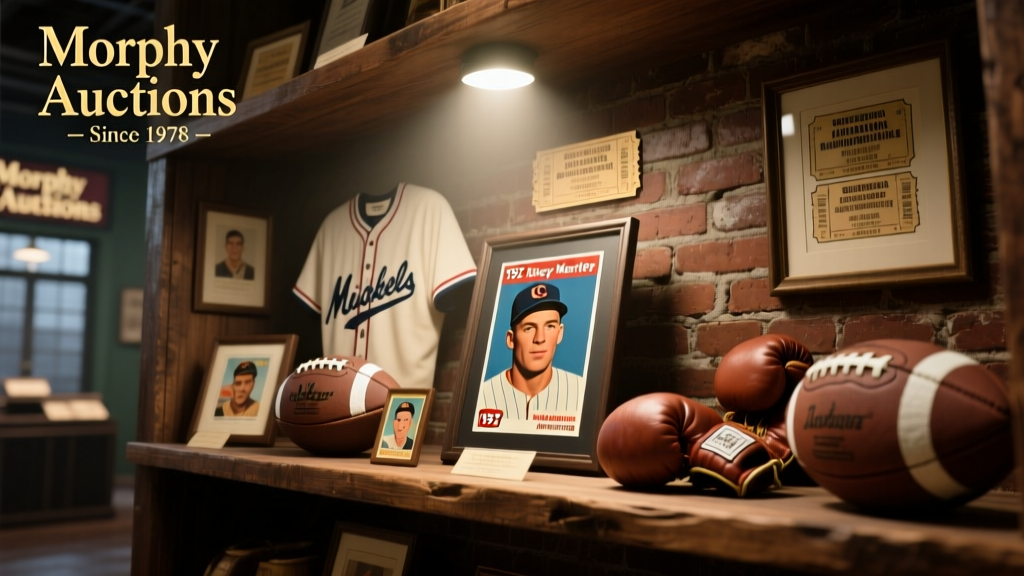
Morphy’s physical preview exhibitions—held biannually in Denver and rotating satellite venues in Chicago, Los Angeles, and New York—feature forensic display cases with integrated environmental sensors, live authentication demo stations, and curatorial talks led by staff historians holding PhDs in sports history from institutions including the University of Michigan, Ohio State University, and the University of Notre Dame. Attendance at the 2023 Fall Preview exceeded 12,470 visitors across four cities, with 37% representing first-time attendees—a 9.6% increase over 2022.
The company’s commitment to long-term collector education extends to free webinars offered every Thursday at 7 p.m. EST, covering topics such as ‘Decoding Vintage Uniform Labels’ (featuring detailed analysis of Rawlings tag fonts, stitching thread counts, and dye lot codes from 1948–1967) and ‘Photograph Authentication for Pre-1950 Sports Images’ (including silver halide grain structure analysis and developer chemistry timelines). Recordings are archived indefinitely and indexed by athlete, sport, and decade for research utility.
Morphy’s vendor ecosystem includes calibrated instrumentation partners: Mitutoyo for precision measurement tools (digital calipers accurate to ±0.001″), Ocean Optics for spectrometers (USB4000 model, wavelength range: 200–850 nm, resolution: 0.3 nm FWHM), and Bruker for micro-CT scanners (Skyscan 1272, voxel resolution: 1.5 µm, X-ray source: 100 kV, 100 µA). All equipment undergoes quarterly NIST-traceable calibration, with certificates archived in Morphy’s Quality Management System per ISO 9001:2015 Clause 7.1.5.
As the sports memorabilia market continues evolving amid digital tokenization and generative AI concerns, Morphy’s emphasis on empirical verification, regulatory alignment, and collector-centric infrastructure positions it not merely as an auction house—but as a steward of historical integrity. Its measurable adherence to scientific methodology, transparent reporting, and ethical enforcement creates a replicable standard for authenticity assurance—one that prioritizes evidentiary rigor over anecdotal attribution and places verifiable data at the core of every valuation decision.
More Like This
Nicholas Lowry and the Enduring Legacy of Travel Posters: Authentication, Provenance, and Market Value
Weather Vanes Featuring Indian Silhouettes with Drawn Bow and Arrow: History, Authentication, and Market Value in Sheet Metal Collectibles
Cut Velvet Vase Yellow Small: Authentication, Provenance, and Market Value of a Rare Mid-Century Decorative Artifact
Roseville Zephyr Lily Plate (Blue, 14-Inch): Authentication, Value, and Historical Context
Banks Mechanical Organ Grinder Performing Bear (Kyser Rex, 7-Inch): Authentication, History, and Market Value Analysis
Federal-Style Cherry Furniture Stand: Authentication, Provenance, and Collector Value of the 28-Inch Two-Drawer Inlaid Design
The 1970s Cast Iron Dog Bottle Opener: Anatomy, Provenance, and Authentication of the 'Paw-Up, Straight-Tail' Variant
Worthington Pale Ale Beer Cans: Authenticity, History, and Collectibility from Burton Upon Trent
Steinway & Sons Model XR Grand Piano (1921) — A Rare Bench-Style Instrument with Historical Significance and Authentication Insights