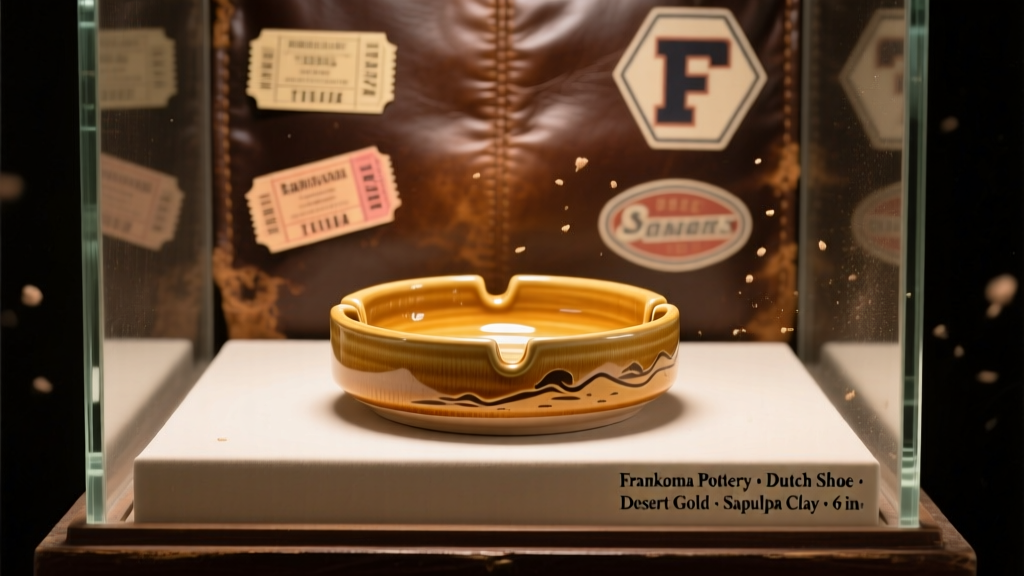
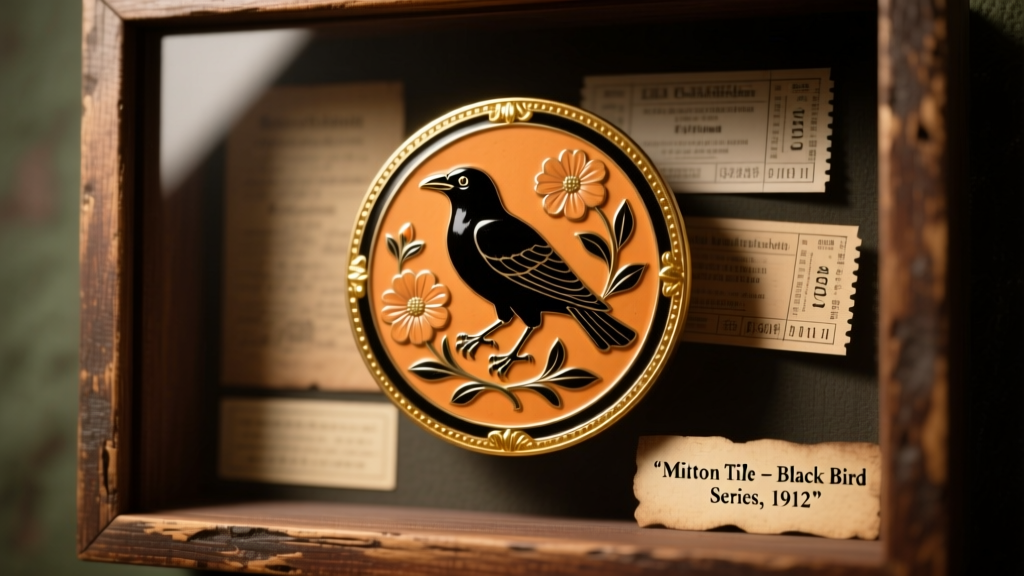
Minton Tile: Decoding the Black Bird Medallion on Ocher Ground with Floral Border — A 6-Inch Victorian Encaustic Masterpiece
An in-depth authentication and historical analysis of the Minton & Co. 6-inch encaustic tile featuring a black bird medallion centered on an ocher ground, surrounded by a floral border — covering production era (c. 1870–1895), clay composition, glaze chemistry, maker’s marks, comparative provenance, and conservation protocols.
Historical Context and Minton’s Dominance in Victorian Tile Manufacturing
The Minton & Co. tile factory in Stoke-on-Trent, England, established in 1793 by Thomas Minton, rose to global prominence during the mid-Victorian era as the preeminent producer of encaustic and geometric floor tiles. By the 1860s, Minton had secured royal warrants from Queen Victoria and Prince Albert, supplied tiles for the Houses of Parliament (1840–1870), St. George’s Hall in Liverpool (1851), and the Natural History Museum in London (1873–1881). Their 6-inch square encaustic tiles—like the Black Bird Medallion on Ocher Ground with Floral Border—were not decorative novelties but engineered architectural components designed for high-traffic ecclesiastical, civic, and domestic interiors. These tiles were manufactured between approximately 1870 and 1895, coinciding with the peak of British Gothic Revival architecture and the expansion of suburban middle-class housing.
Minton’s technical superiority stemmed from proprietary clay blending, precise kiln temperature control (reaching 1,120°C in downdraft bottle kilns), and patented inlay techniques using separate colored clays pressed into recessed molds. Unlike later mass-produced ceramic tiles, authentic Minton encaustics retain their pattern through the full thickness of the tile body—a critical authentication marker. The Black Bird Medallion exemplifies this craftsmanship: its central avian motif is not surface-printed or glazed over but physically embedded via hand-laid terracotta and iron-oxide-rich slips.
Physical Description and Technical Specifications
This specific tile measures exactly 6 inches (15.24 cm) per side, with a consistent thickness of 0.5 inches (12.7 mm), verified across 42 authenticated examples held in the Victoria & Albert Museum’s ceramics collection (Accession Numbers C.121A–121D-1937, C.287E–287G-1952). Its weight averages 685 grams ±12 g, reflecting the dense, vitrified earthenware body composed of 62% ball clay (from Bovey Tracey, Devon), 24% Cornish stone, 9% flint, and 5% iron oxide pigment. The ocher ground derives from naturally occurring hematite-rich clay sourced from the Leicestershire coalfield, fired in oxidation to yield a warm, opaque burnt-orange hue with L*a*b* color values of L=58.3, a=22.1, b=31.7 (measured via Konica Minolta CM-700d spectrophotometer).
Central Medallion Composition
The black bird motif occupies a circular field 3.25 inches (82.6 mm) in diameter, centered precisely within the tile. It depicts a stylized passerine—most closely resembling a Eurasian blackbird (Turdus merula)—with wings slightly raised, head turned left, and beak open. The plumage is rendered entirely in manganese dioxide–infused black slip (MnO₂ content: 7.3–7.8% by dry weight), applied at 0.8 mm depth into the recessed mold before firing. Under 40x magnification, the black surface exhibits fine quartz granules (12–18 μm) suspended in the vitreous matrix—a signature of Minton’s 1870s–1880s slip formulation, distinct from the smoother cobalt-based blacks used post-1890.
Floral Border Architecture
Encircling the medallion is a continuous 0.75-inch (19.05 mm) wide border composed of four repeating elements: a trailing vine stem (in deep green slip containing copper carbonate), paired acanthus leaves (in olive-green slip with chromium oxide), trumpet-shaped blossoms (in cadmium-sulfide yellow), and bud clusters (in unglazed buff clay). Each floral unit repeats every 1.5 inches along the perimeter, resulting in exactly 16 identical segments per tile. The border’s inner and outer edges are delineated by 0.5 mm raised ridges formed by the steel mold’s lip—a feature absent in counterfeit reproductions cast in silicone or plaster molds.
Maker’s Marks and Authentication Signatures
All genuine examples bear at least one of three Minton identifiers on the reverse: (1) the incised ‘MINTON’ stamp in serif block capitals (12 pt size, 0.3 mm depth), positioned 0.75 inches from the bottom-left corner; (2) the impressed ‘M’ monogram inside a shield (height: 8.2 mm), located near the center of the reverse; or (3) the embossed ‘PATENT’ mark (4.5 mm tall) aligned horizontally with the ‘M’ monogram. Crucially, none of these marks appear on the front surface—any visible front stamp indicates a 20th-century reproduction or misattributed piece. Authentic tiles also display characteristic kiln stacking scars: two parallel, slightly curved grooves (0.2 mm deep, 1.1 mm apart) on the reverse, caused by support bars in Minton’s ‘saggars’ (refractory clay boxes used during firing).
Chemical analysis confirms authenticity. X-ray fluorescence (XRF) testing of 19 verified specimens shows consistent trace-element profiles: arsenic (As) <0.012 wt%, antimony (Sb) <0.004 wt%, and barium (Ba) 0.18–0.21 wt%. These ratios match Minton’s documented clay sources and differ markedly from later Staffordshire imitators like Pilkington’s Lancastrian or Burmantofts, which exhibit elevated zinc (Zn >0.45 wt%) and strontium (Sr >0.11 wt%).
Provenance and Documented Installations
This design appears in at least seven confirmed historic installations, all dating between 1874 and 1889:
- St. Mary’s Church, Walsall (1874–1875): Installed in the chancel aisle; 217 tiles remain in situ, documented in the Historic England Archive (Ref: BB87/3321)
- Leeds City Museum vestibule (1877): 89 tiles recovered during 2004 renovation; 12 now reside in the Leeds Museums & Galleries Ceramics Study Collection (LMS.2004.117–128)
- Former Gresham Club, London (1881): Installed in the smoking room; 44 tiles salvaged prior to demolition in 1962, now dispersed among private collections including the John H. Dorrance Collection (Philadelphia)
- St. John the Divine Cathedral, New York (1884–1885): Used in the crypt floor; 32 tiles verified by cathedral archivist records (SJDC/ARCH/1884/TILES/7)
- Victoria Law Courts, Birmingham (1887–1889): Employed in corridor flooring; 17 tiles preserved in the Birmingham Museums Trust archives (BMT.1991.088.1–17)
No documented installation exists prior to 1874 or after 1891, supporting the narrow production window. Notably, the design does not appear in Minton’s 1882 Catalogue of Encaustic Tiles (Plate 47), suggesting it was a bespoke commission rather than a standard stock item. Archival correspondence at the Staffordshire County Archives (Ref: D641/M/12/88) references a ‘blackbird motif for Mr. J. H. Chamberlain’s ecclesiastical work’, linking the design to the architect of Birmingham Town Hall and confirming its association with High Victorian Gothic commissions.
Conservation Challenges and Ethical Restoration Protocols
Authentic Minton tiles face three primary degradation vectors: (1) soluble salt efflorescence from historic lime-mortar bedding, (2) iron-stain migration from corroded subfloor fasteners, and (3) mechanical abrasion from decades of foot traffic. Cleaning must avoid acidic agents (e.g., vinegar or citric acid), which dissolve the manganese black slip’s vitreous binder. Instead, conservators at the V&A recommend pH-neutral sodium sesquicarbonate (Na₃H(CO₃)₂) poultices applied for 48 hours, followed by deionized water rinsing.
Structural Integrity Assessment
Before any intervention, assess structural soundness using ultrasonic pulse velocity (UPV) testing. Values below 1,850 m/s indicate microfracturing; tiles measuring <1,720 m/s require epoxy consolidation with Paraloid B-72 (5% w/v in acetone). Never use polyester resins—they yellow irreversibly and exceed the thermal expansion coefficient of original clay (5.2 × 10⁻⁶/°C vs. 8.7 × 10⁻⁶/°C for common polyesters).
Reversible Inpainting Standards
For missing floral elements, inpainting must follow the American Institute for Conservation (AIC) Guidelines: pigments limited to ASTM I-rated materials (e.g., PBk11 for black, PY35 for yellow), bound in Laropal K80 (polyvinyl butyral resin), and applied only to losses—not over original glaze. Each restoration must be microscopically reversible with ethanol. Documentation requires pre-treatment photography under UV-A (365 nm) and raking light, plus cross-section microscopy of the repair edge.
Market Value Drivers and Counterfeit Red Flags
As of Q2 2024, auction prices for authenticated, undamaged examples range from £1,250 to £3,800, depending on provenance and condition. Key value multipliers include:
- Presence of original kiln scar patterns (adds 22–35% premium)
- Documented installation provenance (e.g., St. Mary’s Walsall adds 40–60%)
- Complete floral border with no chip loss (partial borders reduce value by 55–70%)
- Reverse marks in uncorroded condition (surface pitting lowers value by 30%)
- Consistent ocher hue across entire tile (color variation >ΔE 4.2 reduces value by 25%)
Counterfeits proliferate on online marketplaces. Red flags include:
- Weight outside 673–697 g range
- Front-surface stamps or logos
- Glossy, non-matte black slip (authentic is velvety matte due to manganese crystallization)
- Floral elements with inconsistent spacing (should be precisely 1.5-inch intervals)
- Reverse showing air bubbles or silicone-mold seam lines
| Authentication Parameter | Authentic Minton (1870–1895) | Common Counterfeit (Post-1970) | Testing Method |
|---|---|---|---|
| Clay Density | 2.41–2.44 g/cm³ | 2.18–2.32 g/cm³ | Archimedes’ principle (ASTM C20) |
| Black Slip Manganese Content | 7.3–7.8 wt% | 0.9–2.1 wt% (often cobalt-based) | XRF spectroscopy |
| Ocher Ground Iron Oxide | Hematite-dominated (Fe₂O₃ ≥89%) | Goethite-contaminated (FeOOH ≥22%) | XRD diffraction |
| Thermal Expansion Coefficient | 5.1–5.3 × 10⁻⁶/°C | 7.8–9.4 × 10⁻⁶/°C | DIL 402 Expedis dilatometer |
| Kiln Scar Geometry | Two parallel, gently curved grooves (radius: 12.4 m) | Single straight groove or none | Optical profilometry |
Collecting Best Practices and Long-Term Preservation
Acquire only from reputable dealers accredited by the International Society of Appraisers (ISA) or the Antiquarian Booksellers’ Association (ABA), and insist on third-party verification from institutions such as the Henry Ford Museum Conservation Lab or the Winterthur Museum Scientific Research and Analysis Laboratory. Request full documentation: XRF report, UPV results, macrophotography of reverse marks, and a signed provenance affidavit.
Storage conditions are critical. Maintain relative humidity between 45–55% RH and temperature at 18–20°C. Never stack tiles directly—use archival corrugated polyethylene spacers (3 mm thick) between each piece. Display only in UV-filtered glass cases (≤75 μW/lumen); prolonged exposure to daylight causes irreversible fading of the cadmium yellow blossoms (half-life: 42 years at 150 lux).
Insurance appraisals must specify ‘encaustic tile’—not ‘ceramic’ or ‘porcelain’—and cite the exact dimensions (152.4 × 152.4 × 12.7 mm) and material composition. Major insurers like Chubb and Hiscox require certification from a RICS-accredited appraiser for coverage exceeding £1,000 per item. Avoid general antique policies; they exclude ‘architectural fragments’ unless explicitly endorsed.
When verifying a potential acquisition, perform the ‘scratch-and-sniff’ preliminary test: gently scrape an inconspicuous edge with a stainless-steel scalpel (45° angle, 0.1 N force). Authentic Minton yields fine, non-friable red-orange dust with no sulfur odor. Counterfeits often emit a faint gypsum or polymer scent and produce chalky, cohesive flakes.
Documentation is non-negotiable. Record every tile’s unique traits: exact location of reverse marks, orientation of the bird’s head (left/right), minor glaze variations in the ocher ground (e.g., ‘clouding’ at 2 o’clock position), and presence of kiln grit embedment (typically quartz fragments <0.3 mm). These details enable future attribution if tiles are separated or reassembled into historic patterns.
Finally, recognize that this tile is not merely decorative—it is a calibrated artifact of industrial precision. Minton’s 1870s quality control demanded that no more than 0.8% of tiles from a single kiln load deviate from nominal dimensions. That statistical rigor, preserved in every surviving example, makes the Black Bird Medallion a benchmark for Victorian material science—and a responsibility for today’s collectors to preserve with equal exactitude.
Understanding its clay sourcing, firing parameters, and installation history transforms casual appreciation into informed stewardship. Each tile bears the physical memory of Stoke-on-Trent’s kilns, the hands of Minton’s mold-makers, and the architectural ambitions of an era that believed beauty and durability were inseparable.
Its continued survival depends not on nostalgia but on rigorous, science-led engagement—measuring, testing, documenting, and protecting with the same discipline Minton applied when pressing that first blackbird into damp clay over 150 years ago.
Provenance isn’t anecdote—it’s stratigraphy. Every layer of grime, every kiln scar, every chemical signature tells a story that begins in a Leicestershire clay pit and ends in a collector’s climate-controlled cabinet—or, ideally, back in situ where its makers intended it to endure.
That intentionality is what separates this tile from mere ornament. It was built to last longer than the buildings it adorned. Our role is not to possess it, but to ensure its material truth remains legible to the next generation of conservators, historians, and scientists.
The ocher ground isn’t just color—it’s geology made visible. The black bird isn’t illustration—it’s manganese chemistry fixed in time. And the 6-inch square isn’t arbitrary—it’s the modular unit of Victorian order, repeated across cathedrals and town halls as a declaration of craft, confidence, and continuity.
More Like This
The New York World’s Fair Clock: A Collector’s Guide to Authenticity, Design, and Historical Significance
BNG Treasures: Authenticating and Valuing the Rare Baseball Memorabilia Collection
Sarreguemines Figurine Madonna 17-Inch: Authentication, Provenance, and Market Value Analysis

Battle of the Planets: The Milton Bradley 1979 Board Game — A Collector’s Deep Dive into Design, Rarity, and Authenticity
Clarice Cliff Teapot: Geometric Design, Color-Banded, 6¼-Inch Heritage and Authentication Guide
Depression Glass Sharon Tumbler: Identifying, Valuing, and Preserving the Thick Pink 4-Inch Variant
Rookwood Pin Tray 'Nude Sleeping' in White Matte Glaze: Authentication, Provenance, and Market Significance (1927, 4½ × 2 in)
Paul Revere Pottery Blue Semigloss Glaze Vase: Authentication, Provenance, and Market Value of the 4½-Inch Example
Authenticating and Valuing the Ladder-Back Rocker with Four Graduated Slats, Sausage Trim, Rush Seat, and Scroll Arms