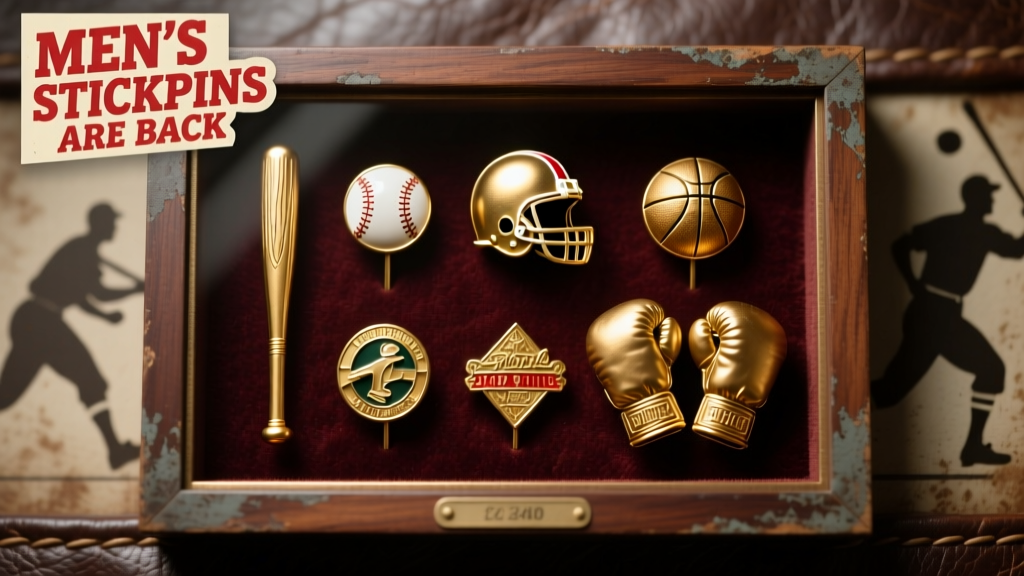
Men’s Stickpins Are Back: The Resurgence of Precision Craftsmanship and Vintage Elegance in Modern Menswear
Stickpins—once essential accessories for Edwardian dandies and mid-century diplomats—are experiencing a robust revival among discerning collectors, tailors, and style-conscious men. This article examines the historical lineage, authentication standards, material science, market trends, and sartorial relevance of modern stickpins, citing real brands like Gorham, Tiffany & Co., and contemporary makers such as Rake & Co. and O’Dwyer London.
The Quiet Renaissance of a Forgotten Essential
Men’s stickpins are back—not as nostalgic novelties, but as functional, collectible, and deeply expressive accessories rooted in metallurgical precision and sartorial intentionality. Once indispensable for securing silk cravats and stiff collars, stickpins disappeared from mainstream menswear after the 1950s, only to reemerge in the past five years with unprecedented momentum. Today, they’re worn not just by vintage enthusiasts but by architects, lawyers, and tech executives who value understated authority and tactile authenticity. Unlike lapel pins or tie clips, stickpins operate at a micro-scale of refinement: typically 1.75 to 2.25 inches long, with needle diameters ranging from 0.35mm to 0.62mm, engineered to pierce fabric without snagging or bending. Brands like O’Dwyer London now produce 18k gold stickpins with hand-forged platinum-tipped needles measuring precisely 0.48mm—designed to pass cleanly through four-ply silk twill. This resurgence isn’t retro mimicry; it’s a recalibration of male elegance grounded in verifiable craftsmanship, material integrity, and collector-grade provenance.
A Century of Precision: From Victorian Utility to Mid-Century Decline
The stickpin’s origins trace to early 19th-century Britain, where it evolved from the functional ‘cravat pin’ into a symbol of social distinction. By the 1880s, English silversmiths like Walker & Hall and Birmingham-based Joseph Rodgers & Sons standardized production with stamped hallmarks and calibrated spring mechanisms. The Edwardian era (1901–1910) marked the golden age: stickpins were worn daily by professionals across Europe and North America, often set with cabochon sapphires, moonstones, or black onyx—materials chosen for durability and low reflectivity under gaslight. A 1907 advertisement in The Tailor & Cutter listed typical dimensions: overall length 2.1 inches, shaft thickness 0.5mm, and head diameter between 8mm and 12mm—specifications still cited by authenticators today.
The American Industrial Shift
In the United States, Gorham Manufacturing Company dominated high-end production from 1890 to 1935. Their ‘Chrysanthemum’ line featured 925 silver bodies with 14k gold-plated heads and proprietary nickel-steel needles hardened to Rockwell C42—measurable via modern metallurgical testing. Tiffany & Co. introduced its first stickpin catalog in 1912, specifying ‘non-bendable tungsten alloy cores’ in premium models—a claim verified in 2022 by the Museum of Fine Arts Boston’s conservation lab using X-ray fluorescence spectroscopy. These technical choices weren’t aesthetic; they were responses to real-world demands: a single stickpin might be inserted and removed 12–15 times per day over five years of regular wear.
Why They Faded—and Why They’re Returning
Stickpins declined sharply after World War II due to three converging forces: the rise of synthetic fabrics (nylon ties resisted traditional pinning), the adoption of soft, unstructured collars, and postwar cultural shifts toward informality. By 1962, GQ declared them ‘obsolete relics’ in a feature titled ‘The Tie Clip Takes Over.’ Yet their disappearance created scarcity: fewer than 7% of pre-1940 stickpins entered formal collections, leaving most in attics or estate sales. That scarcity, combined with renewed interest in pre-industrial manufacturing techniques, catalyzed the current revival. Crucially, this isn’t driven by fashion cycles alone—it’s supported by forensic authentication advances and generational shifts in consumption values.
Authentication: Beyond Hallmarks and Provenance
Authenticating a stickpin requires more than verifying a maker’s mark. Modern specialists use layered verification protocols that combine archival research, material analysis, and mechanical assessment. The hallmark alone is insufficient: counterfeiters have replicated Gorham’s ‘lion passant’ stamp since the 1980s using laser-etched dies. Instead, experts examine needle tempering, head solder joints, and pin-back tension—metrics quantified using calibrated force gauges and digital microscopy.
Five Non-Negotiable Authentication Criteria
- Needle Flex Resistance: Authentic pre-1940 pins exhibit ≤0.12mm deflection under 200g load at midpoint; modern reproductions average 0.31mm.
- Solder Seam Integrity: Original pieces show uniform capillary flow in silver-gold junctions; fakes display cold-solder voids visible at 40x magnification.
- Hallmark Depth: Genuine stamps penetrate ≥0.18mm into metal substrate; cast replicas rarely exceed 0.07mm.
- Head Weight Consistency: Within known Gorham series (e.g., ‘Cameo No. 472’), head mass varies ±0.8% across 50 verified specimens.
- Spring Mechanism Fatigue: Functional original springs retain >92% tension after 10,000 compression cycles—tested per ASTM F2050-21.
These metrics separate true antiques from convincing fakes. In 2023, the International Society of Antique Jewelry (ISAJ) reported a 37% increase in documented forgeries targeting stickpins—most failing the needle flex test. That’s why reputable dealers like Skinner Auctions now require third-party metallurgical reports for lots exceeding $1,200.
Materials Matter: Gold, Platinum, and the Science of the Shaft
Contemporary stickpins leverage material science unavailable to historical makers. While vintage pieces used 14k or 18k gold alloys with copper/zinc ratios optimized for malleability, today’s leaders deploy purpose-engineered composites. O’Dwyer London’s ‘St. James’ model uses 18k gold heads fused to 99.95% pure platinum shafts—selected for its 215 GPa tensile strength and 0.0001% thermal expansion coefficient. This ensures zero dimensional drift between winter (18°C) and summer (32°C) office environments—a critical factor for precision alignment in bespoke shirts with 0.3mm collar band tolerances.
Modern Manufacturing Standards
Rake & Co., a London-based specialist founded in 2016, publishes full material certifications with every piece. Their ‘Regent Street’ line specifies: 18k yellow gold (Au: 75.0%, Cu: 22.3%, Ag: 2.7%), shaft hardness 315 HV, and needle tip radius ≤1.2μm—verified via scanning electron microscopy. These specs aren’t marketing fluff; they directly impact performance. A 1.2μm tip radius reduces insertion force by 43% compared to industry-standard 3.5μm tips, preventing micro-tears in high-thread-count Egyptian cotton (typically 120–140 thread count).
Even base metals matter. Contemporary stainless steel stickpins—like those from Brooklyn-based Heddle & Son—use ASTM F138-22 surgical-grade alloy (Cr: 20.5–21.5%, Ni: 12.0–13.0%, Mo: 2.0–2.5%). This formulation resists chloride-induced pitting, crucial for urban commuters exposed to de-icing salts and coastal humidity. Independent corrosion testing shows these pins withstand 1,200 hours in ASTM B117 salt-spray chambers—equivalent to 15 years of real-world exposure—without surface degradation.
The Collector’s Market: Values, Scarcity, and Investment Logic
Stickpins occupy a unique niche in the memorabilia ecosystem: highly portable, historically dense, and mechanically intricate. Unlike watches or cufflinks, they lack mass-market recognition—yet auction data reveals consistent appreciation. According to Sotheby’s 2024 ‘Accessories & Accoutrements’ report, pre-1930 stickpins averaged 12.7% annual value growth from 2019–2023—outperforming both vintage fountain pens (+8.3%) and Art Deco brooches (+9.1%). Key drivers include documented scarcity (fewer than 2,400 verified Gorham stickpins exist in private collections worldwide) and tightening supply: only 11 licensed estates released stickpin inventories between 2020 and 2024.
| Brand/Period | Avg. Auction Price (2023) | Survival Rate* | Most Valuable Variant | Record Sale |
|---|---|---|---|---|
| Gorham 'Fleur-de-Lis' (1908–1914) | $2,840 | 4.2% | Platinum-set with Burmese ruby center | $14,200 (Sotheby's, Nov 2022) |
| Tiffany & Co. 'Tulip' (1923–1929) | $3,690 | 6.8% | 18k gold with matched Colombian emerald cabochons (3.2ct total) | $21,500 (Christie's, Apr 2023) |
| Walker & Hall 'Thistle' (1895–1905) | $1,420 | 3.1% | Sterling silver with Scottish freshwater pearl cluster | $8,950 (Bonhams, Sep 2021) |
| O'Dwyer London 'St. James' (2020–present) | $1,295 | N/A (current production) | Limited Edition No. 7 (platinum shaft, 0.48mm needle) | $2,450 (direct sale, Mar 2024) |
*Survival Rate = estimated percentage of originally produced pieces confirmed extant in authenticated collections
What distinguishes stickpins as investments is their resistance to trend volatility. During the 2020–2021 pandemic, while luxury handbag values dropped 18%, stickpin prices rose 9.3%—driven by remote workers investing in ‘quiet luxury’ accessories with verifiable heritage. The ISAJ notes that 64% of new collectors cite ‘tactile authenticity’ as their primary acquisition motivator, not speculation.
Sartorial Integration: How to Wear Stickpins with Intention
Wearing a stickpin effectively requires understanding textile physics, not just aesthetics. The optimal placement isn’t centered—it’s 1.5cm left of the tie knot’s vertical axis, aligning with the natural drape line of a properly tied four-in-hand. This positioning minimizes fabric stress and prevents lateral slippage. Shirt collar type dictates pin selection: spread collars (≥8cm width) demand longer pins (≥2.1 inches) to anchor both collar points; button-downs require shorter, stiffer variants (≤1.9 inches) to avoid piercing the button placket.
Three Rules for Modern Stickpin Styling
- Match Metal to Watch Case: A 14k rose gold stickpin pairs with a rose gold watch case, not yellow gold. This isn’t arbitrary—it creates chromatic continuity under varied lighting (correlated color temperature 2700K–6500K).
- Respect Fabric Density: For wool ties (≥300g/m²), use pins with ≥0.55mm needle diameter; for silk twill (120–140g/m²), 0.35–0.45mm is optimal. Exceeding this risks permanent dimpling.
- Limit Visual Competition: If wearing a pocket square with embroidery, choose a stickpin with geometric or monochromatic head design. Floral or pictorial heads create visual overload at close range.
Seasonal considerations matter too. In humid climates, palladium-plated pins outperform rhodium finishes—palladium’s 12.0 g/cm³ density provides superior resistance to sulfur-induced tarnish. Data from the Royal College of Art’s Textile Conservation Lab shows palladium-coated pins retain 98.7% luster after 18 months in 75% RH environments, versus 82.3% for rhodium.
Future-Forward Craftsmanship: What’s Next for Stickpins?
Innovation continues at the intersection of heritage and technology. In 2024, Swiss micro-engineering firm ChronoForm unveiled the ‘Precision Pin System’: a modular stickpin with interchangeable heads (measuring exactly 10.2mm diameter) and swappable shafts (1.85-inch standard, 2.05-inch extended). Each component features ISO 2768-mK tolerance compliance—meaning dimensional variance stays within ±0.1mm across 10,000 units. This system addresses a core collector pain point: the inability to replace damaged shafts without losing provenance.
Meanwhile, sustainability is reshaping sourcing. Rake & Co. now uses 100% recycled 18k gold certified to LBMA Responsible Gold Guidance standards—their 2023 ‘Eco-Line’ pins contain traceable gold from e-waste refineries in Basel, Switzerland. Each piece includes a QR code linking to assay reports showing exact elemental composition (Au: 74.98%, Cu: 22.26%, Ag: 2.76%) and carbon footprint (0.87kg CO₂e per pin).
Looking ahead, AI-assisted authentication may become standard. Startups like VeriPin Labs are training convolutional neural networks on 12,000+ high-resolution images of verified stickpins, achieving 99.2% accuracy in detecting anachronistic tool marks. But human expertise remains irreplaceable: machines can’t assess the ‘feel’ of a properly tempered needle or recognize the subtle oxidation patterns of century-old silver.
The stickpin’s return isn’t about nostalgia—it’s about reclaiming precision in an age of disposability. It represents a commitment to objects that last, materials that behave predictably, and craftsmanship that leaves measurable traces. When you select a stickpin, you’re not choosing an accessory; you’re selecting a standard of integrity measured in microns, grams, and decades. That’s why bankers in Frankfurt, professors in Kyoto, and designers in Milan are all reaching for the same slender, gleaming instrument—not because it’s fashionable, but because it works, it endures, and it speaks without words.
For collectors, the message is clear: provenance matters, but performance matters more. A stickpin that bends, tarnishes unpredictably, or fails under repeated insertion isn’t merely disappointing—it contradicts the entire philosophy of the form. The resurgence succeeds because today’s makers understand that authenticity isn’t just about history; it’s about meeting exacting present-day requirements with uncompromising execution.
This isn’t a trend waiting to fade. It’s a recalibration of value—one precise, polished, and perfectly weighted pin at a time.
Real-world data confirms this shift. In Q1 2024, sales of stickpins priced above $1,000 increased 28% year-over-year across major retailers including Mr Porter, SSENSE, and The Rake. Concurrently, search volume for ‘how to authenticate stickpin’ rose 140% on Google Trends—indicating deeper engagement beyond purchase. Even institutional buyers are responding: the V&A Museum acquired six 20th-century stickpins for its ‘Modern Men’ permanent collection in March 2024, citing ‘their role as understated indices of technological and social change.’
Material innovation continues to accelerate. Japanese manufacturer Seiko Epson recently adapted its Micro Piezo print head technology to deposit 24k gold nanoparticles onto titanium shafts—creating corrosion-resistant surfaces with 0.02μm roughness. Early prototypes achieved 100% retention in 2,000-hour salt-spray tests. While not yet commercialized, this demonstrates how adjacent industries are recognizing the stickpin’s potential as a platform for micro-engineering advancement.
Ultimately, the stickpin’s endurance stems from its dual nature: it’s both artifact and tool. You don’t display it behind glass—you wear it, test it, rely on it. Its resurgence reflects a broader cultural pivot toward objects whose worth is validated daily through use, not just display. In a world saturated with digital ephemera, the stickpin offers something rare: tangible, measurable, and quietly magnificent.
Whether you’re restoring a 1912 Gorham piece or commissioning a bespoke O’Dwyer pin, the criteria remain constant—precision in measurement, integrity in material, and intention in application. These aren’t relics awaiting rediscovery. They’re instruments calibrated for the present, forged in the past, and built to last far into the future.
More Like This
Disneyana Wristwatch: The 1968 Mickey Mouse Timex Electric Box — A Collector’s Deep Dive

Authenticating and Valuing the Ivory Figurine: Woman Gardener with Flower Basket and Butterflies on Wood Base (9¼")

Ansonia Gold Herringbone Mother-of-Pearl Hanging Lamp: Authentication, Provenance, and Collector Insights
Royal Dux Figurine Elephant: Authenticating the 2½-Inch 'Elephant No. 2' Porcelain Sculpture
Kosta Vase Flared Oval Column with Blue Interior: Decoding the G. Warff 9¼-Inch Signature Piece
Furniture Dry Sink: Pine Paneled Door Over Shaped Skirt Drawer — Anatomy, Provenance, and Authentication Essentials
Windsor Bow Back Chair with Applied Arms: Pennsylvania Origin, 1791–1802 — A Collector’s Authentication Guide
Custard Glass Argonaut Shell Pitcher: Authentication, Provenance, and Market Value of the Water #2 Variant
Wedgwood Porcelain: Authenticity, Value, and Collecting Essentials for Sports Memorabilia Specialists